
NHA CET Exam: Certified EKG Technician Complete Guide
 The NHA Certified EKG Technician (CET) exam is a 100-scored-item, multiple-choice certification test administered by the National Healthcareer Association). It costs $129, lasts 2 hours, and requires a scaled score of 390 out of 500 to pass. In 2024, NHA administered 19,241 CET exams with an overall pass rate of 69.66%, meaning roughly 3 in 10 candidates did not pass on their attempt. This guide breaks down every domain, eligibility rule, and study strategy you need to earn your CET credential and launch your career as an EKG technician.
CET Exam at a Glance — Key Facts
|
Detail |
Data |
|---|---|
|
Full Name |
NHA Certified EKG Technician (CET) |
|
Total Questions |
120 (100 scored + 20 pretest) |
|
Time Limit |
2 hours |
|
Exam Fee |
$129 |
|
Scoring Scale |
200–500 |
|
Passing Score |
390 |
|
2024 Overall Pass Rate |
69.66% (19,241 exams administered) |
|
Active Certifications (Dec 2024) |
35,193 |
|
Testing Options |
School-sponsored, PSI testing center, or live remote proctoring |
|
Renewal Cycle |
Every 2 years — 10 CE credits + $185 renewal fee |
|
Accreditation |
NCCA-accredited |
Sources: Official NHA CET page; NHA Annual Pass Rates PDF
What Is the NHA CET Exam and Who Should Take It?
 The NHA CET exam is a nationally recognized certification that validates your competence in performing electrocardiograms, monitoring cardiac rhythms, and supporting patient care in cardiology settings. NHA — founded in 1989 and headquartered in Leawood, Kansas — has awarded over 1 million healthcare certifications to date, and the CET is one of its most specialized credentials.
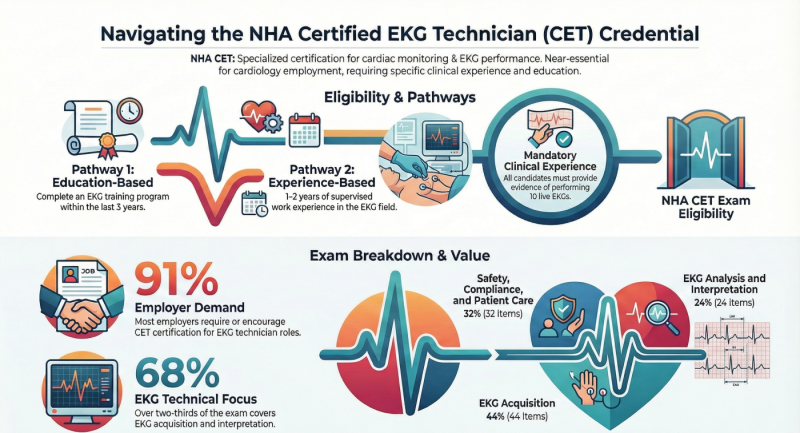
You should consider the CET if you want to work specifically in EKG and cardiac monitoring roles — think hospitals, cardiology clinics, cardiac catheterization labs, and diagnostic testing centers. According to NHA's 2025 Industry Outlook), 91% of employers require or encourage certification for EKG technicians, making the CET a near-essential credential for employment.
The CET is different from broader certifications like the NHA CPCT/A, which includes only 14% EKG content alongside patient care, phlebotomy, and infection control. If your career goal is cardiology-focused, the CET provides the depth employers in that specialty expect.
What Are the Eligibility Requirements for the NHA CET?
To sit for the CET exam, you must meet one of two pathways plus demonstrate hands-on experience. Both pathways require a high school diploma or GED (or scheduled graduation within 12 months).
Pathway 1 — Education-Based:
-
Completion of an EKG technician training or education program within the last 5 years
-
Evidence of performing a minimum of 10 EKGs on live individuals
Pathway 2 — Experience-Based:
-
1 year of supervised work experience in an EKG technician field within the last 3 years, or 2 years of supervised experience within the last 5 years
-
Evidence of performing a minimum of 10 EKGs on live individuals
High school students enrolled in health science programs may earn a provisional certificate prior to graduation. The provisional certificate expires 12 months from the exam date and can be converted to a full certificate after graduation, according to the NHA CET exam guide.
What Are the 3 Domains on the CET Exam?
The CET exam is organized into 3 domains based on the results of a job analysis completed by NHA. Each domain carries a different weight on the 100-scored-item exam, according to the official NHA CET Test Plan:
|
Domain |
Items on Exam |
Percentage |
|---|---|---|
|
1. Safety, Compliance, and Coordinated Patient Care |
32 |
32% |
|
2. EKG Acquisition |
44 |
44% |
|
3. EKG Analysis and Interpretation |
24 |
24% |
|
Total |
100 |
100% |
Together, Domains 2 and 3 account for 68 of 100 scored items — nearly 70% of the exam — and focus exclusively on EKG procedures and interpretation. Domain 1 addresses the patient care, safety, and compliance knowledge that every EKG technician needs in clinical practice.
What Does Domain 1 — Safety, Compliance, and Coordinated Patient Care Cover?
Domain 1 accounts for 32 of 100 scored questions (32%) and tests your knowledge of the regulatory, ethical, and patient-facing skills that support EKG work. This domain is the foundation that ensures EKG technicians practice safely and communicate effectively.
-
HIPAA compliance — protecting patient health information during EKG procedures and when uploading results to EMR/EHR systems
-
Infection control — OSHA guidelines, universal precautions, and proper handling of EKG equipment between patients
-
Scope of practice and ethics — understanding the EKG technician's role boundaries and adhering to the NHA Code of Ethics
-
Patient communication — adapting communication for cultural, language, developmental, and disability considerations
-
Vital signs — obtaining and interpreting vital signs; recognizing normal values across the lifespan
-
Stress test preparation — instructing patients on what to expect before, during, and after exercise stress testing
-
Ambulatory monitoring education — explaining Holter monitor and event monitor use to patients and verifying their understanding
-
EMR/EHR documentation — inputting patient history, medications, vitals, and completed EKG results into electronic records
-
Cardiopulmonary compromise — recognizing signs and symptoms of syncope, chest pain, and abnormal vitals during cardiac testing
Study tip: Domain 1 rewards candidates who understand the "why" behind each protocol. For instance, knowing that you must verify patient identity using two identifiers before every EKG is not just a policy question — it connects to HIPAA and patient safety standards that appear across multiple question types.
What Does Domain 2 — EKG Acquisition Cover?
Domain 2 is the largest section at 44 of 100 scored questions (44%) and tests your hands-on competence in performing EKGs, troubleshooting equipment, and supporting cardiac testing procedures.
12-Lead EKG and Lead Placement
-
Proper electrode placement for standard 12-lead EKG, including limb leads (I, II, III, aVR, aVL, aVF) and precordial leads (V1–V6)
-
Modified placements for special populations: right-sided heart studies, posterior chest leads, amputees, pediatric patients, and late-term pregnancy
-
3-lead and 5-lead monitoring configurations for telemetry
-
Skin preparation techniques for optimal electrode adhesion
Equipment and Machine Settings
-
Verifying EKG machine calibration: standard speed (25 mm/s) and gain (10 mm/mV)
-
Equipment maintenance and troubleshooting
-
Gathering supplies for EKG, Holter monitoring, stress testing, and telemetry
Artifact Identification and Troubleshooting
-
Wandering baseline — caused by patient movement, poor electrode contact, or respiratory interference
-
Somatic tremor (muscle artifact) — caused by patient shivering, anxiety, or involuntary muscle movement
-
AC (electrical) interference — 60 Hz artifact from nearby electrical equipment or improper grounding
-
Methods to resolve each artifact type: repositioning electrodes, reassuring the patient, checking cable connections, and eliminating electrical interference
Stress Testing and Ambulatory Monitoring
-
Assisting in monitoring patient condition during exercise stress tests
-
Recognizing adverse reactions: shortness of breath, chest pain, significant blood pressure changes, and dangerous arrhythmias
-
Responding to complications during stress testing, including initiating CPR and basic life support when needed
-
Applying electrodes and verifying equipment for Holter and event monitors
Documentation
-
Verifying that all leads were recorded and the tracing is complete
-
Mounting completed EKG tracing strips for the patient chart
-
Uploading EKG results to EMR/EHR systems
What Does Domain 3 — EKG Analysis and Interpretation Cover?
Domain 3 contains 24 of 100 scored questions (24%) and requires you to analyze EKG tracings for rate, rhythm, intervals, and abnormalities. This is the most conceptually challenging domain.
Heart Rate Calculation
-
6-second method: count R waves in a 6-second strip and multiply by 10
-
R-R interval method: divide 1,500 by the number of small boxes between R waves
-
Sequence method: use the large-box counting method (300 ÷ number of large boxes between R-R)
-
Maximum and target heart rate formulas (220 − age)
Rhythm Analysis
-
Determining regularity vs. irregularity of heart rhythms
-
Identifying the origin of the rhythm (sinus, atrial, junctional, or ventricular)
Waveform and Interval Measurement
-
P wave: atrial depolarization — assessing morphology, presence, and consistency
-
PR interval: normal range 0.12–0.20 seconds; prolongation indicates conduction delay
-
QRS complex: normal duration 0.06–0.10 seconds; widening above 0.12 seconds suggests ventricular origin or bundle branch block
-
ST segment: elevation or depression indicating ischemia, injury, or infarction
-
T wave: ventricular repolarization — symmetry, direction, and amplitude
-
QT interval: varies with heart rate; prolongation can signal increased risk of arrhythmia
|
Classification |
Key Rhythms to Know |
|---|---|
|
Sinus |
Sinus bradycardia, sinus tachycardia, sinus arrhythmia |
|
Atrial |
Premature atrial contractions (PACs), atrial fibrillation, atrial flutter, supraventricular tachycardia |
|
Junctional |
Junctional escape rhythm, accelerated junctional rhythm |
|
Ventricular |
Premature ventricular contractions (PVCs), ventricular tachycardia (V-tach), ventricular fibrillation (V-fib) |
|
Heart Blocks |
First-degree AV block, second-degree Type I (Wenckebach), second-degree Type II, third-degree (complete) |
Advanced Recognition
-
Pacemaker spikes — recognizing artificial pacing artifacts on the tracing
-
Ischemia, injury, and infarction — ST-segment changes, T-wave inversions, and pathological Q waves that indicate acute coronary events
-
Life-threatening arrhythmias — V-tach, V-fib, asystole, and pulseless electrical activity; knowing when to activate emergency response and initiate CPR/BLS
How Is the CET Exam Scored?
The CET uses a scaled scoring system ranging from 200 to 500 points. A score of 390 or higher is required to pass. The scaled score is not a simple percentage — it adjusts for the difficulty of the specific exam form you receive, ensuring fairness across all test versions.
|
Score Range |
Interpretation |
|---|---|
|
200–299 |
Well below passing — significant knowledge gaps |
|
300–389 |
Below passing — close but additional study needed |
|
390–500 |
Passing — certified as CET |
The 20 pretest questions on the exam are unscored and randomly distributed throughout the test. They are used by NHA to gather performance data for future exams. You will not know which questions are pretest items, so treat every question as scored.
For online exams (PSI testing center or remote proctoring), NHA officially posts certification results to your account within 2 business days of scoring.
What Is the CET Pass Rate?
The NHA CET exam had an overall pass rate of 69.66% in 2024, based on 19,241 examinations administered, according to NHA's 2024 Annual Pass Rates report. This means roughly 3 out of every 10 candidates did not pass.
As of December 31, 2024, there were 35,193 actively certified CET holders across the United States.
While NHA does not publicly separate first-time from repeat pass rates for the CET, the overall 69.66% figure underscores that this exam demands focused preparation. Candidates who rely solely on clinical experience without structured study are most likely to fall short, particularly in Domain 3 (EKG Analysis and Interpretation), which requires precise knowledge of rhythm identification and waveform measurement.
How Does the NHA CET Compare to the CCI CCT?
Two organizations offer nationally recognized EKG/cardiac technician certifications: NHA's CET and Cardiovascular Credentialing International (CCI)'s Certified Cardiographic Technician (CCT). Here is a side-by-side comparison:
|
Feature |
NHA CET |
CCI CCT |
|---|---|---|
|
Full Credential Name |
Certified EKG Technician |
Certified Cardiographic Technician |
|
Total Questions |
120 (100 scored + 20 pretest) |
130 (110 scored + 20 unscored) |
|
Time Limit |
2 hours |
2 hours |
|
Exam Fee |
$129 |
$175 |
|
Passing Score |
390 / 500 |
650 / 900 |
|
Question Types |
Multiple-choice only |
Multiple-choice + multiple-response + hot spot + drag-and-place |
|
Domains |
3 domains |
6 content areas |
|
Heaviest Content Area |
EKG Acquisition (44%) |
Rhythm Analysis (40%) |
|
Testing Centers |
PSI centers or remote proctoring |
Pearson VUE centers |
|
Renewal Cycle |
Every 2 years, 10 CE credits |
Every 3 years (triennial), 16 CEUs |
|
Renewal Fee |
$185 |
$165 |
|
Accreditation |
NCCA |
N/A (CCI is accredited by ANSI/ISO 17024) |
Which should you choose? The NHA CET is often the better entry point for new EKG technicians: it costs $46 less, uses a familiar multiple-choice-only format, and is widely accepted by hospitals and clinics nationwide. The CCI CCT is more common in advanced cardiology departments and cardiac catheterization labs, where its deeper emphasis on rhythm analysis (40% of the exam) and advanced question formats may carry additional weight with employers.
If your training program leads to one credential over the other, follow that path. Both certifications are nationally recognized, and many employers accept either. If you are deciding on your own, the CET's lower cost and simpler format make it the more accessible starting credential.
What Career Paths Are Available for CET-Certified EKG Technicians?
Earning the CET opens doors to cardiology-focused roles across the healthcare system. Common work settings for certified EKG technicians include:
-
Hospitals — performing 12-lead EKGs, monitoring telemetry, and assisting with stress tests in cardiac units and emergency departments
-
Cardiology clinics — running routine EKGs and Holter monitor hookups for outpatient cardiac patients
-
Diagnostic and medical laboratories — conducting cardiac testing as part of broader diagnostic workups
-
Outpatient care centers — performing EKGs in ambulatory surgery centers and urgent care facilities
-
Physician offices — supporting cardiologists and internists with in-office EKG testing
EKG Technician Salary Data
According to the U.S. Bureau of Labor Statistics (May 2024), the median annual wage for cardiovascular technologists and technicians — the BLS category that includes EKG technicians — is $67,260 per year ($32.34/hour).
|
Percentile |
Annual Salary |
|---|---|
|
10th percentile (entry level) |
$37,890 |
|
25th percentile |
$46,470 |
|
50th percentile (median) |
$67,260 |
|
75th percentile |
$91,430 |
|
90th percentile (experienced) |
$108,900 |
Employment in this field stood at 64,700 in 2024, with projected growth of 3% through 2034 — about as fast as average for all occupations. The BLS projects approximately 3,800 job openings per year over the decade, driven largely by retirements and transfers to other roles.
Salary by work setting varies significantly. Nurse.org reports that EKG technicians in outpatient care centers earn substantially more than those in hospitals, with outpatient center salaries reaching $123,610 annually compared to $83,200 in hospital settings (BLS May 2024 data).
Expert insight: "Earning the CET is the fastest way to prove you can work independently with cardiac monitoring equipment. Hospitals want to know that the person hooking up a 12-lead EKG at 3 a.m. knows exactly where V4 goes — and what to do if the tracing shows V-tach." — Sarah Mitchell, RCIS, Lead Cardiovascular Technologist
How Long Should You Study for the CET Exam?
Most candidates need 6 to 8 weeks of dedicated study to pass the CET exam, assuming 1 to 2 hours of study per day. The exam's 69.66% pass rate signals that preparation must be systematic, not casual.
6–8 Week CET Study Plan
Weeks 1–2: Foundation Building (Domain 1 Focus)
-
Study cardiac anatomy and physiology: heart chambers, valves, blood flow, and the electrical conduction system (SA node → AV node → Bundle of His → Purkinje fibers)
-
Review HIPAA regulations, infection control (OSHA/universal precautions), and scope of practice
-
Learn vital sign norms across the lifespan
-
Practice patient communication techniques
-
Goal: Build a solid understanding of the "why" behind EKG procedures
Weeks 3–4: EKG Acquisition Mastery (Domain 2 Focus)
-
Memorize 12-lead electrode placement — limb leads and all 6 precordial positions (V1: 4th intercostal space right sternal border through V6: 5th intercostal space left midaxillary line)
-
Practice identifying and resolving artifacts: wandering baseline, somatic tremor, AC interference
-
Study machine settings: standard speed (25 mm/s), standard gain (10 mm/mV)
-
Learn Holter monitor hookup, telemetry monitoring, and stress test preparation procedures
-
Goal: Be able to describe every step of a 12-lead EKG from skin prep to tracing upload
Weeks 5–6: EKG Analysis and Interpretation (Domain 3 Focus)
-
Master heart rate calculation methods (6-second, R-R interval, sequence/300 method)
-
Practice measuring PR intervals (normal: 0.12–0.20 s), QRS duration (normal: 0.06–0.10 s), and QT intervals
-
Study each arrhythmia classification systematically: sinus → atrial → junctional → ventricular → heart blocks
-
Focus on ST-segment changes: elevation (injury), depression (ischemia), and pathological Q waves (infarction)
-
Learn to recognize pacemaker spikes on tracings
-
Goal: Identify any rhythm strip within 30 seconds using a systematic approach
Weeks 7–8: Review, Practice Tests, and Weak-Spot Remediation
-
Take at least 2 full-length practice exams under timed conditions (100 questions, 2 hours)
-
Review every missed question and identify patterns — are your errors in rhythm ID, lead placement, or patient care?
-
Revisit Domain 2 (44% weight) and Domain 3 (24% weight) for any remaining gaps
-
Study stress test emergency protocols and life-threatening arrhythmia response
-
Goal: Score 80% or higher on practice tests consistently before sitting for the real exam
Study Resources
-
NHA CET Preparation Package — includes an interactive study guide and CET practice test
-
NHA CE Library — free continuing education courses for current certification holders; also useful for pre-exam review
-
MedicoExam CET Practice Tests — simulation-based practice questions aligned with the NHA CET exam domains
What Are the Testing Options for the CET Exam?
-
School-sponsored testing — if your EKG training program partners with NHA, you can take the exam at your school. This is the most common option for students in allied health programs.
-
PSI testing center — NHA contracts with PSI Services for in-person testing at professional test centers across the United States. You schedule through your NHA account.
-
Live remote proctoring — take the exam from home or another private location with a webcam, microphone, and stable internet connection. A live proctor monitors your session in real time.
All three options deliver the same exam with the same 100 scored questions in 2 hours. Results are posted to your NHA account within 2 business days for online exams.
How Do You Renew Your CET Certification?
The CET certification is valid for 2 years from the date it is awarded. To renew, you must complete 10 continuing education (CE) credits and pay the $185 renewal fee before your certification expires.
NHA's continuing education courses are free for current certification holders. The CE library is available online 24/7 and is continuously updated with the latest protocols and techniques. If you hold multiple NHA certifications, you need only 10 CE credits total to maintain all of them — the credits apply across credentials.
Letting your certification lapse means you must retake the full CET exam and pay the $129 exam fee again. Staying current with your CE credits is far simpler and cheaper.
Frequently Asked Questions (FAQ)
Q1. How many questions are on the NHA CET exam?
-
The CET exam contains 120 total questions: 100 scored multiple-choice items and 20 unscored pretest items that are randomly distributed throughout the exam. You have 2 hours to complete all 120 questions.
Q2. What score do you need to pass the CET exam?
-
You need a scaled score of 390 out of 500 to pass the NHA CET exam. The scaled scoring system adjusts for exam difficulty, so 390 does not correspond to a fixed percentage of correct answers.
Q3. How much does the NHA CET exam cost?
-
The CET exam fee is $129. Study materials are sold separately — the NHA CET Preparation Package, which includes an interactive study guide and practice test, is available through NHA's website). Renewal costs $185 every 2 years.
Q4. What is the CET pass rate?
-
The overall CET pass rate was 69.66% in 2024, based on 19,241 exams administered, according to NHA's 2024 Annual Pass Rates report. Approximately 3 in 10 candidates did not pass.
Q5. Can you take the CET exam online?
-
Yes. NHA offers live remote proctoring that lets you take the CET exam from any private location with a webcam, microphone, and internet connection. You can also take it at a PSI testing center or through a school-sponsored testing event.
Q6. What is the difference between NHA CET and CCI CCT?
-
The NHA CET ($129, 100 scored questions, multiple-choice only, 2-year renewal) is a widely accessible entry-level EKG credential. The CCI CCT ($175, 110 scored questions, includes advanced question types like hot spots and drag-and-drop, 3-year renewal) is often preferred in advanced cardiology departments. Both are nationally recognized.
Q7. How long does it take to get CET exam results?
-
For online exams (PSI testing center or remote proctoring), NHA posts your official certification results to your account within 2 business days of scoring. School-sponsored exam timelines may vary.
Q8. Do you need clinical experience to take the CET exam?
-
Yes. You must provide evidence of performing a minimum of 10 EKGs on live individuals regardless of which eligibility pathway you use. Beyond that, you need either completion of an EKG training program (within 5 years) or 1–2 years of supervised work experience.
Q9. How many CE credits are needed to renew the CET?
-
You need 10 continuing education credits every 2 years to maintain your CET certification. NHA provides free CE courses to current certification holders through its online CE library.
Q10. Is the CET worth it for career advancement?
-
Yes. The CET provides a specialized credential that can lead to roles in hospitals, cardiology clinics, and diagnostic labs. The Bureau of Labor Statistics reports a median salary of $67,260 for cardiovascular technologists and technicians (May 2024), and NHA data shows 91% of employers require or encourage EKG technician certification.
Start Your CET Exam Preparation Today
The NHA CET exam is your gateway to a focused career in cardiac monitoring and EKG technology. With 44% of the exam dedicated to EKG Acquisition and another 24% to EKG Analysis and Interpretation, success depends on hands-on knowledge of lead placement, artifact resolution, and rhythm identification.
Ready to start practicing? MedicoExam's CET practice tests simulate the real exam format with domain-weighted questions, detailed explanations, and timed testing conditions. Build your confidence before exam day and join the 35,193 certified EKG technicians already working in healthcare.
Explore all NHA certification resources at MedicoExam.com or visit the MedicoExam homepage to browse practice tests across every major healthcare certification body.
Disclaimer: This article is for informational purposes only and does not contain actual NHA CET exam questions or proprietary content. All exam details are sourced from publicly available NHA materials. Exam content, fees, and policies may change — always verify current information at nhanow.com. MedicoExam is not affiliated with or endorsed by the National Healthcareer Association.
Written by: the MedicoExam Content Team — Healthcare Education Specialists at MedicoExam.com
- NHA CET Question Bank |
- NHA CET Eligibility & Requirements |
- NHA EKG Technician Practice Test |
- NHA CET Exam Cost |
- NHA CET Registration Process |
- NHA EKG Technician Study Guide |
- NHA CET Recertification |
- NHA CET Certification Overview |
- NHA EKG Technician Syllabus |
- NHA CET Preparation Time |
- NHA CET Passing Score |
- NHA CET Exam Format |
- NHA EKG Technician Sample Questions |
- NHA CET Career Opportunities


