
Standard CHPS Prep Is Obsolete: Adopt This New Framework

The AHIMA Certified in Healthcare Privacy and Security (CHPS) credential validates a professional’s advanced competencies in managing, implementing, and administering comprehensive privacy and security programs within healthcare organizations. This certification is designed for health information (HI) professionals, privacy officers, security officers, and compliance experts who navigate the complex intersection of patient data protection, regulatory mandates, and evolving technological threats. This guide outlines a new framework for AHIMA CHPS exam preparation, emphasizing a deep understanding of the domains, practical application, and strategic study techniques to ensure success.
Grasping the CHPS Certification’s Purpose
Achieving the CHPS certification signifies a commitment to safeguarding sensitive health information, a critical responsibility in today’s digital healthcare landscape. It equips professionals with the knowledge to establish robust privacy and security policies, manage incidents effectively, and ensure compliance with complex regulations such as HIPAA, GDPR, and other state-specific laws. The certification demonstrates a candidate's ability to protect patient data from breaches, mitigate risks, and foster a culture of data integrity and confidentiality. For those seeking to advance their careers and become leaders in health information management, understanding the multifaceted role of privacy and security is paramount.
Exam Blueprint: Unveiling the CHPS Structure
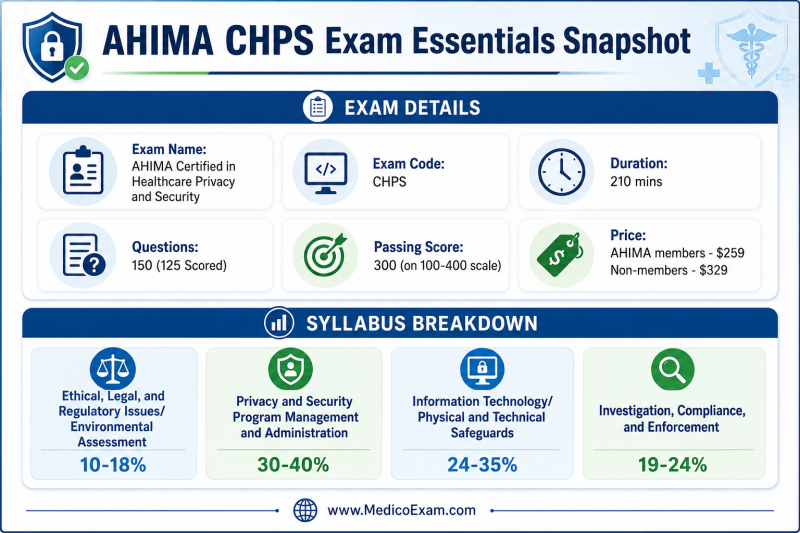
The AHIMA Certified in Healthcare Privacy and Security (CHPS) exam, identified by the exam code CHPS, evaluates a candidate's proficiency across several critical domains. Administered by AHIMA, the exam is a rigorous assessment of knowledge essential for protecting sensitive health information. Candidates should familiarize themselves with the exam’s logistical and scoring details to plan their preparation effectively.
Key aspects of the AHIMA CHPS exam structure include:
-
Exam Name: AHIMA Certified in Healthcare Privacy and Security
-
Exam Code: CHPS
-
Duration: 210 minutes
-
Number of Questions: 150 questions total, comprising 125 scored items and 25 pretest (unscored) items.
-
Passing Score: Candidates must achieve a score of 300 on a scale of 100-400 to pass the examination.
-
Exam Price: The cost varies depending on AHIMA membership status:
-
AHIMA members: $259 USD
-
AHIMA non-members: $329 USD
Understanding these details is the first step in formulating a strategic AHIMA CHPS exam preparation plan.
Mastering the CHPS Content Outline
Effective CHPS exam preparation necessitates a deep dive into the official content outline, which details the percentage weight for each knowledge domain. The AHIMA CHPS exam content outline serves as a blueprint, guiding candidates on where to focus their study efforts. It highlights the critical areas of expertise required to function as a Certified in Healthcare Privacy and Security professional. For a comprehensive overview, candidates should review the official CHPS content outline.
The CHPS syllabus topics are broken down into four main domains:
|
Domain |
Description |
|---|---|
|
Ethical, Legal, and Regulatory Issues/ Environmental Assessment (10-18%) |
This domain covers the foundational legal and ethical principles governing healthcare privacy and security, along with the ability to assess an organization's internal and external environment for risks and compliance requirements. |
|
Privacy and Security Program Management and Administration (30-40%) |
The largest domain, it focuses on the practical aspects of developing, implementing, and overseeing comprehensive privacy and security programs. This includes policy development, risk management, workforce training, and program governance. |
|
Information Technology/Physical and Technical Safeguards (24-35%) |
This section delves into the technical and physical controls necessary to protect electronic protected health information (ePHI). It covers topics such as access controls, encryption, network security, data integrity, disaster recovery, and securing physical environments where data is stored. |
|
Investigation, Compliance, and Enforcement (19-24%) |
This domain addresses the processes for investigating privacy and security incidents, ensuring ongoing compliance with regulations, responding to breaches, and managing enforcement actions. |
A thorough understanding of these domains is crucial for how to pass CHPS exam successfully.
Elevating CHPS Prep: Beyond Rote Memorization
Traditional study methods, often relying on simple memorization of facts, are inadequate for the depth required by the AHIMA CHPS exam. A new framework for CHPS certification focuses on contextual understanding, application of principles, and critical thinking. This approach ensures candidates not only recall information but can also apply it to complex real-world healthcare scenarios. Effective AHIMA Certified in Healthcare Privacy and Security study guide strategies should prioritize hands-on learning and scenario-based problem-solving.
To truly prepare, adopt a multi-faceted strategy:
-
Case Study Analysis: Work through real-world breach scenarios, compliance challenges, and ethical dilemmas. Analyze how privacy and security principles apply and what corrective actions are needed.
-
Policy Development Simulations: Practice drafting or reviewing privacy and security policies based on different organizational structures or regulatory requirements. This reinforces understanding of programmatic elements.
-
Technology Application Drills: Understand how specific technical safeguards (e.g., encryption, access controls) function in practical settings. Don't just know what they are, know how they are implemented and their limitations.
-
Cross-Referencing Regulations: Compare and contrast the requirements of various privacy laws (e.g., HIPAA, state laws, international regulations) to grasp their nuances and potential conflicts.
This advanced framework moves beyond superficial knowledge, preparing you for the nuanced challenges of the actual exam and your future role.
The Value of CHPS Certification for Healthcare Professionals
The benefits of CHPS certification extend far beyond exam day, offering significant career opportunities with AHIMA CHPS. In an era where data breaches and regulatory penalties are increasingly common, professionals with proven expertise in healthcare privacy and security are in high demand. This credential signals to employers that an individual possesses a specialized skill set vital for organizational integrity and patient trust.
Key advantages include:
-
Enhanced Career Opportunities: The certification opens doors to roles such as Chief Privacy Officer, Chief Security Officer, Compliance Manager, or Health Information Manager, demonstrating advanced capability in healthcare privacy certification AHIMA and healthcare security certification CHPS.
-
Increased Earning Potential: Certified professionals often command higher salaries due to their specialized knowledge and the critical nature of their work. The CHPS certification value is reflected in market compensation.
-
Professional Credibility: It establishes you as an expert in the field, recognized by a leading professional organization like AHIMA. This boosts confidence and respect among peers and employers.
-
Regulatory Compliance Expertise: Professionals gain a deeper understanding of complex regulations, making them indispensable assets in ensuring their organizations avoid costly penalties and legal issues.
-
Networking Opportunities: Being part of a certified community provides access to a network of peers and thought leaders, fostering continuous learning and professional growth.
This certification is an investment in a future-proof career, demonstrating a commitment to the highest standards of health information protection.
Strategic CHPS Practice Questions and Review
Engaging with AHIMA CHPS practice questions is a crucial component of this new preparation framework. It’s not just about testing knowledge, but about identifying weaknesses, understanding question patterns, and building exam endurance. Focusing on quality over quantity, practice questions should simulate the complexity and format of the actual CHPS exam. Resources like MedicoExam provide valuable practice tests to gauge readiness.
An effective practice strategy involves:
-
Timed Practice Sessions: Simulate the 210-minute exam environment to build stamina and manage time effectively.
-
Detailed Answer Review: Don't just look at correct answers. Understand why an answer is correct and why others are incorrect, especially for challenging scenarios. This reinforces conceptual understanding.
-
Focus on Weak Areas: Use practice test results to pinpoint specific syllabus topics where you need more study. Allocate extra time to these domains.
-
Scenario-Based Questions: Pay close attention to questions that present realistic healthcare situations, as these often require application of multiple principles.
Regular practice helps in understanding how to approach the CHPS exam, including gauging if the CHPS exam hard for your specific areas of expertise.
Sustaining CHPS Credibility: Certification Renewal
The AHIMA CHPS certification renewal process ensures that certified professionals remain current with the rapidly evolving landscape of healthcare privacy and security. The field is dynamic, with new technologies, regulations, and threats emerging constantly. Maintaining your CHPS credential demonstrates a continuous commitment to professional development and keeping skills sharp.
Key aspects of CHPS certification renewal typically involve:
-
Continuing Education Units (CEUs): Professionals are usually required to earn a certain number of CEUs within a specific renewal cycle. These activities can include attending workshops, conferences, online courses, or publishing relevant articles.
-
Staying Current: Renewal requirements encourage professionals to stay informed about the latest industry trends, regulatory updates, and technological advancements in privacy and security.
-
Maintaining Relevance: The renewal process helps CHPS holders maintain their relevance and expertise in the job market, reinforcing the long-term CHPS certification value.
Details regarding specific CEU requirements and renewal cycles are typically provided by AHIMA on their official certification pages, so candidates should periodically check the official AHIMA CHPS page for the most up-to-date information.
Conclusion
The AHIMA Certified in Healthcare Privacy and Security (CHPS) certification is an essential credential for professionals dedicated to protecting health information. Moving beyond outdated, rote preparation methods, this advanced framework emphasizes a holistic understanding of ethical, legal, technical, and administrative facets of privacy and security. By integrating comprehensive syllabus review, scenario-based learning, and diligent practice, candidates can confidently approach the exam and demonstrate the expertise vital for leadership in health information management.
Embark on your journey to CHPS certification with a strategic and in-depth approach. Explore advanced study resources and practice questions at MedicoExam to validate your knowledge and accelerate your career in healthcare privacy and security. This framework provides the tools necessary to excel not just on the exam, but throughout your professional tenure.
Frequently Asked Questions
1. What is the CHPS certification?
The AHIMA Certified in Healthcare Privacy and Security (CHPS) certification validates an individual's expertise in developing, implementing, and managing privacy and security programs within healthcare settings, ensuring compliance with relevant regulations.
2. Is the CHPS exam hard to pass?
The CHPS exam is considered rigorous, requiring a deep understanding of complex legal, ethical, and technical aspects of healthcare privacy and security. Success depends on comprehensive preparation, practical experience, and strategic study.
3. How much does the CHPS exam cost?
The CHPS exam cost is $259 USD for AHIMA members and $329 USD for non-members, which applies to each attempt.
4. What career opportunities does CHPS certification offer?
CHPS certification opens doors to advanced roles such as Privacy Officer, Security Officer, Compliance Manager, or Health Information Management Director, validating crucial skills in data protection.
5. How do I maintain my CHPS certification?
To maintain your CHPS certification, you must meet specific continuing education unit (CEU) requirements set by AHIMA within each renewal cycle. This ensures ongoing professional development and current knowledge.
- AHIMA CHPS Question Bank |
- AHIMA CHPS Eligibility & Requirements |
- AHIMA Healthcare Privacy and Security Practice Test |
- AHIMA CHPS Exam Cost |
- AHIMA CHPS Registration Process |
- AHIMA Healthcare Privacy and Security Study Guide |
- AHIMA CHPS Recertification |
- AHIMA CHPS Certification Overview |
- AHIMA Healthcare Privacy and Security Syllabus |
- AHIMA CHPS Preparation Time |
- AHIMA CHPS Passing Score |
- AHIMA CHPS Exam Format |
- AHIMA Healthcare Privacy and Security Sample Questions |
- AHIMA CHPS Career Opportunities |
- AHIMA CHPS Exam Difficulty


