
AHIMA CCA vs CCS: Which Medical Coding Credential Is Right for You?
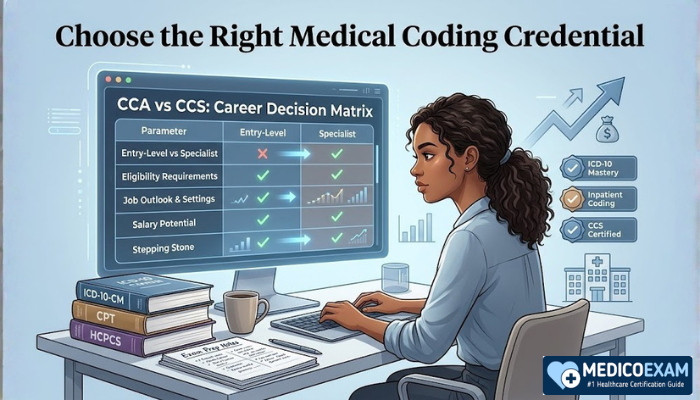
Choose the CCA if you are an entry-level coder with no professional experience. Choose the CCS if you have 2 or more years of hands-on coding experience and want to specialize in complex hospital inpatient coding. The CCA validates foundational competency across both inpatient and outpatient settings, while the CCS is a mastery-level credential recognized as the gold standard for hospital-based medical coding. The CCS exam has a first-time pass rate estimated at just 40–50%, compared to approximately 70% or higher for the CCA, reflecting a significant gap in difficulty (AMBCI).
Key Facts: CCA vs CCS at a Glance
| Fact | CCA | CCS |
|---|---|---|
| Full Name | Certified Coding Associate | Certified Coding Specialist |
| Issuing Body | AHIMA | AHIMA |
| Exam Cost | $199 (member) / $299 (non-member) | $299 (member) / $399 (non-member) |
| Number of Questions | 105 (15 pretest) | 97–115 (includes medical scenarios) |
| Time Limit | 2 hours | 4 hours |
| First-Time Pass Rate | ~70%+ | ~40–50% |
| Passing Score | Scaled score of 300 out of 400 | Scaled score of 300 out of 400 |
| Recommended Experience | None (entry-level) | 1–2+ years of coding experience |
| Average Salary | $45,000–$50,000 per year | $57,500–$70,000+ per year |
| Renewal Cycle | Every 2 years (20 CEUs) | Every 2 years (20 CEUs) |
| Difficulty Level | Moderate | Very High |
What Is the AHIMA CCA Certification?
The Certified Coding Associate (CCA) is an entry-level medical coding credential offered by the American Health Information Management Association (AHIMA). It is designed for professionals who are new to the field and want to demonstrate foundational competency in assigning medical codes across both physician office and hospital outpatient settings. According to AHIMA, the CCA exam costs $199 for AHIMA members and $299 for non-members.
The CCA exam consists of 105 multiple-choice questions, of which 90 are scored and 15 are unscored pretest items used to evaluate future exam content. Candidates are given 2 hours to complete the test. You must achieve a scaled score of 300 out of 400 to pass. The exam is administered through Pearson VUE testing centers and is an open-book exam, meaning you may bring approved current-year coding manuals (CPT, ICD-10-CM, and ICD-10-PCS) into the testing environment (Mometrix).
The CCA covers a broad range of introductory coding topics. These include medical terminology, anatomy and physiology, ICD-10-CM diagnostic coding, ICD-10-PCS procedure coding at a basic level, CPT coding for physician services, healthcare reimbursement methodologies, and health information documentation standards. Unlike the CCS, the CCA does not require candidates to code complex inpatient surgical records or demonstrate advanced DRG grouping knowledge.
The CCA is ideal for recent graduates of medical coding certificate programs, career changers entering healthcare from other industries, and professionals who hold a high school diploma and have completed coursework in coding fundamentals. No prior professional experience is required. The credential serves as proof that a candidate understands the basics of the coding profession and can work under supervision in an entry-level role. CCA certification is valid for two years and requires 20 continuing education units (CEUs) for renewal.
What Is the AHIMA CCS Certification?
The Certified Coding Specialist (CCS) is an advanced, mastery-level credential that validates a coder's ability to independently assign complex medical codes, particularly in the hospital inpatient setting. It is widely recognized as the most respected coding credential in health information management. AHIMA recommends that CCS candidates have at least 1–2 years of on-the-job coding experience or equivalent formal education before attempting the exam (AMBCI).
The CCS exam costs $299 for AHIMA members and $399 for non-members (AHIMA). The test consists of 97–115 questions, including both multiple-choice items and scenario-based medical record coding cases. Candidates have 4 hours to complete the exam. The scenario section simulates real hospital records—sometimes with intentionally incomplete documentation—and requires examinees to abstract data, assign correct ICD-10-CM, ICD-10-PCS, and CPT codes, and validate proper sequencing of diagnoses.
The CCS exam is divided into four weighted domains:
| Domain | Content Area | Weight |
|---|---|---|
| Domain 1 | Coding Knowledge (terminology, pharmacology, anatomy, code sets) | 20–25% |
| Domain 2 | Coding Applications (abstracting data, applying codes to full cases) | 45–50% |
| Domain 3 | Compliance, Query, and Reporting | 10–15% |
| Domain 4 | Information Technologies | 5–10% |
The heavy weighting toward Coding Applications (45–50%) reflects AHIMA's emphasis on practical, real-world coding ability. Candidates must demonstrate fluency in ICD-10-PCS procedural coding for inpatient surgeries, understand present-on-admission (POA) indicators, accurately assign MS-DRG groupings, and navigate clinical documentation to identify principal and secondary diagnoses. According to LinkedIn Insights, advanced AHIMA credentials generally see pass rates ranging from 45% to 60%, confirming the CCS as one of the most challenging certifications in the coding field.
How Do Compare AHIMA CCA vs CCS certification Exam Formats Compare?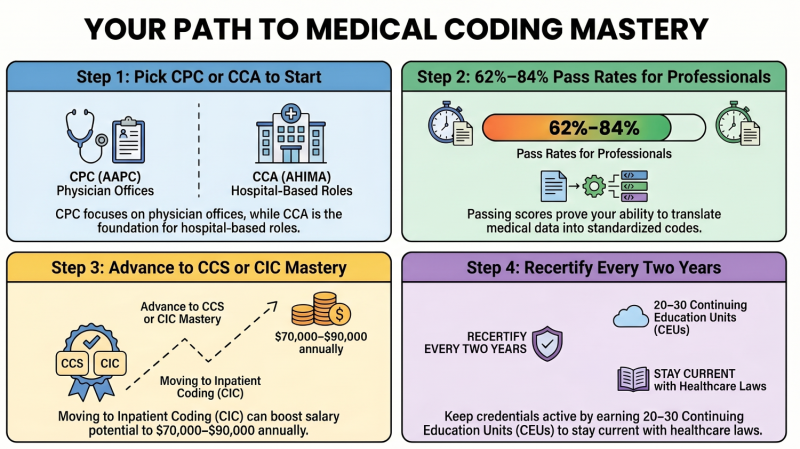 The CCA and CCS exams differ significantly in format, length, question types, and the depth of coding skill they measure. The CCA is a straightforward 2-hour, 105-question multiple-choice test. Every question provides four answer options, and you select the best one. The questions test recognition-level knowledge: can you identify the correct code category, apply a basic coding guideline, or select the right ICD-10-CM chapter?
The CCS, by contrast, is a 4-hour examination that blends multiple-choice questions with scenario-based medical record coding. In the scenario section, you are presented with a partial or complete hospital record and must extract clinical data, assign all relevant diagnosis and procedure codes, and sequence them correctly. This mirrors actual day-to-day hospital coding work. The CCS scenarios may include incomplete documentation, requiring you to recognize when additional physician queries would be needed—a skill that separates experienced coders from beginners.
| Format Feature | CCA | CCS |
|---|---|---|
| Total Questions | 105 | 97–115 |
| Scored Questions | 90 | Varies by form |
| Unscored/Pretest Questions | 15 | Included |
| Time Allowed | 2 hours | 4 hours |
| Main Question Type | Multiple-choice only | Multiple-choice + full coding scenarios |
| Coding Level | Foundational | Advanced / mastery-level |
| ICD-10-PCS Tested? | Yes, basic level | Yes, advanced scenario coding |
| DRG / reimbursement logic | Minimal | High emphasis |
| Best For | Entry-level coders | Experienced hospital coders |
One of the most critical differences is the inclusion of ICD-10-PCS scenario coding on the CCS. The ICD-10-PCS system contains over 78,000 codes built on a 7-character alphanumeric structure. Navigating this system under timed conditions while reading a complex surgical operative report is the single biggest challenge CCS candidates face. CCA candidates encounter ICD-10-PCS only at a basic recognition level.
What Is the Difficulty Difference Between CCA and CCS?
The CCS is substantially more difficult than the CCA. The most telling indicator is the pass rate gap. The CCA has a first-time pass rate of approximately 70% or higher, while the CCS first-time pass rate is estimated at just 40–50% (AMBCI). This means roughly half of all first-time CCS test-takers fail the exam.
Several factors contribute to this difficulty gap:
-
Depth of clinical knowledge required. The CCS demands mastery of complex disease processes, surgical procedures, and pharmacology. You must understand conditions like sepsis sequencing, diabetes with complications, and neoplasm coding at an expert level.
-
ICD-10-PCS procedural coding. The CCS tests advanced ICD-10-PCS skills, including building 7-character codes from root operations, body parts, approaches, devices, and qualifiers. This system has a steep learning curve that takes months of practice to master.
-
Scenario-based coding under pressure. The CCS requires you to code full medical records within strict time limits. A single inpatient case may require assigning 8–12 codes (diagnoses plus procedures) with correct sequencing—all within minutes.
-
DRG and reimbursement complexity. The CCS tests your understanding of how code assignments drive MS-DRG groupings and hospital reimbursement. A single missed code can shift a DRG category and change payment by thousands of dollars.
-
Exam length and stamina. Sitting for a 4-hour exam requires mental endurance that a 2-hour CCA exam does not. Many CCS candidates report fatigue-related errors in the final hour.
"The CCS and CCS-P exams are not considered entry-level coding exams. They are much more difficult to pass, which is why they are only recommended for coders who have a few years of on-the-job experience." — Certification Expert, Cert Mage
How Do CCA and CCS Salaries Compare?
Salary is one of the most significant differences between CCA and CCS credential holders. According to salary data, the average annual salary for CCA-certified professionals is approximately $48,321, while CCS-certified professionals earn an average of $57,500. However, experienced CCS coders working in hospital inpatient settings can earn $70,000–$85,000 per year.
The salary premium for CCS holders reflects the complexity of inpatient coding work. Hospital HIM departments handle high-acuity cases—trauma, organ transplants, complex surgical procedures—where accurate coding directly impacts reimbursement. A single inpatient case can generate tens of thousands of dollars in revenue, and facilities pay a premium for coders who can assign codes accurately and compliantly.
| Salary Metric | CCA | CCS |
|---|---|---|
| Entry-Level Annual Salary | $37,500–$42,000 | $50,000–$55,000 |
| Average Annual Salary | $45,000–$50,000 | $57,500–$70,000 |
| High-End Salary Potential | $52,000–$58,000 | $70,000–$85,000+ |
| Remote Work Potential | Moderate | High |
| Leadership Roles | Limited | Strong pathway |
According to AAPC salary survey data reported by Nurse.org, certified coders earn 20.7% more than non-certified coders on average. Furthermore, professionals holding multiple certifications see the largest salary gains: non-certified coders average $55,721 per year, those with one certification average $62,689, and those with three or more certifications average $81,227 per year (Cert Mage).
The CCS also opens doors to specialized roles that carry higher pay: coding auditor, coding compliance analyst, DRG validation specialist, and health information management director. These positions often require the CCS credential as a minimum qualification.
Who Should Choose the CCA?
The CCA is the right choice if you match one or more of the following career profiles:
-
The Recent Graduate. You have just completed a medical coding certificate or associate degree program and have no prior coding work experience. The CCA gives you a professional credential to list on your resume and demonstrates to employers that you have foundational coding competency.
-
The Career Changer. You are transitioning into healthcare from another industry—perhaps administrative work, education, or retail. You need a credential that is attainable without years of prerequisite experience. The CCA's moderate difficulty and 70%+ pass rate make it a realistic first milestone.
-
The Physician Office Coder. Your career goal is to work in a physician's office, outpatient clinic, or ambulatory surgery center, where coding is less complex than in the hospital inpatient setting. The CCA provides sufficient validation for these roles.
-
The Stepping-Stone Strategist. You plan to eventually pursue the CCS or CPC but want an initial credential to enter the workforce quickly. Earning the CCA first, gaining 1–3 years of experience, and then sitting for the CCS is a proven career acceleration strategy.
-
The Budget-Conscious Candidate. At $199–$299, the CCA exam represents a lower financial risk than the CCS ($299–$399). Combined with its higher pass rate, the CCA offers a stronger probability of return on investment for entry-level professionals.
Who Should Choose the CCS?
The CCS is the right choice if you match one or more of these career profiles:
-
The Experienced Hospital Coder. You have 2 or more years of hands-on experience coding inpatient medical records. You are already familiar with ICD-10-PCS, MS-DRG assignments, and the complexities of hospital documentation. The CCS formalizes the expertise you already practice daily.
-
The Salary Maximizer. You want to maximize your earning potential in medical coding. CCS-certified coders consistently earn $10,000–$25,000 more annually than CCA holders, with experienced inpatient coders earning $70,000–$85,000 per year (Cert Mage).
-
The Remote Inpatient Coder. One of the most in-demand remote healthcare roles is the remote inpatient coder. These positions almost universally require the CCS credential and offer the flexibility of working from home while coding complex hospital records.
-
The HIM Department Leader. If your career path leads toward coding supervisor, coding manager, or HIM director roles, the CCS is expected or required. Hospital leadership teams view the CCS as evidence of mastery-level competence.
-
The Compliance and Auditing Specialist. Roles in coding compliance, DRG validation, clinical documentation improvement (CDI), and coding auditing often list the CCS as a preferred or required credential. These positions involve reviewing other coders' work for accuracy and regulatory compliance.
How Does the Decision Matrix Break Down?
Use this decision matrix to evaluate which credential aligns with your current situation. Each criterion is rated as a clear advantage for one credential.
| Decision Criterion | Better Choice | Why |
|---|---|---|
| You have 0–1 years of experience | CCA | Designed for entry-level; realistic pass rate |
| You have 2+ years of coding experience | CCS | Validates your existing expertise; unlocks senior roles |
| You want faster entry into the workforce | CCA | Easier, shorter, lower-cost credential |
| You want maximum long-term salary | CCS | Higher earnings ceiling |
| You want to work remotely in inpatient coding | CCS | Preferred credential for remote hospital roles |
| You want lower financial risk | CCA | Lower exam cost and higher pass probability |
| You want to specialize in inpatient hospital coding | CCS | Built for complex inpatient work |
Can You Use the CCA as a Stepping Stone to the CCS?
Yes, and this is one of the most effective career strategies in medical coding. Many successful health information professionals follow the CCA-to-CCS pathway:
-
Step 1: Earn the CCA. Pass the CCA exam to validate your foundational skills and make yourself employable. This typically takes 2–4 months of study after completing a coding program.
-
Step 2: Gain real-world experience. Secure an entry-level coding position in a hospital, physician office, or billing company. Spend 1–3 years coding medical records under supervision, building your familiarity with ICD-10-CM, CPT, and especially ICD-10-PCS for inpatient cases.
-
Step 3: Study for the CCS. After accumulating hands-on experience, begin a focused 3–6 month study plan for the CCS exam. Your workplace experience will make the scenario-based questions significantly more manageable than they would be for someone with no practical background.
-
Step 4: Earn the CCS and advance. Pass the CCS exam and immediately qualify for senior coding roles, remote inpatient positions, and leadership tracks. Many coders report a salary increase of 15–25% within the first year after earning the CCS.
AHIMA does not require the CCA as a formal prerequisite for the CCS. You can attempt the CCS directly if you meet the recommended education and experience guidelines. However, the stepping-stone approach significantly improves your CCS pass probability by ensuring you have both theoretical knowledge and practical coding experience before facing the exam.
"Earning my CCA first gave me the confidence and the job that prepared me for the CCS. I spent two years coding hospital records before I attempted it, and that real-world experience made all the difference." — Maria Gonzalez, CCS, HIM Coding Supervisor
Frequently Asked Questions
1. Is the CCA easier than the CCS?
Yes. The CCA is an entry-level exam testing foundational knowledge of medical terminology, basic ICD-10-CM and CPT coding, and healthcare documentation standards. The CCS tests mastery-level application of complex inpatient coding scenarios, including ICD-10-PCS procedural coding and MS-DRG grouping. The CCA pass rate of approximately 70%+ versus the CCS pass rate of 40–50% reflects this difficulty gap.
2. Can I take the CCS without taking the CCA first?
Yes. AHIMA does not require the CCA as a prerequisite for the CCS. You may sit for the CCS directly if you meet the recommended education and experience guidelines. However, AHIMA strongly recommends at least 1–2 years of professional coding experience or completion of a coding certificate program that includes ICD-10-PCS training before attempting the CCS exam.
3. Why is the CCS pass rate so low?
The CCS exam includes complex scenario-based medical records that require deep knowledge of ICD-10-PCS, DRG logic, and clinical documentation. Many candidates underestimate the difficulty of coding complete inpatient records under timed conditions. The scenario section alone can account for the difference between passing and failing, particularly for candidates who lack hands-on hospital coding experience.
4. How much more do CCS coders make than CCA coders?
CCS-certified professionals typically earn $10,000–$25,000 more annually than CCA holders. CCA holders average approximately $48,321 per year while CCS holders average $57,500. Experienced CCS coders in hospital settings can earn $70,000–$85,000 per year.
5. How long are the exams?
The CCA allows 2 hours to complete 105 questions (approximately 1.3 minutes per question). The CCS allows 4 hours to complete 97–115 questions, including scenario-based coding cases (approximately 2.1–2.5 minutes per question). The CCS requires pacing strategies that allocate roughly 90 minutes for multiple-choice items, 120 minutes for scenario coding, and 30–45 minutes for review.
6. Do I need a college degree for either exam?
No. Neither the CCA nor the CCS requires a college degree. Both require a high school diploma or equivalent. However, AHIMA recommends that CCA candidates have completed formal coding education, and CCS candidates should have completed a coding program plus 1–2 years of practical experience or hold a prior certification such as the CCA or CPC.
7. Which credential is better for remote work?
The CCS is significantly better for remote work opportunities. Remote inpatient hospital coding positions—one of the most sought-after work-from-home roles in healthcare—almost universally require the CCS or an equivalent advanced credential. Entry-level CCA holders typically need to work on-site for 1–3 years before qualifying for remote positions.
8. Do both exams use ICD-10-PCS?
Yes, but at very different levels. The CCA tests basic recognition of ICD-10-PCS concepts and simple procedure codes. The CCS requires advanced proficiency in building 7-character ICD-10-PCS codes from root operations, body parts, approaches, devices, and qualifiers, often from complex operative reports in timed scenario-coding exercises.
9. How do I maintain my credential once I pass?
Both credentials require you to earn 20 continuing education units (CEUs) and pay a recertification fee every two years. CEUs can be earned through AHIMA-approved educational activities including webinars, workshops, coding seminars, and self-study programs. If you fail to complete your CEUs within the renewal period, your credential will lapse and you may need to retake the exam.
10. What is the passing score for the CCA and CCS?
Both the CCA and the CCS require a scaled score of 300 out of 400 to pass. The scaled scoring system adjusts for slight variations in exam difficulty across different test forms, ensuring that the passing standard remains consistent regardless of which version of the exam you receive.
Ready to Start Practicing?
Whether you are starting with the CCA to build your foundation or tackling the advanced CCS to unlock senior-level coding opportunities, targeted preparation is the key to passing. Try MedicoExam's simulation-based practice tests to gauge your readiness, practice scenario-based coding questions, and build confidence before exam day. MedicoExam covers both CCA and CCS exam formats with detailed answer rationales.
Written by the MedicoExam Content Team — Healthcare Education Specialists at MedicoExam.com
Last Updated: April 2026
Disclaimer: This article is for informational purposes only. MedicoExam does not provide leaked questions, exam recalls, or proprietary AHIMA content. Always refer to AHIMA for the most current examination policies and fees.
- AHIMA CCA Question Bank |
- AHIMA CCA Eligibility & Requirements |
- AHIMA Coding Associate Practice Test |
- AHIMA CCA Exam Cost |
- AHIMA CCA Registration Process |
- AHIMA Coding Associate Study Guide |
- AHIMA CCA Recertification |
- AHIMA CCA Certification Overview |
- AHIMA Coding Associate Syllabus |
- AHIMA CCA Preparation Time |
- AHIMA CCA Passing Score |
- AHIMA CCA Exam Format |
- AHIMA CCS Question Bank |
- AHIMA CCS Eligibility & Requirements |
- AHIMA Coding Specialist Practice Test |
- AHIMA CCS Exam Cost |
- AHIMA CCS Registration Process |
- AHIMA Coding Specialist Study Guide |
- AHIMA CCS Recertification |
- AHIMA CCS Certification Overview |
- AHIMA Coding Specialist Syllabus |
- AHIMA CCS Preparation Time |
- AHIMA CCS Passing Score |
- AHIMA CCS Exam Format


