
NCC C-EFM Certification Sample Questions
The NCC Certification in Electronic Fetal Monitoring Certification Sample Question Set on this page is designed to familiarize you with the actual NCC C-EFM exam format and question types. These sample questions help you understand how questions are structured and what to expect on test day. While they provide a useful starting point, they represent only a limited preview of the real exam experience.
These sample questions are intended for evaluation and familiarization only. To understand exam style, pacing, and reasoning patterns more clearly, we recommend trying our online sample practice environment. If you are preparing for the NCC Certified-Electronic Fetal Monitoring (C-EFM) and want to assess your readiness more rigorously, structured, timed, scenario-based practice is recommended. This approach aligns with the cognitive demands and professional expectations typically associated with Registered Nurses, Advanced Practice Registered Nurses, and related maternal-newborn care roles working in settings such as Labor and Delivery Units, Obstetric Clinics, Hospital-Based Perinatal Services.
Try Sample Exam » | Access Full NCC C-EFM Practice Exam »
The demo introduces core concepts, while full-length premium simulations provide deeper, scenario-based coverage that more closely reflects the actual cognitive demands of the NCC Certification in Electronic Fetal Monitoring exam, particularly in areas such as Fetal Heart Rate Interpretation, Intrapartum Assessment, Clinical Decision-Making in Perinatal Care. You can use these sample questions as a starting point, then progress to the NCC C-EFM Certification Practice Exam for stronger readiness. Our premium simulations are designed to mirror real exam conditions, helping you refine reasoning, pacing, and decision-making before your official exam attempt.
NCC C-EFM Sample Questions:
01. When an EFM tracing is indeterminate, what ethical principle most strongly supports continued surveillance and reassessment?
a) Autonomy unrelated to fetal status
b) Nonmaleficence applied only to maternal care
c) Beneficence
02. Based on interpretation the above tracing, this tracing would classified as
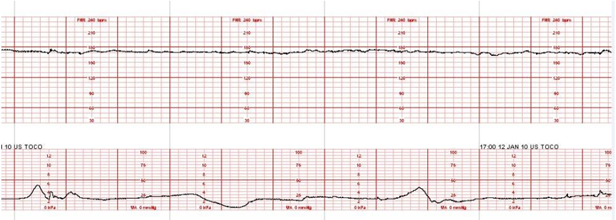
a) Category II
b) Category I
c) Category III
03. Umbilical arterial cord blood shows pH 7.02 with base deficit 16 mmol/L. What is the most concerning implication?
a) Normal adaptation to labor
b) Respiratory alkalosis
c) Severe metabolic acidemia with high risk of neonatal morbidity
04. Cord blood analysis reveals arterial pH 7.04 and base deficit 14 mmol/L. What acid-base status does this most likely indicate?
a) Respiratory alkalosis
b) Severe metabolic acidosis
c) Normal acid-base balance
05. Which physiologic mechanism explains fetal bradycardia associated with prolonged cord compression?
a) Enhanced parasympathetic stimulation via vagal response
b) Increased fetal sympathetic activity
c) Increased maternal oxygenation
06. During prolonged hypoxemia, which acid-base change would most likely be observed in cord blood?
a) Decreased pH with increased base deficit
b) Elevated pH
c) Increased bicarbonate concentration
07. Following an ultrasound which revealed decreased amniotic fluid, a woman at term is admitted in early labor. It should be recognized that oligohydramnios often results in fetal heart rate decelerations that are
a) synchronous with that of the contraction
b) varied in depth and duration
c) late in onset or occur after the peak of the contraction
08. In comparing early and late decelerations, a distinguishing factor between the two is
a) timing in relation to contractions
b) onset time to the nadir of the deceleration
c) the number of decelerations that occur
09. A term NST shows minimal variability and no accelerations over 40 minutes. Acoustic stimulation fails to produce accelerations. What is the most appropriate next consideration?
a) Head compression
b) Normal sleep cycle only
c) Possible fetal acidemia requiring further evaluation
10. Cord blood gas results show pH 7.20 and base deficit 5 mmol/L. How should this result be interpreted?
a) Respiratory alkalosis
b) Mild acidemia
c) Severe metabolic acidosis
Answers:
|
Question: 01 Answer: c |
Question: 02 Answer: a |
Question: 03 Answer: c |
Question: 04 Answer: b |
Question: 05 Answer: a |
|
Question: 06 Answer: a |
Question: 07 Answer: b |
Question: 08 Answer: a |
Question: 09 Answer: c |
Question: 10 Answer: b |
For full-length, timed, scenario-based practice aligned with the official exam framework - and to build pacing, consistency, and confidence - explore our Premium NCC C-EFM Certification Practice Exam.
Note: These sample questions are not official exam questions and are intended only for familiarization and study purposes. If you find any typos or data entry errors in these NCC Certification in Electronic Fetal Monitoring (C-EFM) sample questions, please let us know by emailing us at feedback@medicoexam.com


