
NCC RNC-NIC Neonatal Intensive Care Nursing Certification Complete Guide
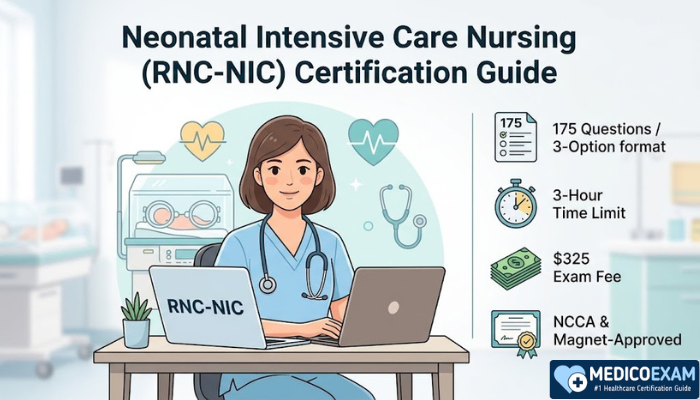 The RNC-NIC (Neonatal Intensive Care Nursing) certification from the National Certification Corporation (NCC) is the largest NCCA-accredited, Magnet-approved credential for NICU nurses in the United States. The exam contains 175 multiple-choice questions — 150 scored and 25 unscored pretest items — with a 3-hour time limit and a fee of $325. With 21,761 active certificants and roughly 2,470 candidates tested in 2024 alone, the RNC-NIC stands as the benchmark specialty credential for nurses who care for acutely and critically ill neonates in intensive care settings.
| Full Name | Neonatal Intensive Care Nursing (RNC-NIC) |
|---|---|
| Certifying Body | National Certification Corporation (NCC) |
| Accreditation | NCCA (National Commission for Certifying Agencies) |
| Total Questions | 175 (150 scored + 25 pretest) |
| Answer Choices | 3 options per question (not 4) |
| Time Limit | 3 hours |
| Exam Fee | $325 (includes $50 non-refundable application fee) |
| Passing Standard | Criterion-referenced (scaled pass/fail; no numeric score) |
| Certification Period | 3 years |
| 2024 Pass Rate | 76% |
| Active Certificants | 21,761 |
| Testing Format | PSI testing centers or Live Remote Proctoring (LRP) |
What Is the RNC-NIC Certification?
The RNC-NIC is a competency-based certification that tests the specialty knowledge of registered nurses who provide direct care to acutely and critically ill neonatal patients and their families within an intensive care environment. According to NCC, the credential validates a nurse's ability to identify life-threatening conditions in the high-risk neonate, perform specialized assessments — including physical examination, gestational age assessment, and neurobehavioral assessment — and understand neonatal pathophysiology to initiate appropriate early intervention.
As an NCCA-accredited and Magnet-approved credential, the RNC-NIC supports nurses seeking recognition for clinical excellence and hospitals pursuing or maintaining Magnet designation.
Who Is Eligible for the RNC-NIC Exam?
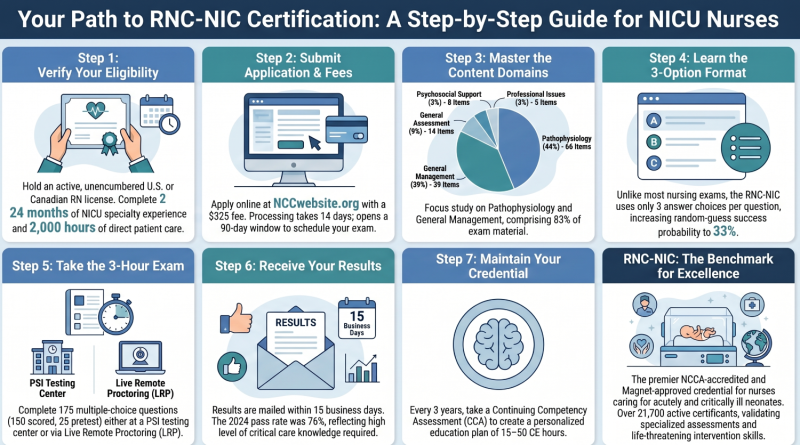
Eligibility requires a current, active, and unencumbered U.S. or Canadian registered nurse license, 24 months of specialty experience, and a minimum of 2,000 hours of direct patient care in neonatal intensive care. Both the time and hours requirements must be met — this is not an either/or criterion. According to NCC's eligibility page, the specific requirements are:
-
Active RN License: Current and unencumbered licensure as an RN in the United States or Canada.
-
24 Months of Specialty Experience: A minimum of two years providing care to acutely and critically ill neonatal patients in an intensive care environment.
-
2,000 Practice Hours: At least 2,000 hours of direct NICU patient care, completed within the 24 months immediately preceding the exam application.
-
Employment Verification: Employment in neonatal intensive care must have occurred within the 24-month period leading up to the exam.
All applications are submitted online through the NCC website. Processing takes up to 14 days. After approval, candidates enter a 90-day testing window.
How Is the RNC-NIC Exam Structured?
The RNC-NIC exam contains 175 multiple-choice questions with 3 answer options each — a format unique to NCC exams. Of the 175 items, 150 are scored and 25 are unscored pretest items used for future exam development. Candidates receive 3 hours to complete the exam. There is no penalty for incorrect answers, so every question should be attempted.
NCC uses criterion-referenced scoring based on item response theory (Rasch analysis). The passing standard is a predetermined ability level rather than a fixed percentage. Results are reported as pass/fail with verbal performance descriptors for each content area. Exam results are mailed within 15 business days.
Unlike most nursing certification exams that use 4 answer choices, all NCC exams present a stem followed by only 3 alphabetized answer options: 1 correct and 2 distractors. This 3-option format slightly changes test-taking strategy — random guessing yields a 33% chance of selecting the correct answer compared to 25% on 4-option exams.
What Content Domains Does the RNC-NIC Cover?
The exam content spans five major domains, with the heaviest emphasis on pathophysiology management and general clinical management. According to the 2026 RNC-NIC Candidate Guide, the distribution is:
| Content Domain | % of Exam | Approximate Scored Items |
|---|---|---|
| General Assessment | 9% | ~14 questions |
| General Management | 39% | ~59 questions |
| Assess & Manage Pathophysiologic States | 44% | ~66 questions |
| Psychosocial Support | 5% | ~8 questions |
| Professional Issues | 3% | ~5 questions |
General Assessment (9%)
This domain tests the ability to evaluate antepartum risk factors and birth history, conduct physical examinations, and perform gestational age assessment. Candidates must identify maternal and fetal indicators of neonatal risk and their potential significance.
General Management (39%)
The largest tested area after pathophysiology, this domain covers:
-
Resuscitation and stabilization — NRP principles, Apgar scoring, initial management
-
Fluids, electrolytes, and glucose homeostasis — IV therapy, electrolyte management
-
Nutrition and feeding — enteral and parenteral nutrition, TPN, breastfeeding support
-
Oxygenation, ventilation, and acid-base homeostasis — ventilator management, pulse oximetry, ECMO indications, noninvasive ventilation
-
Thermoregulation and integumentary care — incubator management, skin integrity
-
Pharmacology, pharmacokinetics, and pharmacodynamics — neonatal drug dosing and metabolism
-
Neuroprotective and neurodevelopmental care — positioning, sensory management, developmental support
Assess & Manage Pathophysiologic States (44%)
The dominant exam domain covers disease processes across all organ systems:
-
Cardiovascular (congenital heart defects, PDA, shock)
-
Respiratory (RDS, BPD, meconium aspiration, pneumothorax)
-
Gastrointestinal/Genitourinary (NEC, gastroschisis, renal failure)
-
Hematopoietic (hyperbilirubinemia, anemia, DIC)
-
Neurological/Neuromuscular/Musculoskeletal (IVH, HIE, seizures)
-
Genetic, metabolic, and endocrine (inborn errors of metabolism, thyroid disorders)
-
Head, eyes, ears, nose, and throat (ROP, choanal atresia)
-
Infection and immunology (sepsis, TORCH infections, antibiotic stewardship)
Psychosocial Support (5%)
Covers discharge management, family-centered care, grieving, palliative care, and mental health considerations for NICU families.
Professional Issues (3%)
Includes evidence-based practice, legal and ethical considerations, patient safety, and quality improvement.
Expert Insight: "Many first-time RNC-NIC candidates underestimate the pathophysiology domain because they rely too heavily on clinical intuition. The exam tests the why behind neonatal conditions — the underlying physiology, not just the bedside interventions. I tell every nurse I mentor to study cardiovascular and respiratory pathophysiology like they're learning it for the first time." — Sarah M. Thornton, MSN, RNC-NIC, NICU Clinical Educator
What Are the RNC-NIC Pass Rates?
The RNC-NIC pass rate has ranged between 76% and 81% over the past five years. According to NCC's published exam statistics, the year-by-year breakdown is:
| Year | Candidates Tested | Pass Rate |
|---|---|---|
| 2020 | 1,696 | 80% |
| 2021 | 1,528 | 81% |
| 2022 | 1,997 | 79% |
| 2023 | 1,058 | 77% |
| 2024 | 2,470 | 76% |
The 2024 pass rate of 76% represents the lowest in the five-year window, suggesting the exam difficulty or candidate preparation may be shifting. By comparison, other NCC core nursing exams in 2024 had pass rates of 86% (RNC-OB/Inpatient Obstetric), 90% (RNC-MNN/Maternal Newborn), and 67% (RNC-LRN/Low Risk Neonatal). The RNC-NIC falls in the mid-range among NCC core certifications, reflecting the complexity of critical care neonatal content.
How Does the RNC-NIC Compare to Other Neonatal Certifications?
NICU nurses often weigh the RNC-NIC against two other credentials: the RNC-LRN (Low Risk Neonatal Nursing) from NCC and the CCRN-Neonatal from the American Association of Critical-Care Nurses (AACN). Each targets a different scope of practice and clinical setting.
| Feature | RNC-NIC (NCC) | RNC-LRN (NCC) | CCRN-Neonatal (AACN) |
|---|---|---|---|
| Focus | Critically ill neonates in NICU | Level II / step-down / well-baby | Acutely/critically ill neonates |
| Total Questions | 175 | 175 | 150 |
| Scored Questions | 150 | 150 | 125 |
| Answer Options | 3 | 3 | 4 |
| Time Limit | 3 hours | 3 hours | 3 hours |
| Exam Fee | $325 | $325 | $255 (AACN members) / $370 (non-members) |
| Passing Standard | Scaled pass/fail | Scaled pass/fail | Cut score of 84 out of 125 |
| Experience Required | 2 years / 2,000 hrs NICU | 2 years / 2,000 hrs Level II/step-down | 1,750 hrs (2-yr) or 2,000 hrs (5-yr) |
| Certification Period | 3 years | 3 years | 3 years |
| Renewal CE | 15–50 CE hrs + $50 fee | 15–50 CE hrs + $50 fee | 100 CERPs + 432 practice hrs |
| 2024 Pass Rate | 76% | 67% | ~60% (first-time, 2025) |
| Active Certificants | 21,761 | 3,229 | 2,047 |
| Magnet Approved | Yes | Yes | Yes |
| Accreditation | NCCA | NCCA | ABSNC |
Key Differences
-
RNC-NIC vs. RNC-LRN: Both share the same exam structure (175 questions, 3 options, $325). The RNC-NIC targets Level III–IV NICU nurses managing ventilators, ECMO, and critical pathophysiology. The RNC-LRN is for Level II special care nurseries, chronic care, and step-down units.
-
RNC-NIC vs. CCRN-Neonatal: The CCRN-Neonatal from AACN uses 4 answer options, has a passing cut score of 84 out of 125 scored items, and reports a first-time pass rate of approximately 60% according to AACN's 2025 statistics. The RNC-NIC has a larger certificant base (21,761 vs. 2,047) and is more widely recognized in maternal-child health settings. Many experienced NICU nurses hold both credentials.
How Do You Register for the RNC-NIC Exam?
Registration follows a straightforward online process through NCC's website:
-
Create an account on NCCwebsite.org and submit your online application with personal, licensure, and employment information.
-
Pay the $325 exam fee (includes the $50 non-refundable application fee). NCC accepts Visa, American Express, and MasterCard. Debit cards and split payments are not accepted.
-
Await approval — processing takes up to 14 days. Incomplete applications incur a $30 reprocessing fee.
-
Schedule your exam within the 90-day testing window. You must schedule within the first 30 days to ensure availability.
-
Choose your testing method: PSI testing center or Live Remote Proctoring (LRP) from home or office. For LRP, test your computer in advance and schedule early.
After a failed attempt, candidates must wait 45 days before resubmitting a new application with full payment. The maximum number of attempts per calendar year is two.
How Do You Maintain RNC-NIC Certification?
RNC-NIC certification is valid for 3 years. Renewal requires completing a Continuing Competency Assessment (CCA) and fulfilling a personalized education plan. According to NCC's coding guide for RNC-NIC, the process works as follows:
-
Take the CCA at the beginning of your renewal cycle. This assessment identifies knowledge gaps across core competency areas.
-
Complete your education plan — a minimum of 15 and a maximum of 50 CE contact hours, depending on your CCA results. The CE hours are distributed across competency areas including General Assessment & Management, Physiology & Pathophysiology, Pharmacology, and Professional Practice.
-
Pay the $50 renewal fee and submit your maintenance application online.
The CCA-based system is unique to NCC. Rather than requiring a flat CE hour count, it tailors each nurse's continuing education to their individual knowledge gaps — a more targeted approach than the generic CE requirements used by many other certifying bodies.
What Are the Best Study Strategies for the RNC-NIC?
Preparing for the RNC-NIC requires focused study across its five content domains, with particular attention to the 83% of the exam devoted to General Management and Pathophysiologic States. Effective strategies include:
-
Start with the NCC Candidate Guide: This free resource provides the complete content outline, competency statements, and sample questions. Use it as your study blueprint.
-
Focus on pathophysiology: With 44% of the exam, this is the highest-yield domain. Review cardiovascular, respiratory, GI, neurological, and hematologic conditions systematically.
-
Master ventilator management and oxygenation: Questions on ventilation modes, oxygen saturation targets, ECMO indications, and acid-base interpretation appear across multiple domains.
-
Review pharmacology thoroughly: Neonatal pharmacokinetics — including drug metabolism in premature infants — is tested both in General Management and within organ-system pathophysiology.
-
Practice 3-option questions: The 3-answer format feels different from NCLEX-style questions. Use NCC-specific practice materials to build familiarity.
-
Use the recommended textbooks: NCC references Fanaroff and Martin's Neonatal-Perinatal Medicine (Elsevier, 2024), Core Curriculum for Neonatal Intensive Care Nursing (Saunders Elsevier, 2021), and Handbook of Neonatal Intensive Care (Elsevier, 2021).
-
Take timed practice tests: Simulate the 3-hour, 175-question format to build endurance and time management skills. MedicoExam's simulation-based practice tests replicate the real exam environment.
What Are Related NCC Certifications for NICU Nurses?
Nurses working in neonatal care may benefit from stacking additional NCC subspecialty certifications alongside the RNC-NIC:
-
C-ELBW (Extremely Low Birth Weight Neonate): Focuses on care of neonates under 1,000 grams. 125 questions, 2 hours, $210.
-
C-NPT (Neonatal Pediatric Transport): For nurses involved in neonatal transport and stabilization. 125 questions, 2 hours, $210.
-
C-EFM (Electronic Fetal Monitoring): Relevant for NICU nurses who interpret fetal monitoring strips. 125 questions, 2 hours, $210.
These subspecialty credentials complement the RNC-NIC and demonstrate additional depth in specific neonatal care areas. Visit the NCC certification hub on MedicoExam for guides on each credential.
Frequently Asked Questions
Q1. How many questions are on the RNC-NIC exam?
The RNC-NIC exam contains 175 total questions. Of these, 150 are scored and contribute to your pass/fail result, while 25 are unscored pretest items being evaluated for future exams. You cannot distinguish scored from unscored items during the exam.
Q2. How much does the RNC-NIC exam cost?
The RNC-NIC exam costs $325, which includes a $275 testing fee and a $50 non-refundable application fee. Changing your exam date costs $125. Renewal after three years costs $50.
Q3. What is the RNC-NIC pass rate?
The most recent pass rate for the RNC-NIC exam is 76% (2024), based on 2,470 candidates tested. Over the past five years, the pass rate has ranged from 76% to 81%.
Q4. How many answer choices do RNC-NIC questions have?
All NCC exams, including the RNC-NIC, use 3 answer options per question — not the 4 choices typical of most nursing certification exams. The options are alphabetized by their first word.
Q5. What experience do I need for the RNC-NIC?
You need a current U.S. or Canadian RN license, 24 months of specialty experience in neonatal intensive care, and at least 2,000 hours of direct NICU patient care within the 24 months preceding your application.
Q6. Can I take the RNC-NIC exam from home?
Yes. NCC offers Live Remote Proctoring (LRP), which allows you to take the exam from home or office using your own computer. A professional proctor monitors you live through your webcam. You can also test at a PSI testing center.
Q7. How long is RNC-NIC certification valid?
RNC-NIC certification is valid for 3 years. Renewal requires completing a Continuing Competency Assessment and fulfilling a personalized education plan of 15 to 50 CE contact hours, plus a $50 renewal fee.
Q8. What happens if I fail the RNC-NIC exam?
You must wait 45 days before retesting and submit a new application with full $325 payment. You can take the exam a maximum of two times per calendar year. There is no lifetime limit on attempts.
Q9. Is the RNC-NIC Magnet-approved?
Yes. All NCC accredited certifications, including the RNC-NIC, are approved for Magnet recognition. This makes it a valuable credential for hospitals pursuing or maintaining Magnet designation.
Q10. Should I get the RNC-NIC or the CCRN-Neonatal?
Both are respected credentials for NICU nurses. The RNC-NIC has a much larger certificant base (21,761 vs. 2,047) and is more common in maternal-child health settings. The CCRN-Neonatal from AACN may be preferred in general critical care organizations. Many experienced NICU nurses pursue both.
Start Your RNC-NIC Exam Preparation Today
The RNC-NIC certification validates the specialized expertise NICU nurses bring to the bedside of the most vulnerable patients. Whether you are certifying for the first time or preparing for recertification, structured practice is the most reliable path to success.
MedicoExam's simulation-based practice tests mirror the real RNC-NIC exam format — including the unique 3-option question style — so you can build confidence and identify knowledge gaps before exam day. Explore our NCC certification hub for additional study resources and guides for related neonatal credentials.
Disclaimer: This article is for informational purposes only. It does not contain exam recalls, leaked questions, or proprietary content from NCC. Always verify current exam policies, fees, and eligibility requirements directly with the National Certification Corporation. Exam details are subject to change.
Written by the MedicoExam Content Team — Healthcare Education Specialists at MedicoExam.com
Last Updated: April 2026
- NCC RNC-NIC Question Bank |
- NCC RNC-NIC Eligibility & Requirements |
- NCC Neonatal Intensive Care Nursing Practice Test |
- NCC RNC-NIC Exam Cost |
- NCC RNC-NIC Registration Process |
- NCC Neonatal Intensive Care Nursing Study Guide |
- NCC RNC-NIC Recertification |
- NCC RNC-NIC Certification Overview |
- NCC Neonatal Intensive Care Nursing Syllabus |
- NCC RNC-NIC Preparation Time |
- NCC RNC-NIC Passing Score |
- NCC RNC-NIC Exam Format |
- NCC Neonatal Intensive Care Nursing Sample Questions |
- NCC RNC-NIC Career Opportunities |
- NCC RNC-NIC Exam Difficulty


