
NCC WHNP-BC Exam: Women's Health Care NP Certification — Complete Guide
 The WHNP-BC (Women's Health Care Nurse Practitioner – Board Certified) is the only national certification for nurse practitioners specializing in women's health. Offered exclusively by the National Certification Corporation (NCC), this exam validates advanced practice competency in obstetrics, gynecology, primary care for women, contraception, menopause management, and STI screening. The computer-based exam contains 175 multiple-choice questions with 3 answer options, allows 3 hours, and costs $325.
What Is the WHNP-BC Certification?
The WHNP-BC is an entry-level, competency-based certification that tests specialty knowledge for licensed registered nurses who have completed a US-accredited nurse practitioner program specifically in women's health care. It is the sole NP certification pathway for the women's health specialty — no other credentialing body offers an equivalent exam.
NCC awards the WHNP-BC credential to nurse practitioners who demonstrate proficiency in providing obstetrical, gynecological, and primary care to women across inpatient and outpatient settings. According to the NCC, the credential verifies "specialty knowledge and the application of that knowledge" for WHNPs. The certification is recognized across all 50 states, and most state boards of nursing require national certification for APRN licensure.
NCC has certified over 250,000 professionals across all its credential programs since its founding in 1975. The organization is accredited by the National Commission for Certifying Agencies (NCCA) under the Institute for Credentialing Excellence, the gold standard for certification program accreditation.
Who Is Eligible for the WHNP-BC Exam?
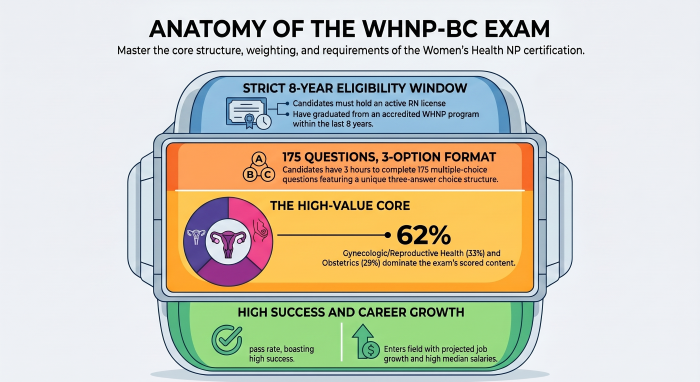
Candidates must hold a current, active, unencumbered US nursing or advanced practice nursing license and must have graduated from an accredited graduate-level WHNP program. The NCC 2026 Registration Catalog specifies these eligibility requirements:
-
Education: Completion of an accredited graduate nurse practitioner program that prepares Women's Health Care Nurse Practitioners. Accepted degrees include MSN, DNP, or post-master's certificate. NCC no longer accepts certificate-prepared applicants.
-
Program accreditation: The program must be accredited by CCNE, ACEN, or another NCC-recognized accreditor.
-
Program requirements: At least 200 didactic clock hours and 600 clinical clock hours. The program must be at least one academic year (9 months) in length.
-
Licensure: Current, active, unencumbered US nursing or advanced practice nursing license (Canadian licensure accepted if the APRN graduated from an NCC-approved US program).
-
Time limit: The certification exam must be taken within 8 years of graduation. No exceptions.
-
Documentation: Official transcripts and diploma uploaded with the application.
Critical note: Graduates from Family Nurse Practitioner (FNP) or nurse midwifery programs are NOT eligible to take the WHNP-BC exam based on their FNP or midwifery education alone. An FNP who wants the WHNP-BC must complete a post-master's certificate program in WHNP that meets NCC's educational requirements.
What Does the WHNP-BC Exam Cover?
The WHNP-BC exam focuses heavily on gynecologic and reproductive health (33%) and obstetrics (29%), which together make up 62% of the scored questions. According to the NCC WHNP Candidate Guide, the six content domains break down as follows:
| Content Domain | Percentage | Approx. Scored Questions |
|---|---|---|
| Gynecologic & Reproductive Health | 33% | 50 |
| Obstetrics | 29% | 44 |
| Primary Care | 13% | 20 |
| Assessment, Diagnostic Testing & Interpretation | 12% | 18 |
| Pharmacology | 10% | 15 |
| Professional Practice Issues | 3% | 5 |
| Total Scored | 100% | 150 |
Domain-by-Domain Breakdown
-
Gynecologic & Reproductive Health (33%) — the largest domain — covers reproductive anatomy and physiology, gynecologic disorders, fertility awareness and contraception methods, and sexual and reproductive health for males, LGBTQ+, and gender non-conforming individuals.
-
Obstetrics (29%) tests anatomy and physiology of pregnancy, prenatal care, assessment of fetal well-being, medical and obstetrical complications of pregnancy, and postpartum care and complications.
-
Primary Care (13%) assesses problem recognition, management and referral for common health conditions in women, plus health screening, education, and counseling — including diabetes, cardiovascular disease, hyperlipidemia, obesity, osteoporosis, and substance use.
-
Assessment, Diagnostic Testing & Interpretation (12%) covers health history and physical examination techniques, plus diagnostic studies including laboratory tests, imaging, and screening protocols.
-
Pharmacology (10%) evaluates pharmacokinetics, pharmacodynamics, and pharmacotherapeutics relevant to women's health care, including contraceptive agents, hormone therapy, and prenatal medications.
-
Professional Practice Issues (3%) includes legal, ethical, safety, and quality improvement topics relevant to WHNP practice.
How Is the WHNP-BC Exam Structured and Scored?
The WHNP-BC exam consists of 175 multiple-choice questions delivered by computer, with 3 hours allotted to complete it. Of the 175 questions, 150 are scored and 25 are unscored pretest items embedded throughout the exam. Pretest questions look identical to scored questions — candidates cannot distinguish between them.
Every NCC exam question uses the same format: a premise (stem) followed by exactly 3 answer options — one correct answer and two distractors. Answer options are alphabetized by their first word to randomize placement. This 3-option format is unique to NCC and differs from the 4-option format used by ANCC, AANPCB, and most other nursing certification bodies.
-
Scoring: NCC uses a scaled scoring system. Your raw score (number of correctly answered scored questions) is converted to a scaled score using statistical methods. Results are reported as pass or fail — NCC does not release numeric scores to candidates. Results are mailed within 15 business days of testing.
-
Testing options: Candidates can test at a PSI testing center or via Live Remote Proctoring (LRP) from home. LRP requires a compatible computer, webcam, and stable internet connection.
-
Scheduling: After application approval, candidates receive a 90-day eligibility window and must schedule their exam within the first 30 days. Candidates who miss the 30-day scheduling deadline may need to pay a change fee.
How Do You Register for the WHNP-BC Exam?
Registration follows a straightforward 4-step process through the NCC website:
-
Create an NCC account and complete the online application with all required documentation (diploma PDF, official transcript PDF, license verification).
-
Pay the $325 exam fee. Application review takes up to two weeks depending on volume.
-
Receive your eligibility letter via email once approved. Schedule your test appointment within 30 days at a PSI center or via LRP.
-
Take the exam within your 90-day eligibility window.
Your program director must also submit online documentation of educational preparation for their program on the NCC website — there is no separate form for the candidate to complete.
What Happens if You Fail the WHNP-BC Exam?
If you do not pass, you must wait 45 days from your exam date before submitting a new application and paying the full $325 fee again. The maximum number of attempts allowed in a single calendar year is two. Retest candidates receive a different form of the examination each time.
Candidates beyond the 8-year educational time frame who need to retest should consult NCC's Alternate Certification Program (ACP) for options.
How Do You Maintain Your WHNP-BC Certification?
WHNP-BC certification is valid for 3 years from the date on your official NCC score report. According to the NCC WHNP Candidate Guide, the renewal process involves these steps:
-
Complete a Continuing Competency Assessment (CCA) at the beginning of each new certification maintenance cycle. The CCA generates a personalized Education Plan.
-
Earn continuing education (CE) credits in the areas defined by your Education Plan. NCC requires 45 CE contact hours over the 3-year cycle for NP certifications.
-
Submit your maintenance application with the $50 renewal fee before your maintenance due date. You can submit up to 12 months early.
-
Maintain documentation of all CE activities, as applications are subject to random audit.
If you let your certification lapse, you may need to retake the exam or complete additional requirements to reinstate your credential.
How Does the WHNP-BC Compare to FNP Certification?
Many prospective NP students weigh the WHNP-BC against Family Nurse Practitioner (FNP) certification. Here is a side-by-side comparison:
| Feature | WHNP-BC | FNP-C / FNP-BC |
|---|---|---|
| Certifying body | NCC (only option) | AANPCB (FNP-C) or ANCC (FNP-BC) |
| Patient population | Women across the lifespan | All ages, all genders |
| Scope of practice | OB/GYN, contraception, prenatal, menopause, women's primary care | Broad primary care, family medicine |
| Exam questions | 175 (3 answer options) | 150 (AANPCB) or 175 (ANCC), 4 answer options |
| Exam fee | $325 | $315 (AANPCB) or $395 (ANCC) |
| Pass rate | ~87% (2023) | ~83% (2024, AANPCB & ANCC) |
| OB care | Prenatal through postpartum | Limited women's health content |
| Delivers babies | No (unlike CNM) | No |
| Practice settings | OB/GYN offices, women's health clinics, reproductive health centers | Family medicine, urgent care, hospitals |
| Renewal cycle | 3 years / 45 CE hours / $50 | Varies by body: 5 years (AANPCB) or 5 years (ANCC) |
As Herzing University notes, "The National Certification Corporation (NCC), the board certifying agency for women's health nurse practitioners, does not accept FNP education as eligible education to sit for WHNP-BC certification." WHNPs who later want FNP certification — or FNPs who want WHNP-BC — must complete a separate post-master's certificate program for the other specialty.
The WHNP offers deeper expertise in reproductive health, prenatal care, contraception, and menopause management. The FNP provides broader versatility across patient populations. Your choice depends on whether you prefer depth in women's health or breadth across family medicine. For a detailed comparison of all NP certification pathways, see our NP certifications comparison guide.
What Is the WHNP-BC Pass Rate?
According to NCC data cited by NP Reviews, the WHNP-BC pass rate was 87% in 2023, though pass rates have been declining steadily since 2020. Despite this decline, WHNPs still have a higher pass rate than FNP and AGNP candidates when comparing across NP certification exams.
The 87% pass rate means approximately 13 out of every 100 test-takers do not pass on their first attempt. The declining trend underscores the importance of thorough exam preparation, particularly in the two highest-weighted domains: Gynecologic & Reproductive Health (33%) and Obstetrics (29%).
What Is the Career Outlook and Salary for WHNPs?
The career outlook for Women's Health Nurse Practitioners is strong. The Bureau of Labor Statistics projects 35% job growth for nurse practitioners from 2024 to 2034 — far above the average for all occupations — with about 32,700 openings projected each year. The BLS reports a median annual salary of $132,050 for nurse practitioners as of May 2024.
For WHNPs specifically, salary data from NPHire indicates an average salary of $130,295 per year in 2025, with most WHNPs earning between $108,000 and $150,000. Top earners in high-demand cities reach $180,000 or more annually.
-
OB/GYN physician offices and women's health clinics
-
Hospital-based women's health departments
-
Reproductive health and family planning centers
-
College and university health services
-
Telehealth practices specializing in women's health
-
Community health centers and federally qualified health centers
According to Midwife Schooling, most WHNPs work standard business hours Monday through Friday, which is a significant lifestyle advantage compared to many other NP specialties that require overnight or weekend shifts.
How Should You Prepare for the WHNP-BC Exam?
Effective preparation focuses on the two dominant content areas — Gynecologic & Reproductive Health (33%) and Obstetrics (29%) — while maintaining coverage across all six domains. Here are evidence-based strategies:
-
Study the NCC Content Outline. Download the official WHNP Candidate Guide from NCC and map your study plan to each domain's percentage weight.
-
Practice with 3-option questions. The WHNP-BC uses 3 answer options, not 4. This format changes your test-taking strategy — random guessing gives a 33% chance rather than 25%. Seek practice resources that mirror the actual 3-option NCC format.
-
Prioritize clinical application. NCC tests both basic knowledge and application of knowledge. Expect scenario-based questions that require clinical reasoning, not just recall.
-
Master pharmacology in context. Pharmacology questions (10%) include pharmacokinetics, pharmacodynamics, and therapeutics. Drug names appear in both generic and trade name formats. Focus on contraceptive agents, hormone replacement therapy, prenatal vitamins, tocolytics, and common antibiotics for STIs.
-
Review laboratory values. The exam presents lab results in conventional units with international units in parentheses. Know normal values for prenatal labs, hormone panels, STI screening tests, and metabolic panels.
-
Use timed practice exams. With 175 questions in 3 hours, you have approximately 1 minute and 2 seconds per question. Building test-day stamina is essential.
Expert Insight: "The biggest mistake I see WHNP students make is treating this like a general NP exam. It's not. Over 60% of questions focus on gynecologic and obstetric content — you need to go deep on reproductive health, prenatal complications, and contraceptive management. Know your content outline and weight your study time accordingly." — Dr. Rachel M. Torres, DNP, WHNP-BC, Women's Health Clinical Educator
Frequently Asked Questions
1. How many questions are on the WHNP-BC exam?
A. The WHNP-BC exam has 175 total questions. Of these, 150 are scored and 25 are unscored pretest items embedded in the exam. Pretest questions are indistinguishable from scored questions.
2. How many answer choices does each WHNP-BC question have?
A. Each question has exactly 3 answer choices — one correct answer and two distractors. This is a unique feature of all NCC exams and differs from the 4-option format used by ANCC or AANPCB.
3. What is the passing score for the WHNP-BC?
A. NCC uses a scaled pass/fail scoring system. The organization does not publish a specific passing score or numeric cutoff. Results are reported only as pass or fail within 15 business days.
4. Can an FNP take the WHNP-BC exam?
A. No. Graduation from a Family Nurse Practitioner program does not qualify you for the WHNP-BC exam. You must complete a post-master's certificate program in Women's Health Care Nurse Practitioner that meets NCC's educational requirements, including at least 200 didactic hours and 600 clinical hours.
5. How long is the WHNP-BC certification valid?
A. The WHNP-BC certification is valid for 3 years. Renewal requires completing a Continuing Competency Assessment (CCA), earning 45 CE contact hours, and paying a $50 renewal fee.
6. Can you take the WHNP-BC exam from home?
A. Yes. NCC offers Live Remote Proctoring (LRP) as an alternative to testing at a PSI test center. LRP requires a compatible computer, webcam, and stable internet connection. You must complete a computer compatibility test before scheduling.
7. What is the WHNP-BC exam pass rate?
A. The WHNP-BC pass rate was 87% in 2023 according to NCC data. Pass rates have declined steadily since 2020, but remain higher than pass rates for FNP and AGNP exams.
8. How long do you have to take the exam after graduating?
A. You must take the WHNP-BC exam within 8 years of your graduation date. NCC enforces this rule strictly with no exceptions. Applicants beyond the time frame must obtain a new graduate degree or use NCC's Alternate Certification Program.
9. What is the difference between WHNP and CNM?
A. WHNPs provide gynecologic, obstetric, and primary care for women but do not attend deliveries or provide intrapartum care. Certified Nurse-Midwives (CNMs) manage labor, deliver babies, and provide full-spectrum midwifery care. WHNPs are certified by NCC, while CNMs are certified by the American Midwifery Certification Board (AMCB).
10. Is the WHNP-BC accepted in all states?
A. NCC certification is recognized nationwide, though each state's board of nursing determines specific APRN licensure requirements. Most states require national certification for NP licensure. Check your state board's regulations for any additional requirements.
Start Preparing for the WHNP-BC Exam Today
The WHNP-BC certification opens the door to a rewarding career in women's health care — a field projected to grow 35% over the next decade. With 62% of exam questions focused on gynecologic, reproductive, and obstetric content, targeted preparation is essential.
MedicoExam offers simulation-based NCC practice tests designed to mirror the actual 3-option question format. Practice under timed conditions, review detailed rationales, and identify knowledge gaps before exam day. Explore these MedicoExam resources:
Disclaimer: This article is for informational purposes only. It does not contain actual exam questions, recalled content, or proprietary NCC materials. Always verify current policies, fees, and requirements directly with the National Certification Corporation before applying.
Written by the MedicoExam Content Team — Healthcare Education Specialists at MedicoExam.com
- NCC WHNP-BC Question Bank |
- NCC WHNP-BC Eligibility & Requirements |
- NCC Women's Health Care Nurse Practitioner Practice Test |
- NCC WHNP-BC Exam Cost |
- NCC WHNP-BC Registration Process |
- NCC Women's Health Care Nurse Practitioner Study Guide |
- NCC WHNP-BC Recertification |
- NCC WHNP-BC Certification Overview |
- NCC Women's Health Care Nurse Practitioner Syllabus |
- NCC WHNP-BC Preparation Time |
- NCC WHNP-BC Passing Score |
- NCC WHNP-BC Exam Format |
- NCC Women's Health Care Nurse Practitioner Sample Questions |
- NCC WHNP-BC Career Opportunities |
- NCC WHNP-BC Exam Difficulty


