
20+ CCMA NHA Questions for the NHA CCMA Practice Test and Exam Success
 A career in healthcare often begins with one crucial milestone: certification. For aspiring clinical medical assistants, mastering CCMA NHA Questions is one of the most reliable ways to prepare for the NHA Certified Clinical Medical Assistant (CCMA) exam. The test validates essential skills in patient care, clinical procedures, and healthcare communication.
The NHA medical assistant certification is widely recognized across hospitals, clinics, and physician practices. According to the National Healthcareer Association, thousands of healthcare professionals pursue this credential each year to strengthen their clinical competencies and career prospects.
Yet many candidates struggle with the same challenge: understanding how the exam questions are structured. Practicing authentic CCMA NHA questions allows you to build confidence, reduce exam anxiety, and recognize patterns in the test format.
This comprehensive guide will:
-
Present 20+ realistic CCMA NHA questions
-
Explain the major exam topics
-
Provide expert strategies to pass the CCMA certification
-
Share insights from real exam preparation experiences
If you are preparing for the NHA Medical Assistant exam, this guide will help you study smarter and approach the certification with confidence.
Why Practicing CCMA NHA Questions Is Essential for the NHA Medical Assistant Exam
Practicing CCMA NHA questions helps candidates understand exam structure, clinical scenarios, and knowledge domains tested in the NHA CCMA certification. Regular practice improves retention, reduces test anxiety, and reveals knowledge gaps before the actual exam.
The CCMA medical assistant exam consists of 180 questions, including 150 scored items and 30 unscored pretest questions. Candidates must achieve a minimum score of 390 on a scale of 200–500.
CCMA Exam Snapshot
|
Exam Detail
|
Information
|
|---|---|
|
Exam Name
|
NHA Certified Clinical Medical Assistant
|
|
Credential
|
NHA Certified Clinical Medical Assistant (CCMA)
|
|
Vendor
|
National Healthcareer Association (NHA)
|
|
Exam Code
|
CCMA
|
|
Exam Delivery Mode
|
Online (Live Remote Proctoring) or In-Person at PSI Test Centers
|
|
Exam Duration
|
180 Minutes
|
|
Total Questions
|
180 Questions (150 Scored + 30 Pretest Items)
|
|
Passing Score
|
390 (Scale: 200–500)
|
|
Exam Price
|
$165 USD
|
A closer look at the CCMA certification exam blueprint is available through the exam syllabus resource on MedicoExam, which outlines every domain tested.
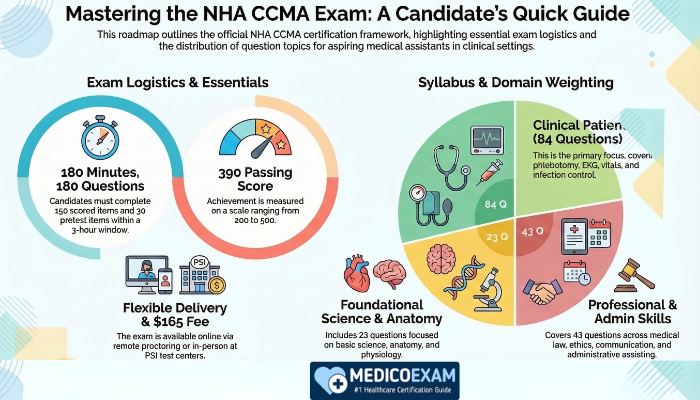
Practicing questions aligned with these domains prepares candidates for real-world clinical decision-making scenarios commonly included in the NHA CCMA practice test.
Healthcare employers value certification because it verifies standardized competencies. Research on allied health certification pathways also highlights that credentialed professionals often experience improved job opportunities and professional credibility.
For reference, the official certification details can be found at: NHA Certified Clinical Medical Assistant (CCMA)
Additionally, organizations like the American Medical Association and Centers for Disease Control and Prevention emphasize the importance of trained healthcare staff in clinical safety, infection control, and patient care protocols.
Practicing exam-style questions prepares candidates to apply this knowledge effectively.
20+ CCMA NHA Questions to Test Your Knowledge for the NHA CCMA Practice Test
The following CCMA NHA questions simulate common formats seen in the NHA medical assistant practice test.
These questions emphasize clinical knowledge, patient safety, administrative responsibilities, and communication skills.
✔ Clinical Patient Care Questions
1. Which vital sign measures the force exerted by blood against artery walls?
A. Respiratory rate
B. Blood pressure
C. Pulse oximetry
D. Temperature
Answer: B. Blood pressure
2. What is the correct order for drawing blood collection tubes?
A. Green, red, blue
B. Blue, red, lavender
C. Lavender, blue, red
D. Red, blue, lavender
Answer: B. Blue, red, lavender
3. Which instrument is used to measure oxygen saturation?
A. Spirometer
B. Pulse oximeter
C. Stethoscope
D. Thermometer
Answer: B. Pulse oximeter
4. When collecting a capillary blood specimen, the puncture site should be:
A. The center of the fingertip
B. The side of the fingertip
C. The nail bed
D. The knuckle
Answer: B. The side of the fingertip
5. A patient complains of dizziness during a blood draw. What should the medical assistant do first?
A. Continue the procedure
B. Remove the needle and assist the patient
C. Leave the room
D. Ignore the complaint
Answer: B. Remove the needle and assist the patient
✔ Infection Control Questions
6. What is the most effective method to prevent infection transmission?
A. Wearing gloves
B. Hand hygiene
C. Mask usage
D. Vaccination
Answer: B. Hand hygiene
7. Which type of isolation is required for airborne diseases like tuberculosis?
A. Contact isolation
B. Airborne isolation
C. Droplet isolation
D. Standard precautions
Answer: B. Airborne isolation
✔ Anatomy and Physiology Questions
8. Which organ is responsible for filtering blood and producing urine?
Answer: Kidneys
9. The heart’s upper chambers are called:
Answer: Atria
✔ Administrative and Communication Questions
10. HIPAA primarily protects:
A. Financial data
B. Patient health information
C. Staff schedules
D. Insurance claims
Answer: B. Patient health information
11. The term “stat” in medical terminology means:
Answer: Immediately
Additional CCMA Practice Questions
12. What blood component carries oxygen? – Red blood cells
13. Normal adult pulse range? – 60–100 bpm
14. Instrument used to measure blood pressure? – Sphygmomanometer
15. Medical term for high blood pressure? – Hypertension
16. What is PPE? – Personal Protective Equipment
17. Common injection site for intramuscular injection? – Deltoid muscle
18. Test measuring electrical activity of heart? – EKG
19 Normal body temperature? – 98.6°F (37°C)
20. Antiseptic used before injections? – Alcohol swab
21. Term for difficulty breathing? – Dyspnea
22. Normal respiratory rate in adults? – 12–20 breaths per minute
You can access more realistic sample CCMA questions through the MedicoExam practice materials.
These question banks simulate the format used in the NHA CCMA exam questions and answers PDF-style practice tests, helping candidates develop exam readiness.
Common Topics Covered in CCMA NHA Questions for the NHA Medical Assistant Certification
The CCMA NHA questions cover several competency domains reflecting real clinical tasks performed by medical assistants.
Below is a breakdown of major topics.
1. Clinical Patient Care (Largest Domain)
This domain accounts for the majority of exam questions.
Key topics include:
-
Patient intake and medical history
-
Vital signs measurement
-
Phlebotomy procedures
-
EKG monitoring
-
Infection control
-
Specimen handling
Clinical competence is essential because medical assistants frequently interact with patients during diagnostics and routine procedures.
Guidelines from the World Health Organization emphasize standardized infection control protocols that align with many CCMA exam questions.
2. Foundational Knowledge and Basic Science
Candidates must understand:
-
Medical terminology
-
Body systems
-
Basic pharmacology
-
Diagnostic procedures
Basic science knowledge ensures medical assistants can communicate effectively with physicians and nurses.
3. Patient Care Coordination
Medical assistants often coordinate patient care through:
-
Appointment scheduling
-
Patient education
-
Care documentation
-
Follow-up communication
Healthcare workforce studies published by organizations like the U.S. Bureau of Labor Statistics highlight the growing demand for certified medical assistants in clinical environments.
4. Administrative Responsibilities
Administrative knowledge includes:
-
Electronic health records
-
Medical billing basics
-
Insurance verification
-
Office workflow management
Understanding these topics ensures smooth clinic operations.
5. Medical Law and Ethics
Candidates must understand:
-
HIPAA regulations
-
Patient confidentiality
-
Legal scope of practice
-
Ethical conduct
Healthcare professionals are expected to follow strict privacy regulations to protect patient information.
For additional certification context, credential recognition can also be reviewed via: Certified Clinical Medical Assistant credential
How CCMA NHA Practice Tests Improve Your Chances of Passing the NHA CCMA Exam
Taking a NHA CCMA practice test is one of the most effective preparation strategies.
Practice tests replicate the real exam environment, allowing candidates to experience time pressure and realistic clinical scenarios.
Benefits include:
1. Familiarity With Exam Format
Many candidates fail simply because they misunderstand question wording. Practice tests expose you to common question patterns.
2. Identifying Weak Areas
Practice exams highlight knowledge gaps in:
-
Anatomy
-
Phlebotomy
-
Infection control
-
Administrative processes
3. Building Clinical Decision Skills
The exam includes scenario-based questions requiring judgment rather than memorization.
4. Reducing Test Anxiety
Practicing under timed conditions builds confidence before the actual exam.
5. Reinforcing Memory Through Repetition
Repeated exposure to exam questions strengthens retention.
For structured exam preparation resources, Visit the CCMA certification overview.
Educational institutions also confirm that certification practice tests significantly improve exam readiness for healthcare students.
Expert Study Tips to Master CCMA NHA Questions and Pass the NHA CCMA Certification
Preparation for the CCMA certification online exam requires both structured study and practical experience.
Below are proven strategies used by successful candidates.
1. Study the Exam Blueprint First
Begin by reviewing the exam domains and their weight.
Prioritize:
-
Clinical procedures
-
Infection control
-
Patient intake
These areas appear most frequently in CCMA NHA questions.
2. Use Practice Tests Strategically
-
Instead of memorizing answers, analyze why an answer is correct.
-
This builds clinical reasoning skills.
3. Simulate Real Testing Conditions
Take full-length practice exams:
-
180 questions
-
3-hour time limit
This prepares you for the pacing required on the actual NHA medical assistant exam.
4. Focus on Clinical Scenarios
The exam frequently presents patient case scenarios.
Example:
-
A patient fainting during phlebotomy requires immediate procedural response.
-
Understanding real-world protocols helps answer these questions accurately.
5. Create Visual Study Aids
Charts, diagrams, and flashcards help remember:
-
Medical terminology
-
Laboratory procedures
-
Infection control steps
6. Avoid Common MistakesCandidates often:
-
Misread patient scenarios
-
Forget infection control steps
-
Overlook patient safety considerations
Carefully reading each question prevents unnecessary errors.
FAQs
Q1. What are CCMA NHA questions?
-
CCMA NHA questions are exam-style practice questions designed to prepare candidates for the NHA Certified Clinical Medical Assistant exam. They cover clinical procedures, patient care, infection control, medical law, and administrative tasks to ensure candidates understand real-world responsibilities expected of certified medical assistants.
Q2. How difficult is the NHA CCMA exam?
-
The exam is considered moderately challenging because it evaluates both theoretical knowledge and clinical judgment. Candidates must apply patient care procedures, infection control protocols, and medical terminology. Proper preparation with practice tests and structured study plans typically improves success rates significantly.
Q3. How long should I study for the CCMA certification?
-
Preparation time varies depending on your healthcare background. Many candidates study for six to twelve weeks, especially if they are new to medical assisting. Those with clinical training or medical assistant coursework may require less preparation time.
Q4. Are CCMA NHA practice tests helpful?
-
Practice tests are extremely useful because they replicate exam conditions and help identify knowledge gaps. They also improve familiarity with exam wording and clinical scenarios, which reduces anxiety during the real certification exam.
Q5. Can I take the CCMA certification online?
-
Yes. The exam may be offered through remote proctoring or testing centers depending on eligibility and availability. Many training programs also arrange testing sessions through educational institutions or employer partnerships.
Q6. What score is required to pass the CCMA exam?
-
Candidates must achieve a scaled score of 390 or higher on a scale of 200–500. The exam includes scored and unscored questions, and only the scored items contribute to the final result.
Q7. What jobs can I get with a CCMA certification?
-
Certification can qualify individuals for roles such as clinical medical assistant, outpatient clinic assistant, physician office assistant, and healthcare support staff. Hospitals, urgent care centers, and private practices frequently prefer certified professionals.
Q8. How often can I retake the CCMA exam?
-
Retake policies typically allow candidates to attempt the exam again after a waiting period. Specific conditions may depend on testing policies, administrative rules, and eligibility guidelines provided by the certification authority.
Q9. Do CCMA certifications expire?
-
Yes, healthcare certifications often require renewal or continuing education to remain valid. Renewal timelines and continuing education requirements vary depending on the credentialing organization.
Q10. Is the CCMA certification worth it?
-
For many healthcare professionals, the certification improves employability, validates clinical skills, and demonstrates commitment to professional standards. Employers often prefer certified candidates because they have proven knowledge of healthcare procedures and patient safety practices.
Conclusion
Success in the NHA Certified Clinical Medical Assistant exam requires more than memorization. It demands practical knowledge, clinical awareness, and familiarity with real exam scenarios.
Practicing CCMA NHA questions is one of the most effective ways to prepare for the certification. These questions reinforce clinical knowledge, sharpen decision-making skills, and help candidates navigate the exam format confidently.
For healthcare professionals, students, and career changers entering the medical field, earning the CCMA certification can open the door to rewarding career opportunities in clinics, hospitals, and healthcare organizations worldwide.
With structured preparation, realistic practice tests, and focused study strategies, passing the NHA CCMA exam becomes an achievable goal.
- NHA Clinical Medical Assistant Practice Test |
- NHA CCMA Question Bank |
- NHA CCMA Eligibility & Requirements |
- NHA CCMA Exam Cost |
- NHA CCMA Registration Process |
- NHA Clinical Medical Assistant Study Guide |
- NHA CCMA Recertification |
- NHA CCMA Certification Overview |
- NHA Clinical Medical Assistant Syllabus |
- NHA CCMA Preparation Time |
- NHA CCMA Passing Score |
- NHA CCMA Exam Format |
- NHA Clinical Medical Assistant Sample Questions |
- NHA CCMA Career Opportunities |
- NHA CCMA Exam Difficulty


