
How to Pass the RCCS Exam: A Study Plan Built on Its Weightings
Candidates for the CCI Registered Congenital Cardiac Sonographer (RCCS) face 170 questions in three hours, and a result of 650 on a 0-900 scale earns the credential. Two topic areas, disease-specific examinations and cardiac image acquisition, hold 84% of the content. That lopsided split should decide how you spend every study hour.
Want a baseline first? Take the RCCS practice test before reading further, and save your score. The sections below show you how to interpret it.
Who is the RCCS credential written for?
Hearts with congenital differences are scanned in infancy, in childhood and, increasingly, in adult life, often after one or more repairs. A sonographer who does this work has to capture images that show the anatomy clearly enough for the cardiology team to reason from them. RCCS is the credential that recognises that specialty. It is awarded by Cardiovascular Credentialing International (CCI).
CCI's own wording says the examination is for professionals in pediatric and adult congenital cardiac ultrasound. That statement sits on the RCCS page at CCI, the place to check qualification routes, fees and anything else that may have changed since this article was written.
Candidates typically work in pediatric cardiology and echocardiography laboratories, adult congenital heart disease programs, hospitals and outpatient cardiac imaging settings. The syllabus summary published on this site lists congenital cardiac sonographers, general cardiac sonographers, echocardiography professionals and cardiovascular ultrasound professionals as the intended candidates.
A note on scope: this page prepares you for an exam. It does not teach scanning technique to use on patients, and it offers no diagnostic or treatment guidance. What it does is explain what the exam rewards, so you can study the right material in the right order.
How is the RCCS exam built: length, timing and passing mark?
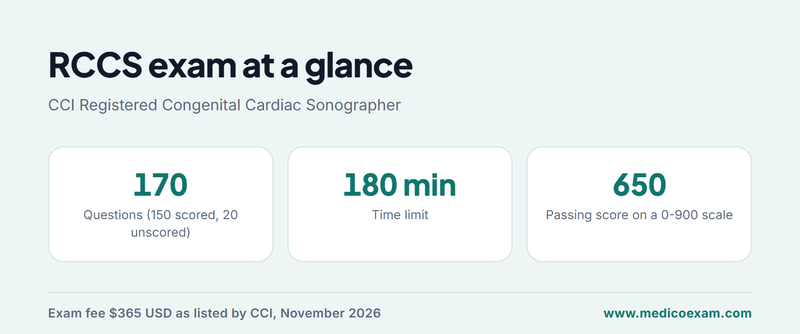
You face 170 questions with 180 minutes on the clock. Only 150 of those count toward your result; the other 20 are unscored trial items, and the screen gives no hint which they are. Treat every question as scored. The passing mark is 650 on a 0-900 scale, which the source sheet describes as approximately 72%.
| Feature | What to know |
|---|---|
| Awarded by | Cardiovascular Credentialing International (CCI) |
| Questions | 170 (150 scored and 20 unscored) |
| Time limit | 180 minutes (three hours) |
| Passing score | 650 out of a possible 900 (approx. 72%) |
| Exam fee | $365 USD (CCI page, November 2026) |
| Delivery | On a computer at a Pearson Professional Center |
Use the table as a quick reference and confirm each entry with CCI before you book. Be careful with the percentage: a scaled score is not a raw count of correct answers, so 72% describes roughly how large 650 is rather than a threshold you can calculate. The safer target is to score well clear of it in practice.
Pacing works out to just over one minute for each question. Short recognition items will take less than that and scenario-style items more. A timed practice paper shows you which kind slows you down, and that is far better learned at home than in the test centre.
What are the five RCCS content areas and their weights?
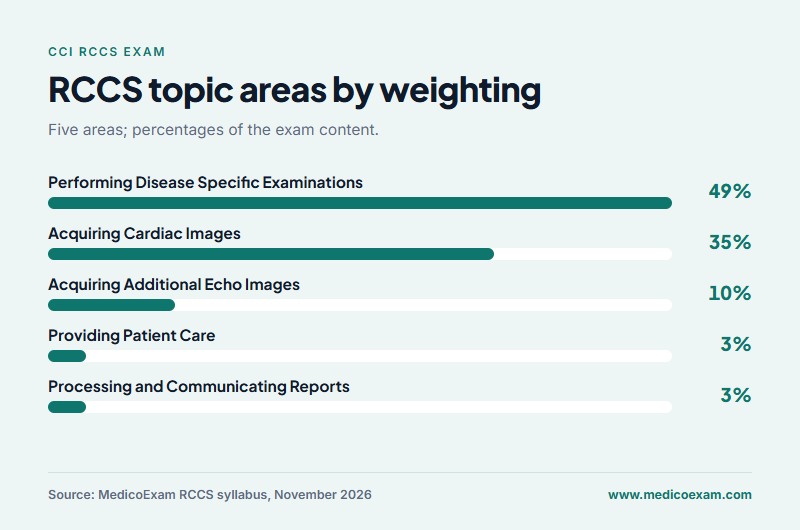
The syllabus page on this site divides the exam into five areas whose weights total 100%. Notice how unevenly they are spread.
| Topic area | Weighting |
|---|---|
| Performing Disease Specific Examinations | 49% |
| Acquiring Cardiac Images | 35% |
| Acquiring Additional Echocardiographic Images | 10% |
| Providing Patient Care | 3% |
| Processing and Communicating Preliminary Reports | 3% |
Performing Disease Specific Examinations (49%). Nearly half the exam sits here. Listed skills are adapting the patient examination, identifying cardiac lesions and obtaining post-surgical or interventional images, such as after repair or palliation of congenital heart disease or after a catheter intervention. In short, the exam checks that you can change your approach when the anatomy or the surgical history calls for it.
Acquiring Cardiac Images (35%). The standard acoustic windows appear by name: subcostal, left parasternal, apical, suprasternal and right parasternal. Optimizing images and applying ultrasound physics are in the same list, so expect questions about why an image looks the way it does as well as how to obtain it.
Acquiring Additional Echocardiographic Images (10%). This group collects the special studies: assisting with transesophageal echo, stress echo, ultrasound enhanced agent echo, agitated saline echo, 3D echo and strain imaging, plus assisting with structural heart procedures in settings such as the cath lab. Each has its own purpose and its own preparation steps.
Providing Patient Care (3%). Here you find triaging orders, checking the indications and appropriateness of a request, reviewing history and carrying out pre-procedural activities.
Processing and Communicating Preliminary Reports (3%). This covers calculations and post-processing analysis, communicating critical results, and the follow-up conversation that summarises findings after the examination.
The verbs in the topic list are worth reading closely. Acquire, optimize, adapt, identify, assist, perform and communicate all describe actions, not definitions. Revise accordingly: for each bullet, ask yourself when you would do it, what you would look for, and what might be mistaken for it.
Notice also that the areas follow the order of a real study. An order arrives and is judged appropriate; images are collected from the standard windows; the examination bends around a particular lesion or repair; extra techniques are added where needed; and measurements are turned into a message for the team. Questions frequently straddle two areas, for instance when poor image quality could hide a lesion. Revising the areas as one chain gives you a better chance with those.
Why should 84% of your preparation go to just two areas?
Add 49% and 35% and you reach 84%. Between them, those two areas carry most of your result. A candidate who is secure on lesion identification, adaptation, repaired anatomy and the standard windows has room to be shaky on the small areas, while the reverse is not true.
An even split of study time across five headings therefore feels fair but works badly. Weighted planning is better: the largest block for disease-specific examinations, the second largest for image acquisition, a modest block for additional techniques, and the leftover for patient care and reporting, which are 3% each.
Inside the disease-specific area, cluster the material by purpose instead of memorising a flat list. One cluster is adaptation: altering the approach to suit the patient and the question being asked. A second is lesion recognition, where the useful habit is knowing how each lesion presents from each window. A third is the post-surgical and interventional cluster, which depends on understanding what a repair or a procedure has altered. Thinking in clusters makes a long syllabus manageable.
For image acquisition, tie each window to what it displays best, to the adjustments that sharpen it, and to the signs of a poor version. Add ultrasound physics to that routine, because many image problems have a physical cause, and the exam expects you to name it.
What study sequence suits the RCCS?
Start with a single timed paper and score it by area, not just overall. A low area score points to a topic gap more precisely than a total can. Then follow the sequence below and shorten or extend each stage according to your own results.
- Physics and image optimization. Be able to explain what governs image quality and how you would fix a weak picture. Later topics build on this.
- Standard windows. Learn what the subcostal, left parasternal, apical, suprasternal and right parasternal views are used to show.
- Cardiac lesions. Review each lesion in the syllabus and how it appears across windows.
- Adapting the examination. Practise judging how the study should change with the patient and the clinical question.
- Post-surgical and interventional imaging. Learn what repair, palliation and catheter-based procedures change, and what a follow-up study must demonstrate.
- Additional techniques. Cover transesophageal assistance, stress echo, enhanced agent and agitated saline studies, 3D, strain and structural procedures.
- Patient care and reporting. Review triage, indications, history, calculations and communicating critical results.
- Full timed papers. Close with mixed papers that span all five areas.
Questions are the engine of this plan. A textbook chapter gives you vocabulary; applying it to unfamiliar items is what builds exam speed. Frequent short sessions beat the occasional marathon, since memory strengthens when review is spread out.
To see the weighting in action, imagine dividing your preparation into the exam's own proportions: roughly half for disease-specific examinations, a little over a third for image acquisition, a tenth for additional techniques, and the remainder for the two 3% areas. If your first paper shows triage and communication are already comfortable, shift that time to the repaired-anatomy and lesion topics where your notes show the most errors.
The last week is for rehearsal and rest. Resist new material; sit timed papers, reread your log of errors and sleep well. Topics learned at the last minute tend to blur with topics you knew well, which costs marks.
What does the RCCS cost, and how does scheduling work?
CCI lists the RCCS fee at $365 USD as of November 2026. Its page adds that part of every exam fee is non-refundable because it pays for staff time spent reviewing and processing applications, so a withdrawal will not return the full amount. Because fees can be revised, read CCI's page again just before paying.
Testing is computer-based at Pearson Professional Centers, available year-round according to each center's capacity. The syllabus summary on this site says you must sit within a 90-day eligibility window that opens once your application is approved and your authorization to test is issued. Apply only when your preparation can realistically use that window, and reserve your seat early in it, since popular times can fill up.
CCI also hosts a Qualification Pathway tool. It asks whether you are enrolled in, or have graduated from, a programmatically accredited program in adult congenital or pediatric cardiac ultrasound, then points you to the pathway that fits. Try it, or read the qualification requirements, before you apply. CCI alone decides eligibility.
Which study materials are worth your time?
The syllabus summary here names several references: the publications and guidelines of the American Society of Echocardiography, A Sonographer's Guide to Assessment of Heart Disease, Feigenbaum's Echocardiography, Sonography Principles and Instruments, The Echo Manual and the Textbook of Clinical Echocardiography. Pick one or two you find readable instead of attempting the whole shelf; their job is to supply vocabulary and reasoning for the lesion and image areas.
Books explain; practice questions train. Start with the RCCS sample questions to learn how items are worded, and move to the full practice test once you want timed work. After each miss, ask what you overlooked, and write it down so you can review the list before the next session.
Stay away from any provider claiming to sell recalled or leaked questions. Honest preparation uses original practice items that build the skill. Recalled content violates testing rules and cannot prepare you for the form you will sit.
Your error log is the most valuable document you will produce. Record the area, the topic and the exact distinction you missed. Within a week, repeated entries reveal where to focus, and a short list of repeated errors is easy to repair, whereas scattered errors suggest you need wider practice.
How should you approach a long scenario question on the RCCS?
Scenario items describe a situation and ask what you would do or expect. Begin with the closing sentence, which tells you what is being asked, and then read the scenario with that question in mind. Many candidates lose time by absorbing every detail before they know which details matter.
Next, name the area the question belongs to. If it concerns a repaired heart, you are in the disease-specific area, and your knowledge of what a repair alters should guide the answer. If it concerns a poor image, you are in image acquisition, and physics or window choice is probably the key. If it asks about an extra study, think about the purpose of that technique and what it needs to show. Labelling the area narrows the field before you look at the options.
Then eliminate. Options that contradict the scenario, that solve a different problem or that would never suit the patient described can usually be removed quickly. When two options remain, return to the final sentence and ask which one answers it more directly. Avoid changing an answer unless you can state a concrete reason, because second-guessing without a reason lowers more scores than it raises.
Practise this routine on every item in your mock papers until it is automatic. Over time you will find that the routine also protects your pace, since it stops you from rereading a long stem three times. If a question still resists after a sensible attempt, make your best choice, flag it if the software allows, and move on; there will be time to return if the clock permits.
Finally, treat your wrong answers as data. If most of your errors on scenario items come from misreading the question rather than from missing knowledge, you need more practice with the routine, not more reading. If they come from missing knowledge, the error log will show which topic to revise. Telling these two causes apart makes every practice paper more useful than the score alone.
What mistakes cost RCCS candidates marks?
Giving each area equal time. The weights are unequal by design. Spending as long on a 3% area as on the 49% area leaves you thin where it matters.
Memorising pictures. A view or a lesion rarely looks identical to the one in your notes. Learn the defining principles and apply them to each new description.
Leaving physics until last. It lives inside image acquisition, yet it explains image problems that surface in other areas too, so weak physics leaks marks in several places.
Skipping the additional techniques. Stress, enhanced agent, agitated saline, 3D and strain studies make up a tenth of the exam. Those items tend to be readable, and a little revision wins them.
Practising untimed. With just over a minute per item, there is time to think but not to wander. Untimed practice hides how long scenario questions really take.
Hunting for the unscored items. Twenty questions do not count, but you cannot tell which, so searching for them only burns minutes. Answer everything as though it counts.
How do you know you are ready to sit the RCCS?
Replace gut feeling with three checks. Your timed scores should stay clearly above the 72% guide over several full papers, not on a single lucky day. Your results in the disease-specific and image acquisition areas should be your best or close to it, as together they are worth 84%. And your mistakes should look random; if one topic keeps recurring in the error log, you are not ready on that topic whatever the total says.
Once all three agree, book the seat and spend the remaining days on light review. The evening before, confirm your appointment time, your identification and your route, then rest. A calm, rehearsed routine counts for a lot on the day.
For a realistic rehearsal, repeat the practice test against the clock, compare each area's score with the weights above, and let the weakest areas set your next week. Check qualification routes, the current fee and scheduling rules on the CCI website before applying.
Frequently Asked Questions
How many questions are on the RCCS exam?
The paper holds 170 questions to be finished in 180 minutes. 150 of them are scored and 20 are unscored trial items. That allows just over a minute each, a pace worth rehearsing with a timer.
What is the RCCS passing score?
The pass mark is 650 on a scale running from 0 to 900, approximately 72% according to our exam data. A scaled result is not a simple count of correct answers, so aim to land well above that level in timed practice.
What topics does the RCCS exam cover?
Two areas dominate: disease-specific examinations at 49% and cardiac image acquisition at 35%. Three smaller ones cover additional echo techniques (10%), patient care (3%) and preliminary reports (3%). Verify the outline with CCI in case it changes.
How much does the RCCS exam cost?
CCI's November 2026 price for the RCCS is $365 USD. Part of that is non-refundable, as it covers application review, and CCI may revise the amount, so recheck its page before paying.
Where do you take the RCCS exam?
It is a computer-based test delivered at Pearson Professional Centers, with seats offered all year depending on each center. Once CCI approves your application and issues authorization to test, you book inside a 90-day window.
Which RCCS area should you study first?
Begin with ultrasound physics and image optimization. After that, put the bulk of your hours into disease-specific examinations (49%) and image acquisition (35%), then cover the smaller areas and end with timed mixed papers.
- CCI RCCS Eligibility & Requirements |
- CCI RCCS Registration Process |
- CCI Registered Congenital Cardiac Sonographer Study Guide |
- CCI RCCS Certification Overview |
- CCI Registered Congenital Cardiac Sonographer Syllabus |
- CCI RCCS Preparation Time |
- CCI RCCS Passing Score |
- CCI RCCS Exam Format |
- CCI RCCS Certification Practice Exam |
- CCI RCCS Exam Sample Questions


