
Can You Sit the CCHP-MH Exam? Eligibility, Weights, Prep
The NCCHC Certified Correctional Health Professional - Mental Health (CCHP-MH) exam has 80 to 100 multiple-choice questions in 120 minutes, and our exam data lists a 65% pass mark. You must already hold a current CCHP to apply. Content is weighted, with patient care and specialized services each worth 15% to 20%.
Wondering how ready you are right now? Take the CCHP-MH practice test before you read further and note your score for each content area. Every section that follows is organised around what that first result reveals.
Who is eligible to sit the CCHP-MH exam?
Eligibility is the first hurdle, and it is stricter than for many certification exams. The National Commission on Correctional Health Care (NCCHC) says the specialty certification is open to qualified mental health professionals as its Standards for Mental Health Services in Correctional Facilities define them: psychiatrists, psychologists, clinical social workers, licensed professional counselors, psychiatric nurse practitioners, psychiatric nurses and other professionals legally authorized by education, credentials and experience to assess and treat mental health needs.
Having the right job title is not enough. Before you submit an application, NCCHC's candidate handbook says you must have all four of the following.
- A current CCHP certification, the general credential that the mental health specialty builds upon.
- A graduate-level degree, meaning a master's or above.
- A current, active, full and unrestricted licence or registration from a US state, the District of Columbia, Puerto Rico, a US territory or Canada.
- The equivalent of three years of full-time practice in a correctional environment.
The application itself asks for a copy of your professional licence (or proof you are eligible for one, such as a diploma, where the law of your state does not require a licence), a resume or CV, and the completed form with the fee. NCCHC confirms candidacy in writing once the application, supporting papers and exam fee have been received and approved. Application fees are not refundable, so confirm every requirement on the page and handbook linked below before paying.
This ordering has a practical consequence. If you do not hold the CCHP yet, your first exam is that one, and the specialty comes afterwards. Our practice test is built for people who are already at the specialty stage, so use it once the foundation credential is in place. For a wider view of the mental health route, see this toolkit for correctional mental health certification. For the final word on who qualifies, read NCCHC's CCHP-MH page and the candidate handbook, because the eligibility rules, the fee and the deadlines are theirs to change.
How is the CCHP-MH exam timed, structured and scored?
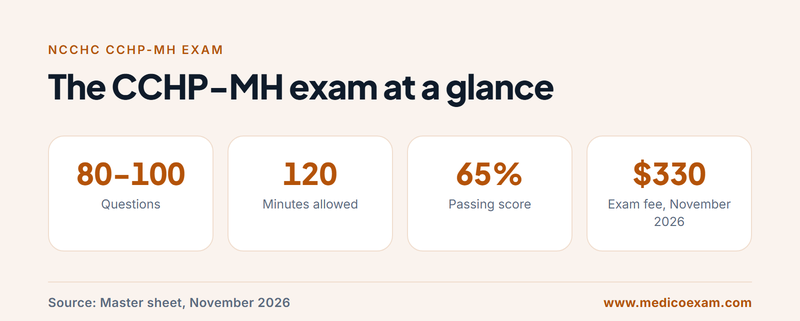
The proctored, written examination is made up of 80 to 100 multiple-choice, objective questions, and candidates have two hours to finish. Our exam data records the result as pass or fail, with a pass mark of 65%. NCCHC reports only the outcome to the candidate, not a numeric score, so you will not receive a breakdown of how you did in each area.
| Feature | What to know |
|---|---|
| Credentialing body | National Commission on Correctional Health Care (NCCHC) |
| Question count | 80 to 100 multiple-choice questions |
| Allowed time | Two hours, which is 120 minutes |
| Pass mark | Pass or fail, at 65% according to our exam data |
| Fee | $330 USD as of November 2026 |
| Prerequisite | A current CCHP, plus the other requirements listed earlier |
Do the arithmetic before exam day. Two hours over 100 questions gives 72 seconds per question; over 80 questions it gives 90 seconds. Treat those as averages only, since a short factual item will take far less and a scenario with several plausible options will take more. A pass mark of 65% corresponds to about 52 correct answers on an 80-question paper and 65 on a 100-question paper. Because the question count varies, aim for practice scores that clear 65% comfortably, not ones that hover on it.
One rule works in your favour. NCCHC states that there is no penalty for incorrect answers and that a candidate should choose the single best answer to each item. Leave nothing blank. If you mark more than one response to the same question, no credit is given for that question, so decide on one answer before you move on.
Think carefully about the words "single best answer". Several options will often sound reasonable to an experienced clinician. The task is to pick the one that matches nationally recognised correctional standards and guidelines, not the one you would choose in your own facility on a quiet day. The handbook says the purpose of the exam is to assess knowledge and application of those nationally recognised standards, including legal principles, ethical obligations and the professional role of the mental health provider inside a correctional setting.
How is the CCHP-MH content split across its eight areas?
NCCHC publishes a content outline whose major areas are weighted according to an established test plan. The version in its handbook applies to the exam effective April 1, 2026, and is based on the 2026 NCCHC Standards for Mental Health Services in Correctional Facilities and other reference materials. Each area is given as a range, not a single figure.
| Content area | Weighting |
|---|---|
| Governance and administration | 10%-15% |
| Health promotion, safety, and disease prevention | 10%-15% |
| Personnel and training | 7%-12% |
| Ancillary health care services | 5%-10% |
| Patient care and treatment | 15%-20% |
| Specialized patient services | 15%-20% |
| Medical-legal issues | 10%-15% |
| Current trends in treatment and evidence-based practice | 5%-10% |
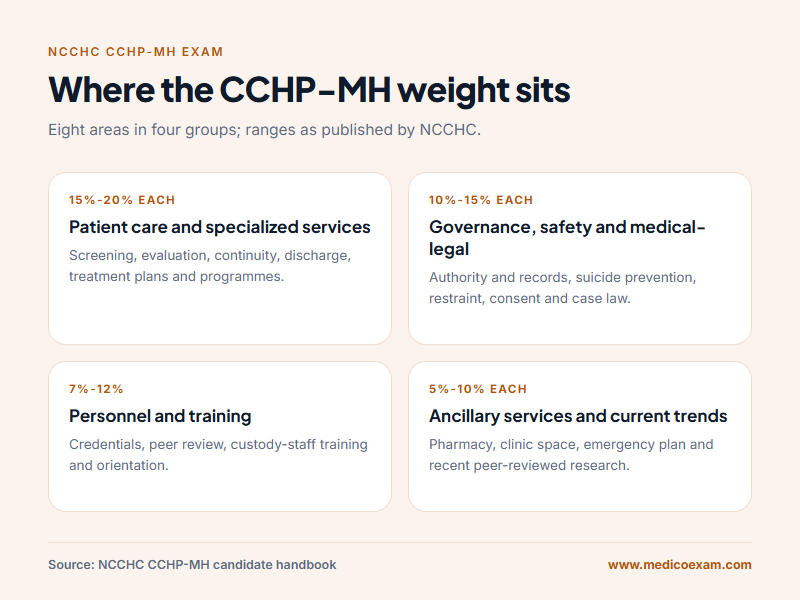
Governance and administration (10%-15%). This area covers how a mental health service is run: access to care, the responsible mental health authority and designated staff, clinical autonomy, administrative meetings and reports, policies and procedures, a continuous quality improvement programme, confidentiality and privacy, health records, the procedure after a death and the grievance process for mental health complaints.
Health promotion, safety, and disease prevention (10%-15%). Listed topics are healthy lifestyle promotion, infection prevention and control, suicide prevention and intervention, communication about patients' mental health needs, patient safety and staff safety.
Personnel and training (7%-12%). Expect credentials, clinical peer review and competency assessment, staff professional development, mental health training for custody staff, medication administration training, incarcerated workers in mental health services, staffing, the mental health liaison and orientation for new mental health staff.
Ancillary health care services (5%-10%). The smallest area names pharmaceutical operations, medication administration services, clinic space, equipment and supplies, on-site diagnostic services, the emergency services and response plan, and inpatient psychiatric and specialty care.
Patient care and treatment (15%-20%). One of the two heaviest areas follows the patient through the system: information about mental health services, receiving screening, transfer screening, the initial mental health screening and evaluation, non-emergent requests and services, continuity, coordination and quality of care during incarceration, and discharge planning.
Specialized patient services (15%-20%). This area lists treatment plans, mental health services and programmes, services for substance use disorder, the response to sexual assault and abuse, care of the pregnant and postpartum patient, mental health residential units and behavioural consultation.
Medical-legal issues (10%-15%). Topics include restraint and seclusion, restrictive housing, emergency psychotropic medication, the therapeutic relationship, forensic information and disciplinary actions, informed consent and the right to refuse, medical and other research, executions, and seminal legal cases and legal principles.
Current trends in treatment and evidence-based practice (5%-10%). NCCHC describes this area as published peer-reviewed journal articles, from within the past five years, covering evidence-based practice in the areas named in the rest of the outline. It is the least predictable part of the paper, because it depends on what has been published recently.
Notice what the outline is built from. Almost every heading is a topic from NCCHC's own standards for mental health services. The exam therefore rewards candidates who know what the standards expect of a service, not only how to treat an individual patient. That is a different kind of preparation from clinical training, and it is the reason experienced clinicians sometimes underestimate the paper.
Which areas deserve the largest share of study hours?
Add up the published ranges and a pattern appears. Patient care and treatment plus specialized patient services together account for 30% to 40% of the content. Add governance, safety and medical-legal issues, each at 10%-15%, and five areas carry most of the paper. Personnel and training, ancillary services and current trends are the smaller three, and between them they range from 17% to 32%.
Equal time for eight headings feels fair but works against you. Give the largest share of hours to the two 15%-20% areas, then spread the rest according to weight. The small areas still matter, because a range such as 5%-10% still means a meaningful handful of questions, but they reward short, targeted review more than long study blocks.
Within each area, sort topics by the question they answer. For patient care and treatment, the question is "what happens at each point of contact?": receiving screening, transfer screening, the initial evaluation, requests for care, continuity and discharge. Learn it as a sequence along a patient's path and each item has a place. For governance, the question is "who is responsible and how do we know the service works?": the authority, the policies, the quality programme, the records and the complaints route.
For specialized patient services, the question is "which programme or setting does this population need?", and the list moves from the treatment plan outwards to programmes, substance use services, responses to abuse, pregnancy and postpartum care, residential units and consultation. Medical-legal issues are best studied as pairs of a practice and its safeguard: restraint and seclusion, restrictive housing and emergency medication each come with conditions the standards attach, and consent and the right to refuse sit beside them.
How do legal and ethical topics appear on the paper?
The medical-legal area carries 10%-15% of the content, and the handbook names "seminal legal cases, legal principles" in its outline. NCCHC also lists an Exam Resource Guide on legal cases among its recommended study materials, which tells you the exam expects familiarity with specific court decisions and the principles they set out, not only with general ideas about rights.
Study this area as an exam topic, not as legal advice. The aim is to recognise which principle a question is testing: the duty of the clinician in a therapeutic relationship, the limits on sharing forensic information, the need for informed consent and the right to refuse, or the conditions under which emergency psychotropic medication is addressed in the standards. Write each case or principle on a card with one line on what it established and one line on how a mental health professional is expected to act.
Ethics questions often turn on role clarity. The outline places the therapeutic relationship, forensic information and disciplinary actions together for a reason: a mental health professional in a correctional facility works alongside custody staff, but the clinical role is distinct from the security role. When two answers both sound caring, prefer the one that protects that boundary and follows the standards. That reading habit alone can turn several guesses into confident answers.
Suicide prevention and intervention appears in the safety area and is worth particular attention because it links several headings. Receiving screening, the initial evaluation, communication about patients' needs, staff training and the response plan all touch it. Treat it as a thread running across the outline and revise it from each angle in turn.
How do you apply, book and sit the exam?
Start with the application, then book. Once NCCHC approves your application, you must take the exam within six months of the approval date. Incomplete applications are kept on file for three months; after that a new application and fees are needed. Examinations are offered throughout the year, including at NCCHC conferences, at partner sites, at Prometric test centres and online.
NCCHC conference and partner-site candidates receive an admission notice with the site address, and they need it together with a valid state photo ID or driver's licence to gain admission. Those arriving late may be admitted but are not given extra time. Test-centre and online candidates follow the Prometric instructions given at registration. Online exams use live remote proctors, require internet access, a laptop or PC and a web camera, and begin with a system test.
The rules inside the room are strict. No phones, pagers, alarms or similar devices may be operating, handheld computers are prohibited, and no books, reference materials or study aids of any kind are allowed. Anyone using such a device is dismissed and disqualified. If you need special accommodations under the Americans with Disabilities Act, NCCHC asks for a written request at least 90 days before the exam date.
Results are graded electronically and sent by email within two weeks, as a pass or fail only. If you do not pass on the first attempt, you may retake the exam two additional times within one year of the application approval date. Cancelling or rescheduling less than 5 days before the exam makes you responsible for the full re-registration fee, and Prometric applies its own reduced fees for changes made earlier. NCCHC may publish a list of passing candidates but does not refer to people who defer or do not pass.
Plan backwards from your preferred date. Your application approval starts a six-month clock and your retake allowance runs for a year from the same date, so booking too early without preparing wastes part of that window, while leaving it late narrows your options if a retake is needed.
In what order should you study the CCHP-MH material?
Begin with a timed baseline paper and record your result for each of the eight areas. A score by area exposes a gap more precisely than a single total. The sequence that follows then gets more or fewer hours at each step, depending on what that baseline shows.
- Read the standards for the heavy areas first. NCCHC's Standards for Mental Health Services in Correctional Facilities are the first item on its recommended list. Work through the sections behind patient care and treatment, and specialized patient services.
- Add the legal cases. Use the Exam Resource Guide for medical-legal issues and make the principle cards described above.
- Cover governance, safety and personnel. These are policy-style topics, so learn who does what and which records, meetings and reviews the standards expect.
- Scan the recent literature. Skim peer-reviewed articles from the past five years in the areas the outline names, taking one-line notes on each.
- Finish with full timed papers. Sit complete papers at 72 seconds per question, review every wrong answer against the standard, and let your weakest area choose the next session.
The handbook also lists the juvenile standards and the jail and prison standards among its recommended materials, along with NCCHC position statements, tools and guidance. It says the outline's study topics cover adult and adolescent populations, so do not neglect questions framed around young people in detention or confinement. The more familiar a setting is to you, the more likely you are to assume it, so read those sections even if you rarely work there.
Keep a short list of "standard says" statements in your own words. Writing what a standard requires, not what you do in practice, trains the habit the exam tests. When your facility's local practice differs from a standard, mark the difference and remember that the exam follows the standard.
Which mistakes cost candidates marks?
The first mistake is answering from local habit. Every facility has workarounds, and your daily practice may differ from what the standards describe. The exam asks about the standards, so a familiar routine can mislead you.
The second is skipping the legal material because it feels like a topic for lawyers. Ten to fifteen percent of the content is a lot to leave to chance, and the principle cards take far less time than they appear to.
The third is treating the smallest areas as optional. Ancillary services at 5%-10% and current trends at 5%-10% will not decide the result alone, but together they make up a real share of the paper, and short revision blocks win marks there cheaply.
The fourth is poor pacing. A 100-question paper gives 72 seconds per item on average. If a scenario question consumes three minutes, you are borrowing from the rest. Practise moving on and returning, and remember that a blank earns nothing while a guess costs nothing.
Finally, rehearse the logistics. Know whether you are sitting at a conference site, a Prometric centre or online, carry the right identification, and complete the system test if you are testing remotely. A calm, practised routine protects the preparation you have done.
In the last week, sit one more full paper against the clock, line up each area's result next to the weights, and let the weakest area decide your final sessions. Before applying, confirm eligibility, the current fee and the booking rules with NCCHC directly.
Frequently Asked Questions
How long is the CCHP-MH exam, and how many questions does it have?
The paper has 80 to 100 multiple-choice questions and you have two hours, which is 120 minutes. That averages 72 to 90 seconds per question depending on the count. There is no penalty for a wrong answer, so answer every item and choose a single best option.
What is the CCHP-MH passing score?
Our exam data lists pass or fail at 65%. NCCHC reports only a pass or fail to the candidate, not a numeric score. On a paper of 80 questions that is about 52 correct answers, and on 100 questions about 65, so practise well above that line.
Who can take the CCHP-MH exam?
Qualified mental health professionals who already hold a current CCHP, a graduate-level degree, an active unrestricted licence or registration and the equivalent of three years of full-time correctional practice. NCCHC approves each application before you can book, so check its handbook for the current rules.
What topics does the CCHP-MH exam cover?
Eight weighted areas: patient care and treatment (15%-20%), specialized patient services (15%-20%), governance and administration, health promotion and safety, and medical-legal issues (each 10%-15%), personnel and training (7%-12%), and ancillary services and current trends (each 5%-10%).
How much does the CCHP-MH exam cost?
Our exam data lists $330 USD as of November 2026. NCCHC says application fees are not refundable, and fees can change, so look at NCCHC's CCHP-MH page again immediately before you pay.
Can you retake the CCHP-MH exam if you fail?
Yes. NCCHC allows two additional attempts within one year of the application approval date. The exam must first be taken within six months of approval. Cancelling or rescheduling less than 5 days before the exam means paying the full re-registration fee.
Where do you take the CCHP-MH exam?
NCCHC offers it at its conferences and partner sites, at Prometric test centres and online with a live remote proctor. Online candidates need a laptop or PC, a web camera and internet access, and must complete a system test first. Results arrive by email within two weeks.
- NCCHC CCHP-MH Eligibility & Requirements |
- NCCHC CCHP-MH Registration Process |
- NCCHC Correctional Health Professional - Mental Health Study Guide |
- NCCHC CCHP-MH Certification Overview |
- NCCHC Correctional Health Professional - Mental Health Syllabus |
- NCCHC CCHP-MH Preparation Time |
- NCCHC CCHP-MH Passing Score |
- NCCHC CCHP-MH Exam Format |
- NCCHC CCHP-MH Certification Practice Exam |
- NCCHC CCHP-MH Exam Sample Questions


