
Stop Studying EP Evenly: What the RCES Exam Really Rewards
Sitting the CCI Registered Cardiac Electrophysiology Specialist (RCES) means 170 questions in three hours, with 650 on a 0-900 scale as the line you must reach. The content is not spread evenly: work during the procedure accounts for 36% and diagnostic work for 26%. Plan your revision around those proportions.
Curious where you stand today? Try the RCES practice test cold and keep the score for each area. Everything below explains how to turn that first result into a schedule.

Is the RCES meant for you?
Picture the electrophysiology laboratory mid-case: a patient on the table, catheters in place, signals scrolling across several screens, a stimulator delivering paced beats, and a team that must keep everything sterile and safe. The RCES recognises people who operate that environment beside the physician. Cardiovascular Credentialing International (CCI) is the body that grants it.
CCI says the examination is for professionals working in electrophysiology. You will find that statement on CCI's RCES page, which remains the authority on qualification routes, fees and policy changes made after this article went live.
Our syllabus summary names cardiovascular technologists, cardiac electrophysiology professionals and allied health professionals as the target audience, working in electrophysiology laboratories, cardiac device and implant services or hospital cardiovascular services. If recording systems, mapping, device checks or ablation support are part of your routine, much of the exam language will feel familiar.
One boundary matters. This guide is exam preparation. It does not instruct anyone how to carry out a procedure on a patient and it contains no diagnostic or treatment advice. Its purpose is narrower: to show what the test rewards so your study hours are well spent.
What are the RCES exam format, time limit and pass mark?
The paper has 170 questions and a 180-minute limit. Scoring uses 150 of them; the remaining 20 are unscored trial questions mixed in with the rest, and the software does not mark them. Because you cannot tell them apart, give each one full effort. A result of 650 on the 0-900 scale earns a pass, and our exam data puts that at approximately 72%.
| Feature | What to know |
|---|---|
| Credentialing body | Cardiovascular Credentialing International (CCI) |
| Question count | 170 in total; 150 are scored, 20 are not |
| Allowed time | Three hours, which is 180 minutes |
| Pass mark | 650 out of 900, roughly 72 percent |
| Fee | $365 USD according to CCI in November 2026 |
| Where it is taken | At a Pearson Professional Center, on a computer |
Treat this table as a summary and check each line against CCI before booking. The percentage deserves a warning: scaled scoring converts your raw performance onto a different scale, so you cannot count correct answers and compare the tally with 72%. Practise until your results sit clearly above that mark rather than hovering on it.
The clock gives you roughly 64 seconds per item. Quick recall questions will use less, and longer case-style items will use more, so that average is only a guide. Sitting a full paper against a timer is the surest way to learn which kind of question eats your minutes.
How is the RCES content split across its five areas?
The syllabus on this site lists five areas, together worth 100%. They run in the order of a case: preparation, the procedure itself, diagnostics, therapy and aftercare.
| Topic area | Weighting |
|---|---|
| Conducting Pre-Procedural Activities | 9% |
| Conducting Intra-Procedural Activities | 36% |
| Performing Diagnostic Procedures | 26% |
| Assisting with Therapeutic Procedures | 21% |
| Conducting Post-Procedural Activities | 8% |
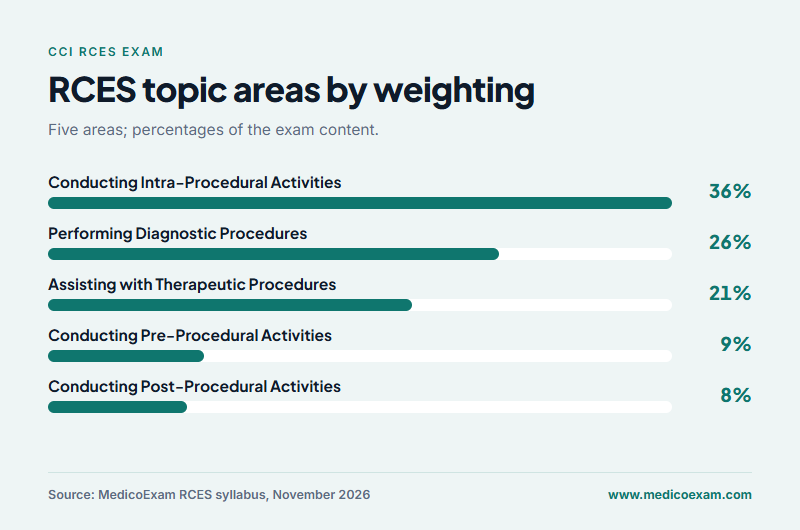
Pre-Procedural Activities (9%). Expect room preparation (equipment, radiation safety, sterile supplies), checking patient and procedure details such as results, orders, consent, allergies and the universal time-out, plus identification and transport. Preparing the patient and the access site is listed too, along with interrogating cardiac implantable electronic devices before the case begins.
Intra-Procedural Activities (36%). The widest area. It lists patient comfort, vital-sign monitoring, the pharmacologic effects of medications, help with vascular access and watching values like ACT, glucose and ABG. It continues with device interrogation, passing on what was found, aseptic technique, running the EP recording system and cardiac stimulator and running a 3D mapping system. Fixing communication faults caused by noise, filters, cables or catheters belongs here as well, together with ALARA radiation safety and acquiring or interpreting radiographic and non-radiographic images.
Diagnostic Procedures (26%). The listed skills are recognising where a diagnostic catheter sits, delivering pacing stimulation (thresholds, baseline measurements, standard protocols), taking and analysing ECG and EGM measurements, applying differential techniques and assisting with intra-cardiac echocardiography.
Therapeutic Procedures (21%). Transseptal access, arrhythmia mapping by activation, pace and entrainment, operating ablation equipment and tracking parameters like time, temperature and impedance all appear. So do assisting with device implants, left atrial appendage closure and lead extraction, and helping manage procedural complications.
Post-Procedural Activities (8%). The closing area covers collecting and judging post-procedure data, achieving hemostasis, dealing with complications afterwards, educating the patient, a last assessment and the report and transfer of care.
Look at the verbs: prepare, monitor, operate, troubleshoot, interpret, assist. Each describes something done in a working laboratory, not a definition to recite. Take each bullet and ask yourself the moment you would act, the sign you would look for and the lookalike you must rule out. Questions are written in that spirit.
Where should most of your revision time go?
The three procedure-day areas, at 36%, 26% and 21%, together make up well over four-fifths of the exam. The preparation and aftercare areas make up only 9% and 8%. Someone who is firm on recording, pacing, signals and mapping can afford a few slips on the small areas; someone who reverses that order is gambling.
Equal slices of time for five headings sound fair yet underperform. Scale your hours to the weights instead: the biggest share to intra-procedural work, the next to diagnostics, then therapy, with the two bookends sharing the remainder. Those bookends are small but predictable, so brief and targeted review usually collects most of their marks.
Within the 36% area, sort topics by purpose rather than memorising a long flat list. The patient group holds comfort, vital signs, medications and laboratory values. The equipment group holds the recording system, stimulator, mapping system and the fault-finding that keeps traces clean. The safety group holds sterile technique and radiation protection. The data group holds device interrogation and imaging. Four groups are far easier to carry than fifteen separate bullets.
For the diagnostic area, attach each technique to the question it settles. Catheter position tells you where you are. Pacing stimulation shows how tissue responds. ECG and EGM analysis reveals what the rhythm is doing. Differential techniques help decide between explanations. Seeing the area as four questions gives you a fast way to place an unfamiliar item.
In what order should you study the RCES material?
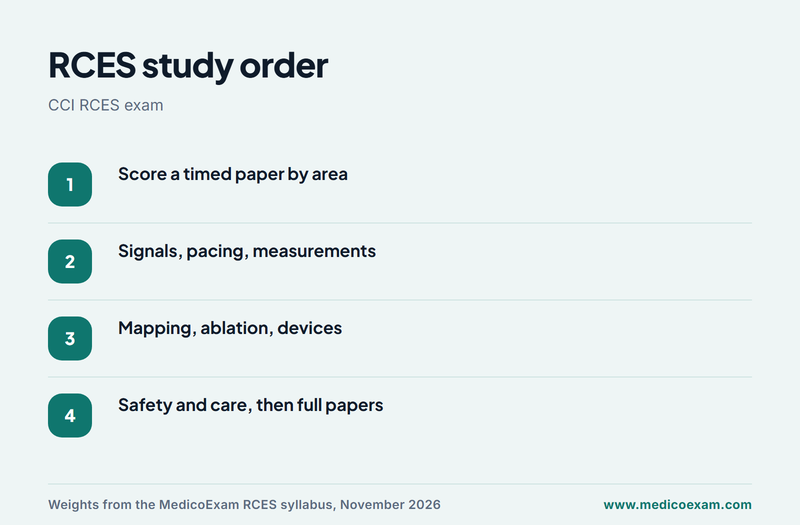
Begin with one timed paper and mark it area by area. An area score shows a gap more exactly than the overall number. After that, work through the list below, giving each step more or fewer hours according to what your results say.
- Signals and recording. Explain what the recording system displays, how filters and noise alter it and how you would trace a poor signal back to a cause. Everything later leans on this.
- Pacing and measurements. Revise thresholds, baseline measurements and standard protocols, then ECG and EGM measurement and analysis.
- Catheter position and imaging. Rehearse naming diagnostic catheter positions and the part played by radiographic and non-radiographic imaging, including intra-cardiac echocardiography.
- Mapping and ablation. Cover activation, pace and entrainment mapping, the mapping system itself and the ablation parameters you would watch.
- Devices. Learn what interrogation involves, which data you would pass on and the purpose of each implant in the syllabus.
- Safety and sterile technique. Return to radiation protection, the time-out and aseptic practice; these become reliable marks once rehearsed.
- Pre- and post-procedural care. Review preparation, hemostasis, complications, education and handover.
- Full timed papers. Finish with mixed papers touching every area.
Practice questions drive the whole plan. Reading supplies vocabulary, but answering unfamiliar items builds the speed the clock demands. Several short sessions each week outperform a single long one, because recall firms up when review is spaced out.
As an illustration, split your hours by the exam's own proportions: just over a third on intra-procedural work, about a quarter on diagnostics, a fifth on therapeutic procedures, and what remains on the two bookend areas. Suppose your first paper shows handover and hemostasis are already solid. Then redirect those hours towards mapping or signal fault-finding, wherever your notes record the most misses.
Reserve the final days for rehearsal and sleep. Do not open new topics. Complete timed papers, reread your error log and rest. Material crammed at the last minute blurs into material you already knew, and that confusion costs marks.
What does the RCES exam cost and how do you book it?
CCI gives the RCES fee as $365 USD in November 2026. Its page also explains that each exam fee contains a non-refundable portion, which covers the staff time spent reviewing and processing applications; withdrawing therefore does not return the whole payment. Fees are sometimes revised, so look at CCI's page again before you pay.
The exam is taken on a computer at a Pearson Professional Center, offered year-round according to each center's availability. Our syllabus summary mentions a 90-day window, starting when CCI accepts your application and sends the Authorization to Test, in which the exam must be scheduled. Apply when your preparation can use that window, and secure a date soon after it opens, because busy slots go first.
Before you apply, try the Qualification Pathway tool on CCI's page. You answer whether you are a student or a graduate of a programmatically accredited cardiac electrophysiology program, and the tool suggests which exam pathway you are best placed to take. The qualification requirements are published alongside it. The final word on eligibility belongs to CCI.
Which books and practice resources are worth using?
Our syllabus summary lists these references: the American Heart Association's Advanced Cardiac Life Support provider manual; Ellenbogen and Wood on cardiac pacing and ICDs; Hayes, Asirvatham and Friedman on pacing, defibrillation and resynchronization; Opie's Drugs for the Heart; and Wilber, Packer and Stevenson on catheter ablation of cardiac arrhythmias. You do not need all of them. Choose one or two that read well for you, since their role is to supply vocabulary and reasoning on devices, medications and ablation.
Books teach, whereas questions train. Begin with the RCES sample questions to see how items are phrased, then switch to the full practice test when you want timed work. Every time you miss an item, note what you overlooked so that you can reread the list before the next session.
Avoid anyone selling recalled or leaked exam content. Genuine preparation relies on original questions that develop skill. Recalled material violates testing rules, and it will not match the paper in front of you anyway.
The error log is the most useful document you will create. Record which area, which topic and which precise difference caught you out. Patterns emerge within a few sessions, and a short list of recurring mistakes is simple to fix, while scattered mistakes signal that you need broader practice.
How can you handle long case-style questions?
Case-style items describe something happening in the laboratory and want to know the best action or the likely finding. Read the final sentence first because it states the task, then go through the case knowing what you are looking for. Candidates who absorb every detail before finding the question waste minutes.
Second, decide which area the item belongs to. A noisy tracing or a connection fault points to the intra-procedural area, so equipment knowledge should drive your answer. A question about catheter position or tissue response to pacing is diagnostic. One about ablation parameters or an implant is therapeutic. Naming the area narrows the options before you read them.
Third, eliminate. Choices that conflict with the case, answer a different problem or would compromise sterile or radiation-safety practice can often be discarded fast. If two remain, go back to the last sentence and pick the one that responds to it more directly. Change an answer only for a specific reason, because unexplained second-guessing costs more marks than it earns.
Repeat this routine on every mock item until it is automatic. It protects your pace by preventing a third reading of a lengthy stem. When an item still resists, pick your best option, flag it if the software permits and continue; if time remains, you can return.
Lastly, read your wrong answers as evidence. If most slips come from misreading the task, you need more routine practice, not more reading. If a gap in knowledge is the cause, the log points to the topic to reopen. Separating the two causes makes each mock paper far more informative than its score.
Which habits cost candidates marks on the RCES?
Splitting time equally. The weights differ on purpose. Giving an 8% area the same hours as the 36% area leaves you underprepared where it counts.
Memorising tracings. No signal looks exactly like the one in your notes. Learn the principles behind a tracing, then apply them to every description you meet.
Assuming safety is obvious. Radiation protection, sterile technique and the time-out are all named in the syllabus. Revise them with their proper vocabulary rather than trusting habit.
Neglecting device interrogation. The syllabus mentions it before, during and after the procedure, so questions can arrive from three directions. Weak device knowledge costs marks in more than one place.
Practising without a clock. About a minute per question leaves room to think but not to drift. Untimed work conceals how slowly case-style items really go.
Trying to spot the unscored items. Twenty questions carry no weight, yet nothing reveals which. Searching for them only burns minutes, so answer each one as though it counts.
What does the RCES test beyond the topic lists?
A syllabus lists tasks; an exam asks you to choose between plausible actions. Expect items where two options are both reasonable in general and only one fits the situation described. The difference is usually a detail in the case: a stage of the procedure, a measured value, a piece of equipment or a safety consideration. Learning to spot that detail is a skill separate from knowing the facts.
Notice how often the syllabus joins an action to its reason. Operate the ablation equipment, and also monitor time, temperature and impedance. Interrogate a device, and also interpret and convey what it shows. Acquire an image, and also interpret it. Because the exam rewards that pairing, revise in pairs: for every task you can name, be ready to say what you would check and what you would report.
Finally, remember that communication appears throughout. Passing on interrogated device data, reporting at the transfer of care and educating the patient all involve saying the right thing clearly. Practise phrasing your answers in a sentence or two. If you can explain a step simply, you probably understand it well enough to pick it out among four options.
When are you ready to book the RCES?
Rely on three tests instead of instinct. First, your timed results should stay well above the 72% guide across several complete papers, not on a single good day. Second, your intra-procedural and diagnostic scores, together worth 62%, should be among your strongest. Third, your errors should look scattered; a topic that keeps returning in the log means you are not ready on it, whatever your total says.
When all three line up, reserve the seat and keep the remaining days for light review. The night before, confirm the appointment time, your identification and the journey, then sleep. A calm, practised routine helps on the day itself.
For a final rehearsal, run the practice test again under the clock, compare each area's result with the weights above and let your weakest area decide the next session. Before applying, look up qualification routes, today's fee and the booking rules on CCI's own site.
Frequently Asked Questions
How many questions are on the RCES exam?
There are 170 questions and 180 minutes to answer them. Scoring counts 150; the other 20 are unscored trial items. That leaves close to a minute per question, so practise with a timer well before the day.
What is the RCES passing score?
You need 650 on a 0-900 scale, which our exam data describes as approximately 72%. Scaled scores are not simple tallies of correct answers, so rely on timed practice results that clear that mark by a good distance.
What topics does the RCES exam cover?
Five areas: intra-procedural activities (36%), diagnostic procedures (26%), therapeutic procedures (21%), pre-procedural activities (9%) and post-procedural activities (8%). Check CCI's page in case the outline changes before your exam.
How much does the RCES exam cost?
CCI lists $365 USD as of November 2026. Part of each fee is non-refundable because it pays for processing applications. Because fees can be revised, look at CCI's RCES page again immediately before paying.
Where do you take the RCES exam?
At a Pearson Professional Center, sitting at a computer, offered year-round depending on each center's availability. Our syllabus summary describes a 90-day window for scheduling after CCI accepts your application and sends the Authorization to Test.
Does the RCES exam include unscored questions?
Yes, 20 of the 170 questions are unscored, leaving 150 that count. Nothing on screen separates them, so answer every item as though it matters and do not spend time guessing which are the trial ones.
- CCI RCES Eligibility & Requirements |
- CCI RCES Registration Process |
- CCI Registered Cardiac Electrophysiology Specialist Study Guide |
- CCI RCES Certification Overview |
- CCI Registered Cardiac Electrophysiology Specialist Syllabus |
- CCI RCES Preparation Time |
- CCI RCES Passing Score |
- CCI RCES Exam Format |
- CCI RCES Certification Practice Exam |
- CCI RCES Exam Sample Questions


