
Is the RCS Exam Mostly Interpretation? Read the Weightings
The CCI Registered Cardiac Sonographer (RCS) exam has 170 questions and a three-hour limit, and its weightings show that interpretation outweighs scanning. Evaluating anatomy, physiology and hemodynamics carries 29% and valvular findings 25%, while performing the imaging itself carries 24%. Study the findings, not just the technique.
Not sure where you stand? Take the RCS practice test before you read further and note your score in each of the five areas. The rest of this guide explains how to turn that first result into a plan.
Who is the RCS exam written for?
Cardiovascular Credentialing International (CCI) describes the Registered Cardiac Sonographer examination as being for professionals working in the area of echocardiography. In practice that means people who perform and interpret cardiac ultrasound in a hospital, a cardiovascular or echocardiography laboratory or an outpatient diagnostic imaging centre. Our syllabus summary names cardiac sonographers, cardiovascular technologists and diagnostic medical sonographers as typical candidates.
CCI also publishes a qualification pathway tool that starts with one question: are you currently enrolled in, or a graduate of, a programmatically accredited program in cardiac ultrasound? Your answer decides which exam pathway applies to you. Eligibility rules and the application process change from time to time, so read them on CCI's RCS page before you pay anything.
This article is exam preparation only. It describes what the test covers and how to study for it. It does not teach anyone how to scan a patient, and nothing here is diagnostic or treatment advice.
What are the RCS exam format, fee and pass mark?
Delivery is by computer at Pearson Professional Centers, year-round and subject to availability at each centre. Expect 170 questions in total, with 150 counted towards your result and 20 left unscored. Those trial items look like any other on screen, so give every question full attention. The time limit is 180 minutes, which works out to about 63 seconds for each question if you spend the whole paper at an even pace.
The pass line is 650 out of 900. Our data puts it near 72%, yet the scaled figure is the real target, since scaling is not a plain share of correct answers.
| Feature | RCS detail |
|---|---|
| Awarding body | CCI (Cardiovascular Credentialing International) |
| Questions | 170 in total, 150 of them scored |
| Time | 180 minutes |
| Passing score | 650 of 900 (about 72%) |
| Exam fee | $365 USD, as of November 2026 |
| Delivery | Computer-based at Pearson Professional Centers |
| Scheduling window | 90 days after approval, with one 90-day extension on request |
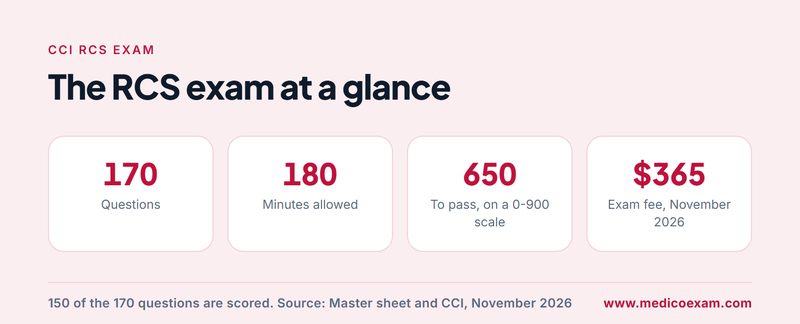
CCI states that part of the fee is non-refundable because it pays for reviewing and processing your application. In other words, even if your plans change, part of what you pay is not coming back. Plan your date before you apply, not after.
Once approval comes through, the authorization starts a clock. Reserve your seat early, because popular slots at a test centre fill up and the booking is the one step you fully control.
Is the RCS exam mostly interpretation rather than scanning?
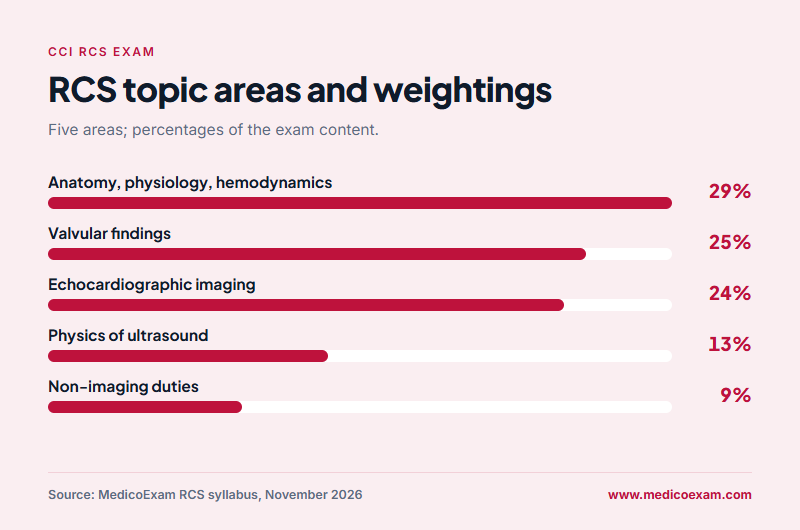
Yes, if you read the weightings literally. The syllabus lists five topic areas and their share of the exam content, and the three that deal with evaluating what the images show add up to a clear majority.
| Topic area | Weighting |
|---|---|
| Evaluating Anatomy, Physiology, and Hemodynamics | 29% |
| Evaluating Valvular Echocardiographic Findings | 25% |
| Performing Echocardiographic Imaging | 24% |
| Applying the Physics of Ultrasound | 13% |
| Performing Non-Imaging Responsibilities | 9% |
Add the two evaluation areas together and 54% of the content is about judging cardiac structure, function, valves and flow. Add the imaging area and three of the five areas account for the great majority of the paper. The rest is split between ultrasound physics and the non-imaging duties around the study. These sums come straight from the published percentages, and they show why a candidate who only practises acquisition leaves a lot of marks on the table.
CCI does not publish a different weighting on its own page, which is why we take these figures from our syllabus summary. Treat them as a planning guide and confirm any change with CCI before you rely on them for exam day.
What do the imaging questions cover?
Performing Echocardiographic Imaging is worth 24%. The topic list is wide: two-dimensional transthoracic echocardiography, M-mode, colour Doppler and spectral Doppler form the core. Beyond those sit contrast studies using an ultrasound enhancing agent, agitated saline studies, exercise and pharmacological echocardiography, non-ischemic stress echocardiography, assisting with transesophageal echocardiography, strain imaging, and three-dimensional transthoracic and transesophageal imaging.
Because the list is broad, no single technique dominates. A sensible way to study it is to group the modes by what each one answers. Motion and timing questions point to M-mode, flow direction and velocity point to the Doppler modes, and enhanced visualisation points to contrast and agitated saline. When a question describes a clinical setting, ask which technique the scenario is really about before you look at the answer choices.
Stress and strain topics deserve their own block of revision time. They are a smaller part of the imaging area, but they are the sort of subject that appears as a short scenario with four plausible options, and recognising the right modality is half the answer.
How are valve questions built?
Evaluating Valvular Echocardiographic Findings carries 25%, and the topic list reads like a grid. For each of the aortic, mitral, tricuspid and pulmonic valves, you are expected to assess structure and function, stenosis and regurgitation. On top of that come prosthetic valves and valvular endocarditis.
That grid is useful to you. Draw it on a single sheet: four valves down the side, three questions across the top. Twelve cells cover most of the area, and the last two topics add the remainder. When you do practice questions, write the cell each one belongs to, and you will quickly see which valve or which pattern you keep missing.
Prosthetic valves are the area candidates most often under-prepare because they are not part of a normal routine study. Give them a dedicated session instead of assuming they will follow from what you know about native valves.
Why does anatomy, physiology and hemodynamics carry the most weight?
Evaluating Anatomy, Physiology, and Hemodynamics is the largest area at 29%, and its list is the longest. It names cardiac chambers and structures, cardiomyopathies, diastolic and systolic function, ischemic heart disease, pericardial disease, the great vessels, diseases of the aorta, pulmonary hypertension and cardiac masses. It also names recognising congenital heart disease, recognising implanted devices such as an ICD, pacemaker, LAA occluder, closure devices and mechanical support, evaluating strain imaging, evaluating cardiac hemodynamics and evaluating infiltrative disease.
The reason it is largest is plain: this is where pictures become findings that a reading physician can use. Questions here tend to describe what is seen or measured and ask what it indicates. They test recognition and reasoning, which a list of facts cannot supply.
For revision, split the list into three piles. The first is function, meaning systolic and diastolic assessment and hemodynamics. The second is structure and disease, covering chambers, pericardium, aorta, great vessels, masses and infiltrative conditions. The third is recognition, covering congenital findings and implanted devices. Use a different method for each pile: work through measurements for the first, compare images with descriptions for the second, and use flash cards for the third.
How much do physics and non-imaging duties count?
Applying the Physics of Ultrasound is worth 13%. The syllabus lists the properties of ultrasound waveforms, recognising artifacts, and optimising resolution, frame rate, Doppler waveforms, colour Doppler and the two-dimensional, three-dimensional and contrast images. It rewards candidates who know why an image looks the way it does and which control changes it.
Performing Non-Imaging Responsibilities is the smallest area at 9%. It covers reviewing the clinical history and prior studies, verifying the echocardiographic order, maintaining ergonomic safety, preparing the patient for the examination, preparing a report of findings for the reading physician and communicating significant findings. These questions feel like common sense, and that is exactly why they are good value: a few hours of careful reading usually secures most of them.
Do not skip either area because it is small. Together they hold a real share of the content, and the margin between passing and failing is often smaller than that.
How should you plan your RCS study time?
Start with a timed baseline. Sit a full set of questions against the clock, record the score for each of the five areas and use that, not your preferences, to decide where the hours go. Most candidates find that the area they enjoy most is not the one that needs the most work.
- Weeks one and two: read the topic lists for the three evaluation areas and build the valve grid and the three piles described above.
- Weeks three and four: work through the imaging modes by purpose, then spend a session each on strain, stress and contrast.
- Week five: cover physics and artifacts with an eye on which control fixes which problem, then the non-imaging duties.
- Final stage: sit full-length timed papers and review every wrong answer by area.
The syllabus page lists the reference books CCI points candidates towards, including Feigenbaum's Echocardiography, Otto's Textbook of Clinical Echocardiography, The Echo Manual, Understanding Ultrasound Physics and Sonography Principles and Instruments. You do not need all of them. Pick one general echocardiography text and one physics text and use them as a reference for the areas where you lose marks.
For pacing, remember the arithmetic: about 63 seconds a question. Practise reading a scenario, naming the area it belongs to and answering inside that time. If a question takes longer, flag it and return at the end. Spending three minutes on one item costs you the time for two or three others.
How do you read a scenario question under time pressure?
Most items on a certification exam of this kind are short scenarios followed by four options. A reliable routine keeps you fast without making you careless. First, decide which of the five topic areas the question belongs to. Second, find the single thing it asks for, which is usually in the last sentence. Third, cross out the options that answer a different question. Only then compare what is left.
Naming the area first matters because the same words can mean different things in different areas. A question that mentions a valve may be asking about assessing its structure, about the Doppler technique used to measure a gradient, or about an artifact that makes a measurement unreliable. Each of those is a different topic area and a different kind of answer.
Watch the wording that narrows a question: first, best, most likely and except. Slow down on those words, because they change which option is correct. If you can state the question in your own words before you look at the choices, you are far less likely to be drawn toward a distractor that is true but irrelevant.
Practise this routine on untimed questions first until it becomes automatic, then add the clock. Candidates who start with timed papers often rush the routine and reinforce bad habits.
What should you do in the last week before the exam?
Do not try to learn new topics in the final days. Spend them on review and rehearsal instead. Go back through the questions you missed during the course of your preparation and sort them by area. If one area still produces most of the errors, give it a short, focused session and then move on.
- Three days out: sit one final full-length timed paper and review it area by area.
- Two days out: revisit your valve grid, the three piles for the largest area and your list of physics controls.
- The day before: confirm your appointment, route and identification, and stop studying early.
- Exam day: arrive in good time so that you start calm.
Rest is part of the plan. A three-hour computer-based paper rewards steady concentration, and tired candidates tend to misread the one word that decides a question. Eat, hydrate and sleep as you would before any long working day.
Finally, keep the result in perspective. The credential is a measure of your readiness for the profession, and the preparation itself, learning to connect images, measurements and findings, is useful in daily work whatever the outcome of a single sitting.
How do the RCS and its sister CCI exams compare?
CCI offers several cardiovascular credentials, and candidates often wonder how they differ. The RCS is built around echocardiography, so its content centres on imaging, valves, function and ultrasound physics. Other CCI credentials cover different fields, such as rhythm analysis, electrophysiology and congenital cardiac sonography, each with its own topic areas and weightings.
If you work across more than one of those fields, avoid assuming that a topic weighted heavily in one exam is weighted the same way in another. Read each syllabus on its own, and check the percentages for the credential you are actually sitting. Our blog covers several of them. One guide builds a study plan around its weightings, and another explains why abnormal rhythm analysis dominates a different CCI paper. Compare the areas before you choose which exam to sit first.
The RCS suits you best when your daily work is performing and reporting transthoracic and stress echocardiography, and when you want a credential that reflects that work. Choose the exam by your role, not by which one looks easiest on paper, because a credential that matches your job will be the one you use.
What does the MedicoExam RCS practice exam include?
The premium MedicoExam practice exam for this credential offers 335+ questions, two months of unlimited access, timed mock exams and scenario-based multiple-choice items. Progress tracking shows you, question by question, which of the five areas is still weak. The price is shown on the product page, and the purchase carries a money-back guarantee.
There is a free demo as well, which lets you see the interface and the style of question before you buy. Open the demo from the product page to try it. Our practice material is our own and is not the awarding body's exam, so use it for rehearsal and pacing, and use CCI's page for the rules.
What mistakes cost RCS candidates marks?
- Studying acquisition only. Imaging is 24%, while the two evaluation areas together are 54%.
- Skipping prosthetic valves. They are listed on their own line in the valve area and are easy to neglect.
- Ignoring recognition topics. Congenital findings and implanted devices sit inside the largest area.
- Treating the scaled score as a percentage. Hitting 650 of 900 is not the same as answering 72% of items correctly.
- Leaving timing practice until the last week. Pace is a skill, and it needs repeated timed sessions.
Finally, confirm every rule on CCI's own page before exam day: the current fee, the pathway you qualify for, test centre procedures and the rules for keeping the credential. On the CCI website, the credential material sits under the headings Exam Preparation, Approved Test Taker, Exam Day and Maintaining Credentials, and those pages are the authority if anything here differs.
Where do you go from here?
The RCS rewards candidates who can read an echocardiogram's findings, not only produce one. Weight your hours the way the exam weights its content: put the most time into anatomy, physiology and hemodynamics, then valves, then imaging, and finish with physics and the non-imaging duties. Start with a timed baseline this week, note the five scores, and rebuild the plan around the lowest one.
Frequently Asked Questions
How many questions are on the CCI RCS exam?
The paper holds 170 items. Scoring counts 150 of them, and 20 are trial items. Nothing marks the trial ones, so treat every question seriously. With 180 minutes available, an even pace is about 63 seconds each.
What score do you need to pass the RCS exam?
Candidates must reach 650 out of 900. That is roughly 72% by our data, though scaling means it is not a raw percentage. Build steady strength across all five areas rather than chasing one number.
How much does the RCS exam cost?
As of November 2026 the fee on CCI's RCS page is $365 USD. A portion is non-refundable, since it pays for reviewing your application. Confirm the figure on that page before you apply, as fees can change.
Which RCS topic area has the highest weighting?
Evaluating Anatomy, Physiology, and Hemodynamics is the largest at 29%, followed by Evaluating Valvular Echocardiographic Findings at 25% and Performing Echocardiographic Imaging at 24%. Applying the Physics of Ultrasound is 13% and Performing Non-Imaging Responsibilities is 9%.
How long do you have to take the exam after approval?
After your application is approved and an Authorization to Test is issued, you have a 90-day window to schedule and sit the exam. You may ask for a single extra 90 days. Book early, because test centre availability varies.


