
RCIS Exam Readiness: Where 74% of the Marks Sit
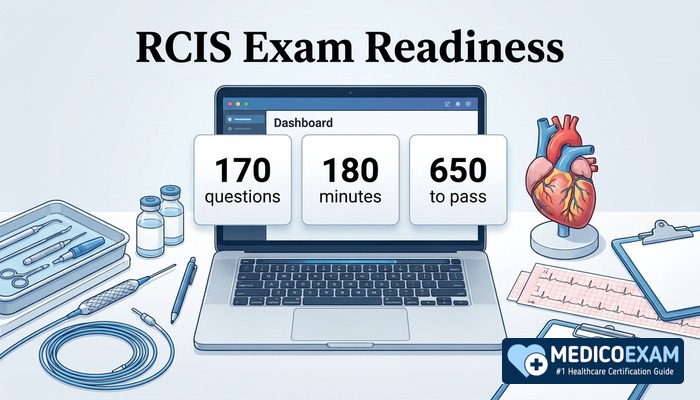
The CCI Registered Cardiovascular Invasive Specialist (RCIS) exam has 170 questions and a 180-minute limit, and 74% of its content sits in just two areas: diagnostic procedures at 40% and interventional procedures at 34%. If your cath lab experience is lopsided, that split is where readiness is won or lost.
Curious where you stand today? Sit the RCIS practice test first and jot down how you score on each of the five topic areas. The sections below show how to turn it into a plan that follows the exam's own weightings.
Who sits the RCIS exam, and how does CCI describe it?
Cardiovascular Credentialing International (CCI) says its Registered Cardiovascular Invasive Specialist examination is meant for people working in cardiac catheterization. Our syllabus summary names invasive cardiovascular technologists, cardiac catheterization nurses and radiologic technologists as typical candidates, working in cardiac catheterization laboratories, interventional cardiology departments and hospital cardiovascular procedure units.
The credential page also carries a qualification pathway tool, which begins by asking whether you are a student or graduate of a programmatically accredited invasive cardiovascular technology program. How you answer determines the exam pathway CCI points you to. Because eligibility rules and application steps can change, read them on CCI's page for this credential before you pay anything.
A word on scope: what follows is study guidance. It explains what the test measures and how to organise your revision, it is not a manual for performing procedures, and none of it is clinical or medical advice.
What are the RCIS exam format, fee and pass mark?
The exam is computer-based and is given at Pearson Professional Centers year-round, subject to availability at each test centre. You answer 170 questions in total. Scoring counts 150 of them, and the other 20 are unscored items that look exactly like the rest on screen, so every question deserves full attention. Three hours are allowed, so an even pace leaves roughly 63 seconds for each item.
The pass mark is set at 650 out of 900, and our data puts that near 72%. Scaling makes that figure something other than the proportion of questions you got right, so target the scaled mark.
| Feature | RCIS detail |
|---|---|
| Issued by | CCI |
| Items on the paper | 170, of which 150 count toward the score |
| Time | 180 minutes (a three-hour exam) |
| Passing score | 650 out of 900 (approx. 72%) |
| Exam fee | $365 USD (November 2026) |
| Delivery | On computer, at Pearson Professional Centers |
| Booking window | 90 days from the Authorization to Test |
CCI notes that part of each exam fee is non-refundable, because it covers staff time spent reviewing and processing applications. So if your plans shift, that slice is gone. Settle on a realistic exam date before applying.
When CCI approves you and issues an Authorization to Test (ATT), a 90-day eligibility window opens for booking the sitting through Pearson VUE. The sequence below shows the steps in order, from checking your pathway to sitting the exam.
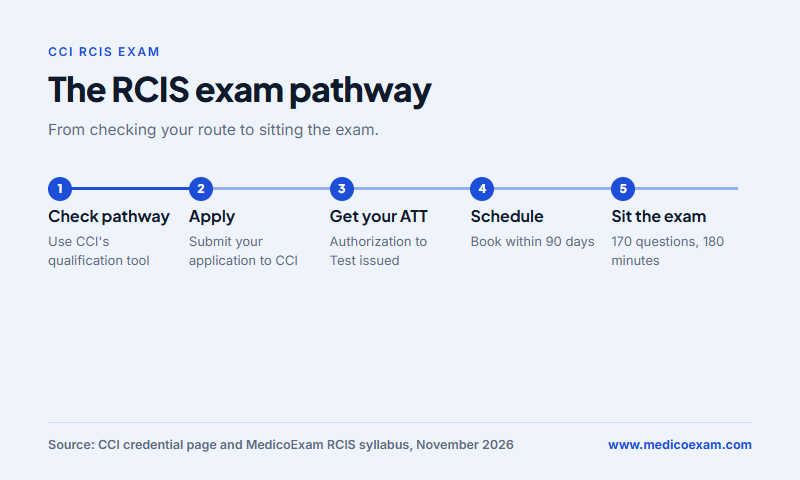
Notice that booking is its own step. Popular test-centre slots fill up, so the practical lesson is to schedule soon after approval, and to build your study calendar backwards from that date.
Where do the RCIS marks sit across the five areas?
The exam content is divided into five topic areas. Diagnostic procedures carry 40%, interventional procedures 34%, emergency procedures and protocols 13%, pre-procedural activities 8% and post-procedural activities 5%. The five add up to 100%, and the two largest together make up 74% of the content.
| Topic area | Weighting |
|---|---|
| Conducting Diagnostic Procedures | 40% |
| Conducting Interventional Procedures | 34% |
| Responding to Emergency Procedures and Protocols | 13% |
| Conducting Pre-Procedural Activities | 8% |
| Conducting Post-Procedural Activities | 5% |
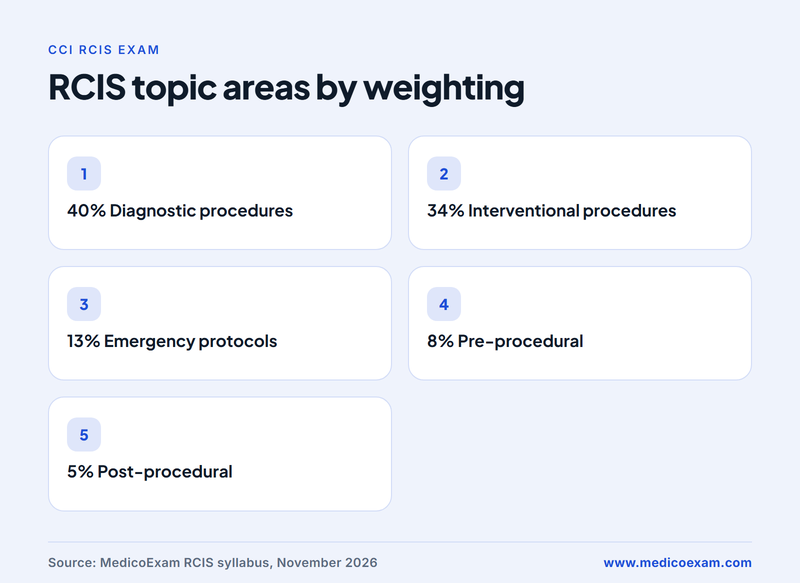
Read the table as a budget for your hours. A topic worth 5% of the content cannot justify the same study time as one worth 40%, yet many candidates study in the order they met the material at work, which over-rewards whatever they already do every day. The weightings are a better guide than habit.
Remember too that weightings describe content, not difficulty. A small area can still cost you marks if you skip it, and it is often the easiest place to collect points because the list of tasks is short and concrete.
What does the diagnostic area at 40% ask of you?
Conducting Diagnostic Procedures is the heaviest area and also the broadest. The syllabus lists fourteen kinds of task under it. They include monitoring vital signs, assisting with or performing left heart and right heart catheterization, 12-lead ECG analysis, intra-cardiac and intra-vascular imaging, identifying structures on cardiac ultrasound images, fractional flow reserve and instantaneous fractional reserve studies, radiation safety, radiographic procedures and image interpretation, pharmacology and vascular access.
That list is wide, so it helps to sort it into families before you study. One family is physiological monitoring and waveforms: vital signs, rhythm, pressure, oxygen saturation, waveform analysis and hemodynamic calculations. A second is imaging, covering angiography, ultrasound, IVUS, OCT and intra-cardiac echo, where the exam expects you to identify structures. A third is safety, which names time, distance, shielding, ALARA and C-arm and table geometry. The fourth is access and pharmacology, including femoral, radial, brachial and jugular routes and ultrasound-guided access.
Questions built on this area tend to reward candidates who can connect a finding to the next sensible action in the lab. Practise that habit by taking each bullet from the syllabus and asking yourself what you would need to know, see or prepare for that task. Keep your answers to what the exam can test: terminology, recognition, sequence and the reasoning behind each step.
Because the area is so large, give it the first block of your study calendar and return to it every week. Reading about it once and moving on is the most common way to leave a 40% area half-learned.
What do the interventional questions at 34% cover?
Conducting Interventional Procedures is the second largest area, and its list reads like a catalogue of the work a busy cath lab supports. It names device implants such as pacemakers, ICDs, CRT devices and loop recorders; coronary interventions such as balloon angioplasty and stenting; vascular closure devices; complex coronary work such as CTO, atherectomy and alcohol ablation; and peripheral interventions on renal and lower-extremity vessels, including vena cava filters.
It goes on to complex peripheral interventions such as carotids and critical limb salvage, mechanical circulatory support (IABP, LVAD, Impella and ECMO), transvenous temporary pacemaker insertion, pericardiocentesis, cardiac and peripheral thrombectomy, distal protection devices, non-valvular structural heart therapies such as septal defects and left atrial appendage work, and percutaneous valve interventions including valvuloplasty, TAVR, annuloplasty, paravalvular leak and valve repair.
Two features of that list matter for planning. First, many of the topics are ones that a single hospital may rarely perform. If your own lab does not do structural heart work, you still need to recognise the devices, the vocabulary and the role of the team, because the exam is written for the whole profession and not for one department. Second, the list mixes routine and rare procedures under one weighting, so rare topics are not a safe thing to skip.
A practical approach is to build a one-page sheet for each family: devices and rhythm management, coronary, peripheral, circulatory support, and structural heart. For each, write the procedure names, the equipment you would expect to see and the team tasks listed in the syllabus. Reviewing five sheets is easier than rereading a whole textbook.
How do the emergency questions at 13% differ?
Responding to Emergency Procedures and Protocols is smaller, but it changes the style of the questions. Instead of asking about a routine step, it asks how you respond when something goes off plan. The syllabus lists four groups of tasks: responding to emergency clinical presentations such as STEMI, cardiogenic shock, pulmonary edema and stroke; responding to intraprocedural coronary complications such as perforation and no reflow; responding to intraprocedural peripheral and structural heart complications such as embolism, dissection, device migration and perforation; and maintaining and operating emergency equipment such as the defibrillator, code cart, suction and airway management.
These items usually test recognition and priorities. Scenario-based practice is the best preparation, because the skill being measured is calm, ordered thinking. When you review a missed question in this area, do not just note the right answer. Write down what clue in the scenario pointed to it, so the pattern becomes automatic.
The equipment line deserves a mention of its own. It is easy to treat it as obvious, yet it is a named task in the syllabus and therefore fair game.
Are pre-procedural (8%) and post-procedural (5%) topics worth your time?
Yes, because together they are 13% of the content, which is the same as the whole emergency area. They are also the areas where preparation pays back fastest.
Pre-procedural activities cover preparing the procedure or control room (equipment set-up, radiation equipment, sterile technique, quality control and quality assurance), preparing the patient and the personnel, and reviewing and validating patient or procedure information such as records, lab values, the time out, consent and patient status. Post-procedural activities cover assisting with or obtaining arterial and venous hemostasis, managing access-site complications such as bleeding and occlusion, providing post-procedure patient education, and reporting and transfer of care.
Both lists are short and procedural, so they suit a flash-card method. Give each an afternoon, test yourself on it, then revisit it briefly each week. If you are scoring well there, you can spend the saved hours where the marks are heavier.
How should you divide your study time by weighting?
A simple rule is to split study hours roughly in line with the weightings, then shift extra time to whichever area your baseline shows is weakest. Before you start, decide how many hours a week you can truly keep up; CCI does not set a preparation time, so you choose the length of the plan. As an illustration, a candidate with ten hours a week might give four to diagnostic work, three to interventional, a little over one to emergencies and the remainder to the two small areas. The numbers are an example of the method, not a prescription.
- Take a timed baseline. Use a full-length practice exam to see your score in all five areas.
- Rank the areas by gap times weight. A weak result in a 40% area matters far more than a weak result in a 5% area.
- Study in families. Group the syllabus bullets into the families described above, rather than reading them line by line.
- Use the reading list. The syllabus page lists four references, covering catheterization, angiography and intervention, hemodynamic monitoring, a cardiac catheterization handbook and a manual for cath lab personnel. Use them to fill gaps, not to read cover to cover.
- Retest every week or two. Keep the real time limit and log each area's score.
Notice what the plan does not do. It does not ask you to memorise a script. The exam assesses applied judgment as well as knowledge, so the retest step matters more than another read-through.
Are you ready? Five signs to check
Readiness is more than a single practice score. Use these signs as a checklist, and be honest about each one.
- Steady results across all five areas. A strong overall score that hides a very weak area is a risk, because every area is examined.
- Comfortable pace. You finish a 170-question timed run with time left to review flagged items.
- Clear reasons for wrong answers. You can say why you missed a question, not just what the answer was.
- Familiar vocabulary. You recognise the devices, procedures and complications named in the syllabus, including the rare ones.
- A booked date. Your Authorization to Test window is running and a test-centre slot is confirmed.
If three or more of these are not yet true, move your study date rather than your standards. If all five are true, you are in the zone where a final week of light review is more useful than new material.
How do you tackle a scenario question against the clock?
At roughly 63 seconds an item you cannot reread every stem. Start with the closing question so you know what is wanted, then scan the scenario for the details that matter. Look for a change in status, a named complication or a stated step in the procedure, because those details usually decide between two close options.
Then eliminate. In a best-answer item, one or two options are usually wrong for a reason you can name: wrong sequence, wrong equipment or something that does not address the problem described. Pick from what remains, flag the item if doubt lingers, and keep going. Twenty of the 170 items do not count, so one stubborn question is never worth five minutes.
Finally, practise this under a timer. Pacing is a skill, and it improves only through repeated timed sessions, not through reading about technique.
How does RCIS compare with its sister CCI exams?
CCI offers credentials for several parts of cardiovascular care, and the weightings differ sharply between them. If you are choosing between them, compare how each exam spends its marks. The cardiac sonographer exam, for example, leans on interpretation of findings, while the electrophysiology exam rewards a different mix of skills. To see how those blueprints differ, read how the electrophysiology exam rewards its areas; set beside this one, the contrast is plain.
The RCIS is different in one key way: it is the broadest procedural exam, with two large areas that both describe hands-on lab work. Choose by your role, because the credential that matches the work you do is the one you will use.
What comes with the MedicoExam RCIS practice exam?
Our premium practice exam for this credential bundles 335+ questions with 2 months of full access. Expect timed mock exams, scenario-based multiple-choice items, a Personalized Result Book and a detailed result history. The product page showed $36.80 USD in November 2026, and a money-back guarantee backs the purchase.
A free online demo lets you test the interface and question style before paying. This is MedicoExam's own material rather than CCI's exam, so treat it as rehearsal for pacing and reasoning and rely on CCI for the rules.
Which habits cost RCIS candidates marks?
- Studying what you do daily. Your own lab covers only part of the syllabus, while the exam covers all of it.
- Skipping rare procedures. They share a 34% weighting with the common ones.
- Treating the small areas as optional. Pre- and post-procedural content together equals the emergency area.
- Reading the scaled score as a percentage. Reaching 650 of 900 does not mean 72% of your answers were right.
- Saving timed work for the final days. Speed comes from many timed runs.
Ahead of exam day, check CCI's own pages for the current fee, your pathway, test-centre procedures and what keeping the credential involves. On the CCI website the credential menu lists Qualification Requirements, Apply for Exam, Exam Preparation, Approved Test Taker, Exam Day and Maintaining Credentials; trust those pages if they ever disagree with this guide.
What should you do next?
This exam favours candidates whose preparation mirrors its blueprint. Put the most hours into diagnostic procedures, then interventional ones, keep emergency scenarios sharp, and clear the two small areas early. Take a timed baseline this week, record the five scores, and rebuild your plan around the largest gap.
Frequently Asked Questions
How many questions does the CCI RCIS exam contain?
You face 170 items, of which 150 are scored and 20 are unscored trial questions that look identical to the others. Because you cannot spot the unscored ones, answer every question with care and keep a steady rhythm through the three hours.
What is the RCIS passing score?
Passing takes a scaled 650 from a possible 900, which our data lists as approximately 72%. A scaled score is not simply the share you answered correctly, so build even strength across the five content areas instead of fixating on one figure.
How much does the RCIS exam cost?
CCI's credential page showed $365 USD in November 2026. Part of that price is non-refundable, set aside for application review. Fees can change, so confirm the amount on CCI's page before you apply.
Which RCIS topic area has the highest weighting?
Conducting Diagnostic Procedures is the largest at 40%, followed by Conducting Interventional Procedures at 34%. Emergency procedures and protocols carry 13%, pre-procedural activities 8% and post-procedural activities 5%.
How soon must you sit the exam once approved?
Once CCI approves your application and issues an Authorization to Test, you get 90 days to schedule through Pearson VUE. Reserve your seat promptly, since availability at test centres differs from place to place.
- CCI RCIS Question Bank |
- CCI RCIS Eligibility & Requirements |
- CCI RCIS Exam Cost |
- CCI RCIS Registration Process |
- CCI Registered Cardiovascular Invasive Specialist Study Guide |
- CCI RCIS Recertification |
- CCI RCIS Certification Overview |
- CCI Registered Cardiovascular Invasive Specialist Syllabus |
- CCI RCIS Preparation Time |
- CCI RCIS Passing Score |
- CCI RCIS Exam Format |
- CCI RCIS Certification Practice Exam |
- CCI RCIS Exam Sample Questions


