
AAPC COC Exam: Certified Outpatient Coder Study Guide - Format, Domains & 20 FAQ
 The AAPC Certified Outpatient Coder (COC) exam is a 100-question, multiple-choice test with a 4-hour time limit and a 70% passing score, designed for coders who work in hospital outpatient departments, ambulatory surgery centers (ASCs), and facility billing environments. Formerly known as the CPC-H, the COC credential validates your ability to apply CPT, HCPCS Level II, and ICD-10-CM codes in facility settings — and with outpatient services now accounting for the majority of hospital revenue, demand for COC-certified coders continues to grow.
This guide answers 20 of the most common questions about the COC exam, organized by eligibility, format, study preparation, COC vs. CPC differences, and career value.
COC Exam at a Glance — Key Facts (2026)
|
Attribute |
Detail |
|---|---|
|
Full Name |
Certified Outpatient Coder (COC) |
|
Certifying Body |
American Academy of Professional Coders (AAPC) |
|
Formerly Known As |
CPC-H (Certified Professional Coder — Hospital) |
|
Total Questions |
100 multiple-choice |
|
Time Limit |
4 hours |
|
Passing Score |
70% (70 correct answers) |
|
Exam Cost |
$425 for 1 attempt; $499 for 2 attempts |
|
AAPC Membership Required |
Yes — $222/year; $157/year for students |
|
Open Book |
Yes — CPT, ICD-10-CM, and HCPCS Level II manuals permitted |
|
Renewal |
36 CEUs every 2 years |
|
Delivery Mode |
Online (live remote proctor) or in-person at a Meazure Learning center |
Who Can Take the COC Exam?
1. What Are the Eligibility Requirements for the COC Exam?
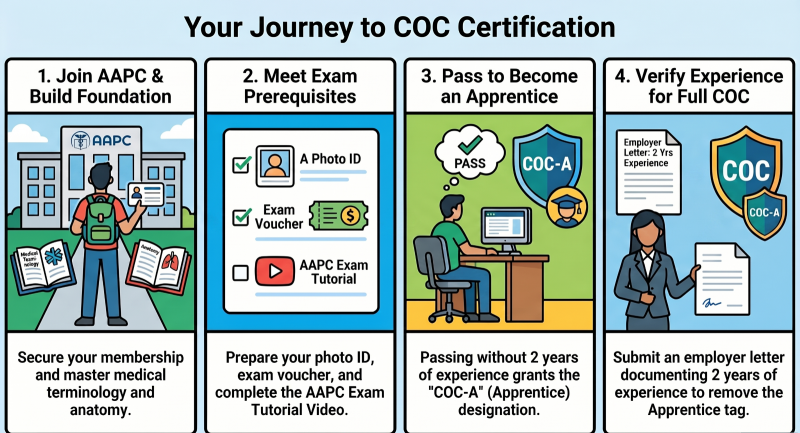
There are no strict educational prerequisites to sit for the COC exam. According to AAPC, the basic requirements are:
- Current AAPC membership ($222/year or $157/year for students)
- A valid, government-issued photo ID with a name that exactly matches your exam confirmation
- A valid, unused electronic exam voucher
- Completion of the AAPC Exam Tutorial Video
AAPC does not require a specific degree or minimum years of experience to register. However, the organization strongly recommends completing the COC Training Course and having a solid understanding of medical terminology, anatomy, and pathophysiology before attempting the exam.
2. Do I Need Coding Experience Before Taking the COC Exam?
No formal experience is required to take the exam. However, AAPC recommends at least two years of professional coding experience in outpatient facility settings. If you pass the exam without two years of verified experience, you receive an “Apprentice” designation (COC-A) until you document the required experience with an employer letter. Once verified, the apprentice tag is removed and your credential becomes a full COC.
3. What Training Does AAPC Recommend Before the COC Exam?
AAPC offers an 80-clock-hour COC Preparation Course that covers outpatient facility coding fundamentals, including CPT, ICD-10-CM, and HCPCS Level II coding, as well as the Outpatient Prospective Payment System (OPPS) used by most payers in outpatient facilities. The course also provides an introduction to ICD-10-PCS. Successful completion of the course earns 40 CEUs for current AAPC credential holders.
What Is the COC Exam Format?
4. How Many Questions Are on the COC Exam?
The COC exam contains 100 multiple-choice questions. You have 4 hours to complete it. That works out to approximately 2.4 minutes per question — slightly more generous than the CPC exam’s pace — but facility coding questions often involve complex operative notes and payment methodology scenarios, so time management is still critical.
5. What Is the Passing Score for the COC Exam?
You need a score of 70% to pass, meaning you must answer at least 70 of the 100 questions correctly. There is no penalty for wrong answers, and there is no minimum score required in individual domains — only an overall 70% threshold matters.
6. What Domains Does the COC Exam Cover?
According to AAPC’s official COC exam breakdown, the 100 questions are distributed across the following domains:
|
Domain |
Number of Questions |
Percentage |
|---|---|---|
|
Medical Terminology |
7 |
7% |
|
Anatomy |
7 |
7% |
|
Coding Guidelines |
3 |
3% |
|
Payment Methodologies |
13 |
13% |
|
Compliance |
3 |
3% |
|
Outpatient Coding(CPT, HCPCS, ICD-10-CM) |
67 |
67% |
|
Total |
100 |
100% |
The outpatient coding section — at 67 questions — is the dominant domain. It tests your ability to assign CPT, HCPCS Level II, and ICD-10-CM codes for services performed in hospital outpatient departments, emergency departments, ambulatory surgery centers, and other facility settings.
7. What Code Sets Are Tested on the COC Exam?
The COC exam tests three primary code sets:
- CPT (Current Procedural Terminology): Used to report outpatient procedures and services
- HCPCS Level II: Used for durable medical equipment, supplies, drugs, and services not covered by CPT
- ICD-10-CM: Used for diagnosis coding in outpatient settings
Unlike the CIC (Certified Inpatient Coder) exam, the COC does not test ICD-10-PCS procedure coding. Outpatient facility coders use CPT and HCPCS Level II for procedure reporting, while inpatient coders use ICD-10-PCS — this is one of the fundamental differences between inpatient and outpatient coding.
8. Is the COC Exam Open Book?
Yes. The COC exam is open book. You may bring the following printed coding manuals into the exam:
- AMA CPT Professional Edition
- ICD-10-CM Official Code Set
- HCPCS Level II Code Book
Highlighting, underlining, and tabs are permitted in your books. However, handwritten notes, loose papers, and unofficial reference materials are not allowed. If you take the exam via live remote proctoring, you must display your books to the proctor before starting.
9. Can I Take the COC Exam Online?
Yes. Since 2024, all AAPC certification exams — including the COC — are administered electronically through Meazure Learning. You can choose between two testing options:
- Live remote proctoring from home or office
- In-person testing at a Meazure Learning center
Paper-based exams are no longer offered. The electronic platform includes an on-screen notepad (scratch paper is not allowed for remote proctored exams) and may eventually offer electronic code books as an option.
How Should You Prepare for the COC Exam?
10. How Should I Prepare for the COC Exam?
A structured study plan is essential. Most successful candidates follow a three-phase approach:
Phase 1: Learn the Core Material (Weeks 1–6)
- Complete the AAPC COC Preparation Course or an equivalent training program
- Study each body system section in CPT, focusing on how facility coding differs from physician coding
- Learn OPPS, APCs (Ambulatory Payment Classifications), and revenue codes
Phase 2: Review and Reinforce (Weeks 7–10)
- Use the BAT method (Bubble, Annotate, Tab) to organize your code books for quick reference
- Review ICD-10-CM Official Guidelines for Coding and Reporting, especially outpatient-specific sections (Section IV)
- Focus on high-weight domains: outpatient coding (67%) and payment methodologies (13%)
Phase 3: Practice Exams (Weeks 11–12)
- Take timed practice exams under realistic conditions
- Aim for consistent scores of 85% or higher before scheduling your exam
- Analyze missed questions to identify weak areas
"Candidates pursuing facility-based coding roles should review this Complete Guide to COC AAPC Certification before scheduling the exam."
11. What Study Resources Does AAPC Offer for the COC?
AAPC provides several official COC preparation resources:
- COC Online Course (80 clock hours, includes exam voucher depending on package)
- COC Study Guide — chapter-by-chapter review with practice questions
- COC Practice Exams — timed, exam-format tests aligned with domain weights
- Practicode — hands-on coding practice with real medical records
Third-party training providers also offer COC-aligned courses.
12. How Important Is the BAT (Bubble, Annotate, Tab) Method?
The BAT method is widely recommended by AAPC-endorsed instructors for open-book coding exams. It involves:
- Bubble: Circle or highlight key terms, guidelines, and inclusion/exclusion notes in your code books
- Annotate: Write brief cross-references and page numbers in the margins
- Tab: Use color-coded tabs to mark frequently used sections
Since the COC is open book, your ability to find codes and guidelines quickly is just as important as your coding knowledge. A well-prepared code book can save 15–20 minutes over the course of the exam, which often makes the difference between passing and running out of time.
How Does the COC Compare to the CPC?
13. How Does the COC Differ from the CPC?
The COC and CPC are complementary AAPC credentials that test different coding environments. The CPC (Certified Professional Coder) focuses on professional (physician) coding, while the COC covers facility (hospital outpatient) coding. Here is a side-by-side comparison:
|
Feature |
COC (Certified Outpatient Coder) |
CPC (Certified Professional Coder) |
|---|---|---|
|
Type of Coding |
Facility/outpatient coding |
Professional/physician coding |
|
Settings |
Hospital OPDs, ASCs, EDs |
Physician offices, clinics |
|
Total Questions |
100 multiple-choice |
100 multiple-choice |
|
Time Limit |
4 hours |
4 hours |
|
Passing Score |
70% |
70% |
|
Exam Cost |
$425 (1 attempt) |
$425 (1 attempt) |
|
Claim Form |
UB-04 (CMS-1450) |
CMS-1500 |
|
Payment System |
OPPS / APCs |
Medicare Physician Fee Schedule (MPFS) |
|
Focus Area |
Facility resources and overhead |
Physician professional services |
|
Billing Emphasis |
Revenue codes, APCs, OPPS |
E/M levels, modifiers, RVUs |
|
Code Sets |
CPT, HCPCS Level II, ICD-10-CM |
CPT, HCPCS Level II, ICD-10-CM |
Source: AAPC
14. Should I Get the COC or the CPC First?
Most coding professionals start with the CPC because it is the most widely recognized entry-level AAPC credential and opens the broadest range of job opportunities. The COC is typically pursued as a second credential by coders who want to specialize in facility coding or who already work in hospital outpatient departments.
If you already work in a hospital outpatient setting and your employer specifically requires or prefers the COC, you can take it first. The exam domains overlap significantly — both test CPT, ICD-10-CM, and HCPCS Level II — but the COC adds payment methodology and compliance content specific to facility billing, such as OPPS, APCs, and revenue codes.
“The COC and CPC exams use the same code books and test similar coding skills, but the COC asks every question from the facility perspective. You need to understand how hospitals are reimbursed, not just how physicians bill,” says Jennifer Martinez, CPC, COC, AAPC-approved instructor and coding education director with 15 years of outpatient facility coding experience.
15. Can I Hold Both COC and CPC Credentials?
Yes. Many coders hold dual credentials, especially those who work in health systems that handle both professional and facility billing. Holding both the CPC and COC demonstrates versatility and can increase your earning potential. According to the 2024 AAPC Salary Survey, professionals holding multiple AAPC certifications earn higher average salaries than those with a single credential.
What Is the Career Value of the COC?
16. What Is the Average Salary for a COC-Certified Coder?
According to public salary data sources, the average base salary for COC-certified professionals is approximately $61,000, with a range of $45,000 to $96,000 depending on experience, location, and employer type. The 2025 AAPC Salary Survey reported that outpatient coders earned an average of $67,147, while public salary aggregators place the average at approximately $52,502 for outpatient medical coders and $54,819 for those specifically holding the COC title.
For comparison, CPC-certified coders earn an average of $60,500 per year, and CIC-certified inpatient coders earn between $70,000 and $90,000 annually.
17. What Jobs Can I Get with a COC Certification?
COC-certified coders are qualified for roles in:
- Hospital outpatient departments — coding ED visits, observation services, outpatient surgeries, and ancillary services
- Ambulatory surgery centers (ASCs) — coding same-day surgical procedures under the ASC payment system
- Revenue cycle management — auditing, compliance, and charge capture for facility services
- Health information management (HIM) — facility-side coding leadership and quality assurance
- Consulting and auditing firms — outpatient coding audits and compliance reviews
Common job titles include outpatient coder, facility coder, hospital coder, coding auditor, and coding compliance specialist. Remote positions are increasingly common — the AAPC salary survey found that over 63% of medical coders work remotely.
18. Is the COC Worth It in 2026?
Yes. Healthcare continues its long-term shift toward outpatient and ambulatory settings. According to the American Hospital Association, outpatient visits now exceed inpatient admissions by a ratio of roughly 25 to 1 at community hospitals. As hospital systems expand their outpatient services — including ASCs, urgent care centers, and observation units — the need for coders who understand facility billing, OPPS, and APC assignments continues to grow.
The COC also differentiates you from the large pool of CPC holders. While more than 200,000 professionals hold the CPC, the COC is a more specialized credential that can help you stand out in hospital and health system job markets.
What Should You Expect on Exam Day?
19. What Should I Expect on COC Exam Day?
On exam day, you should arrive (or log in) at least 30 minutes early. Key things to prepare:
For in-person testing at a Meazure Learning center:
- Bring your valid, government-issued photo ID
- Bring your printed coding manuals (CPT, ICD-10-CM, HCPCS Level II)
- No personal electronics, scratch paper, or unauthorized materials
For live remote proctored exams:
- Ensure your computer, webcam, and internet connection meet Meazure Learning requirements
- Clear your desk of all items except your computer and coding manuals
- Show your coding manuals to the proctor on camera before the exam begins
- Use the on-screen notepad (no physical scratch paper allowed)
Your exam results are typically released to your AAPC account within 7–10 business days, though many candidates report receiving results within a few hours.
20. What Happens If I Fail the COC Exam?
If you do not pass, your options depend on the exam voucher you purchased. If you bought the 2-attempt voucher ($499), you can schedule a retake immediately. If you bought the single-attempt voucher ($425), you will need to purchase a new voucher.
There is no mandatory waiting period between attempts. However, AAPC recommends you take time to review your score report, which shows your performance by domain. Focus your restudy efforts on weak areas before reattempting. A good benchmark is scoring 85% or higher on practice exams consistently before rescheduling.
For targeted practice in your weakest domains, use MedicoExam’s simulation-based AAPC practice tests to build confidence before your retake.
Frequently Asked Questions (FAQ)
Q1: How much does the COC exam cost in 2026?
A: The COC exam costs $425 for one attempt or $499 for two attempts. AAPC membership ($222/year or $157 for students) is also required. Total first-time cost ranges from $557 (student, single attempt + membership) to $721 (member, two attempts + membership).
Q2: Is the COC exam harder than the CPC?
A: The COC is considered comparable in difficulty to the CPC. While both exams have 100 questions, a 4-hour time limit, and a 70% passing score, the COC focuses more heavily on facility-specific content like OPPS, APCs, and revenue codes, which may be unfamiliar to coders trained only in physician coding.
Q3: How long should I study for the COC exam?
A: Most candidates study for 3–4 months. AAPC’s COC Preparation Course is 80 clock hours. Combined with independent study and practice exams, plan for 200–300 total hours of preparation.
Q4: Can I use the same code books for the COC and CPC exams?
A: Yes. Both exams use CPT, ICD-10-CM, and HCPCS Level II manuals. You can use the same books, but your annotations and tabs should include facility-specific guidelines for the COC.
Q5: Does the COC exam test ICD-10-PCS?
A: No. The COC exam focuses on outpatient coding using CPT, HCPCS Level II, and ICD-10-CM. ICD-10-PCS is used for inpatient procedure coding and is tested on the CIC exam instead.
Q6: What is the COC exam pass rate?
A: AAPC does not publicly publish COC-specific pass rates. However, for CPC exams, AAPC has reported pass rates of 83% for students trained through AAPC programs, 60% for education partner students, and approximately 27% for all other candidates. COC pass rates are expected to follow a similar pattern.
Q7: How does COC renewal work?
A: COC certification requires 36 continuing education units (CEUs) every two years. At least 2 CEUs must be in coding-specific topics. CEUs can be earned through AAPC webinars, workshops, local chapter meetings, and approved providers.
Q8: What is the difference between COC and CCS?
A: The COC (AAPC) tests only outpatient facility coding with 100 multiple-choice questions. The CCS (AHIMA) tests both inpatient and outpatient facility coding with 97 multiple-choice questions and 8 coding scenarios in 4 hours. The CCS costs $299 for AHIMA members, and 64–68% of the exam covers combined inpatient and outpatient coding.
Q9: Can I take the COC exam internationally?
A: Yes. International candidates can take the exam via live remote proctoring. International exam pricing is $500 for one attempt. AAPC membership fees apply.
Q10: Do employers prefer the COC or CCS for hospital outpatient coding?
A: It depends on the employer. Many hospitals accept either credential. AAPC-affiliated employers tend to prefer COC, while AHIMA-affiliated HIM departments may prefer CCS. Holding both credentials provides the strongest competitive advantage.
Start Your COC Exam Preparation Today
The COC credential opens doors to facility coding roles in one of healthcare’s fastest-growing segments. Whether you are adding it to an existing CPC or starting fresh in outpatient coding, thorough preparation is the key to passing on your first attempt.
Build your exam readiness with MedicoExam’s AAPC practice tests, featuring simulation-based questions that mirror the real exam format, timed testing conditions, and domain-specific performance tracking.
Visit MedicoExam.com to start your free practice session today.
Disclaimer: This article is for educational purposes only. It does not contain actual exam questions, recalled content, or proprietary AAPC materials. Always verify current exam details on the official AAPC website.
Written by the MedicoExam Content Team — Healthcare Education Specialists at MedicoExam.com
Last Updated: April 2026
- AAPC COC Question Bank |
- AAPC COC Eligibility & Requirements |
- AAPC Outpatient Coder Practice Test |
- AAPC COC Exam Cost |
- AAPC COC Registration Process |
- AAPC Outpatient Coder Study Guide |
- AAPC COC Recertification |
- AAPC COC Certification Overview |
- AAPC Outpatient Coder Syllabus |
- AAPC COC Preparation Time |
- AAPC COC Passing Score |
- AAPC COC Exam Format |
- AAPC Outpatient Coder Sample Questions |
- AAPC COC Career Opportunities |
- AAPC COC Exam Difficulty


