
AAPC CPC Exam: Complete Preparation Guide 2026
 The AAPC Certified Professional Coder (CPC) exam is the most widely recognized medical coding certification in the United States, and passing it requires a strategic combination of coding knowledge, manual navigation skills, and rigorous time management. The CPC exam costs $425 for a single attempt (or $499 for two attempts), consists of 100 multiple-choice questions across 17 content domains, and requires a minimum score of 70% within a strict 4-hour time limit.
Explore how AAPC certification can boost your earning potential and open doors to advanced coding roles.
Key Facts: AAPC CPC Exam 2026
What Is the CPC Exam?
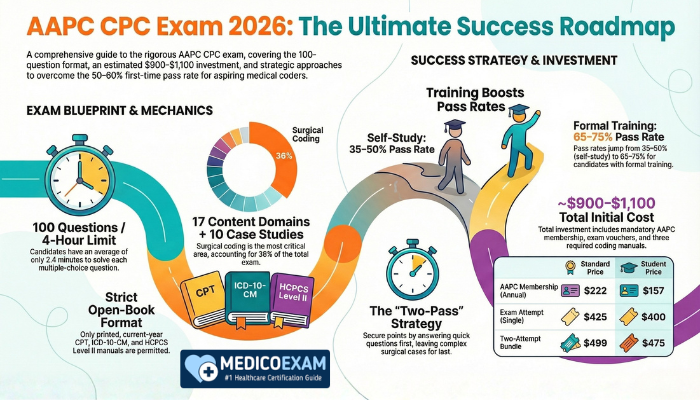
The Certified Professional Coder (CPC) exam is administered by the American Academy of Professional Coders (AAPC) and is the industry's leading credential for physician-office (outpatient) medical coding professionals. The CPC certification validates your ability to correctly assign CPT, ICD-10-CM, and HCPCS Level II codes from medical documentation, and it is recognized by healthcare employers across hospitals, physician practices, insurance companies, and government agencies.
The CPC exam is an open-book test, meaning candidates are permitted — and expected — to bring current-year printed editions of the CPT Professional Edition, ICD-10-CM code set, and HCPCS Level II manual into the exam room. However, the open-book format does not make the exam easy. With only 2.4 minutes per question, candidates who cannot navigate their coding manuals quickly will run out of time.
The AAPC reports that over 200,000 individuals hold the CPC credential, making it the single most common medical coding certification in the United States. Employers consistently list CPC certification as a preferred or required qualification in medical coding job postings, and holding this credential opens doors to roles in physician offices, outpatient clinics, ambulatory surgery centers, insurance companies, and remote coding positions.
The CPC exam is distinct from hospital-based coding certifications like the AHIMA CCS. While the CCS tests inpatient coding with ICD-10-PCS procedure codes and clinical simulation scenarios, the CPC focuses exclusively on physician/outpatient coding using CPT, ICD-10-CM, and HCPCS Level II. This outpatient focus makes the CPC the most relevant credential for candidates targeting physician-office, ambulatory, or remote outpatient coding roles. Understanding this distinction helps you choose the right certification for your career goals.
How Many Questions Are on the CPC Exam?
The CPC exam consists of exactly 100 multiple-choice questions to be completed in 4 hours (240 minutes). This gives candidates an average of 2.4 minutes per question a pace that requires efficient code-book navigation and disciplined time management.
The 100 questions span 17 distinct content domains covering medical terminology, anatomy, compliance, coding guidelines, ICD-10-CM diagnosis coding, HCPCS Level II, evaluation and management (E/M) services, anesthesia, and surgical coding across multiple body systems. In addition to standalone questions, the exam includes 10 practical case studies, each presenting a clinical scenario (such as an operative report) that requires integrating multiple coding skills to identify the correct answer.
Questions are scenario-based, not memorization-based. You will be given clinical documentation such as operative notes, encounter summaries, or pathology reports and must determine the correct procedure code, diagnosis code, or modifier. The most heavily weighted sections are surgical coding, modifier usage, and regulatory accuracy.
The exam is computer-based, administered either at a Pearson VUE testing center or online through a live remote proctor with webcam monitoring. Both testing modes present the same exam content and are timed identically.
How Much Does the CPC Exam Cost in 2026?
The CPC exam costs $425 for a single attempt or $499 for a two-attempt bundle for standard (non-student) candidates, according to the AAPC exam pricing page. Students enrolled in accredited coding programs receive a discounted rate of $400 for one attempt or $475 for two attempts.
Beyond the exam fee, all candidates must hold an active AAPC membership before they can schedule their test. The annual AAPC membership fee is $222 for individual professionals and $157 for students. This membership is non-optional, you cannot register for the CPC exam without it.
Full CPC Exam Cost Breakdown (2026)
| Cost Component | Standard Price | Student Price |
|---|---|---|
| AAPC Membership (annual) | $222 | $157 |
| Single Exam Attempt | $425 | $400 |
| Two-Attempt Bundle | $499 | $475 |
| Total (Single Attempt) | $647 | $557 |
| Total (Two Attempts) | $721 | $632 |
| Current-Year CPT Manual | ~$110 | ~$110 |
| Current-Year ICD-10-CM Manual | ~$100 | ~$100 |
| Current-Year HCPCS Level II Manual | ~$65 | ~$65 |
| AAPC Study Guide (optional) | ~$160 | ~$160 |
When factoring in the cost of required coding manuals (CPT, ICD-10-CM, HCPCS Level II), the total investment for a first-time CPC exam candidate typically ranges from $900 to $1,100. The two-attempt bundle offers significant savings effectively $351 off the cost of purchasing a second single attempt separately and is strongly recommended for first-time test-takers given the exam's estimated 50–60% first-time pass rate.
Some employers and training programs offer exam sponsorship or reimbursement programs. If your employer has a tuition reimbursement or professional development benefit, the CPC exam and AAPC membership may qualify. Additionally, students enrolled in AAPC-recognized training programs may have access to bundled pricing that includes membership, study materials, and exam vouchers at a discount compared to purchasing each component separately. Always check with your program or employer before paying out of pocket.
What Is the CPC Exam Pass Rate?
The AAPC does not publish official CPC exam pass rates, which creates a frustrating information gap for candidates. Based on aggregate data from training programs, industry surveys, and AAPC community forums estimates the following pass rates for 2026:
| Metric | Estimated Rate |
|---|---|
| First-time pass rate (all candidates) | 50–60% |
| First-time pass rate (with formal training) | 65–75% |
| First-time pass rate (self-study only) | 35–50% |
| Retake pass rate (second attempt) | 60–70% |
| Eventual pass rate (all attempts combined) | 70–80% |
These numbers mean that roughly 4 to 5 out of every 10 first-time test-takers fail the CPC exam. Candidates who complete accredited training programs or structured study courses pass at significantly higher rates (65–75%) than self-study candidates (35–50%).
Three factors make the CPC exam particularly challenging: (1) the breadth of 17 content areas spanning anatomy, coding systems, and medical specialties;(2) the time pressure of 2.4 minutes per question in an open-book format; and (3) the scenario-based question design that requires applying coding guidelines to clinical documentation rather than simple recall.
The pass rate gap between formally trained candidates (65–75%) and self-study candidates (35–50%) underscores the value of structured preparation. Self-study candidates often underestimate the exam's difficulty, skip timed practice exams, or fail to develop efficient code-book navigation skills. If you are self-studying, compensate by taking at least three full-length timed mock exams and spending extra time tabbing and navigating your coding manuals under time pressure.
What Topics Does the CPC Exam Cover?
The CPC exam tests knowledge across 17 content domains plus 10 integrated practical case studies. Each domain is assigned a specific number of questions, allowing candidates to allocate study time proportionally.
CPC Exam Domain Breakdown (All 17 Categories + Cases)
| # | Content Domain | Number of Questions | % of Exam |
|---|---|---|---|
| 1 | Medical Terminology | 4 | 4% |
| 2 | Anatomy | 4 | 4% |
| 3 | Coding Guidelines (including modifier use) | 7 | 7% |
| 4 | Compliance and Regulatory Topics | 3 | 3% |
| 5 | ICD-10-CM Code Application and Official Guidelines | 5 | 5% |
| 6 | HCPCS Level II (including modifiers) | 3 | 3% |
| 7 | Evaluation and Management (E/M) Services | 6 | 6% |
| 8 | Anesthesia | 4 | 4% |
| 9 | Integumentary System (CPT 10000 Series) | 6 | 6% |
| 10 | Musculoskeletal System (CPT 20000 Series) | 6 | 6% |
| 11 | Respiratory, Cardiovascular, Hemic/Lymphatic (CPT 30000 Series) | 6 | 6% |
| 12 | Digestive System (CPT 40000 Series) | 6 | 6% |
| 13 | Urinary, Reproductive, Endocrine (CPT 50000 Series) | 6 | 6% |
| 14 | Nervous System (CPT 60000 Series) | 6 | 6% |
| 15 | Radiology | 6 | 6% |
| 16 | Pathology and Laboratory | 6 | 6% |
| 17 | Medicine | 6 | 6% |
| — | Practical Case Studies | 10 | 10% |
| — | TOTAL | 100 | 100% |
What Are the CPC Exam Eligibility Requirements?
There are no formal prerequisites to sit for the CPC exam. You do not need a specific degree, prior work experience, or completion of an accredited training program to register. However, there are important credential distinctions based on your experience level.
If you pass the CPC exam with fewer than two years of professional coding experience, the AAPC awards you the CPC-A (Apprentice) designation rather than the full CPC credential. According to Ultimate Medical Academy, the "A" designation is removed once you meet one of the following requirements:
Two years of on-the-job medical coding experience, verified by two signed letters of recommendation (one from a supervisor and one from a colleague), OR
One year of on-the-job coding experience plus completion of at least 80 contact hours of a coding preparation course, verified by one signed letter from your employer
To register for the CPC exam, you must:
-
Purchase an AAPC membership ($222 for professionals, $157 for students)
-
Select your exam attempt package ($425 for one attempt, $499 for two attempts)
-
Create an AAPC account and upload two forms of government-issued identification
-
Schedule your exam through the AAPC's testing platform, choosing either an in-person testing center or live remote proctoring
-
Acquire current-year coding manuals (CPT, ICD-10-CM, HCPCS Level II) — these are required for the open-book exam
How Long Should You Study for the CPC Exam?
Most successful CPC candidates study for 8 to 12 weeks, dedicating 8 to 15 hours per week, for a total of approximately 80 to 150 study hours. Candidates with prior coding education or work experience can sometimes prepare in 6 to 8 weeks, while those studying from scratch may need the full 12 weeks or longer.
The key benchmark: do not schedule your official exam until you are consistently scoring 80% or higher on full-length timed practice exams. Candidates who schedule their exam while scoring only 65–70% on practice tests often fail because the real exam is harder than most practice materials.
12-Week CPC Exam Study Plan
| Week | Focus Area | Key Activities | Hours/Week |
|---|---|---|---|
| Week 1 | Medical Terminology & Anatomy | Learn prefixes, suffixes, root words; review body systems and anatomical planes | 8–10 |
| Week 2 | Compliance, Regulatory & Coding Guidelines | Study OIG compliance, modifier rules, bundling/unbundling, NCCI edits | 8–10 |
| Week 3 | ICD-10-CM Diagnosis Coding | Master ICD-10-CM Official Guidelines, sequencing rules, combination codes | 10–12 |
| Week 4 | HCPCS Level II & Modifiers | Supply codes, DME coding, modifier application (25, 59, 51, 76, 77) | 8–10 |
| Week 5 | E/M Services | 2021 E/M guidelines for office visits, MDM components, time-based coding | 10–12 |
| Week 6 | Surgery — Integumentary & Musculoskeletal | Wound repair, skin grafts, fracture care, arthroscopy codes | 10–12 |
| Week 7 | Surgery — Respiratory & Cardiovascular | Bronchoscopy, CABG, catheterization, pacemaker/defibrillator coding | 10–12 |
| Week 8 | Surgery — Digestive, Urinary, Reproductive | Endoscopy hierarchy, lithotripsy, maternity coding packages | 10–12 |
| Week 9 | Surgery — Nervous System, Anesthesia | Spinal injection codes, nerve blocks, base units + time units formula | 10–12 |
| Week 10 | Radiology, Pathology/Lab & Medicine | Component coding, panel rules, infusion hierarchies, immunization admin | 10–12 |
| Week 11 | Practical Case Studies & Full Mock Exam #1 | Complete 10-case practice sets; take first full 100-question, 4-hour timed mock exam | 12–15 |
| Week 12 | Weak Area Review & Full Mock Exam #2 | Focus on domains scoring below 70%; take second full timed mock exam; code-book tabbing | 12–15 |
Study Time Allocation by Exam Weight
| Section Group | % of Exam | Recommended Study Hours |
|---|---|---|
| Surgery (all subsections, domains 9–14) | 36% | 30–40 hours |
| ICD-10-CM | 5% | 10–12 hours |
| E/M Services | 6% | 10–12 hours |
| Coding Guidelines & Compliance | 10% | 8–10 hours |
| Medicine, Radiology, Path/Lab | 18% | 15–18 hours |
| Anesthesia | 4% | 4–6 hours |
| Medical Terminology & Anatomy | 8% | 6–8 hours |
| HCPCS Level II | 3% | 3–4 hours |
| Practice Exams (full-length timed) | — | 12–16 hours |
What Study Materials Are Best for CPC Exam Preparation?
Choosing the right study resources directly impacts your pass probability. Candidates who use structured study programs pass at rates of 65–75% compared to just 35–50% for self-study candidates.
CPC Study Material Comparison Table
| Resource | Type | Best For | Approximate Cost | Pros | Cons |
|---|---|---|---|---|---|
| AAPC Official CPC Study Guide | Textbook | Understanding AAPC's rationale and exam structure | ~$160 | Aligned with exam content; official source | Dense; no adaptive learning |
| AAPC Practice Exams (3 available) | Practice Tests | Simulating real exam difficulty | ~$65 each | Closest match to real exam | Limited to 50 questions each |
| AAPC CPC Preparation Course | Online Course | Comprehensive structured learning | ~$600–$800 | Instructor-led; covers all domains | Expensive; lengthy |
| MedicoExam Practice Tests | Simulation Tests | Timed, realistic test-day simulation | Varies | Pressure-tested format; identifies weak areas | Supplement, not standalone |
| CPT Professional Edition (current year) | Coding Manual | Required for exam day | ~$110 | Must-have; learn to navigate it thoroughly | No practice questions |
| ICD-10-CM Code Set (current year) | Coding Manual | Required for exam day | ~$100 | Essential reference | Need guideline familiarity |
| HCPCS Level II Manual (current year) | Coding Manual | Required for exam day | ~$65 | Covers supply/DME codes | Smaller section weight |
| Third-Party Prep Books (Mometrix, etc.) | Study Guide | Budget-friendly alternative | ~$40–$80 | Affordable; good overviews | May not match AAPC style |
The most effective study strategy combines multiple resource types: use the AAPC Study Guide for content learning, coding manuals for hands-on navigation practice, and simulation-based practice tests (like MedicoExam) for timed exam rehearsals.
What Should You Bring on CPC Exam Day?
The CPC exam is open-book, but there are strict rules about what is and is not permitted. Arriving prepared prevents delays and reduces exam-day anxiety.
CPC Exam Day Checklist
Required Items:
✅ Two forms of valid, government-issued photo identification
✅ Current-year CPT Professional Edition (printed, not electronic)
✅ Current-year ICD-10-CM code set (printed)
✅ Current-year HCPCS Level II manual (printed)
✅ AAPC exam confirmation or scheduling receipt
Allowed in Coding Manuals:
✅ Tabs, sticky notes, and color-coded page markers
✅ Highlighting and underlining in the printed manuals
✅ Handwritten notes inside your coding manuals (per AAPC policy)
NOT Allowed:
❌ Electronic devices (phones, tablets, smart watches)
❌ Electronic or online versions of coding manuals
❌ Loose papers or separate note sheets
❌ Food or beverages in the testing area (store in a locker for break use)
❌ Calculators (an on-screen calculator is provided for computer-based tests)
Pro Tip: Tabbing your code books is the single biggest time-saver on exam day. Create tabs for frequently accessed sections (E/M guidelines, modifier appendix, surgery subsection guidelines) and practice locating codes with your tabs before exam day.
For remote proctored exams: Your testing area must be clear of all materials except your computer, coding manuals, and ID. The proctor will ask you to show your workspace via webcam before the exam begins. Ensure your desk is clean, your room is quiet, and no one else is in the room during the exam. Technical issues (internet disconnection, webcam failure) can disrupt your exam session, so test your equipment thoroughly the day before.
How to Register for the CPC Exam
Registering for the CPC exam involves five steps:
-
Create an AAPC Account: Visit aapc.com and set up your member profile with your full legal name, email address, and contact information. Your name must exactly match your government-issued ID.
-
Purchase AAPC Membership: Select either the professional membership ($222/year) or student membership ($157/year). Membership must be active before you can register for the exam.
-
Purchase Your Exam Voucher: Choose either the single-attempt ($425) or two-attempt bundle ($499). The two-attempt bundle is recommended for first-time candidates given the exam's difficulty.
-
Upload Identification Documents: Submit two forms of government-issued photo ID to your AAPC digital locker. If you have two or more years of coding experience and want the full CPC credential (without the Apprentice "A"), also upload two verification letters from employers.
-
Schedule Your Exam: Select your preferred testing mode — in-person at a Pearson VUE or Meazure Learning testing center, or online via live remote proctoring. Choose a date and time that allows you to complete your study plan and reach the 80%+ practice exam benchmark.
Registration timeline: Most candidates can complete the registration process in 3–5 business days. However, scheduling availability at testing centers varies by location and season — popular months (January, April, and October) tend to fill up faster due to new code-set releases and training program graduation cycles. Register at least 2–4 weeks before your desired exam date to secure your preferred time slot.
Maintaining your certification: Once you pass the CPC exam, you must complete 36 Continuing Education Units (CEUs) every two years to maintain your active certification status. At least 1 CEU must be in compliance/regulatory topics. The AAPC offers CEU opportunities through webinars, conferences, workshops, and its online learning platform. Failure to complete CEUs by your renewal deadline results in credential revocation, which requires retaking the exam to reinstate.
What Happens If You Fail the CPC Exam?
CPC Retake Policy
| Detail | Policy |
|---|---|
| Retake Fee | $425 per single attempt (or use second attempt from $499 bundle) |
| Waiting Period | None — you can schedule your retake immediately |
| Number of Retakes Allowed | Unlimited |
| Score Report | Pass/fail with overall percentage score (no section-by-section breakdown) |
Important retake insight: Candidates who only study their weak topics during retake prep often fail again because they lose ground on areas they previously passed. The recommended approach is to dedicate 60% of retake study time to weak areas and 40% to maintaining your strengths.
Retake Study Strategy
-
Review your overall percentage to gauge how far below 70% you scored
-
Recall which question types took the longest, this reveals time management gaps
-
Take a full diagnostic practice exam to identify your actual weak sections with current scoring
-
Rebuild your code book tabs based on where you lost the most time
-
Score 80–85% on practice exams before scheduling your retake
-
Practice the two-pass strategy: answer quick questions first (pass 1), then tackle complex surgical/case questions (pass 2)
How Does CPC Certification Affect Your Salary?
CPC certification has a measurable and significant impact on medical coding salaries. According to PayScale/Hourly_Rate), the average hourly pay for a CPC-certified coder in 2026 is $23.39 per hour, with a total annual compensation range of $38,000 to $64,000 depending on experience, location, and specialization.
CPC Salary by Experience Level
| Career Stage | Credential | Annual Salary Range |
|---|---|---|
| Entry-Level | CPC-A (Apprentice) | $38,000–$48,000 |
| Mid-Career | CPC (2–5 years) | $47,000–$62,000 |
| Specialized | CPC + Specialty (e.g., CIRCC, CIC) | $55,000–$70,000 |
| Senior/Auditor | CPC + 5+ years | $58,000–$75,000 |
| Coding Manager/Director | CPC + leadership experience | $70,000–$90,000+ |
The Bureau of Labor Statistics reports a median annual salary of $48,780 for medical records specialists, with 9% projected job growth through 2033. CPC-certified coders consistently earn above this median. In top-paying states like California, the mean annual salary for CPC coders reaches $62,430, according to ZipRecruiter.
Remote coding positions increasingly common post-pandemic pay $45,000 to $70,000 for CPC holders, with the added benefit of location flexibility. The return on investment is clear: a total exam investment of $700–$1,100 can yield a salary increase of $5,000–$15,000 or more within the first year of certification.
Factors That Increase CPC Salary
Several factors can push your CPC salary above the median:
-
Specialization: Adding a specialty credential on top of your CPC (such as CIRCC for interventional radiology, CIC for inpatient coding, or CPMA for auditing) increases your value to employers and typically adds $5,000–$10,000 to your annual salary.
-
Experience: The biggest salary jumps occur between years 1–2 (moving from CPC-A to full CPC) and years 3–5 (qualifying for senior coder or auditor roles).
-
Location: Metropolitan areas and high-cost-of-living states (California, Massachusetts, New York, Washington) pay significantly above the national median. California CPC coders earn a mean of $62,430 annually, according to ZipRecruiter.
-
Remote work: The explosion of remote coding positions post-pandemic has expanded access to higher-paying employers regardless of geographic location. Remote CPC positions typically pay $45,000–$70,000 depending on the employer and specialty.
-
Industry sector: Coders working for insurance companies, consulting firms, and large health systems generally earn more than those in small physician practices.
Expert Insight
"The CPC exam is deceptively challenging because it's open-book. Candidates assume they can look everything up, but with only 2.4 minutes per question, you need to know where codes are before you start searching. The two-pass strategy — answer easy questions first, then return to complex surgical cases is the single most effective time management technique I recommend to every candidate. Tab your books, practice under timed conditions, and don't schedule your exam until you're hitting 80% on mock tests." — **Sarah Mitchell, CPC, CPC-I, CPMA**, Medical Coding Educator with 12 years of experience in outpatient coding and CPC exam preparation
Frequently Asked Questions
1. Is the CPC exam an open-book test?
-
Yes, the CPC exam is open-book. You are required to bring current-year printed editions of the CPT Professional Edition, ICD-10-CM code set, and HCPCS Level II manual. Electronic or digital versions are not permitted. You may highlight, underline, tab, and write notes directly in your printed manuals. Loose papers, separate note sheets, and printed study guides are not allowed at the testing station. The open-book format is designed to test your ability to apply coding knowledge — not memorize codes — so invest significant study time in learning to navigate your manuals efficiently.
2. How many questions are on the CPC exam, and what types?
-
The CPC exam has exactly 100 multiple-choice questions. These include standalone questions testing individual concepts (such as anatomy, terminology, or coding guidelines) and 10 practical case studies that present clinical documentation like operative reports, requiring you to integrate multiple coding skills to select the correct code. All questions are multiple-choice with a single correct answer. There are no fill-in-the-blank, essay, or select-all-that-apply questions on the current CPC exam format.
3. What score do I need to pass the CPC exam?
-
You need a score of 70% — meaning 70 out of 100 questions answered correctly — to pass the CPC exam. There is no penalty for guessing; unanswered questions are scored as incorrect. This means you can miss up to 30 questions and still pass. Given the time pressure, if you have fewer than 5 minutes remaining and have unanswered questions, make your best educated guess rather than leaving them blank.
4. How long do I have to complete the CPC exam?
-
Candidates are given exactly 4 hours (240 minutes) to complete all 100 questions. This translates to an average of 2.4 minutes per question. However, time requirements vary by question type: ICD-10-CM and compliance questions typically take 1–2 minutes, while surgical coding and case study questions may take 3–5 minutes each. Effective time management is the difference between passing and failing for many candidates.
5. Can I take the CPC exam online from home?
- Yes. The AAPC offers live remote proctoring, which allows you to take the CPC exam from your home or office. Your computer must have a working webcam, microphone, and stable internet connection. A proctor monitors you via video throughout the exam. You must have your physical coding manuals at your desk. The same exam content, question count, and time limit apply whether you test remotely or at a physical testing center.
6. What happens if I fail the CPC exam?
- If you fail, your score report will show your overall percentage (but no section-by-section breakdown). If you purchased the two-attempt bundle ($499), you can use your second attempt immediately — there is no mandatory waiting period. If you purchased a single attempt, you will need to pay $425 for a new exam voucher.
7. Do I need work experience to take the CPC exam?
-
No prior work experience is required to sit for the CPC exam. However, if you pass with fewer than two years of professional coding experience, you receive the CPC-A (Apprentice) designation. To remove the "A" and hold the full CPC credential, you must verify either two years of coding experience (with two employer letters) or one year of experience plus 80 contact hours of coding coursework, according to Ultimate Medical Academy.
8. How much does a CPC-certified coder earn?
-
CPC-certified coders earn an average of $23.39 per hour, or approximately $48,600 annually, according to PayScale 2026 data/Hourly_Rate). Entry-level CPC-A holders earn $38,000–$48,000, while experienced CPC coders earn $47,000–$62,000. Specialized certifications and management roles can push salaries to $70,000–$90,000. The Bureau of Labor Statistics projects 9% job growth for medical records and coding specialists through 2033.
9. How quickly will I receive my CPC exam results?
-
Exam results are typically available within 7 to 10 business days in your online AAPC account. You will receive an email notification when your results are posted. The score report shows pass/fail and your overall percentage. If you passed, your CPC or CPC-A certificate and digital badge will be available for download through your AAPC account. There is no expedited results service — all candidates receive results within the same timeframe.
10. What are the most common reasons candidates fail the CPC exam?
-
The seven most common failure causes are: (1) poor time management — spending too long on surgical questions and running out of time; (2) reading case studies top-to-bottom instead of checking answer codes against the documentation; (3) insufficient practice with timed exams; (4) not tabbing coding manuals for quick navigation; (5) memorizing codes instead of learning manual navigation; (6) taking the exam while scoring below 80% on practice tests; and (7) ignoring test anxiety management. The two-pass strategy — answering easy questions first, then returning to complex questions — is the most widely recommended approach.
Ready to Pass the CPC Exam?
Mastering the CPC exam requires more than reading a study guide it demands practicing under realistic, timed test conditions with the same pressure you will face on exam day. Identify your weak domains, sharpen your coding manual navigation speed, and build the stamina to maintain focus across a full 4-hour exam.
Try MedicoExam's simulation-based CPC practice tests to benchmark your score against the 70% passing threshold, drill the 17 content domains with scenario-based questions, and walk into your exam with confidence. Start your preparation today at MedicoExam.com.


