
ACRP Certification Explained: A Career Roadmap to Becoming a Certified CCRA
 Clinical research is no longer a niche career hidden inside pharmaceutical companies. It has become a global, compliance-driven profession where accuracy, ethics, and regulatory knowledge directly affect patient safety and trial outcomes. For professionals aiming to stand out in this regulated environment, ACRP Certification has emerged as a defining credential particularly the CCRA certification for Clinical Research Associates.
This guide walks you through what ACRP certification is, how the CCRA credential works, what the exam actually tests, and whether it’s worth your time and investment. If you are transitioning from healthcare, compliance, quality assurance, or audit-focused roles or planning a long-term career in clinical trials this roadmap is built for you.
What Is ACRP Certification and Why It Matters for Clinical Research Professionals
ACRP Certification is a professional credential awarded by the Association of Clinical Research Professionals to validate real-world competency in clinical research roles, regulatory compliance, Good Clinical Practice (GCP), and ethical trial conduc
ACRP certifications are globally recognized and role-specific. Unlike academic degrees, they are experience-based credentials, meaning candidates must demonstrate hands-on involvement in regulated clinical research environments.
Why ACRP Certification Has Industry Weight
ACRP certification matters because it:
-
Validates job-ready competence, not just theoretical knowledge
-
Aligns directly with ICH-GCP, FDA, and EMA expectations
-
Is recognized by sponsors, CROs, and research institutions worldwide
-
Demonstrates ethical accountability in participant safety and data integrity
For employers, it reduces onboarding risk. For professionals, it signals credibility in an industry where mistakes are costly.
ACRP Certification vs Other Clinical Research Credentials
ACRP certifications differ from training certificates because they:
-
Require verifiable work experience
-
Are governed by a professional association, not vendors
-
Emphasize regulatory compliance and operational excellence
Among all ACRP credentials, the ACRP CCRA certification is the most sought-after for professionals responsible for site monitoring and trial oversight.
Certified Clinical Research Associate (CCRA): Roles, Responsibilities, and Career Opportunities
A Certified Clinical Research Associate (CCRA) is a monitoring professional responsible for ensuring clinical trial sites comply with protocols, regulations, and ethical standards while maintaining high-quality data.
What a CCRA Actually Does in Real Projects
CCRA responsibilities extend beyond site visits. In practice, CCRAs:
-
Verify protocol adherence at investigator sites
-
Monitor informed consent documentation
-
Ensure accurate source data verification (SDV)
-
Identify compliance risks before audits
-
Act as the liaison between sponsors and research sites
This role demands regulatory judgment, not just checklist execution.
Career Paths Opened by CCRA Certification
Professionals holding ACRP CCRA certification commonly move into roles such as:
-
Senior CRA
-
Lead CRA
-
Clinical Trial Manager
-
Quality Assurance Auditor
-
Regulatory Affairs Specialist
CCRA certification is also recognized internationally, supporting mobility across regions.
Why Employers Prefer Certified Clinical Research Associates
From a hiring standpoint, certified CCRAs:
-
Require less compliance training
-
Understand inspection readiness
-
Reduce audit findings and protocol deviations
-
Are prepared for sponsor and regulatory scrutiny
This makes ACRP certification worth it for long-term career stability.
ACRP CCRA Certification Eligibility, Requirements, and Cost Breakdown
To earn ACRP CCRA certification, candidates must demonstrate 3,000 hours of verifiable clinical research experience and pass a standardized, role-specific certification exam.
CCRA Certification Requirements
Eligibility typically includes:
-
3,000 documented hours performing CRA-level tasks
-
Experience aligned with monitoring, site management, and GCP
-
Agreement to ACRP’s Code of Ethics
Experience is reviewed before exam approval, ensuring only qualified professionals test.
ACRP Certification Cost Explained
| Item | Cost |
|---|---|
|
Single Exam Attempt
|
$425 |
| Two Exam Attempts | $499 |
| Recertification | Varies by cycle |
This CCRA certification cost reflects professional credentialing standards rather than training fees.
Hidden Costs to Consider
While exam fees are fixed, candidates should also plan for:
-
Study resources
-
Practice exams
-
Time investment (8–12 weeks typical)
Many candidates offset preparation risk by using structured practice-based tools, such as scenario-driven assessments available through MedicoExam’s ACRP preparation resources.
You can explore structured preparation options through MedicoExam’s ACRP exam practice section, designed around exam-mapped scenarios rather than rote memorization.
CCRA Certification Exam Overview and Preparation Strategy
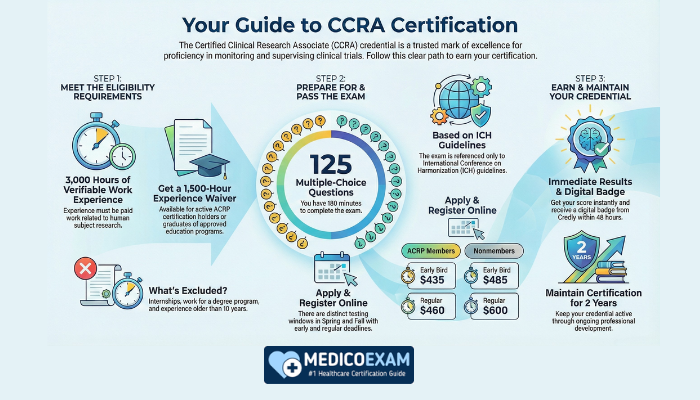
The ACRP CCRA certification exam consists of 125 multiple-choice questions, completed in 180 minutes, testing applied knowledge across six clinical research domains.
CCRA Exam Format at a Glance
-
Questions: 125 multiple choice
-
Duration: 3 hours
-
Passing standard: Scaled score
-
Delivery: Computer-based
Examination Content Outline (What Really Matters)
|
Domain
|
Weight
|
|---|---|
|
Scientific Concepts & Research Design
|
12%
|
|
Ethical & Participant Safety
|
18%
|
|
Regulatory Requirements
|
14%
|
|
Clinical Trial Operations (GCP)
|
18%
|
|
Study & Site Management
|
25%
|
|
Data Quality
|
13%
|
The exam favors judgment-based decision-making, not memorization.
Common Mistakes Candidates Make
Experienced candidates often fail because they:
-
Underestimate regulatory nuance
-
Memorize definitions instead of applying principles
-
Ignore study management scenarios
-
Skip timed practice under exam condition
Practical ACRP Certification Exam Preparation Strategy
Effective preparation includes:
-
Mapping experience gaps to exam domains
-
Reviewing official ACRP exam content outlines
-
Practicing scenario-based questions
-
Simulating full-length exams under time pressure
Structured preparation tools—such as role-aligned mock exams—help candidates internalize how questions are framed. MedicoExam’s clinical research certification practice tests are commonly used for this purpose, especially for readiness benchmarking.
Is ACRP Certification Worth It? Career Growth, Salary Impact, and Industry Demand
Yes, ACRP certification is worth it for professionals seeking long-term growth in regulated clinical research roles, particularly in monitoring, quality, and compliance-focused positions.
Career ROI of CCRA Certification
Professionals with CCRA certification often report:
-
Faster promotion timelines
-
Greater role autonomy
-
Higher project responsibility
-
Increased credibility during audits
While salary impact varies by region, certified CCRAs generally command stronger negotiating leverage.
Industry Demand Trends
Clinical trials continue to expand globally, increasing demand for:
-
Compliance-trained CRAs
-
Inspection-ready professionals
-
Data-quality-focused monitors
Regulatory agencies increasingly expect certified oversight, making credentials like ACRP CCRA certification a strategic asset.
Who Benefits Most from ACRP Certification
ACRP certification delivers the most value to:
-
Aspiring CRAs transitioning from CRC roles
-
Healthcare professionals entering research
-
Quality or compliance professionals moving into trials
-
Employers seeking standardized competency benchmarks
Frequently Asked Questions (FAQs)
Q1. What is ACRP certification?
ACRP certification is a professional credential validating applied clinical research competence, ethical conduct, and regulatory knowledge. It is issued by the Association of Clinical Research Professionals and is experience-based rather than training-based.
Q2. How difficult is the CCRA certification exam?
The exam is moderately challenging and focuses on real-world judgment. Candidates with hands-on monitoring experience perform better than those relying solely on study guides.
Q3. How long does CCRA certification preparation take?
Generally, most candidates prepare within 8–12 weeks; however, the exact timeline ultimately depends on their experience level and familiarity with regulatory requirements and site management scenarios
Q4. Is ACRP certification worth it for career changers?
Yes, especially for professionals transitioning from healthcare, quality assurance, or regulatory roles. However, required work experience must be met before exam eligibility.
Q5. What is the retake policy for the ACRP exam?
Candidates can purchase a two-attempt exam option. Retake eligibility and waiting periods are defined by ACRP policies and may change over time.
Q6. Do practice tests really help for CCRA exams?
Practice tests are useful when they mirror scenario-based decision-making. Timed simulations help candidates manage exam pressure and question framing.
Q7. How long is CCRA certification valid?
Certification validity and renewal requirements vary by cycle. Professionals typically maintain certification through continuing education and professional activities.
Q8. Is ACRP certification globally recognized?
Yes. ACRP certification is recognized by sponsors, CROs, and research institutions across North America, Europe, and Asia-Pacific regions.
Q9. What experience counts toward CCRA eligibility?
To meet the eligibility requirements, candidates must demonstrate relevant experience in key CRA functions.
Q10. Where can I find official ACRP guidance?
Official eligibility criteria and exam outlines are published on ACRP’s website and supporting documentation, including examination content outlines.
Conclusion: Turning ACRP Certification into a Career Advantage
ACRP Certification and specifically the CCRA certification is not a shortcut credential. It is a professional validation earned through experience, ethical accountability, and applied knowledge. For those serious about advancing in clinical research, it offers clarity, credibility, and long-term career security.
When paired with structured preparation, official guidance, and realistic practice, ACRP certification becomes more than an exam, it becomes a professional milestone. If you are planning your next move in clinical research, this credential can anchor your growth for years to come.
For additional guidance and structured preparation support, MedicoExam’s ACRP resource hub provides exam-aligned insights tailored to candidate needs.


