
Two Routes Into Inpatient Coding: Should You Sit the CCS or CIC?
The AHIMA Certified Coding Specialist (CCS) and the AAPC Certified Inpatient Coder (CIC) both point at hospital inpatient coding, but they come from different certifying bodies and are built as different kinds of exam. The CCS has 107 questions in four hours, with a scaled passing score of 300 on a 100 to 400 scale. The CIC has 40 multiple-choice questions plus seven inpatient coding cases, also in four hours, and needs 70 percent.
If you have already chosen, you can go straight to a practice test for the CCS or for the CIC. If you are still deciding, this guide sets the two side by side. The figures that follow are taken from MedicoExam's exam data sheet, the certifying bodies' own pages (AHIMA's CCS page and AAPC's CIC page), the MedicoExam syllabus and product pages, or plain arithmetic on those values.
Which inpatient coding credential should you earn, the CCS or the CIC?
The honest answer is that it depends on where you want to work and how you like to be tested. Both credentials show that you can assign ICD-10-CM diagnosis codes and ICD-10-PCS procedure codes for hospital stays and apply the rules that group those codes into payment categories. Neither is a general "best" credential, and this guide does not rank one above the other.
AHIMA describes the CCS as designed for people skilled in classifying medical data from records, and as a natural progression for professionals who already code inpatient and outpatient records or who hold the entry-level CCA. AAPC describes the CIC as a way to start or grow an inpatient coding career, aimed at new coders who want to begin in the hospital setting, seasoned coders still without a credential, wanting a way to show what they can do, and certified coders who want to move into inpatient coding and MS-DRG assignment.
So the first difference is the road each credential assumes you are on. The CCS assumes you have been coding records and want to prove mastery. The CIC speaks to someone who wants the hospital inpatient setting as a specialty from the start. This is study guidance for an exam, not clinical direction of any kind.
How do the CCS and CIC exams compare at a glance?
The table lists the published exam details side by side. Question counts, time limit, fees and pass marks come from the MedicoExam exam data sheet and match the certifying bodies' pages.
| Detail | CCS (AHIMA) | CIC (AAPC) |
|---|---|---|
| Questions | 107, made up of 97 scored items and 10 pretest items | 40 multiple-choice questions plus seven inpatient cases with fill-in-the-blank answers |
| Time allowed | 240 minutes (four hours) | 240 minutes |
| Passing score | A scaled 300 (range 100 to 400), roughly 66 percent | 70 percent of the exam |
| Exam fee | $299 for AHIMA members, $399 for non-members | Single attempt $425; two attempts $499 |
| Code books | Required code books from AHIMA's 2026 list must be brought to the test centre | Open code books (manuals) |
| Where it is taken | Pearson VUE testing centre | From home with a remote proctor, or at a testing centre |
| Credential cycle | Two-year renewal period | Two-year renewal period |
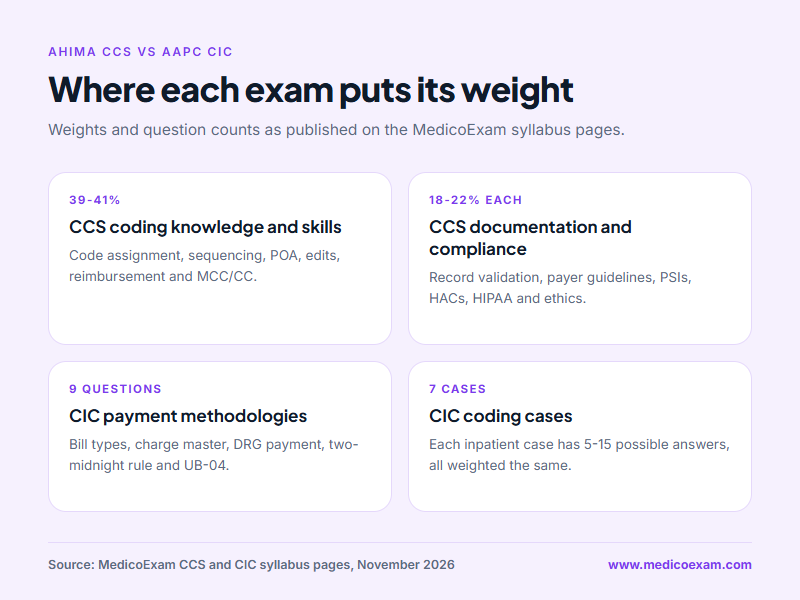
The shared figure is the four-hour limit. The CCS spreads it across 107 questions, which is about 135 seconds for each question. The CIC exam gives you the same four hours for 40 multiple-choice questions and seven cases, so a good share of your time goes into the cases, where you code a whole inpatient record rather than answer a single question.
Who is each credential built for?
AHIMA's page for the CCS recommends, but does not require, one of several routes before you apply. You can complete courses in anatomy and physiology, pathophysiology, pharmacology, medical terminology, reimbursement methodology, intermediate or advanced ICD diagnostic coding and procedural coding, plus one year of coding experience applying codes. You can have two years of related coding experience. You can hold the CCA plus one year of experience, hold a coding credential from another certifying organisation plus one year of experience, or hold a CCS-P, RHIT or RHIA credential.
That list tells you the CCS is pitched at someone with some practice behind them. A reader straight out of a coding course can still sit it, because the routes are recommendations, but the exam rewards time spent applying codes to real records.
AAPC's CIC page names four groups: new entrants to medical coding who want to begin in the inpatient hospital setting, coders with experience but no certificate who hope to prove their ability, certified coders who want to expand into inpatient coding and MS-DRG assignment, and healthcare professionals moving into inpatient coding, auditing or compliance roles. The saved page lists no required courses or years of experience, so confirm the current rules with AAPC before you book.
For a single-credential look at the AHIMA side, MedicoExam has an earlier article on AHIMA's coding specialist route, and for the AAPC side a piece on why coders should reconsider their inpatient future.
If you are a certified outpatient coder looking to add hospital skills, the CIC page speaks to you directly. If you already work in a hospital coding department and want a credential from the health information management side, the CCS is the better match to AHIMA's own description.
What does each exam actually cover?
The two blueprints are organised differently, and that matters when you build a study plan. The CCS publishes percentage weights for five domains. The CIC publishes a number of questions for each of seven areas.
On the CCS, Coding Knowledge and Skills carries 39 to 41 percent of the exam. It covers assigning diagnosis and procedure codes from the documentation, choosing the principal diagnosis and procedure, applying coding conventions and guidelines, sequencing codes, present on admission guidelines, coding edits, reimbursement methodologies such as DRG and APC, and identifying major comorbid conditions (MCC) and comorbid conditions (CC). Coding Documentation is 18 to 22 percent, and covers resolving conflicting documentation, confirming that the health record holds what a code needs, and verifying the record. Regulatory Compliance is also 18 to 22 percent, with payer-specific guidelines, patient safety indicators and hospital-acquired conditions, HIPAA, the AHIMA Standards of Ethical Coding and the Uniform Hospital Discharge Data Set. Provider Queries and Information Technologies are each 9 to 11 percent. The medical scenarios are split equally between inpatient, outpatient and emergency department cases, which means a third of that section is outpatient work.
On the CIC, the largest area is Inpatient Payment Methodologies with nine questions: bill types, the charge master, the two-midnight rule, the 72-hour rule, disposition, base payments for DRGs, the different types of DRG, Medicare code edits and the data on a UB-04. Medical Record and Healthcare Documentation Guidelines and Inpatient Coding have seven questions each. Regulatory and Payer Requirements has six, Compliance five, and Medical Terminology, Anatomy and Pathophysiology and Outpatient Payment Methodology three each. The Coding Cases section has seven inpatient cases, each with between five and 15 possible answers, all weighted the same.
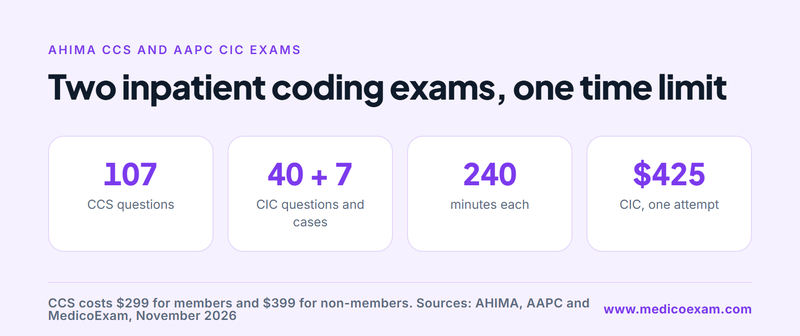
Reading the two side by side, the CCS leans toward coding skill, documentation and compliance judgment across settings. The CIC leans toward the money side of the inpatient stay, from bill types and the charge master to DRG payment, and then tests you by having you code seven full cases.
Does the CCS test outpatient coding, and does the CIC?
The CCS is not only an inpatient exam. Its blueprint includes attaching CPT and HCPCS modifiers to outpatient procedures, and a third of its medical scenarios are outpatient and a third emergency department. If you want a credential that shows range across settings, that is a point in its favour. If you want an exam that stays in the hospital inpatient world, the CIC stays closer to that focus, with only three questions on outpatient payment methodology, written to help you tell inpatient and outpatient payment apart.
This distinction is worth weighing before you spend months studying. A candidate who has only ever coded inpatient stays may find the CCS outpatient and emergency material the most unfamiliar part, while a candidate with an outpatient background may find the CIC payment methodology material the steepest climb.
What happens on test day for each exam?
The CCS is a computer-based exam taken at a Pearson VUE testing centre, and AHIMA says it is offered domestically and globally. AHIMA lets you revisit earlier items once an answer is chosen, and mark items for a final review pass when time remains. AHIMA also switched the exam to its 2026 code book list for every sitting from 1 May 2026 onward. On test day you must bring the right code books to the test centre, and a candidate without them is not allowed to test and forfeits the exam fee. Treat the code book list as part of your registration checklist.
The CIC can be taken from home under a live proctor who watches remotely, or in a testing centre. The MedicoExam exam record lists open code books (manuals) for the CIC, so you work with your code books throughout. The syllabus page also notes an exam voucher valid for one year from purchase, which gives you room to schedule.
Both formats reward fast, accurate navigation of your code books. A coder who knows the ICD-10-CM and ICD-10-PCS conventions well will spend less of the four hours hunting for the right section, and that is where practice under time pressure pays off.
What are the fees, and how do you keep each credential current?
AHIMA charges members $299 and non-members $399 for the CCS, so membership saves $100 on the exam. The retake fee is the same as the exam fee, and a candidate who does not pass must wait at least 30 days before the new application is approved. AHIMA's page also names optional preparation products, including a CCS exam preparation textbook with two full practice exams and an online course. It stresses these are not required and do not guarantee a result.
The CIC voucher is $425 for a single attempt and $499 for a pair of attempts, so the second attempt adds $74 when bought together. A non-member CCS candidate pays $26 less than the CIC single-attempt price, and a member pays $126 less. AAPC shows its self-paced and virtual instructor-led CIC course from $2,195, so training is a much bigger line in the budget than the exam fee if you choose that route.
Each credential renews on a two-year timeline. AAPC ties the CIC to a paid yearly AAPC membership and 36 CEUs per two-year cycle. AHIMA ties the CCS to its recertification rules, meaning continuing education units plus a recertification fee within the period. Check AHIMA's Recertification Hub for the exact counts.
What do AHIMA's published pass rates tell you?
AHIMA publishes first-time pass rates for the CCS. In 2025, 6,331 first-time testers sat the exam and 84 percent passed. In 2024 the figure was 75 percent of 4,031 testers, and in 2023 it was 64 percent of 3,287. AHIMA also reports 36,925 certified CCS professionals as of 31 December 2025.
Read these numbers with care. They describe who sat the exam in each year and do not predict your own result. AAPC's CIC page, as saved, gives no pass rate, so there is nothing to compare it with. Use the CCS rates as a sign that the exam is passable with preparation and not as a measure of how it compares with the CIC.
How do you decide between the CCS and the CIC?
Work through these questions in order, and let your answers point to one credential.
- Which certifying body do your employers or target employers mention? Look at job listings in your area. If hospitals you want to work for ask for one credential by name, that settles most of the decision.
- Do you want proof of range or of inpatient depth? The CCS covers inpatient, outpatient and emergency department scenarios. The CIC concentrates on the inpatient stay and its payment rules.
- How do you handle different exam styles? The CCS is a single question set with a scaled score. The CIC combines 40 questions with seven cases where you assign several codes each. Some candidates prefer one big block of questions, others prefer hands-on case coding.
- How much experience do you have? AHIMA recommends experience or related credentials. AAPC aims the CIC at new entrants as well as experienced coders.
- What does your budget look like? Compare the exam fees above, then add training and the cost of the required code books.
- Will you hold more than one credential? Some coders hold credentials from both bodies. Each has its own two-year cycle, so ask each body how continuing education counts before you plan for both.
What mistakes do candidates make with each exam?
The first common mistake is studying the wrong blueprint. A CCS candidate who spends weeks on the charge master is working on a topic the CCS outline does not list, and a CIC candidate who ignores payment methodology is skipping the CIC's largest topic area. Use each body's own outline as the study map.
The second mistake is bringing the wrong books. For the CCS, AHIMA is explicit that the 2026 code book list applies from 1 May 2026, and a wrong edition means you do not test. For the CIC, the books are open, but you still lose time if you have not tabbed and learned your way around them.
The third is treating the cases as an afterthought. The CIC's seven cases carry real weight because every answer in a case is weighted the same, so careful coding of each case matters. On the CCS, the medical scenarios give you practice at the same skill across three settings.
The fourth is guessing at pass marks. The CCS scale of 100 to 400 and the 300 passing score are not a raw 300 answers. The MedicoExam record shows roughly 66 percent. The CIC is a flat 70 percent.
How do you prepare once you have chosen?
Begin from the blueprint your certifying body publishes and turn each line into a question you can answer from memory. For the CCS, work through the five domains in proportion to their weights, giving the most time to Coding Knowledge and Skills. For the CIC, work through the seven areas and spend extra time on payment methodology and on timed practice coding of full inpatient records.
Next, practise under the real conditions. A timed practice test shows you how long you take per question, and for the CCS the 135-second average is a useful benchmark. MedicoExam offers practice tests for both credentials: the CCS practice test and the CIC practice test. Review every wrong answer against your code books and the guidelines rather than memorising the answer.
Finally, plan your logistics. Book the exam when your practice scores are steady, confirm the code books you need, and check the certifying body's cancellation and rescheduling rules. AHIMA, for instance, lets you cancel and reschedule up to 15 business days before the exam at no charge, while later changes bring a fee from Pearson VUE.
Which credential suits which reader?
Choose the CCS if you already code records or hold the CCA, if you want a credential that shows skill across inpatient, outpatient and emergency department settings, if documentation, provider queries and compliance are where you want to be seen as strong, or if AHIMA membership appeals to you and its lower member fee matters.
Choose the CIC if you want your credential to say inpatient hospital coding, if you like working through whole cases, if the idea of an online proctored exam at home suits your schedule, or if the employers you are targeting name AAPC.
Whichever you pick, build your plan from the certifying body's own page, and use practice questions to find the gaps. MedicoExam is not affiliated with AHIMA or AAPC, and passing remains your own work. Check current fees, rules and code book requirements with the certifying body before you pay.
Frequently Asked Questions
Is the CCS or the CIC harder?
Neither AHIMA nor AAPC ranks its exam by difficulty, and the two test different things. The CCS has 107 questions in 240 minutes, while the CIC has 40 questions and seven cases in 240 minutes. Judge difficulty by your own practice scores against each blueprint.
How much do the CCS and CIC exams cost?
AHIMA charges members $299 and non-members $399 for the CCS, while AAPC sells the CIC at $425 for one attempt or $499 for two. Confirm current fees with each body before paying.
What is the passing mark for the CCS and the CIC?
The CCS uses a scaled score: you need 300 out of a 100 to 400 range, which the MedicoExam record puts at about 66 percent. The CIC needs 70 percent.
Can you use code books in the CCS and CIC exams?
Yes for both, but the rules differ. The CCS requires you to bring the correct code books from AHIMA's 2026 list to the test centre, and candidates without them cannot test. The CIC is an open code book exam.
How long do the CCS and CIC credentials last?
Each renews on a two-year timeline. The CIC needs your yearly AAPC membership plus 36 CEUs per cycle. The CCS needs the continuing education units and recertification fee that AHIMA sets.
Is this guide medical advice?
No. This guide is exam-preparation material that sets two coding certifications next to each other. It offers no clinical direction and promises neither a pass nor a job. Check each requirement directly with the two certifying bodies first.
- AHIMA CCS Question Bank |
- AHIMA CCS Eligibility & Requirements |
- AHIMA Coding Specialist Practice Test |
- AHIMA CCS Exam Cost |
- AHIMA CCS Registration Process |
- AHIMA Coding Specialist Study Guide |
- AHIMA CCS Recertification |
- AHIMA CCS Certification Overview |
- AHIMA Coding Specialist Syllabus |
- AHIMA CCS Preparation Time |
- AHIMA CCS Passing Score |
- AHIMA CCS Exam Format |
- AAPC CIC Question Bank |
- AAPC CIC Eligibility & Requirements |
- AAPC Inpatient Coder Practice Test |
- AAPC CIC Exam Cost |
- AAPC CIC Registration Process |
- AAPC Inpatient Coder Study Guide |
- AAPC CIC Recertification |
- AAPC CIC Certification Overview |
- AAPC Inpatient Coder Syllabus |
- AAPC CIC Preparation Time |
- AAPC CIC Passing Score |
- AAPC CIC Exam Format |
- AHIMA CCS Certification |
- AAPC CIC Certification


