
Same 72-Second Clock, Different Blueprints: PMHNP-BC or AANPCB PMHNP?
Both psychiatric-mental health nurse practitioner exams are entry-level and valid for 5 years, and both give you 72 seconds a question, so the choice is not about difficulty or speed. It comes down to blueprint design, fee, and what your employer and state board accept. This guide sets the ANCC PMHNP-BC beside the AANPCB PMHNP so you can decide.
If you have already chosen, the practice exams are here: PMHNP-BC and PMHNP. If you are still deciding, keep reading. Figures come from the data sheet MedicoExam maintains, from ANCC's and AANPCB's own pages, from MedicoExam's product and syllabus pages for each exam, or from simple arithmetic on those numbers.
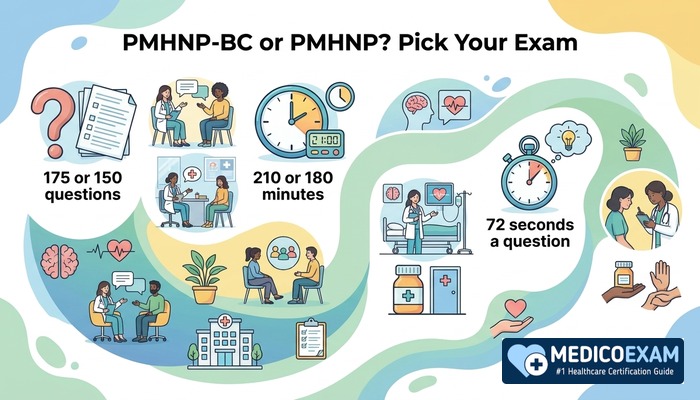
Which psychiatric NP exam is the right one for you?
Neither exam is the better credential in general. ANCC and AANPCB are separate certifying bodies, and each one awards its own title to a nurse practitioner who passes. The ANCC credential is PMHNP-BC, short for Psychiatric-Mental Health Nurse Practitioner-Board Certified. The AANPCB credential is simply PMHNP. Employers, state boards and payers may name one or both in their requirements, which is why the first step is to read the requirement you actually have to meet before you read any study guide.
ANCC describes its exam as a competency-based assessment of the entry-level clinical knowledge and skills of the psychiatric-mental health nurse practitioner, and says the certification aligns with the Consensus Model for APRN Regulation. AANPCB describes its PMHNP exam as an entry-level, competency-based examination that tests clinical knowledge of psychiatric mental health across the life span. On paper the two bodies are describing the same kind of professional. What differs is how each one measures that professional.
One historical note helps when you read older study material. ANCC says this certification was formerly known as the Family Psychiatric-Mental Health Nurse Practitioner exam, so some resources still use the older name. The current title carries the phrase across the lifespan, which is the wording on ANCC's page today.
Two earlier MedicoExam articles may help with the background. One explains what the credential means and how the certification process works, and another answers the common question of whether a psychiatric nurse practitioner counts as a doctor.
How do the two exams compare side by side?
The table below puts the logistics next to each other. Every row comes from the Master data sheet or from the certifying body's own page.
| Feature | PMHNP-BC (ANCC) | PMHNP (AANPCB) |
|---|---|---|
| Credential awarded | Psychiatric-Mental Health Nurse Practitioner-Board Certified | Psychiatric Mental Health Nurse Practitioner |
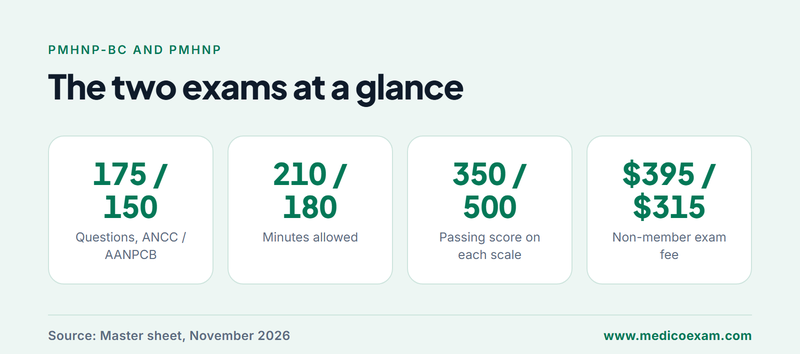
| Questions | 175, of which 150 are scored and 25 are pretest items | 150, of which 135 are scored and 15 are unscored |
| Time allowed | 210 minutes (3.5 hours) | 180 minutes |
| Seconds per question | 72 | 72 |
| Passing score | 350 on a scale of 0 to 500 | 500 on a scale of 200 to 800 |
| Exam fee | Non-members $395, members $295 | Non-members $315, AANP members $240 |
| Credential valid for | 5 years | 5 years |
| Delivery | Computer-based at a Prometric test center | Computer-based at Prometric test centers |
| Testing window | Apply year round and test within a 120-day window | 120-day testing eligibility window |
The two passing scores sit on different scales, so they cannot be compared. A scaled score is not a simple count of questions answered correctly, which means you should not convert 350 or 500 into a percentage of your own. Treat the pass mark as the threshold on that exam's scale and prepare to perform comfortably above it.
Does 72 seconds a question change how you pace yourself?
Divide the minutes by the questions and the ANCC exam works out to 72 seconds a question: 210 minutes shared across 175 questions leaves 72 seconds for each. The AANPCB exam also works out to 72 seconds a question: 180 minutes across 150 questions leaves the same 72 seconds. The two exams have different lengths, but the clock per question is identical, so the pacing habits that suit one suit the other.
Pretest and unscored items matter for stamina rather than for the score. ANCC mixes 25 pretest questions into its 175, and AANPCB mixes 15 unscored questions into its 150. You will not know which ones they are, so each one deserves your full attention. What the extra items do change is length. The ANCC sitting is 25 questions and 30 minutes longer than the AANPCB sitting, and that is a real difference in how tired you will be at the end.
Build your pacing around checkpoints instead of a running total. Decide in advance how far through the exam you want to be at the halfway mark, flag any question that stalls you beyond its share of time, and return to it only after the rest is answered. A practice exam taken under the real time limit is the quickest way to find out where your own pace drifts.
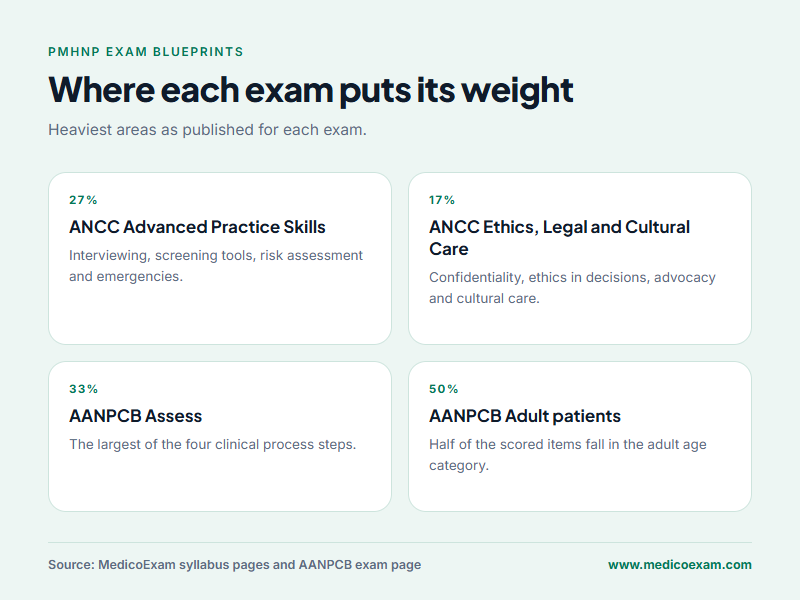
What does each exam blueprint actually weigh?
This is where the two exams differ most. MedicoExam's syllabus pages summarise each outline, and AANPCB publishes its breakdown on its own exam page.
How is the ANCC PMHNP-BC outline organised?
ANCC's outline, as summarised on MedicoExam's syllabus page, is organised by topic area and gives each one a weighting:
- Scientific Foundation, 22%: advanced pathophysiology, advanced pharmacology and psychopharmacology, neurodevelopment, neuroanatomy, neurophysiology, psychogenomics and advanced physical assessment.
- Advanced Practice Skills, 27%: clinical interviewing, health promotion and disease prevention, mental health and substance use screening tool selection and interpretation, the mental status exam, psychiatric emergency management, psychoeducation, recovery and resilience promotion, and risk assessment.
- Diagnosis and Treatment, 22%: DSM-5-TR diagnostic criteria, complementary and alternative treatments, diagnostic and laboratory test selection, diagnosis including differentials, evidence-based practice, and psychopharmacotherapeutic and pharmacotherapeutic management.
- Psychotherapy and Related Theories, 11%: psychotherapy principles, change theories, developmental theories, family theories and therapeutic alliance development.
- Ethics, Legal Principles, and Cultural Care, 17%: the Patient's Bill of Rights, scope of confidentiality, the ANA Scope and Standards of Practice for Psychiatric-Mental Health Nursing, cultural and spiritual competence, equity and inclusion, ethics in clinical decision making and patient advocacy.
The heaviest single area is Advanced Practice Skills at 27%, and the lightest is Psychotherapy and Related Theories at 11%. Ethics, legal principles and cultural care carries 17%, which is a bigger share than many candidates expect. If your preparation has been mostly pharmacology and diagnosis, that last area is the one most likely to be under-studied.
How is the AANPCB PMHNP outline organised?
AANPCB organises its exam around the clinical process and then separately by the age of the patient. It states the numbers for the 135 scored items:
- Domain I, the clinical process: Assess 33% (45 items), Diagnose 21% (28 items), Plan 26% (35 items) and Evaluate 20% (27 items).
- Domain II, patient age category: Infant and Child 6% (8 items), Pre-Adolescent 8% (11 items), Adolescent 16% (22 items), Adult 50% (67 items) and Older Adult 20% (27 items).
AANPCB adds that age parameters are not defined for any population, and that it uses growth and development to build the exams. Its knowledge areas are grouped under scientific foundations, pharmacology, nonpharmacological therapies, psychotherapies, assessment and diagnosis, care practices and the professional role. Among them are neuroanatomy and neurophysiology, psychopharmacology and medication monitoring, electroconvulsive therapy and repetitive transcranial magnetic stimulation, clinical interviewing, risk assessment and safety planning, crisis management and de-escalation, trauma-informed care, telehealth, and billing and coding schemes.
What does the difference mean for your study time?
The ANCC outline asks you to think in subject areas, so a candidate can study it chapter by chapter. The AANPCB outline asks you to think in steps of care, so a candidate studies each topic through four lenses: assessing, diagnosing, planning and evaluating. AANPCB also tells you that half of the scored items concern adults, while a fifth concern older adults and a sixth concern adolescents. ANCC's outline as summarised on the syllabus page shows no age-group split, so there you spread your attention across the topic areas instead.
Neither approach is easier. Candidates who learn well from a clean topic list often prefer the ANCC structure, while candidates who think in case flow from assessment to evaluation may find the AANPCB structure maps to how they already work. That is a study-style preference, not a verdict on either credential.
How much do the exams cost and how do you register?
ANCC charges non-members $395 and members $295, a gap of $100. AANPCB charges non-members $315 and AANP members $240, a gap of $75. At the non-member rate the ANCC exam costs $80 more than the AANPCB exam, and at the member rate it costs $55 more. Membership means different things at each body, so read each one's pricing page before you assume you qualify. Fees change, and the certifying body's page is the source to confirm on the day you pay.
Both exams are delivered by Prometric. ANCC tells candidates to schedule on the Prometric website using the certification number, and the exam is available year round within a 120-day testing window. AANPCB describes the same 120-day eligibility window, with appointment dates subject to test center availability.
ANCC's application asks you to have three things ready in electronic form: a copy of an active RN license showing the license number and expiration date, clinical hours documentation, and unofficial transcripts. ANCC explains that submitting unofficial transcripts, or official ones without degree conferral, gives you Authorized to Test status, and that a final official transcript shows the program of study, the degree conferred and the date it was awarded. Read the ANCC certification handbook before you apply, because it sets out the eligibility rules, scoring, accommodations and deadlines. AANPCB's eligibility rules sit on its own certification pages, so read them before you pay either fee.
Which exam suits which kind of candidate?
Use these questions to decide. They are prompts for your own judgment, not rules.
- Does a job posting, a state board or a payer name one credential? If so, that decides it. Confirm the wording with the employer or the board rather than with a study site.
- Do you hold, or plan to hold, AANP membership? It lowers the AANPCB fee to $240, but ANCC also has a member fee of $295 that depends on its own membership terms.
- Which outline matches the way you studied? If your program taught psychiatric care as assess, diagnose, plan and evaluate, AANPCB's domains will feel familiar. If it taught by topic, ANCC's five areas may feel closer.
- Can you sustain 210 minutes? The ANCC exam is 30 minutes longer and has ten more pretest questions than AANPCB has unscored ones. Some candidates find the longer sitting harder, and others prefer it because the pace per question is the same.
- How much do you rely on adult and older-adult patients in your clinical placements? AANPCB puts 70% of its scored items there (50% adult and 20% older adult), which is the sum of two published percentages.
If both credentials would be accepted where you plan to work, the practical difference is the exam experience and the fee. Look at the sample questions and the syllabus for each before you commit, so your decision rests on the exam itself and not on hearsay.
How should you prepare once you have chosen?
Preparation for both exams follows the same arc. Start from the blueprint, test yourself under timed conditions, and use the results to decide what to restudy. The steps below suit either exam.
- Download the outline and map it to what you know. ANCC provides a test content outline, a test reference list and a role delineation study on its certification page, and its certification handbook is available as a PDF. AANPCB publishes its domain tables and knowledge areas on its exam page. Mark each line as strong, shaky or unfamiliar.
- Weight your time by the blueprint. For ANCC, that means giving Advanced Practice Skills more hours than Psychotherapy and Related Theories. For AANPCB, it means giving Assess more attention than Evaluate, and adults more than infants and children.
- Practise with scenario questions. Both exams are competency-based, so questions ask you to apply what you know instead of recalling a definition. Work through the reasoning behind each answer, including the options you rejected.
- Sit full-length timed attempts. A 72-second pace is a skill you build. Practise it until reading, deciding and moving on feels routine.
- Review your results by area. A result history that shows performance question by question reveals patterns, such as always rushing the ethics items or lingering on pharmacology.
- Rest before the exam. Plan the travel to the Prometric center, check what identification the testing center requires, and keep the final day light.
MedicoExam's premium practice for the PMHNP-BC includes 265+ exam-aligned questions and 2 months of access for $45.80. The PMHNP practice includes 300+ questions and 2 months of access for $36.80. Both are scenario-based, show your selected answers next to the correct ones, and keep a result history so you can track your progress. MedicoExam is not affiliated with ANCC or AANPCB, and no practice test guarantees a pass.
What mistakes do candidates make when choosing and preparing?
- Choosing on pass-mark numbers. A 350 on a 0 to 500 scale and a 500 on a 200 to 800 scale are not comparable, so a larger number does not mean a harder exam.
- Ignoring the ethics and professional-role content. ANCC gives its ethics, legal and cultural care area 17%, and AANPCB lists professional-role topics such as ethical issues, scope and standards, and professional boundaries among its knowledge areas.
- Studying only from one blueprint. Resources written for one exam can overweight topics the other exam treats lightly. Match your resources to the outline of the exam you booked.
- Treating pretest items as throwaway questions. You cannot tell which items are unscored, so answer every one carefully.
- Confirming fees from memory. Prices and membership terms change. Check the certifying body's page, ideally the day you register.
- Using outdated material. The ANCC certification was renamed, so older resources may carry the Family Psychiatric-Mental Health title. Make sure the study guide you use matches the current exam and the across the lifespan title.
- Skipping the renewal question. Renewal is a recurring task, not a one-off. Read each body's current renewal rules early and plan your professional development around them.
What should you do the week your testing window opens?
Once you have booked, the work shifts from learning content to protecting your performance. Open the certifying body's candidate instructions again and confirm the name on your registration, the identification the test center will ask for, and the rules about what you may bring into the room. Both exams are delivered on a computer at a Prometric center, so a short visit to the location beforehand removes one source of stress.
Revisit your weakest blueprint areas with short, focused sessions instead of long, new reading. For an ANCC candidate that often means rereading the screening and risk assessment skills inside Advanced Practice Skills and the ethics area. For an AANPCB candidate it may mean practising the Plan and Evaluate steps with adult and older-adult scenarios, since those carry the most scored items. Stop adding new material the day before, and use that day to review your notes on the questions you got wrong.
If a result does not go your way, ANCC points candidates to its retesting information on the certification page, so read that policy before your first attempt and know what a second sitting would involve. Check AANPCB's current retake policy with the same care. Knowing the retake route in advance lowers the pressure on the first attempt, which tends to help pacing.
Can you decide today?
You can narrow it down today. First, confirm which credential your employer or state accepts. Second, compare the blueprints above and note which one matches how you think about care. Third, compare the fees against the membership you hold. Then read ANCC's page for the PMHNP-BC and AANPCB's page for the PMHNP exam, because those pages hold the current handbook, eligibility rules and prices. When you are ready, start timed practice for whichever exam you chose and let your first full-length result show where to focus.
Frequently Asked Questions
Is the ANCC PMHNP-BC harder than the AANPCB PMHNP?
Neither certifying body publishes a difficulty ranking, and their scores sit on different scales, so the passing marks cannot be compared. Both give you 72 seconds a question. The ANCC exam is longer, with 175 questions in 210 minutes against 150 questions in 180 minutes, and the blueprints are organised differently.
How many questions are on each exam?
The ANCC PMHNP-BC has 175 questions, of which 150 are scored and 25 are pretest items. The AANPCB PMHNP has 150 questions, of which 135 are scored and 15 are unscored. You cannot tell which items are unscored, so answer each one carefully.
What do the PMHNP-BC and PMHNP exams cost?
The ANCC exam costs $395 for non-members and $295 for members. The AANPCB exam costs $315 for non-members and $240 for AANP members. Confirm current fees and membership terms on the certifying body's own page before you pay.
How long is each credential valid?
Both the ANCC PMHNP-BC and the AANPCB PMHNP are valid for 5 years. ANCC says you keep the credential by maintaining your license and meeting the renewal requirements in place when you renew. Check each body's current renewal rules early.
How is the content weighted on each exam?
ANCC weights five topic areas: Scientific Foundation 22%, Advanced Practice Skills 27%, Diagnosis and Treatment 22%, Psychotherapy and Related Theories 11%, and Ethics, Legal Principles and Cultural Care 17%. AANPCB weights the clinical process (Assess 33%, Diagnose 21%, Plan 26%, Evaluate 20%) and patient age category (Adult 50%).
Where are the exams taken?
Both exams are computer-based and delivered through Prometric test centers. Each has a 120-day testing window, and appointment dates depend on test center availability. Schedule through the certifying body's instructions.
- ANCC Psychiatric-Mental Health Nurse Practitioner Practice Test |
- ANCC PMHNP-BC Question Bank |
- ANCC PMHNP-BC Eligibility & Requirements |
- ANCC PMHNP-BC Exam Cost |
- ANCC PMHNP-BC Registration Process |
- ANCC Psychiatric-Mental Health Nurse Practitioner Study Guide |
- ANCC PMHNP-BC Recertification |
- ANCC PMHNP-BC Certification Overview |
- ANCC Psychiatric-Mental Health Nurse Practitioner Syllabus |
- ANCC PMHNP-BC Preparation Time |
- ANCC PMHNP-BC Passing Score |
- ANCC PMHNP-BC Exam Format |
- AANPCB PMHNP Question Bank |
- AANPCB PMHNP Eligibility & Requirements |
- AANPCB Psychiatric Mental Health Nurse Practitioner Practice Test |
- AANPCB PMHNP Exam Cost |
- AANPCB PMHNP Registration Process |
- AANPCB Psychiatric Mental Health Nurse Practitioner Study Guide |
- AANPCB PMHNP Recertification |
- AANPCB PMHNP Certification Overview |
- AANPCB Psychiatric Mental Health Nurse Practitioner Syllabus |
- AANPCB PMHNP Preparation Time |
- AANPCB PMHNP Passing Score |
- AANPCB PMHNP Exam Format


