
Run the Site or Monitor It? Choosing Between CCRC and CCRA
The ACRP CCRC suits you if you coordinate a trial at the research site, and the CCRA suits you if you monitor trials for a sponsor. Both exams use the same format, the same pass mark and the same fees, so the real choice is the job you do, and which blueprint matches it.
Ready to start practising? Here are the practice exams: CCRC and CCRA. Still weighing them up? Read on. The numbers here were checked against MedicoExam's exam data, the two ACRP certification pages and the syllabus pages we publish, and anything calculated is plain arithmetic on them.
Which ACRP exam is the right one for your role?
Neither credential is the better one in general. They are two flagship certifications from the same body, the Association of Clinical Research Professionals, and each recognises a different seat in a clinical trial. One seat is at the research site, where participants are consented, visits are run and records are kept. The other seat is on the sponsor side, where someone checks that the site is following the protocol and that the data can be trusted.
That is why a comparison based on difficulty does not help. A site coordinator who sits the monitor exam is asked about monitoring plans, root cause analysis and risk-based monitoring. A monitor who sits the coordinator exam is asked about recruitment and retention, investigational product handling at the site and the study documentation a site must keep. Each person would be answering questions about someone else's day. The better question is which day looks most like yours today, or which one you want to have in two years.
It also helps to know what ACRP is. The association calls itself a non-profit for clinical research professionals. It was founded in 1976 and counts over 22,000 members. Its certifications are standardised exams, so two candidates with different employers sit the same test under the same rules. What follows puts the two exams next to each other, so you can see where they match and where they part ways.
What does each credential actually recognise?
On its CCRC page, ACRP presents the Certified Clinical Research Coordinator credential as recognition for people who coordinate and facilitate trial activities according to GCP while answering to a principal investigator. Three ideas stand out: coordinating, facilitating and working for the principal investigator. This is the person who keeps a study moving at the site from one visit to the next.
The CCRC syllabus page on MedicoExam lists the applied skills as consent and safety management for participants, protocol and site compliance, and data collection with study documentation. Its settings are investigator sites, academic medical centers, hospitals and research institutions, and its roles are clinical research coordinator, study coordinator and research site operations professional.
The CCRA page from ACRP describes the Certified Clinical Research Associate as recognition for people who monitor and supervise how a trial is carried out and how far it has got, acting for the sponsor. The ideas to hold on to are monitoring, supervising and acting for the sponsor. This is the person who looks at a site from the outside and asks whether the trial is being run as planned.
The CCRA syllabus page on MedicoExam lists trial monitoring and oversight, participant protection with ICH GCP compliance, and site management with data quality as the applied skills. Its settings are sponsor organizations, contract research organizations and trial sites, and its roles are clinical research associate, trial monitor, and sponsor or CRO research professional.
Put simply, the coordinator works inside the site and the associate works with the site. Both roles touch the same protocol, the same consent forms and the same safety reports, which is why the two blueprints overlap so much. What changes is the angle. The coordinator exam asks what the site must do. The associate exam asks what a monitor must check, and what the sponsor expects.
What do the CCRC and CCRA exams have in common?
Almost everything about the format is identical, which surprises many candidates. Each exam presents 125 questions. Of those, 100 count toward your score and the other 25 are trial items that do not. The clock is set at 180 minutes. Results are reported on a scale from 200 to 800, you need 600 to pass, and MedicoExam's data sheet puts that at approximately 67%. Nothing marks the trial items, so give every question your full attention.
Divide the 180 minutes by the 125 questions and you get about 86.4 seconds a question. The pace is identical on both papers, so time pressure will feel the same whichever one you pick. A practical habit is to read the scenario once, choose the best answer, flag any question that needs a second look and move on, so the last stretch of the exam is not rushed.
MedicoExam's syllabus pages say both are taken on a computer, either in a PSI test center or with a live remote proctor. The data sheet lists a 2-year validity for each credential. Here is how the main facts line up.
| Detail | CCRC | CCRA |
|---|---|---|
| Credential | ACRP Certified Clinical Research Coordinator | ACRP Certified Clinical Research Associate |
| Questions | 125 (100 scored, 25 pretest) | 125 (100 scored, 25 pretest) |
| Exam length | 180 minutes | 180 minutes |
| Pass mark | 600 (scale 200-800), about 67% | 600 (scale 200-800), about 67% |
| Work experience | 3,000 hours of verifiable experience | 3,000 hours of verifiable experience |
| Valid for | 2 years | 2 years |
| Heaviest area | Clinical Trial Operations (GCPs), 23% | Study and Site Management Activities, 25% |
| Typical role | Coordinator at the research site | Monitor for a sponsor or CRO |
Because the structure is the same, nothing about the exam itself should push you toward one or the other. The decision rests on the content and on your career, which the next section takes apart.
How do the two blueprints differ?
Both exams are built from a content outline, and MedicoExam's syllabus pages publish the weighting of each topic area. Each blueprint has six areas, and in each the weights add up to 100%. Four of the six areas have the same name or nearly the same name on both exams. The other two differ, and those two differences tell you most of what you need to know.
| Topic area | CCRC weight | CCRA weight |
|---|---|---|
| Scientific Concepts and Research Design | 8% | 12% |
| Ethical and Participant Safety Considerations | 19% | 18% |
| Product Development and Regulation | 13% | not an area |
| Regulatory Requirements | not an area | 14% |
| Clinical Trial Operations (GCP) | 23% | 18% |
| Study and Site Management | 22% | 25% |
| Data Management and Informatics (CCRC) or Data Quality (CCRA) | 15% | 13% |
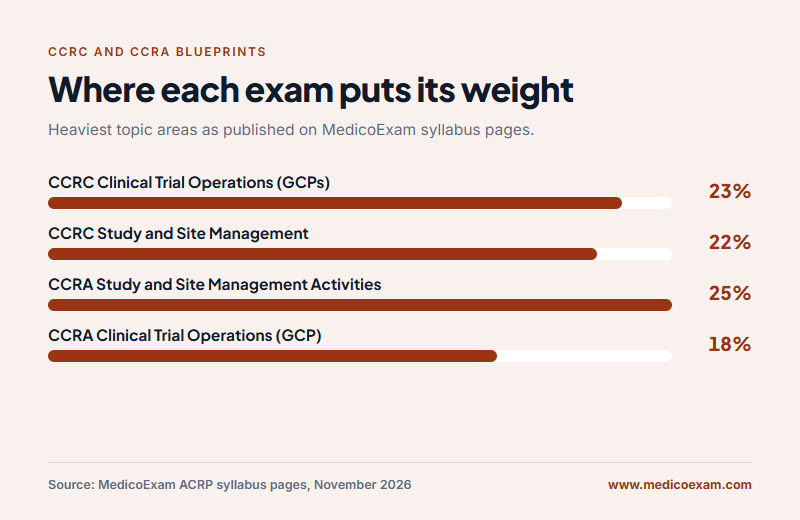
The CCRC puts its largest weight on Clinical Trial Operations, which covers good clinical practice at the site. The topics include site staff qualifications for delegation of responsibilities, corrective and preventive action plans, monitoring activities from the site's point of view, principal investigator oversight, project feasibility, site initiation and close-out, and the roles of CROs, sponsors and regulators. Study and Site Management follows closely at 22%. Added up, these two areas make up 45% of the CCRC blueprint, so the exam is mostly about how a site runs.
The CCRA reverses the order. Its largest area is Study and Site Management Activities at 25%, with Clinical Trial Operations and Ethical and Participant Safety tied behind it at 18% each. The two largest areas together carry a little over two-fifths of the blueprint. The topics lean toward what a monitor reviews: interim visit activities, management of study site documentation such as reconciling the investigator site file with the trial master file, contracts and budgets, and the processes for managing non-compliance. The operations area adds the elements of a monitoring plan, monitoring responsibilities and the principles of risk-based monitoring.
Now the two areas that differ. The CCRC has Product Development and Regulation at 13%. It includes the clinical development process, clinical trial registries, IRB and IEC reporting, and audit and inspection processes. The CCRA has Regulatory Requirements at 14%, centered on IRB and IEC reporting and communication, the protocol and amendment submission and approval processes, and regulatory authority reporting for safety and the clinical study report. The two areas are close in weight and overlap in content, yet the CCRA version is narrower and more procedural.
Science carries more weight on the CCRA: 12% against 8% for the CCRC. That area covers elements of a protocol, the investigator's brochure, study design characteristics such as double-blind, crossover and randomized designs, and treatment assignments. A monitor must understand why a protocol is built the way it is, so the exam asks for a little more depth. The CCRA also lists stages of product development, while the CCRC lists statistical principles such as sample size and screen fail rate.
Ethics and participant safety is the most evenly matched area, at 19% for the CCRC and 18% for the CCRA. On both exams it covers adverse event classification, documentation and reporting, blinding and unblinding, informed consent, protection of human subjects including vulnerable populations, protocol deviations, recruitment and retention, and conflicts of interest. The CCRA adds examples such as SAE, AESI and SUSAR, the Declaration of Helsinki and participant compensation. This is the area where preparing for one exam helps you most on the other.
The last area is data. The CCRC calls it Data Management and Informatics at 15%, and it includes data query processes, essential documents, record retention, source data review and verification, and the ALCOA+ documentation principles. The CCRA calls it Data Quality at 13%, and it adds critical variables and critical processes along with query writing. Both exams expect you to know why source data matters and how a query moves from the person who raises it to the person who resolves it.
Who can sit each exam, and what does it cost?
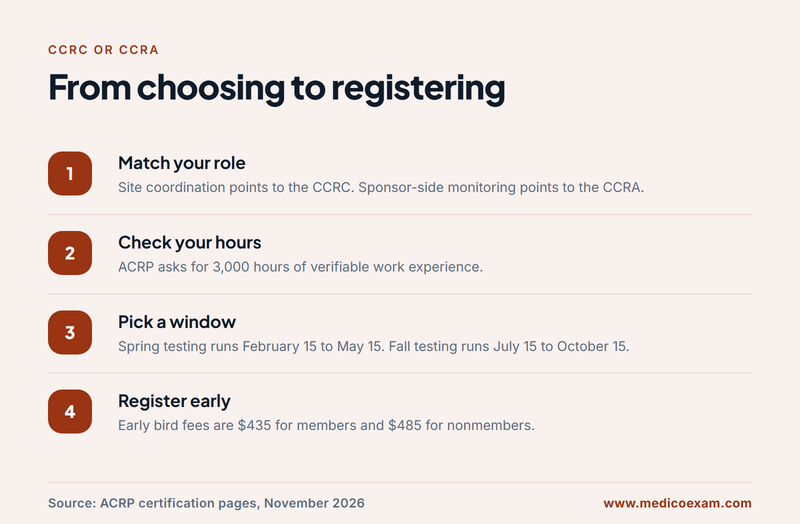
The eligibility rule is the same for both. Eligibility is one rule for both. Each of ACRP's pages, for the CCRC and for the CCRA, asks for 3,000 hours of work experience that can be verified, and points to the Academy's policy manual for the full criteria. Open that manual before you pay anything, since it settles what counts in your own case.
Qualifying hours must involve human subject research, sit under a paid employer-employee agreement and be something ACRP can confirm with your employer. Left out are hours that belong to a degree track or education program, anything older than ten years, and internships whether paid or unpaid. If most of your time came from a placement during a degree, it will not add up to the 3,000.
A single waiver worth 1,500 hours is possible. It is open to holders of an active ACRP certification and to people who finished a clinical research education program, provided that program follows the topics in the matching Exam Content Outline, is accredited by a third party and teaches the equivalent of 1,500 working hours. ACRP keeps program approval to its own discretion and does not pre-approve outside a paid application, so a course should not be assumed to count until you have applied.
The fees are also identical on both exams, and they depend on when you register and whether you are an ACRP member.
| Registration | ACRP members | Nonmembers |
|---|---|---|
| Early bird | $435 | $485 |
| Regular | $460 | $600 |
An early registration is $25 cheaper for a member and $115 cheaper for a nonmember. Membership trims $50 off the early fee and $140 off the regular fee. Those gaps are arithmetic on the fees ACRP publishes, and they do not include the cost of membership, which you should check on ACRP's membership page before you decide that joining pays for itself. Fees can change, so confirm them on the ACRP page before you register.
When can you take the CCRC or CCRA exam?
Each year offers two sittings. The spring sitting opens on February 15 and ends May 15, while the fall sitting opens July 15 and ends October 15. Registration has its own calendar, which many candidates overlook. Spring early bird sign-up goes from October 20 through December 31, then regular sign-up from January 1 through April 30. Fall early bird sign-up goes from May 20 through July 15, then regular sign-up from July 16 through September 30.
Work backwards from the window you want. If you aim for the spring window and want the lower fee, you must register by the end of December, which leaves little time if you start in the autumn. If you miss it, regular registration still runs until April 30. For the fall window, early bird registration closes on July 15, the same day the fall testing window opens. Treat these dates as a checklist and confirm them on ACRP's page, because the association can change them.
A sensible plan gives you enough time to study before you register, not after. Decide your window first, count back the weeks you need for each blueprint area, and book once you can finish a full timed practice exam comfortably inside 180 minutes. Candidates who register first and study later often end up paying the regular fee or pushing the exam to the next window.
How do you decide between the CCRC and the CCRA?
Start with your current job, because that is where your 3,000 hours came from. If you spend your days at a site, consenting participants, scheduling visits, handling investigational product, keeping the regulatory binder and answering queries, the CCRC maps onto work you already do. If you spend your days reviewing sites, writing visit reports, following up on findings and checking source data against case report forms, the CCRA does.
Then look one step ahead. Many people move from the site to the sponsor side, and a coordinator who wants to become a monitor may want the CCRA to show an employer that they understand the monitor's view. A monitor who wants to return to a site or lead a site team may prefer the CCRC. Neither exam stops you from taking the other later, and ACRP says an active ACRP certification can qualify you for the experience waiver, so one credential may help with the next. For the monitor's side, an earlier MedicoExam article lays out a career roadmap for monitors, and another looks at the research roles coordinators aim for.
These questions can help you decide.
- Do most of your hours come from working at a research site, or from working for a sponsor or CRO? Pick the exam that matches the larger share.
- Would your answers draw more on running study visits and keeping records, or on reviewing how others do it?
- Which job title do you see in the postings you want to apply to? Read what the employer asks for, as some name a credential and some do not.
- Can you meet the 3,000-hour rule today, or do you need the waiver, or more time first?
- Which testing window fits your calendar, and do you have enough weeks to cover your weaker areas?
If your hours are split evenly, look at the blueprints once more. The CCRC tilts toward running a site, while the CCRA tilts toward managing sites and monitoring them. Take the sample questions for each exam and see which feel familiar. The one where you recognise the situations is usually the one you will pass with less effort.
How do you prepare for the one you pick?
Preparation is the same method on both exams, applied to a different blueprint. Begin with ACRP's Exam Content Outline and MedicoExam's syllabus page for your exam, and mark each topic as strong, shaky or new. Spend your time in proportion to the weights. On the CCRC, that means Clinical Trial Operations and Study and Site Management first. On the CCRA, it means Study and Site Management first, then Clinical Trial Operations and Ethical and Participant Safety.
Next, read the standards behind the topics rather than memorising a summary of them. Good clinical practice, the informed consent process, the roles of the sponsor, the investigator and the IRB or IEC, and the source documentation principles appear on both exams. A candidate who understands why a rule exists will usually reach the right answer even when a scenario is worded in an unfamiliar way.
Then practise with scenario questions under time. Both exams lean on scenarios, and best-answer questions reward judgment over recall. Work through a set, review each miss and put into words what made the correct option stronger. Each MedicoExam premium practice exam has 250+ questions written to the blueprint, plus two months of unlimited use, and it is priced at $41.30. The mock exams are timed, and a result history lets you review your answers question by question. A free demo is on each product page if you want to see the interface first.
Finally, avoid the mistakes that cost the most marks. Do not study only the topics from your own job, because the unscored questions are mixed in and you cannot tell which ones they are. Do not rely on a single pass through the content. Do not skip ethics and safety, which carries roughly a fifth of the marks on both exams. And do not book the exam before you have checked that your work experience counts, since ACRP verifies it through your employer.
In the end, the CCRC and the CCRA reward the same discipline: know the rules of a clinical trial, apply them to realistic situations and hold a pace of about 86 seconds a question. Choose the credential that fits the work you do or hope to do, give yourself time to prepare for its blueprint and confirm every fee and date with ACRP before you commit.
Frequently Asked Questions
Is the CCRA harder than the CCRC?
ACRP does not publish a difficulty ranking, and the two exams share the same format. Each runs 125 questions across 180 minutes, with 600 as the pass mark on a 200 to 800 scale. They test different blueprints, so the harder exam is the one further from your daily work.
How many questions are on the CCRC and CCRA exams?
Both papers carry 125 questions: 100 scored and 25 pretest. The pretest items are not flagged, so assume each one is scored. With 180 minutes available, that leaves roughly 86.4 seconds per question.
What does the CCRC or CCRA exam cost?
Both exams cost the same. Registering early costs members $435 and nonmembers $485. Registering at the regular time costs members $460 and nonmembers $600. Confirm the current fee on ACRP's page before you register.
How much work experience do I need for the CCRC or CCRA?
ACRP says the same threshold applies to both credentials: 3,000 hours of work that ACRP can verify. One waiver of 1,500 hours exists for an active ACRP certification or an approved education program. Internships and degree work are excluded.
When can I take the CCRC or CCRA exam?
There are two sittings a year, one in spring and one in fall, and the spring one starts in mid-February. Registration closes before each sitting ends, so read the registration dates on ACRP's page when you plan.
Which exam is for site coordinators and which is for monitors?
The CCRC is for coordinators working at the research site, under the direction of a principal investigator. The CCRA is for clinical research associates who monitor and supervise trials on behalf of a sponsor. Your current role and your next role should guide your choice.
How long is each credential valid?
MedicoExam's data sheet lists both credentials as valid for 2 years. Renewal rules are set by ACRP, and its certification pages do not spell them out in full, so read the renewal requirements in ACRP's own materials before you plan.
- ACRP CCRA Question Bank |
- ACRP CCRA Eligibility & Requirements |
- ACRP Clinical Research Associate Practice Test |
- ACRP CCRA Exam Cost |
- ACRP CCRA Registration Process |
- ACRP Clinical Research Associate Study Guide |
- ACRP CCRA Recertification |
- ACRP CCRA Certification Overview |
- ACRP Clinical Research Associate Syllabus |
- ACRP CCRA Preparation Time |
- ACRP CCRA Passing Score |
- ACRP CCRA Exam Format |
- ACRP Clinical Research Associate Sample Questions |
- ACRP CCRA Career Opportunities |
- ACRP CCRC Question Bank |
- ACRP CCRC Eligibility & Requirements |
- ACRP Clinical Research Coordinator Practice Test |
- ACRP CCRC Exam Cost |
- ACRP CCRC Registration Process |
- ACRP Clinical Research Coordinator Study Guide |
- ACRP CCRC Recertification |
- ACRP CCRC Certification Overview |
- ACRP Clinical Research Coordinator Syllabus |
- ACRP CCRC Preparation Time |
- ACRP CCRC Passing Score |
- ACRP CCRC Exam Format |
- ACRP Clinical Research Coordinator Sample Questions |
- ACRP CCRC Career Opportunities


