
CCA vs CPC: Which Entry-Level Coding Credential Fits You First?
Choosing between the AHIMA Certified Coding Associate and the AAPC Certified Professional Coder comes down to the kind of work you want and how you handle a long exam. The CCA has 105 questions in two hours and a pass mark of 300 on a scale of 100 to 400. The CPC has 100 questions in four hours and needs 70 percent. This guide sets them side by side so you can decide which to earn first.
If you already lean one way, you can go straight to the practice material: CCA and CPC each have a MedicoExam practice exam. If you are still undecided, read on. Every figure below comes from the certifying body's own page, the MedicoExam syllabus page for the exam, or simple arithmetic on those numbers.
Which coding credential should a newcomer earn first?
There is no single right answer, and neither organization claims there is. AAPC describes the CPC as the most respected medical coding certification in the healthcare industry and as a place to start a coding career, because it builds a foundation you can expand into inpatient coding, risk adjustment, compliance, auditing and specialty certifications. AHIMA positions the CCA as a credential for candidates who hold a high school diploma and want to show coding competence across inpatient, outpatient and physician settings.
Those descriptions point to different starting points. The CPC is framed around outpatient and physician services, so it suits a reader who expects to work in a physician practice, an outpatient clinic or a same-day surgical center. The CCA's content outline covers inpatient, outpatient and physician coding guidelines together, alongside records management, compliance, information technology and privacy, so it suits a reader who wants a broader entry-level base that includes health information work.
This article never ranks one above the other. It tells you what each exam asks of you, so that you can match the exam to your situation. It is exam-preparation information only and gives no clinical or medical advice.
How do the CCA and CPC exams compare at a glance?
The table below puts the published exam details next to each other. The figures for questions, time, fee and passing score appear in the Master record MedicoExam keeps for each exam, and they match the certifying bodies' pages that we read for this guide.
| Detail | CCA (AHIMA) | CPC (AAPC) |
|---|---|---|
| Questions | 105 (90 scored, 15 pretest) | 100 |
| Time allowed | 120 minutes | 240 minutes |
| Passing score | 300 on a scale of 100 to 400 | 70 percent, which means 70 correct answers |
| Exam fee | $199 for AHIMA members, $299 for non-members | $425 single attempt; $499 bundle of two |
| How it is taken | Computer-based at a Pearson VUE testing center | At home with remote proctoring, or on-site at a testing center |
| Certification period | 2 years | 2 years |
Two details deserve a second look. First, the CCA's 105 questions include 15 pretest items that do not count toward your result, and nothing on screen tells you which ones they are. Second, the passing scores are not comparable. The CCA score is scaled, so 300 is a position on a 100 to 400 scale and is not a count of right answers. The CPC mark is a plain percentage of 100 questions.
Who is each credential built for?
The CCA asks for a high school diploma. AHIMA recommends, but does not require, at least one of three things before you sit the exam: six months of coding experience applying codes directly, completion of an AHIMA-approved coding program (its PCAP Program), or other coding training that includes anatomy and physiology, medical terminology, basic ICD diagnostic and procedural coding and basic CPT coding. The MedicoExam syllabus page lists the roles the exam targets as entry-level medical coders, health information technicians, and coding and billing professionals working in hospitals, physician offices and healthcare organizations.
The CPC is aimed, in AAPC's words, at people launching a medical coding career, experienced but uncertified professionals who want to validate their skills, healthcare staff moving into coding from administrative or clinical support roles, and professionals planning long-term growth. AAPC says training requires a high-level knowledge of medical terminology, anatomy and pathophysiology, and it recommends its CPC training course before the exam. It lists that course as starting at $2,799, which is a cost to weigh separately from the exam fee.
A fair summary is that the CCA lists its recommended preparation as a menu, while the CPC page leans on a structured training course. Neither is a substitute for your own study of the code sets, and in both cases you should confirm the current requirements on AHIMA's CCA page and AAPC's CPC page before you pay for anything.
What does each exam actually cover?
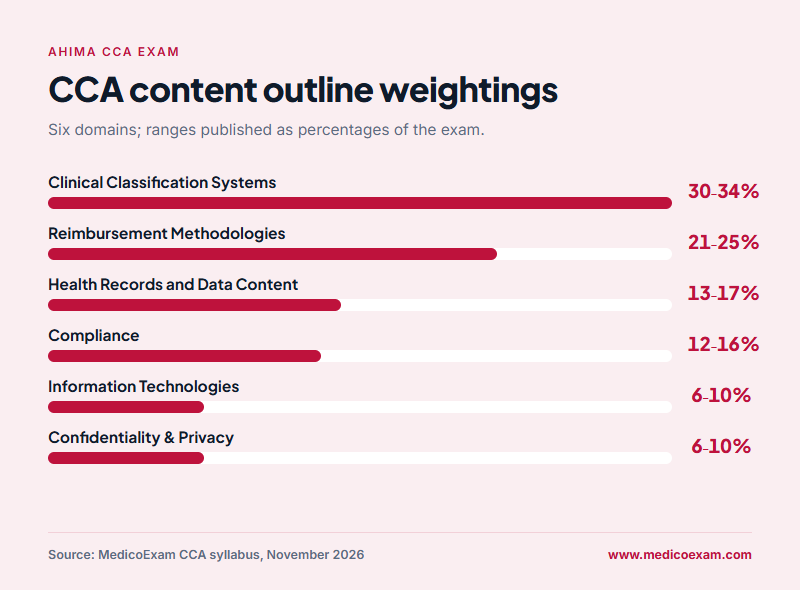
The CCA exam is organized into six domains, and each one is given a weighting range. According to the MedicoExam syllabus summary of the content outline, the domains are:
- Clinical Classification Systems, 30 to 34 percent: interpreting healthcare data for code assignment, applying inpatient, outpatient and physician coding guidelines, sequencing codes by setting, choosing an evaluation and management level by medical decision making or time, and using modifiers.
- Reimbursement Methodologies, 21 to 25 percent: sequencing codes for reimbursement, linking diagnoses and procedure codes to payer rules, DRG and APC methodology, NCCI edits, medical necessity, claim forms and denials, and risk adjustment.
- Health Records and Data Content, 13 to 17 percent: retrieving and analyzing records for completeness and deficiencies, data abstraction and understanding the components of a medical record.
- Compliance, 12 to 16 percent: matching coded data to documentation, ethical coding, ethical physician queries and preparing for external audits.
- Information Technologies, 6 to 10 percent: working in the electronic health record, encoder and grouper software and computer-assisted coding tools.
- Confidentiality and Privacy, 6 to 10 percent: protecting patient information, minimum necessary access, secure transfer and retention of records.
Add the first two domains and the CCA places between 51 and 59 percent of its content on classification and reimbursement. The remaining four domains are about the records, rules and systems around coding, which is where the CCA differs most from the CPC.
The CPC exam is built differently. Rather than percentage weightings, AAPC publishes the number of questions in each area, and the MedicoExam syllabus page repeats them. AAPC says they assess 17 areas of knowledge, most of them presented as coding scenarios, with ten cases at the end that test your ability to read a medical record and code it accurately. The published counts are:
- Medical terminology: 4 questions, and anatomy: 4 questions.
- Compliance and regulatory: 3 questions, covering Medicare Parts A to D, NCCI edits, NCDs and LCDs, HIPAA, ABNs and RVUs.
- Coding guidelines: 7 questions, covering the ICD-10-CM Official Guidelines, CPT guidelines and modifier use.
- ICD-10-CM: 5 questions, and HCPCS Level II: 3 questions.
- CPT surgical series: 6 questions each for the 10000, 20000, 30000, 40000, 50000 and 60000 series.
- Radiology, pathology and laboratory, medicine, and evaluation and management: 6 questions each.
- Anesthesia: 4 questions, and cases: 10 questions.
Put the two blueprints side by side and the difference is clear. The CPC is a code-assignment exam with a heavy CPT section, since the six surgical series alone account for 36 of the 100 questions. The CCA spends nearly half its content on subjects beyond classification, such as records, compliance, technology and privacy. A reader who enjoys working through procedure code ranges will feel at home with the CPC. A reader who wants to understand how coding fits into the wider health information function may prefer the CCA.
How different do the two exams feel on test day?
Time pressure is the biggest difference. The CCA gives you 120 minutes for 105 questions, or about 69 seconds each. The CPC gives you 240 minutes for 100 questions, and AAPC works that out as roughly 2.4 minutes per question. The CPC questions are longer and more scenario-based, and the ten cases at the end need real reading time, so the extra minutes are not a bonus. They are the time you need to look things up.
Both exams involve code books. AAPC states that you may use the AMA's CPT Professional Edition plus any publisher's current ICD-10-CM and HCPCS Level II volumes, printed or electronic, and that nothing else is allowed. You may bring current-year books, preceding-year books or a mix, but only one copy of each. Handwritten notes are acceptable only if they relate to daily coding activities, and altering the pages is prohibited. An online calculator is provided, and physical calculators are not permitted.
AHIMA's rules for the CCA are just as strict about books. From exams delivered on or after 1 May 2026, candidates must bring the code books from AHIMA's 2026 list, and candidates who arrive without the correct ones are not allowed to test and forfeit their exam fees. Look up the current list before you buy books, because buying the wrong edition is an expensive mistake that has nothing to do with how well you know the material.
The CCA lets you move back and forth between questions as long as an answer has been selected, and you can flag items to review before you submit. The CPC's 100 multiple-choice questions are delivered in one sitting with no break in the clock. AAPC suggests reading the answer choices before the question and leaving harder questions for last, and it says to answer every question, since a best guess is better than no answer.
What do the exams cost, and what happens if you do not pass first time?
The fees differ by more than the headline numbers suggest. The CCA costs $199 for AHIMA members and $299 for non-members, so membership saves $100. AAPC prices the CPC at $425 with a single attempt, or $499 if you buy two attempts together, which means the second attempt adds $74. At the standard single attempt, the CPC costs $126 more than the CCA at the non-member price and $226 more at the member price.
Retakes work differently as well. AHIMA says a candidate who has attempted the CCA and not passed must wait at least 30 days before a new application is approved, and that the retake fee equals the original exam fee. A new application is needed each time. AAPC's two-attempt option is a bundle bought at the start, and the MedicoExam syllabus page notes that an exam voucher is valid for one year from purchase.
Two other costs belong in your budget. AHIMA charges a $30 fee through Pearson VUE if you cancel or reschedule between 14 days and 24 hours before the exam, and no-shows forfeit their fees. AAPC lists its CPC training course from $2,799, though it is recommended rather than compulsory. Add the cost of current code books and any practice material, and the total for the CPC route is usually the higher of the two. Check both organizations' pages for today's prices, since fees change.
Results also arrive at different speeds. AAPC says CPC results come online within 7 to 10 business days of the exam, and that if you do not pass, you are shown the areas where your sub-scores were 65 percent or lower. That is useful feedback for a retake.
What keeps each credential valid after you pass?
Both credentials run on a two-year cycle. For the CPC, AAPC says you need to keep annual membership active and log 36 CEUs per two years. For the CCA, AHIMA says you complete the recertification requirements over the two-year period, which means submitting the required amount of continuing education units and paying the recertification fee. AHIMA's Recertification Hub holds the details.
The practical point is that a credential is a continuing commitment, not a one-off purchase. If you pick the CPC, build the membership into your budget. If you pick the CCA, check the current CEU requirement and fee on AHIMA's site. In either case, keep records of the education you complete as you go, so that renewal does not turn into a scramble in the final month.
It also helps to know how big each credential community is, though a headcount says little about quality. AHIMA reports 7,753 certified CCA professionals as of 31 December 2025. AAPC's CPC page does not publish a comparable count, so no like-for-like comparison is possible.
How do you decide between the CCA and the CPC?
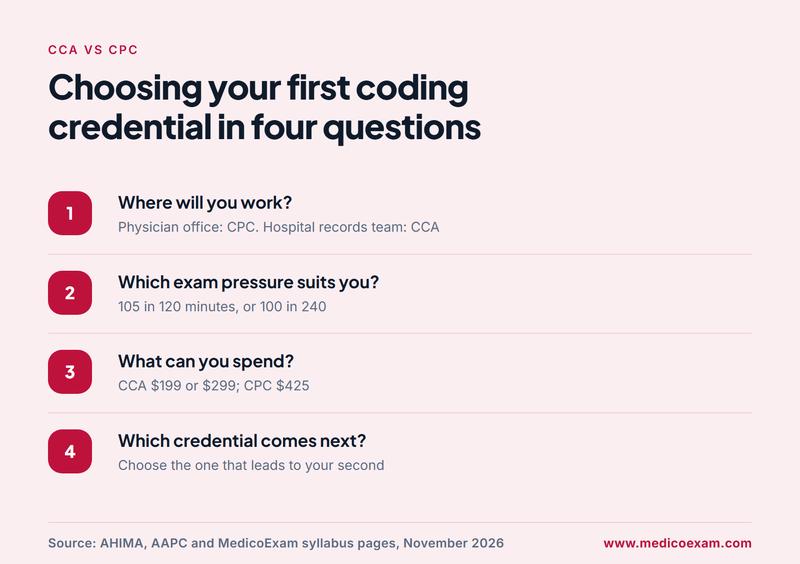
Work through these questions in order, and stop at the first one that gives you a clear answer.
- Where do you expect to work? A physician practice, outpatient clinic or surgical center points toward the CPC, whose blueprint centers on outpatient and physician services. A hospital or health information department, where records, privacy and systems matter alongside coding, points toward the CCA.
- How do you handle long exams? Four hours of scenario questions and ten cases is a test of stamina and book navigation. Two hours with about 69 seconds per question is a test of speed and recall. Be honest about which pressure you handle better.
- What can you afford right now? The CCA's lower fee and the lack of a mandatory course make it the cheaper start. The CPC costs more up front, and AAPC's membership requirement continues after you pass.
- What do the job postings you want ask for? Employers differ, and a posting that names a credential is the best evidence you will find. Read several before you commit, and do not rely on anyone's general claim, including ours.
- Are you planning a second credential? Many coders end up holding more than one. AAPC says each of its exams measures only its own credential, so earning another requires passing another exam. Choose the first credential that moves you toward the second.
For a wider view of where an entry-level credential can lead, read this look at how medical coding careers progress.
How should you prepare once you have chosen?
Start with the certifying body's own outline, because it defines what can be asked. For the CCA that is AHIMA's exam content outline, and for the CPC it is AAPC's list of areas and question counts. Then measure yourself against the blueprint rather than against a general feeling of readiness.
A sensible routine for either exam has four parts. First, take a practice test early, before you have studied, and record your score in each area. Second, study the heaviest areas first: classification and reimbursement for the CCA, and the CPT sections and guidelines for the CPC. Third, practice with your actual code books so that looking things up becomes automatic, because time lost to unfamiliar books is time lost from answering. Fourth, finish with timed full-length sessions that match the real exam, 120 minutes for 105 questions or 240 minutes for 100.
MedicoExam's practice exams are built around those blueprints. The CCA practice exam lists 310 or more exam-aligned questions at $26.90, and the CPC practice exam lists 195 or more at $41.30. Each includes two months of access, timed mock exams and a result history that shows your performance question by question. They are practice tools from MedicoExam and are not AHIMA or AAPC products, so pair them with the certifying body's own materials. AHIMA, for instance, sells its own CCA preparation, which it describes as 200 practice questions and two complete practice exams.
Both practice exams include a free demo, so you can see the question style before you buy anything.
Which credential suits which reader?
The CCA suits the reader who holds a high school diploma, wants a lower exam fee, prefers a shorter exam, and is drawn to the health information side of coding, including records, compliance, systems and privacy. The CPC suits the reader who is aiming at physician and outpatient coding, can sustain four hours of scenario work with approved code books, and accepts the membership and CEU commitment AAPC sets.
Neither choice closes a door. Both credentials renew on a two-year cycle, both are taken on a computer, and both reward steady practice more than last-minute cramming. Pick the one that matches your next job, confirm the details with the certifying body, and begin with a practice test so that your plan rests on your own results.
Frequently Asked Questions
Is the CCA or the CPC easier?
Neither organization ranks them by difficulty, and they test different skills. The CCA has 105 questions in 120 minutes, which is about 69 seconds each. The CPC has 100 questions in 240 minutes, with ten cases at the end. Judge difficulty by your own practice test scores in each blueprint.
How much does the CCA exam cost compared with the CPC?
On the figures published today, the CCA is the cheaper exam: AHIMA members pay $199 and non-members $299, against $425 for a single CPC attempt. Fees change, so check AHIMA and AAPC before you pay.
What is the passing score for the CCA and the CPC?
The CCA passing score is 300 on a scale of 100 to 400, so it is a scaled score and not a count of right answers. The CPC requires 70 percent, which AAPC says means at least 70 of the 100 questions answered correctly.
Can you use code books in the CCA and CPC exams?
Yes, and the rules are strict. AAPC names the books it permits and allows only one copy of each. AHIMA requires the code books on its 2026 list for CCA exams delivered from 1 May 2026, and candidates without them cannot test.
How long do the CCA and CPC credentials last?
Each credential renews on a two-year cycle. CPC holders keep membership current and log 36 CEUs. CCA holders submit the required continuing education units and pay a recertification fee, as AHIMA sets out in its Recertification Hub.
Is this guide medical advice?
No. This guide compares two certification exams and explains how to prepare for them. It does not give clinical, diagnostic or treatment advice, and it does not promise a pass or a job outcome. Confirm every requirement with AHIMA and AAPC before you apply.
- AHIMA CCA Question Bank |
- AHIMA CCA Eligibility & Requirements |
- AHIMA Coding Associate Practice Test |
- AHIMA CCA Exam Cost |
- AHIMA CCA Registration Process |
- AHIMA Coding Associate Study Guide |
- AHIMA CCA Recertification |
- AHIMA CCA Certification Overview |
- AHIMA Coding Associate Syllabus |
- AHIMA CCA Preparation Time |
- AHIMA CCA Passing Score |
- AHIMA CCA Exam Format |
- AAPC CPC Exam Cost |
- AAPC CPC Passing Score |
- AAPC Professional Coder Study Guide |
- AAPC CPC Recertification |
- AAPC CPC Exam Format |
- AAPC CPC Certification Overview |
- AAPC CPC Question Bank |
- AAPC CPC Eligibility & Requirements |
- AAPC Professional Coder Practice Test |
- AAPC CPC Registration Process |
- AAPC Professional Coder Syllabus |
- AAPC CPC Preparation Time


