
Coordinator, Monitor, Investigator or Generalist? Choosing Your ACRP Credential
ACRP offers four flagship exams for clinical research professionals: the ACRP-CP for professionals across study-team roles, the CCRC for coordinators, the CCRA for monitors working for a sponsor, and the CPI for principal and sub-investigators. All four have 125 questions in 180 minutes and a scaled pass score of 600, so the real choice is the role you hold and the experience you can document.

If you already know your lane, the practice exams are here: ACRP-CP, CCRC, CCRA and CPI. If you are still deciding, keep reading. The figures in this guide are taken from the data sheet MedicoExam maintains, from ACRP's certification pages, from MedicoExam's own pages for each exam, or from arithmetic on those numbers.
Which ACRP certification matches the job you do?
ACRP describes each credential by the work behind it. The ACRP-CP recognizes clinical research professionals across diverse roles and functions on the study team. The CCRC recognizes people who coordinate and facilitate clinical trial activities in adherence to good clinical practice, under the direction of a principal investigator. The CCRA recognizes people who monitor and supervise the conduct and progress of trials on behalf of a sponsor. The CPI recognizes people who have served as a principal investigator or sub-investigator.
That framing makes the first question simple and a little uncomfortable: which of those sentences describes the work you did over the last few years? A coordinator who runs visits and keeps the regulatory binder sits naturally in the second sentence. A monitor who travels to sites and reviews source documents sits in the third. A physician who signs the protocol and oversees participants sits in the fourth. A professional whose title does not fit one of those boxes, for example someone who moves between site, sponsor and regulatory tasks, may find the first sentence closest.
No credential is ranked above another here. The aim is to set each exam's requirements beside your own work history, and the content stays on exam preparation rather than clinical advice.
How do the four ACRP exams compare at a glance?
Start with what is identical. Each exam holds 125 questions, made up of 100 scored items and 25 pretest items, and gives you 180 minutes. Passing takes 600 on ACRP's scaled range, which runs from 200 up to 800. Those details come from the MedicoExam data sheet and match the MedicoExam syllabus page for each credential. The table shows what differs.
| Detail | ACRP-CP | CCRC | CCRA | CPI |
|---|---|---|---|---|
| Role it recognizes | Professionals across study-team roles | Coordinators | Sponsor-side monitors | Principal and sub-investigators |
| Experience to sit | 3,000 hours | 3,000 hours | 3,000 hours | 3,000 hours as PI or Sub-I within five years |
| Weighted areas | 5 | 6 | 6 | 6 |
| Largest area | Trial operations, 25 | Trial operations, 23 | Site management, 25 | Ethics and safety, 22 |
| Valid for | 2 years | 2 years | 2 years | 2 years |
Because the exam rules match, logistics cannot settle the choice. Time per question is the same too: 180 minutes across 125 questions leaves about 86 seconds for each item, counting the pretest questions you cannot tell apart from the scored ones. The differences sit in who qualifies, what the questions are about, and how the weight is spread across the blueprint.
Who is each credential built for?
ACRP-CP: the broad professional credential
The ACRP-CP is the one credential that is not tied to a single job title. MedicoExam's syllabus page ties it to professionals in clinical research sites and academic medical centers, in sponsors and contract research organizations, and in healthcare and life sciences organizations. ACRP also states a specific scope: the exam is referenced only to the International Conference on Harmonization guidelines, and no other regulatory framework is tested, including country-specific regulations. That makes it a natural fit for readers who work across borders or who want a credential that does not depend on one regulator.
CCRC: the site-level coordinator
The CCRC fits the person at the site who turns a protocol into daily activity: consenting participants, scheduling visits, documenting events, handling investigational product and keeping records ready for a monitor or an inspector. MedicoExam's syllabus page places it in clinical trial investigator sites, academic medical centers, hospitals and healthcare research institutions. Its blueprint spends most of its weight on trial operations, site management and participant safety, which mirrors that coordinator workload.
CCRA: the sponsor-side monitor
The CCRA fits the person who oversees trials from the outside of the site: choosing sites, setting up monitoring plans, reviewing source data, following up on deviations and closing a site out. ACRP describes the credential in terms of monitoring and supervising the conduct and progress of clinical trials on behalf of a sponsor. MedicoExam's syllabus page places it in sponsor organizations, contract research organizations and clinical trial sites. The weight is concentrated in site management, trial operations and ethics.
CPI: the investigator
The CPI fits a person who has led or co-led a study. ACRP asks applicants to have held the investigator role on at least one study. MedicoExam places it in clinical trial sites, academic medical centers and research hospitals and institutions. Its blueprint has six areas and puts the heaviest weight on ethics and safety, then on trial operations.
What does each exam cover, and where does the weight sit?
The percentages below come from the MedicoExam syllabus page for each exam. Each set adds up to 100. Use them to decide where to spend study time, and treat them as a guide to emphasis, not a promise about any single sitting.
ACRP-CP weighting
The ACRP-CP blueprint has five areas. Clinical Trial Operations carries 25, Study and Site Management 21, Research Design and Data Management 19, Ethical and Participant Safety Considerations 18, and Clinical Research Standards and Guidelines 17. The spread is the flattest of the four: no area is below 17, so a candidate cannot lean on a single strength. Topics run from informed consent and vulnerable populations to the phases of research, audits, delegation of duties, contracts and budgets, randomization, biostatistics concepts and documentation practices.
CCRC weighting
The CCRC blueprint has six areas. Clinical Trial Operations carries 23, Study and Site Management 22, Ethical and Participant Safety Considerations 19, Data Management and Informatics 15, Product Development and Regulation 13, and Scientific Concepts and Research Design 8. Operations and site management together carry 45 of the 100, which is where a working coordinator usually already has the most experience. The smallest area, research design, still lists protocol elements, eligibility rationale and study design characteristics.
CCRA weighting
The CCRA blueprint has six areas. Study and Site Management Activities carries 25, Ethical and Participant Safety Considerations 18, Clinical Trial Operations 18, Regulatory Requirements 14, Data Quality 13, and Scientific Concepts and Research Design 12. It is the only one of the four with a separate Regulatory Requirements area and a Data Quality area. Topics include root cause analysis and corrective and preventive action plans, monitoring responsibilities, risk-based monitoring, source data review and verification, and query writing.
CPI weighting
Reading the CPI blueprint from the lightest area up: Product Development and Regulation is worth 12, Data Management 13, Scientific Rationale and Principles of Research Design 15, Study and Site Management 17, Clinical Trial Operations 21 and Ethical and Safety Considerations 22, which makes six areas in all. Ethics and operations together carry 43. The topic lists are shorter than the others and cover: human participant protection, safety monitoring and reporting, feasibility, investigator responsibilities, quality assurance and operational participant oversight.
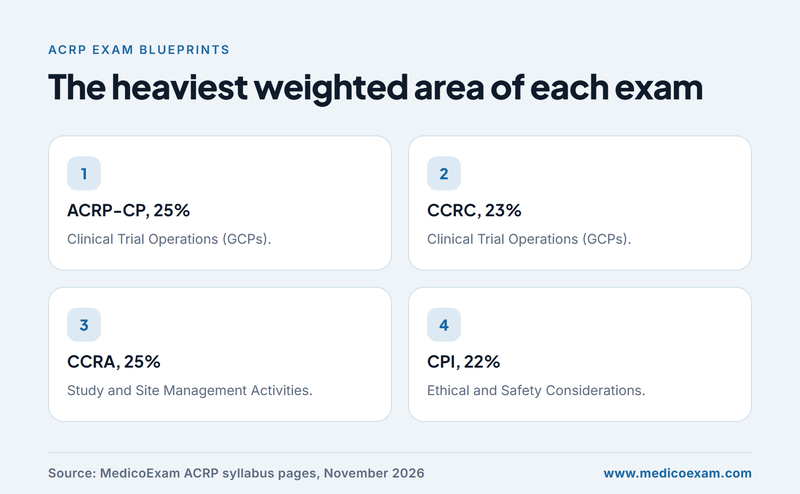
Read across the four blueprints and a pattern appears. Ethics and participant safety is never lower than 18 on any exam, and trial operations is never lower than 18 either. Those two areas are the shared core. What changes is the third and fourth area: site management and data work dominate the coordinator and monitor exams, research design and regulatory frameworks matter more on the ACRP-CP, and investigator oversight sits in the CPI.
What do the eligibility and experience rules look like?
ACRP states the rule for the ACRP-CP, CCRC and CCRA in the same words: a clinical research professional with 3,000 hours of verifiable work experience is eligible to sit for the exam. The complete criteria sit in ACRP's policy manual, and the pages say what counts and what does not.
Work counts when it relates to human subject research, is done under a paid contract with an employer, and can be verified by ACRP through the employer. Work is excluded when it formed part of a degree or other course of study, when it is older than ten years, or when it was an internship, paid or unpaid.
ACRP may grant one experience waiver of 1,500 hours to an applicant who holds an active ACRP certification or who has finished a clinical research course of study. Such a course must align with the topics in the exam content outline, must have valid third-party accreditation and must give knowledge equivalent to 1,500 hours earned through employment. ACRP says approval of a program is at its discretion and is not reviewed or pre-approved outside a paid application. Because of that, do not assume a course qualifies until your application is accepted.
The CPI adds role-specific conditions. An applicant must have served as a principal investigator or sub-investigator on at least one clinical research study and have completed 3,000 hours of qualifying experience within the past five years. Accepted proof includes a document from a regulatory authority confirming your role on the trial you submit. The waiver of 1,500 hours is open to applicants who have an active ACRP certification, a doctorate or a finished clinical research course, and those applicants must still document at least 1,500 hours as a principal investigator or sub-investigator within the most recent five years.
Eligibility is the point where many readers discover that the decision is already made for them. A coordinator with a long record at a site may not be able to document the monitoring hours the CCRA expects, and a monitor may not hold the investigator role the CPI requires. Check the hours you can prove before you compare anything else, and read the full criteria on ACRP's ACRP-CP page or ACRP's CPI page.
What will exam day, windows and results feel like?
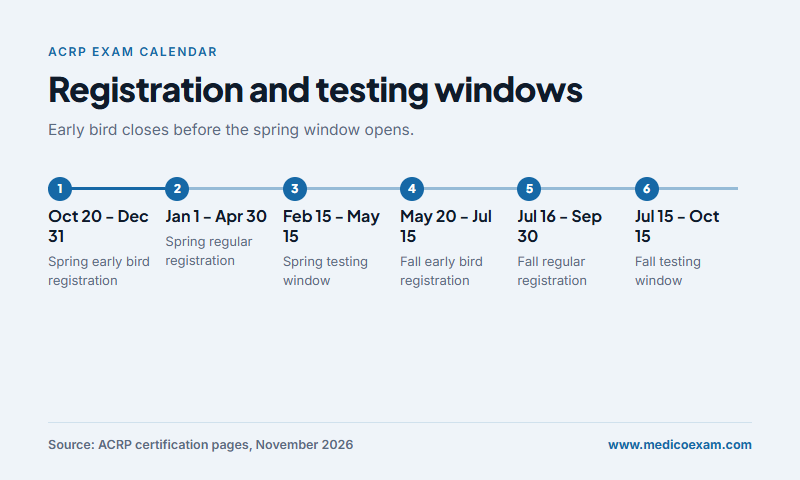
All four exams are computer-based and are delivered through PSI, either at a testing center or with live remote proctoring. Candidates test in a spring window that opens February 15 and closes May 15, or in a fall window that opens July 15 and closes October 15. Registration follows its own calendar, and the cheaper early bird period is set out in the fees section below.
ACRP says an application selected for audit goes through a formal review by its subject matter experts, and in most instances you receive a status update on your application within 10 business days. Candidates who need a reasonable accommodation complete a special accommodations form that is submitted with the application. Do all of that before you plan your study calendar, because an audit review can eat into your preparation time.
Results are shared immediately at the end of the exam. PSI then emails a full score report within 48 hours, and your ACRP account reflects the result within the same period. Passing candidates receive information from ACRP's digital badging partner Credly about claiming a digital badge. A candidate who does not pass is told to refer to the results email or the ACRP Certification Handbook for the next steps.
For the ACRP-CP, ACRP adds a detail that candidates should plan around. Beginning July 15, 2026, the ICH E6(R3) Guideline for Good Clinical Practice replaces E6(R2) across all ACRP examinations. Study materials written for the older guideline can lead you to the wrong answer, so check the date on anything you use. ACRP also lists the only references from which ACRP-CP content can be supported: the E6(R3) guideline, the expedited reporting definitions in E2A, the general considerations for clinical trials in E8(R1), the statistical principles in E9 and E9(R1), the pediatric population guideline E11(R1) and the Declaration of Helsinki.
What does it cost to sit an ACRP exam, and how long does a credential last?
All four exams share one fee schedule. Early bird registration costs members $435, and nonmembers pay $485 for the same exam. Regular registration costs members $460 against $600 for nonmembers. For spring, early bird registration runs from October 20 to December 31 and regular registration from January 1 to April 30. For fall, early bird runs from May 20 to July 15 and regular registration from July 16 to September 30.
The arithmetic is worth doing before you register. A nonmember who registers early saves $115 against registering at the regular rate, since $600 minus $485 is $115. A member who registers early saves $25. Membership itself trims the fee by $50 at the early rate and by $140 at the regular rate, but the pages reviewed here do not show the membership price, so check that figure with ACRP before you count the saving.
Once certified, you have 2 years to keep the credential in good standing through continuing professional development, and ACRP points holders to its Maintenance of Certification details. ACRP also says that if you hold an active ACRP certification you may qualify for the experience waiver on another credential, which is useful if you expect to add a second one later.
Preparation costs are separate. The MedicoExam premium practice exam for each credential is $41.30 and includes 250 or more exam-aligned practice questions, 2 months of unlimited access to the question bank, timed mock exams, scenario-based questions, a result book and a result history. The price is the same on all four product pages.
How do you decide between the four credentials?
Work through the decision in this order, because each step removes options.
- Start with the hours you can verify. If you cannot document 3,000 hours of qualifying work, no credential is open to you yet, and the waiver is the only shortcut. If you have not been a principal investigator or sub-investigator, the CPI is closed.
- Match the credential to your daily work. Site-level coordination points to the CCRC, sponsor-side monitoring points to the CCRA, and investigator duties point to the CPI.
- Decide how much you want a role-free credential. If your work spans several functions, or you expect to move between site and sponsor, the ACRP-CP states its scope as professionals across study-team roles.
- Compare the blueprints to your own strengths. A coordinator strong in operations but weak in regulation will find the CCRC friendlier than the CCRA, which carries a separate regulatory area at 14.
- Time the registration. Pick the window, then register in the early bird period if your preparation allows it.
A tempting shortcut is to pick the exam you think will impress most. The exam rules are the same, the fee is the same and the pass score is the same, so impressiveness is not a useful tiebreaker. A credential that matches the work you do is easier to study for, because the questions describe situations you have already handled.
How should you study once you choose?
Begin with ACRP's own material. The ACRP-CP page says the best way to prepare is to fully understand the scope of the exam content and its references, and it points to a 50-question ACRP practice exam aligned with the exam content outline and with ICH E6(R3). It also notes that ACRP offers training and continuing education programs on the key ICH guidelines.
Then build a plan around the weighted areas rather than around a textbook. Here is a method that works for all four exams.
- Take a timed baseline. Sit mixed questions without notes and file every miss under the blueprint area it belongs to.
- Rank the areas by weight and by your misses. An area worth 25 where you miss most questions comes before an area worth 8 where you miss all of them.
- Study the shared core first. Ethics and participant safety and trial operations appear on every blueprint at 18 or more, so they pay off whichever credential you pick.
- Pair each topic with a scenario. The exams are scenario-based, so for each topic write a short case that you could meet at work, such as a missed visit window, an unreported event or an expired delegation.
- Rehearse a full sitting. Run 125 questions in 180 minutes so you know what 86 seconds per item feels like.
- Sort mistakes by cause. Separate knowledge gaps from misread questions and from time pressure, because each needs a different fix.
The CCRC, CCRA and CPI each have a syllabus page on MedicoExam with the weighted areas and topic lists, and the ACRP CPI page lists the investigator criteria in full. Practice that mirrors your chosen blueprint helps you spot gaps before exam day, though no resource can guarantee a pass.
Which credential suits which reader?
The summary below pairs each credential with the reader it fits best. It is a guide to fit, not a verdict that one credential is better than another.
- ACRP-CP: suits the professional who works across study-team roles, wants a credential that is not tied to one job title and is comfortable with an exam referenced only to ICH guidelines.
- CCRC: suits the coordinator at a site, hospital or research institution whose work is consent, visits, documentation, investigational product and site compliance.
- CCRA: suits the monitor or sponsor-side professional whose work is site selection, monitoring, source data review and corrective action.
- CPI: suits the principal investigator or sub-investigator who can document at least 1,500 or 3,000 qualifying hours in the role within the past five years, depending on whether a waiver applies.
When two of these fit you, choose the one whose blueprint matches your strongest area, because that is the exam you can reach soonest. When none fits, the likely reason is the experience rule, and the next step is to build the verifiable hours before you register.
Whichever you pick, read the full criteria on ACRP's own page before paying, and then start practice with the matching MedicoExam exam: ACRP-CP, CCRC, CCRA or CPI.
Frequently Asked Questions
Which ACRP certification should I take first?
ACRP does not set an order. Match the credential to your work: CCRC for site coordination, CCRA for sponsor-side monitoring, CPI for investigators and ACRP-CP for professionals across study-team roles. Each needs 3,000 hours of verifiable experience, or a 1,500-hour waiver where ACRP grants one.
Do the ACRP exams have the same format?
Yes. Each of the four exams gives you 180 minutes for 125 questions: 100 scored items plus 25 pretest items. A scaled score of 600 on a range of 200 to 800 passes. What differs is the content weighting and who is eligible to sit the exam.
How much do the ACRP exams cost?
All four share one fee schedule. At early bird registration members pay $435 and nonmembers $485. At regular registration members pay $460 and nonmembers $600, so a nonmember saves $115 by registering early. Confirm current fees with ACRP before you pay.
When can I sit the ACRP exams?
Testing happens in two windows each year: spring, February 15 through May 15, and fall, July 15 through October 15. Exams are computer-based through PSI, at a test center or with live remote proctoring. Registration dates differ from testing dates, so check both.
What experience do I need for the CPI compared with the others?
The ACRP-CP, CCRC and CCRA need 3,000 hours of verifiable work experience. The CPI also needs service as a principal investigator or sub-investigator on at least one study, with 3,000 qualifying hours inside the past five years. A waiver of 1,500 hours may apply.
How long does each ACRP certification last?
Each of the four credentials is valid for 2 years. ACRP asks certified professionals to keep it in good standing through continuing professional development during that period, and points to its Maintenance of Certification details for the requirements. Start planning well before the two years end.
- ACRP-CP Question Bank |
- ACRP-CP Eligibility & Requirements |
- ACRP Certified Professional Practice Test |
- ACRP-CP Exam Cost |
- ACRP-CP Registration Process |
- ACRP Certified Professional Study Guide |
- ACRP-CP Recertification |
- ACRP-CP Certification Overview |
- ACRP Certified Professional Syllabus |
- ACRP-CP Preparation Time |
- ACRP-CP Passing Score |
- ACRP-CP Exam Format |
- ACRP CCRA Question Bank |
- ACRP CCRA Eligibility & Requirements |
- ACRP Clinical Research Associate Practice Test |
- ACRP CCRA Exam Cost |
- ACRP CCRA Registration Process |
- ACRP Clinical Research Associate Study Guide |
- ACRP CCRA Recertification |
- ACRP CCRA Certification Overview |
- ACRP CCRC Question Bank |
- ACRP CCRC Eligibility & Requirements |
- ACRP Clinical Research Coordinator Practice Test |
- ACRP CCRC Exam Cost |
- ACRP CCRC Registration Process |
- ACRP Clinical Research Coordinator Study Guide |
- ACRP CCRC Recertification |
- ACRP CCRC Certification Overview |
- ACRP Clinical Research Coordinator Syllabus |
- ACRP CCRC Preparation Time |
- ACRP CCRC Passing Score |
- ACRP CCRC Exam Format


