
Aiming for the RVS Credential? Plan Around Seven Weighted Areas
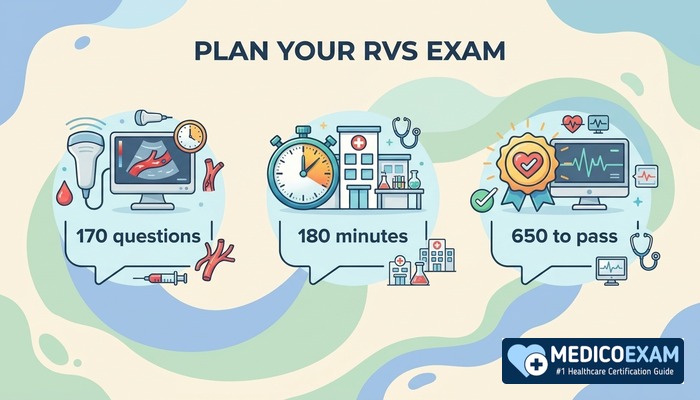
Candidates for the CCI Registered Vascular Specialist (RVS) credential face 170 questions in three hours, and they need 650 out of 900 to pass. Arterial examinations of the arms and legs carry the largest share of marks at 22 percent, and extracranial and intracranial work follows at 20 percent. This guide turns those weightings into a plan.
Ready to measure where you stand today? Start with the RVS practice test, note your score in every topic area, and then use the sections below to decide where the next four weeks of study should go.
Who sits the RVS exam, and what does it certify?
Cardiovascular Credentialing International (CCI) describes the Registered Vascular Specialist examination as the one for professionals working in vascular ultrasound. The MedicoExam syllabus summary adds the typical working settings: hospitals and medical centers, vascular laboratories and diagnostic imaging facilities. Job titles it lists include vascular sonographer, vascular ultrasound professional and diagnostic medical sonography professional.
The exam is computer based and is delivered at Pearson Professional Centers. CCI's credential page states that it is available year-round, depending on availability at the test centers, and it links to a test center locator for finding a site near you. Booking details change from time to time, so read the RVS page at CCI before spending any money.
That page also carries a short Qualification Pathway Tool. It opens by asking about your training in vascular ultrasound, and the answers steer you to the pathway that fits. The detailed eligibility rules sit behind the Qualification Requirements link on the same page, so this guide does not restate them.
CCI also runs a sister credential for venous work. Its Registered Phlebology Sonographer exam is described on another CCI credential page, and the RVS page itself suggests mentioning it to colleagues who hold an RVS or RVT. It is a separate exam with its own blueprint, so do not mix the two when you revise.
A note on scope. Everything here concerns how the exam is built and how to prepare for it. Nothing in this article teaches scanning technique or clinical decision making, and none of it should be read as medical advice.
What do the RVS exam format and fee look like?
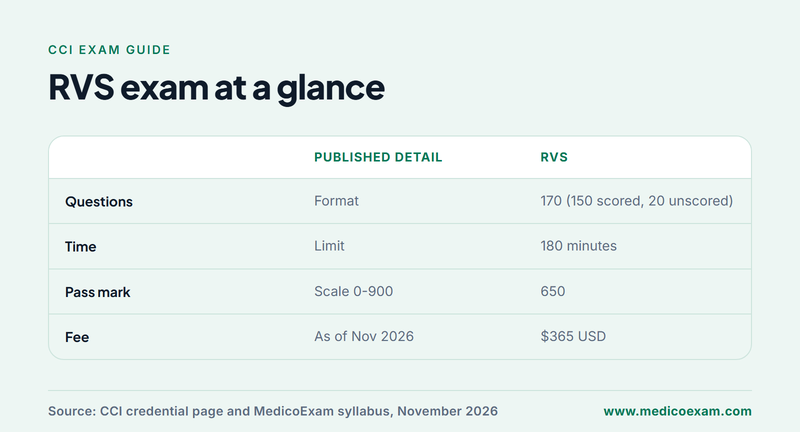
The facts fit in one small table, and each is worth knowing before booking. Prices are in US dollars, as of November 2026.
| Item | What is published |
|---|---|
| Exam code | RVS |
| Questions | 170 questions (150 scored and 20 unscored) |
| Time allowed | 180 minutes |
| Passing score | 650 (scale 0-900), roughly 72% |
| Exam fee | $365 USD |
| Where | A Pearson Professional Center, on a computer |
| Booking period | 90 days, counted from approval and the Authorization to Test |
Two details deserve a second look. First, only 150 of the 170 questions are scored. The other 20 are unscored, and nothing on screen tells you which are which, so every question deserves a full effort. Second, part of the fee cannot be refunded, since it covers the cost of reviewing and handling your application. Consider that slice gone once you apply.
Time per question is the other number to hold on to. Three hours for 170 questions leaves roughly 64 seconds each if you spread the time evenly. That is comfortable for a short knowledge question and tight for a long scenario with several answer options, which is why timed practice matters more than most candidates expect.
Results come as a scaled score, not a raw tally of right answers. Treat the 72 percent figure as a loose guide, since the scale itself belongs to CCI.
What does the RVS exam actually test?
The syllabus on our site lists seven topic areas, each with a published weighting. Together they add up to 100 percent, and the spread is wide: the biggest area is worth more than seven times the smallest. Read the table once, then treat it as the backbone of your schedule.
| Topic area | Weighting |
|---|---|
| Performing arterial examinations of the upper and lower extremities | 22% |
| Performing extracranial and intracranial examinations | 20% |
| Performing venous examinations of the upper and lower extremities | 19% |
| Applying principles of physics and hemodynamics | 15% |
| Maintaining patient care and safety | 11% |
| Performing abdominal and visceral examinations | 10% |
| Performing hemodialysis examinations | 3% |
Take the arterial, extracranial and venous examination areas together and they hold more than half of the marks. That is the clearest signal in the whole blueprint: a candidate who is shaky on arterial, extracranial and venous work cannot make it up elsewhere.
Which topic areas carry the most marks?
Arterial examinations of the upper and lower extremities lead at 22 percent. The tasks that the syllabus names are extremity arterial duplex, post-intervention assessment such as bypass grafts and stents, segmental pressures and ankle-brachial indices, pulse volume recording, exercise testing and specialty physiologic testing. It also names the assessment of arterial complications after a procedure, listing pseudoaneurysm, arteriovenous fistula and hematoma as examples.
Extracranial and intracranial examinations come next at 20 percent. The listed tasks are extracranial duplex, transcranial Doppler in both imaging and non-imaging forms, and extracranial duplex after an intervention. This area is narrower than the arterial one, which means a fixed number of topics to master and a good return on revision time.
Venous examinations of the upper and lower extremities are worth 19 percent. The syllabus lists extremity venous duplex, lower extremity venous insufficiency testing, vein mapping and venous assessment around a procedure, with ablation and PICC placement given as examples. If you already work in a vein clinic, this area may feel familiar and the arterial one less so.
Arterial and extracranial work alone account for well over a third of the exam, and adding venous work carries the share past half. The remaining four areas split what is left, and that spread is exactly why neglecting any one of them is risky.
How much does physics matter, and what sits inside it?
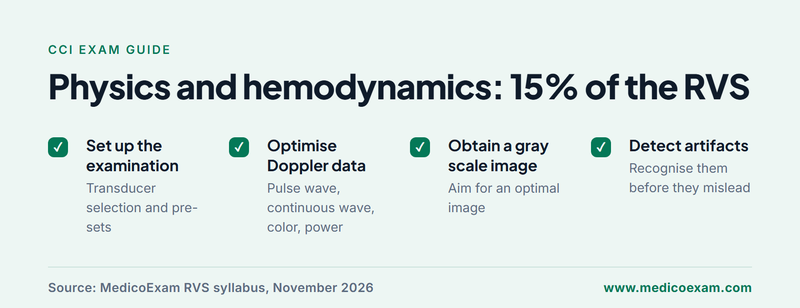
Applying principles of physics and hemodynamics is worth 15 percent, which makes it the fourth largest area. It is also the one that quietly touches every other question, since a duplex examination of any vessel depends on setting up the equipment and optimising the data.
The syllabus names these tasks: setting up the examination, including transducer selection and examination pre-sets, obtaining an optimal gray scale image, applying hemodynamic principles, optimising pulse wave Doppler data, optimising continuous wave Doppler data, optimising color Doppler data, detecting artifacts and optimising power Doppler. Notice the verb in nearly every line. The exam asks you to optimise and detect, not simply to define.
That wording suggests a practical way to revise. For each Doppler mode, write down in your own words what you would adjust and why, then test yourself with a question that gives a poor image or an odd waveform and asks for the next step. Memorised definitions alone will not carry you through that kind of item.
Three references on the syllabus page cover this ground directly: Edelman's Understanding Ultrasound Physics, Kremkau and Forsberg's Sonography Principles and Instruments and the Inside Ultrasound vascular reference guide. Pick one as your main text and use the others to fill gaps.
What should a technical-background candidate study first?
Many candidates arrive from a strongly technical route. They can operate the scanner and recite the physics, yet they have spent less time on the paperwork and judgment around an examination. The patient care and safety area, at 11 percent, is where that gap tends to show, though the weighting is the only published fact here and the pattern is simply a reason to check yourself.
Other CCI exams show the same pattern of uneven weighting. If you want to see how a blueprint can drive a study schedule, read how another CCI exam concentrates its marks,.
The syllabus lists these tasks under patient care and safety: identifying and assessing the patient, verifying that the examination is appropriate and recognising contraindications, eliciting patient history and risk factors, positioning the patient, identifying and documenting critical findings, using standard and universal precautions and sterile techniques, maintaining ergonomic safety, performing quality assurance and improvement, practising bioeffect safety and maintaining equipment, and generating a preliminary finding for physician interpretation.
At 11 percent, this area is worth about the same as a whole examination type. Do not leave it for the final weekend. Read each of those task names, ask yourself whether you could answer a scenario question about it, and note any line where you hesitate.
The reverse also applies. A candidate who has worked mostly with patients and documentation may find the physics and hemodynamics area the steep climb. Whichever side you start from, your practice test results will show which one needs the hours.
What kinds of real-world tasks appear in the abdominal and dialysis areas?
Abdominal and visceral examinations carry 10 percent. The listed tasks are renal duplex, mesenteric duplex, abdominal aortoiliac duplex including endovascular repair, iliocaval duplex including venous stents, and organ transplant duplex, with kidney and liver given as examples. Study these as a family of examinations that share one skill set: the exam wants you to know what each one involves, not only the names.
Hemodialysis examinations are worth 3 percent, the smallest area. The syllabus lists hemodialysis access examination and pre and post operative testing. A small weighting is not a reason to skip it entirely, but it does tell you where one extra evening should not go when the arterial area is still weak.
Put the two together and they still form a modest slice of the exam. A sensible plan gives them a short, steady block rather than a long one, and revisits them at the end through practice questions.
How should you plan your RVS study time?
There is no published rule for how many weeks the RVS needs, and nobody can honestly tell you one number that fits every candidate. A plan built on the weightings, though, can be scaled to whatever time you have. The idea is to give each area hours in proportion to its marks, then add extra hours where your practice scores are lowest.
Begin with a diagnostic sitting. Take a timed practice test, record your result in each of the seven areas, and mark every area where you were noticeably below your own average. Those become your priority list.
Keep a simple log as you go. After each session, write one line on what you covered, one line on what still feels weak and one question you could not answer. A week of those notes becomes a personalised revision sheet, and it is far more useful on the final Sunday than rereading chapters from the beginning.
Next, divide your study sessions by weighting. If you have ten sessions in a week, a rough split would give two to arterial work, two to extracranial work, two to venous work, and one and a half to physics, with the remainder shared across patient care, abdominal and dialysis topics. Adjust it freely. The point is to avoid spending equal time on unequal areas, which is the most common planning mistake.
Then work through your main references. The syllabus page lists these titles: Techniques in Noninvasive Vascular Diagnosis by Daigle, Understanding Ultrasound Physics by Edelman, Sonography Principles and Instruments by Kremkau and Forsberg, Vascular Technology: An Illustrated Review by Rumwell and McPharlin, Vascular Ultrasound: How, Why, and When by Thrush and Hartshorne, and the Inside Ultrasound vascular reference guide. You do not need all six. Choose a physics text and a vascular text, and use the rest as lookups.
In the final stretch, switch from reading to retrieval. Do timed blocks of questions, review every wrong answer, and write down why the right option was right. Your aim in the last week is steady pacing, not new material.
How do you use a practice exam without fooling yourself?
A practice exam is a measuring tool, and it only measures well when you treat it like the real thing. Sit it in one block, set the clock to the real time limit, and close every reference. A set of questions answered with a textbook open measures your ability to look things up, which is not what the exam checks.
Our own premium bank for this credential is priced on its product page, and it is built around scenario-style multiple-choice items with timed mock sittings. MedicoExam wrote it, CCI did not, so treat it as rehearsal and not as a preview of CCI's actual items.
Track three things after each attempt: your score in each topic area, the number of questions you flagged and returned to, and the time left at the end. If you finish with a lot of spare time but a low score, slow down and read more carefully. If you run short of time, you need more speed on the physics and hemodynamics items, where reasoning from first principles is quick once practised.
Beware of memorising a bank. If you can repeat an answer without being able to explain why the other options fail, you have learned the question, not the topic. The real exam will word things differently.
What should you do in the final week and on exam day?
Check your scheduling window first. The MedicoExam syllabus page notes a 90-day eligibility window that opens after your application is approved and you receive the Authorization to Test. Book your seat early in that period, because the credential page makes clear that appointments depend on availability at the test centers.
In the last few days, review your notes on weak areas, redo a handful of timed question sets and stop adding new resources. Sleep and a calm morning help more than a late extra chapter. Confirm your travel time to the Pearson Professional Center, and check that you have the identification and confirmation CCI tells approved candidates to bring, which are listed under the Exam Day link on the credential page.
During the exam, use the 64-second average as a guide rather than a rule. Answer straightforward items quickly, bank the saved seconds for scenario items, and avoid sinking three minutes into one question. Because 20 of the 170 questions are unscored, a single hard item is never worth panic.
Prepare the practical side too. Know how long the journey to the center takes, eat beforehand and arrive early enough that the first question is not answered in a rush. Candidates sometimes lose focus in the opening ten minutes because of logistics, not because of difficulty.
After the exam, the credential is maintained according to CCI's rules. The credential page links to a Maintaining Credentials section, and that is the place to read the current requirements rather than relying on a summary here.
A final word on planning your RVS preparation
The RVS blueprint rewards balance with a lean towards the large examination areas. Arterial, extracranial and venous work together hold more than half the marks, physics and hemodynamics add 15 percent, and the rest is shared by three smaller areas. A study plan that mirrors those proportions, tested through timed practice, gives you the most honest picture of readiness.
Take the practice test, fill in your seven scores, and start with the lowest large area. Check every figure against CCI's own page before you book, since fees and procedures can change.
Frequently Asked Questions
How many questions are on the RVS exam?
Expect 170 items on the screen, but only 150 of them count; 20 are unscored. The time allowed is 180 minutes. Since nothing flags the unscored items, answer each one as though it counts toward your result.
What is the passing score for the CCI RVS exam?
Candidates need 650 out of a possible 900, a mark that our syllabus page puts near 72 percent. How a scaled score maps to correct answers is decided by CCI, so confirm current details with the vendor instead of leaning on the percentage.
How much does the RVS exam cost?
As of November 2026, CCI lists the RVS examination fee at $365 USD. A slice of that fee covers application processing and is not returned, so budget for the full amount and confirm the current wording on CCI's own page before you apply.
Which RVS topic area has the highest weighting?
Performing arterial examinations of the upper and lower extremities is the largest area at 22 percent. Extracranial and intracranial examinations follow at 20 percent and venous examinations of the upper and lower extremities at 19 percent. Hemodialysis examinations are the smallest at 3 percent.
Where do you take the RVS exam?
The RVS is a computer-based exam delivered at Pearson Professional Centers. CCI says it is offered year-round, depending on availability at the test centers. After your application is approved you receive an Authorization to Test, and our syllabus page notes a 90-day window in which to schedule.
Is the RVS a clinical or medical qualification?
No. The RVS is a certification exam for professionals who work in vascular ultrasound, and it tests examination tasks, physics, hemodynamics and patient care and safety. This guide covers exam preparation only and never offers clinical or medical advice.
- CCI RVS Question Bank |
- CCI RVS Eligibility & Requirements |
- CCI Registered Vascular Specialist Practice Test |
- CCI RVS Exam Cost |
- CCI RVS Registration Process |
- CCI Registered Vascular Specialist Study Guide |
- CCI RVS Recertification |
- CCI RVS Certification Overview |
- CCI Registered Vascular Specialist Syllabus |
- CCI RVS Preparation Time |
- CCI RVS Passing Score |
- CCI RVS Exam Format |
- CCI RVS Certification Practice Exam |
- CCI RVS Exam Sample Questions


