
The RPhS Testing Window Change Candidates Must Plan Around
From February 1, 2027, the CCI Registered Phlebology Sonographer (RPhS) exam stops being a year-round test and is offered only in February and August. The format stays the same: 170 questions in 180 minutes, with 650 on a 0-900 scale needed to pass. Your application date now decides which window you can sit.
Thinking of applying? Take the RPhS practice test first and record how you do on every topic area. The rest of this guide shows how to convert those results into a schedule that suits the new windows and the exam's weightings.

Who is the RPhS exam for, and what is changing?
Cardiovascular Credentialing International (CCI) pitches the Registered Phlebology Sonographer examination at people whose work lies in venous ultrasound, the field known as phlebology. Our syllabus summary adds the kinds of people and places involved: venous and vascular sonographers, physicians and advanced practice clinicians, and related vascular imaging professionals, working in vascular ultrasound laboratories, phlebology and vein clinics, hospitals and outpatient diagnostic imaging settings.
The credential page includes a Qualification Pathway Tool as well. Its opening question asks whether you hold a valid license to practice medicine (MD or DO), and the reply points you toward the pathway CCI considers best suited to you. Rules on eligibility and the application process may change, so confirm them on the RPhS page at CCI before paying for anything.
The big change is the schedule. At present the computer-based test runs at Pearson Professional Centers throughout the year, depending on how many seats each site has. Effective February 1, 2027, CCI moves it to a window format. The next section sets out how the dates work, because the rule is easy to misread.
Scope matters here. Everything below concerns the structure of the exam and how to prepare for it. It does not teach scanning or treatment, and it should never be read as clinical or medical advice.
When can you sit the RPhS exam under the new windows?
Under the window format, the exam is administered only during August and February each year. Which window you get depends on when CCI receives your application. CCI's credential page, read in November 2026, lays out three date ranges.
| Application received by CCI | Date range the exam can be taken |
|---|---|
| August 1, 2026 to December 31, 2026 | February 1, 2027 to February 28, 2027 |
| February 1, 2027 to June 30, 2027 | August 1, 2027 to August 31, 2027 |
| July 1, 2027 to December 31, 2027 | February 1, 2028 to February 29, 2028 |
Read the table as a waiting rule. An application received after the end of June 2027 cannot be tested in August 2027, and an application received in the first half of 2027 cannot be tested before August. Missing a deadline therefore costs you months, not days.
CCI also protects people who were already approved. Applicants approved to test before August 1, 2026 can still sit within the dates on their Authorization to Test (ATT) email, provided those dates do not run beyond the close of the February 2027 testing window.
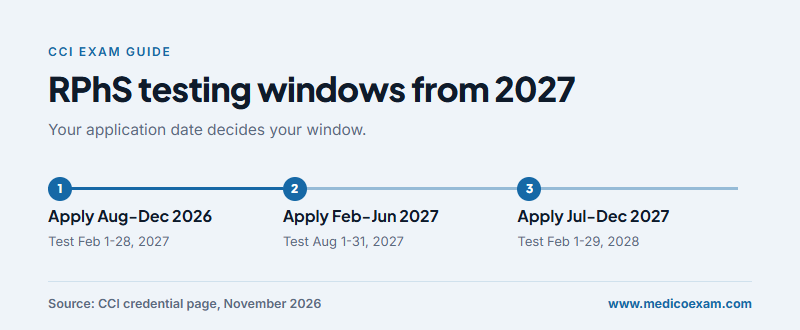
Work backwards from your window. If you want the February 2027 sitting, the application range closes on December 31, 2026, and your preparation needs to be mostly finished before the month of the exam. If you miss that range, the August 2027 window becomes your target and the extra months become study time you can plan properly. The CCI menu also lists a separate page headed Exam Preparation After February 1, 2027, so check it for anything that changes once windows begin.
A practical way to choose between the two windows is to ask how much of the outline you can already explain without notes. If you scored well across all five areas on a baseline test, the nearer window is realistic. If one or two areas are clearly behind, accept the later window and use the gap deliberately: a few weeks per weak area, then a block of timed practice. Because each window lasts only one month, also think about travel to a test centre and time off work, and book your seat as soon as CCI authorises you to test.
One more point is easy to miss. The exam used to be available whenever a centre had space, so a failed attempt or a postponed date meant a short wait. Once windows apply, a missed sitting means waiting for the next one. That makes the quality of your last preparation weeks more important than it used to be, and it is a good reason to schedule your final full-length mock exam well before the window opens, not on the weekend before.
What are the RPhS exam format, fee and pass mark?
The facts below come from the CCI credential page and from our own Master data for the exam, as of November 2026. Where a cell holds more than one figure, both are shown.
| Detail | RPhS exam |
|---|---|
| Delivery | Computer-based, at Pearson Professional Centers |
| Fee | $365 USD |
| Items | 170 in total: 150 scored, 20 unscored |
| Pass mark | 650 out of 900 (approx. 72%) |
| Clock | 180 minutes |
Only 150 of the 170 items count toward your result. The remaining 20 are unscored, and nothing on screen marks which are which, so treat every item as live. Spread across three hours, the paper allows about 63 seconds a question. That is enough to read a scenario properly, yet short enough that one stubborn item must never be allowed to eat five minutes.
A scaled 650 out of 900 is required, and our Master data glosses that as roughly 72%. Because results are scaled, it would be a mistake to read it as the proportion of questions you must get right, so do not build your plan around a raw percentage. Develop even competence in every area and leave the scaling to CCI.
CCI lists the RPhS fee as $365 USD and says part of every exam fee is non-refundable because it covers the effort of checking each application. Check the current figure with CCI when you apply, since prices are subject to revision. Many candidates will find that a missed window, which delays the sitting by months, costs them more than the fee does.
How is the RPhS content weighted?
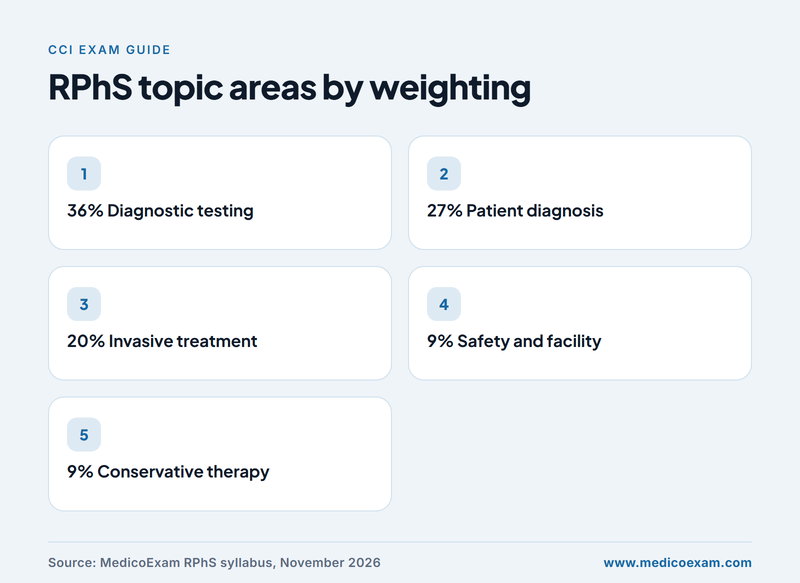
The syllabus page on MedicoExam lists five topic areas with the weightings below. Together, the first two areas that involve hands-on scanning and patient evaluation make up 63% of the paper, so they deserve the largest share of your hours. The published figures add up to 101%, so treat each one as approximate.
| Topic area | Weighting |
|---|---|
| Performance of Diagnostic Testing | 36% |
| Patient Diagnosis | 27% |
| Minimally Invasive and Invasive Treatment of Patients | 20% |
| Maintain Information, Facility, and Safety | 9% |
| Conservative Treatment/Therapy of Patients | 9% |
The largest area, Performance of Diagnostic Testing at 36%, covers confirming indications for a study, positioning the patient, choosing equipment and settings, and selecting a transducer and optimising its frequency. It also names the abdominopelvic, lower extremity and upper extremity venous duplex studies, plus documenting findings and communicating unusual or abnormal ones.
Patient Diagnosis at 27% is about the assessment around the scan: triaging patient status, taking a comprehensive history including social history, performing a pertinent physical exam, reviewing post-treatment status, establishing differential diagnoses, analysing patient data and assisting in formulating diagnostic and treatment plans.
Minimally Invasive and Invasive Treatment of Patients carries 20%. Its topics include confirming signed informed consent, knowing visual sclerotherapy, assisting in ultrasound guided procedures, evaluating patients before and after open surgical, superficial venous and catheter directed interventions, using patient or physician reported outcome measures and providing discharge instructions.
The two smallest areas are still worth your time. Maintain Information, Facility, and Safety at 9% covers patient identifiers, universal precautions and sterile techniques, facility emergency protocols, equipment inspection and preventative maintenance, workspace and ergonomics, continuous quality improvement, and securing and archiving patient information. Conservative Treatment/Therapy of Patients at 9% covers knowledge of conservative treatments, compression therapy, the treatment of lymphedema and lipedema, and pharmaceutical therapy.
A useful habit is to turn every bullet in the outline into a question you must be able to answer aloud. For "Select Appropriate Transducer and Optimize Frequency", ask yourself what drives the choice and what you would check before changing it. For "Review Post-Treatment Status", ask what prior treatment history changes about how a study is planned and read. If a bullet leaves you silent, it is a gap, and the weighting tells you how urgently to fill it.
How should you study each RPhS area?
Begin with the blueprint, not with your daily work. Most sonographers are strongest in the area they scan every day and weakest in the areas where someone else leads, such as treatment planning or conservative therapy. Because the exam samples everything, a lopsided background shows up as a lopsided score.
Performance of Diagnostic Testing. Build a checklist for each of the three duplex study types named in the syllabus: abdominopelvic, lower extremity and upper extremity. For each, rehearse the order of decisions in plain words, from indication through positioning, equipment and transducer choice, to documentation and communication of abnormal findings. Answering aloud exposes gaps that silent reading hides. Give the equipment topics real time, since settings and transducer frequency are named in the outline.
Patient Diagnosis. These questions usually reward reasoning. Practise reading a short patient scenario and naming what the history, physical exam and prior treatment status add to the picture. Pay attention to comorbidity and medications, which the outline lists under differential diagnoses, because they change how a case is read. Keep your answers within what a sonographer or team member would do and ask which action comes first. Where a scenario describes an unusual or abnormal finding, remember the outline's own wording: communicating it is part of the task, so a good answer often involves passing information to the right person promptly.
Minimally Invasive and Invasive Treatment. Many candidates work only on the diagnostic side, so this area is where a plan pays off. Learn the before-and-after evaluation logic for each intervention type listed: open surgical, superficial venous, catheter directed deep venous and catheter directed abdominopelvic venous. Then cover consent, outcome measures and discharge instructions, which are easy marks if you have looked at them.
Safety and conservative therapy. These two 9% areas are the cheapest to learn. Make flash cards for universal precautions, emergency protocols and ergonomics, then for compression therapy, lymphedema, lipedema and pharmaceutical therapy. Clearing them early frees your final weeks for timed practice.
A simple phasing keeps the work organised. In the first phase, take a baseline test and rank the five areas by your score. In the second, study the weakest area against the outline until you can answer each bullet aloud, weighting your hours by the table above. In the third, mix areas in timed sets so you practise switching topics, as the real paper does. In the fourth, sit full-length mocks, review each wrong answer, and write down why the correct option was better. The number of weeks per phase depends on your starting point and your window, so set it from your baseline rather than from a generic schedule.
The syllabus page lists reference books that candidates can use, among them Fundamentals of Phlebology (3rd edition, American College of Phlebology), Inside Ultrasound Venous Vascular Reference Guide (2nd edition), Practical Phlebology: Venous Ultrasound, The Vascular System (2nd edition, LWW) and The Vein Book (2nd edition, Oxford University Press). Pick one or two that match your weakest areas rather than trying to read them all, and use the topic outline as the index to what you read.
How do you handle RPhS exam questions on the day?
Start each item by finding the actual ask, which usually sits in the final sentence. Then go back through the scenario for details relevant to it: which study is being performed, what the patient's status is, what has already happened and what comes next. Best-answer items often contain one or two options that fail for a reason you can state, for example a step taken out of order, a study that does not fit the indication or an action that leaves the stated problem untouched.
Strike those, pick from the rest, flag the item if you are still unsure, and move on. Because 20 of the 170 items are unscored, no single question deserves a big share of your time, and flagged items can be revisited with whatever minutes remain at the end.
Practise all of this against a clock. Pace is learnt through repeated timed sets, not through reading about it. A complete 180-minute mock shows you how your concentration holds in the final hour, something no amount of reading can reveal. Fit in several before your window and sort every wrong answer into one of the five topic areas so your remaining hours go where they are needed.
If you also work in cardiac imaging and wonder how another CCI credential splits its marks, compare the blueprints on this site, for example how the cardiac sonographer exam spends its weightings. Seeing a different distribution helps you notice that the RPhS puts the most weight on the scan itself.
What comes with the MedicoExam RPhS practice exam?
The premium RPhS package offers 335+ practice questions, with the full question bank open to you without limits for 2 months. You get timed mock exams that copy official testing conditions, scenario-based multiple-choice questions, a Personalized Result Book and a result history with insight down to individual questions. When we checked in November 2026 the price was shown on the product page, with a candidate-first money-back guarantee.
You can try a free online demo to get a feel for the platform and the wording of questions before spending anything. Keep the role of this material clear: it is MedicoExam's own preparation, not CCI's test. Use it to rehearse pacing and reasoning, and look to CCI for rules, fees and dates.
Which habits cost RPhS candidates marks, and what should you do next?
- Studying only your daily work. The exam covers all five areas, including those handled by other colleagues.
- Ignoring the treatment area. It carries 20%, more than safety and conservative therapy together.
- Treating the small areas as optional. The two 9% areas are quick to learn and every mark counts.
- Converting the pass mark into a percentage target. The scale is CCI's, so a raw score of 72% is not the thing to aim for.
- Missing the application range. Under the windows, a late application can move your sitting back by six months.
- Leaving timed practice to the last days. Speed comes from many timed runs.
Before committing to a date, read CCI's own material for the present fee, your pathway, test-centre procedures and the requirements for keeping the credential. The credential menu on CCI's main site opens with Qualification Requirements and Apply for Exam, and also has pages on preparation, approved test takers, exam day and maintaining your credentials. If anything there conflicts with this guide, CCI's version wins.
Your next step is simple. Choose the window you are aiming for, write down the application range that goes with it, and sit a timed baseline this week. Log one score per topic area, then build your revision around the widest gap, giving diagnostic testing and patient diagnosis the most attention.
Frequently Asked Questions
When can I take the RPhS exam from 2027?
From February 1, 2027, CCI offers the RPhS only in February and August. An application received August 1 to December 31, 2026 can test in February 2027, one received February 1 to June 30, 2027 tests in August 2027, and July 1 to December 31, 2027 tests in February 2028.
How many questions are on the CCI RPhS exam?
There are 170 items, and 150 of them are scored while the other 20 are not. Nothing tells you which are unscored, so give each one proper thought. With 180 minutes available you can spend roughly 63 seconds on a question.
What is the RPhS passing score?
Candidates need 650 on a 0-900 scale, a figure our Master data lists as approximately 72%. The scale is not a plain percentage of correct answers, so aim for solid results in all five topic areas instead of chasing one number.
How much does the RPhS exam cost?
The fee on CCI's credential page was $365 USD in November 2026. Part of it is not refundable and covers application review and processing. Amounts can be revised, so check CCI before you apply.
Which RPhS topic area carries the most weight?
Performance of Diagnostic Testing is the largest at 36%, followed by Patient Diagnosis at 27% and Minimally Invasive and Invasive Treatment of Patients at 20%. Maintaining information, facility and safety and Conservative Treatment each carry 9%.
Where is the RPhS exam taken?
It is a computer-based exam administered at Pearson Professional Centers. Until the window format begins it is available year-round based on availability at the test centres. Check CCI's page for how to locate a centre.
- CCI RPhS Question Bank |
- CCI RPhS Eligibility & Requirements |
- CCI Registered Phlebology Sonographer Practice Test |
- CCI RPhS Exam Cost |
- CCI RPhS Registration Process |
- CCI Registered Phlebology Sonographer Study Guide |
- CCI RPhS Recertification |
- CCI RPhS Certification Overview |
- CCI Registered Phlebology Sonographer Syllabus |
- CCI RPhS Preparation Time |
- CCI RPhS Passing Score |
- CCI RPhS Exam Format |
- CCI RPhS Certification Practice Exam |
- CCI RPhS Exam Sample Questions


