
Beyond the ED Floor: What the CEN Exam Really Measures
The BCEN Certified Emergency Nurse (CEN) exam gives you 175 items and 180 minutes, scores 150 of them, and sets the pass mark at 99 correct scored items, roughly 66%. The marks spread across eleven content areas, and none holds more than 18 scored items, so broad preparation beats deep specialising.
Want a baseline before you plan anything? Sit the CEN practice test first and note which content areas cost you the most marks. The sections below turn that result into a study order that follows the exam's own published layout.
Who is the CEN exam for, and how does BCEN describe it?
The Board of Certification for Emergency Nursing (BCEN) calls the Certified Emergency Nurse the foundational nursing specialty certification for registered nurses working in the emergency department and across the emergency spectrum. On its credential page, BCEN also describes the CEN as a cornerstone credential for emergency nursing, and says it positions certified nurses to advance in their careers.
Our syllabus summary lists registered nurses, emergency department nurses and emergency nursing professionals as typical candidates, working in hospital emergency departments and other acute care settings. The skills it names are emergency nursing assessment, emergency intervention and prioritisation, and specialty emergency nursing knowledge. Those three phrases are a useful lens: the exam is less about reciting facts than about deciding what matters first.
BCEN states that its CEN, CFRN, CPEN, CTRN, TCRN and CBRN programmes are accredited by the Accreditation Board for Specialty Nursing Certification (ABSNC). Eligibility rules, application steps and discounts are set by BCEN and can change, so read them on BCEN's CEN page before you pay for anything.
One note on scope. Everything here is exam-preparation guidance: it describes what the test covers and how to organise your revision. It is not clinical or medical advice and is no substitute for your employer's protocols or your own training.
What are the CEN exam format, fees and pass mark?
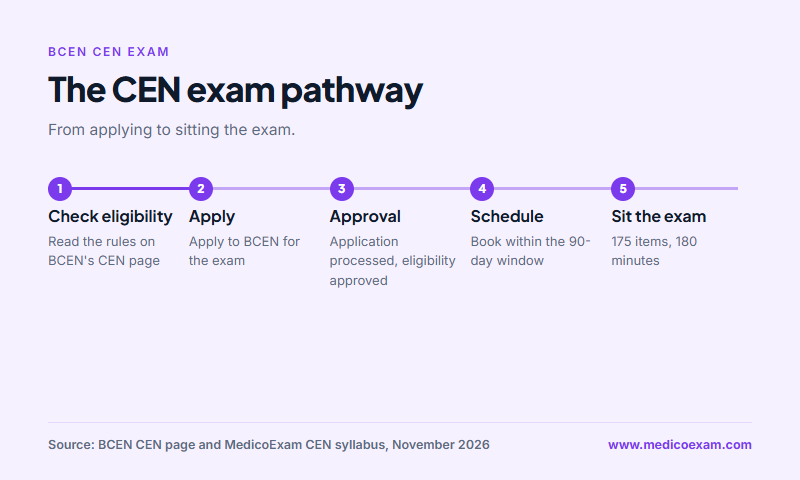
The exam is computer-based. According to our syllabus summary it is delivered either at a PSI testing centre or online through PSI Live Remote Proctoring, and you get a 90-day testing window once your application has been processed and your eligibility approved. You face 175 items in 180 minutes. Of those, 150 are scored and 25 are unscored pretest items.
The unscored items look exactly like the scored ones, so you cannot tell them apart on screen. That is the practical reason to give every item the same care. The pass mark is 99 correct answers out of the 150 scored items, which BCEN's data puts at approximately 66%.
| Feature | CEN detail |
|---|---|
| Issued by | Board of Certification for Emergency Nursing (BCEN) |
| Items on the exam | 175, of which 150 are scored and 25 are unscored pretest items |
| Time allowed | 180 minutes |
| Passing score | 99 of the 150 scored items (approx. 66%) |
| Initial exam fee | $380 USD (November 2026) |
| Delivery | PSI testing centre or PSI Live Remote Proctoring |
| Testing window | 90 days after application processing and eligibility approval |
| Credential length | 4 years |
Fees depend on who you are. As of November 2026 the initial exam costs $380. ENA members pay $285, a saving of $95, and the military rate is $195. If you add BCEN Test Assurance, those three prices become $450, $355 and $265 respectively, which is $70 more in each case. A retest costs $200. Check BCEN's current fee page before you apply, because prices and discount rules are the vendor's to change.
Time per item is easy to work out. A full 180 minutes across 175 items leaves about 62 seconds for each one, and that figure includes the unscored items you cannot identify. Practise at that speed before test day instead of discovering it during the exam.
How do the 150 scored items spread across the eleven content areas?
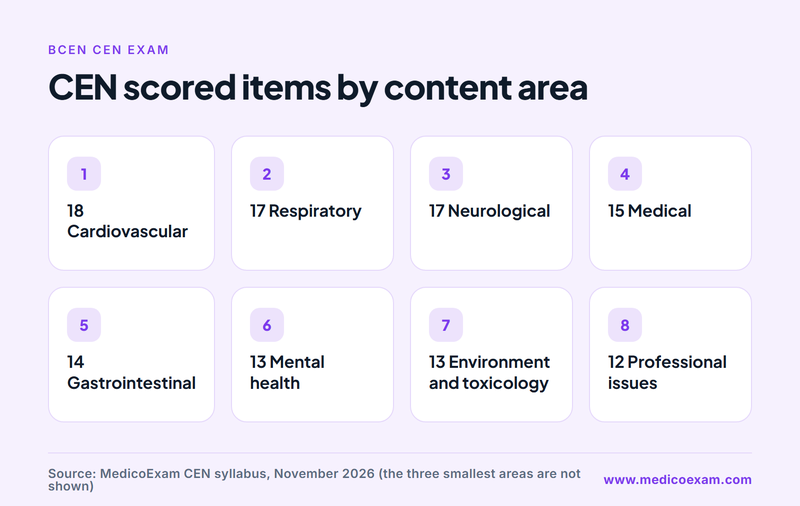
The syllabus lists eleven topic areas, with a number of scored items beside each. The counts add up to exactly 150, so each one is a direct share of the marks you can earn. Here is the full list, from the heaviest area to the lightest.
| Topic area | Scored items |
|---|---|
| Cardiovascular emergencies | 18 |
| Respiratory emergencies | 17 |
| Neurological emergencies | 17 |
| Medical emergencies | 15 |
| Gastrointestinal emergencies | 14 |
| Mental health emergencies | 13 |
| Environment and toxicology emergencies, and communicable diseases | 13 |
| Professional issues | 12 |
| Musculoskeletal and wound emergencies | 11 |
| Genitourinary, gynecology and obstetrical emergencies | 10 |
| Head, eye, ear, nose and throat emergencies | 10 |
The spread is unusually flat. The heaviest area, cardiovascular, carries 18 items and the lightest two carry 10 each. A candidate who is brilliant in one area and weak in four others will struggle, because there is no heavyweight area to bank marks in. The pass mark of 99 means you need to be reliably competent almost everywhere.
That flatness also changes how you should read your practice results. A single bad score in a 10-item area costs you at most 10 marks, but a pattern of middling scores across eight areas costs far more. Look for patterns, not outliers.
What do the cardiovascular, respiratory and neurological areas ask?
These are the three largest areas, with 18, 17 and 17 scored items. The syllabus names the subjects under each, so you can check your coverage against a concrete list rather than a vague title.
Under cardiovascular emergencies the syllabus lists acute coronary syndrome, aneurysm and dissection, cardiopulmonary arrest, dysrhythmias, endocarditis, myocarditis and pericarditis, heart failure, hypertension, pericardial tamponade, peripheral vascular disease, thromboembolic disease, cardiovascular trauma, and cardiogenic and obstructive shock. That is a broad list, and the exam expects you to recognise how each presents and what takes priority.
Respiratory emergencies names aspiration, asthma, chronic obstructive pulmonary disease, infections, inhalation injuries, obstruction, pleural effusion, pneumothorax, noncardiac pulmonary edema, pulmonary embolus, respiratory distress syndrome, respiratory trauma, pulmonary hypertension and croup. Notice how many entries are conditions that can look alike at the bedside; questions often hinge on telling them apart.
Neurological emergencies covers neurological disorders, headache, increased intracranial pressure, meningitis, seizure disorders, stroke, transient ischemic attack, head and spinal cord trauma, and neurogenic shock. Stroke and trauma topics overlap with other areas, so reading the stem carefully for what is actually being asked saves marks.
Together these three areas hold 52 of the 150 scored items. They deserve a large share of your time, but because the rest of the exam is nearly as heavy, they should not take all of it.
What sits in the medical, gastrointestinal and mental health areas?
Medical emergencies (15 items) groups allergic reactions and anaphylaxis, hematologic disorders, electrolyte and fluid imbalance, endocrine disorders, immunocompromise, sepsis, hypovolemic and distributive shock, substance use and abuse, and withdrawal syndrome. Several of these cut across body systems, which is why this area rewards a systematic approach more than memorised lists.
Gastrointestinal emergencies (14 items) lists appendicitis, peritonitis, bowel perforation, cyclic vomiting syndrome, bleeding, cholecystitis, cirrhosis, diverticulitis, esophageal varices, foreign bodies, hepatitis, intussusception, obstructions, pancreatitis, gastrointestinal trauma and gastrointestinal disorders generally.
Mental health emergencies (13 items) names aggressive and violent behavior, anxiety disorders, depressive disorders, homicidal and suicidal ideation, intentional overdose and ingestions, psychotic disorders and bipolar disorders. Candidates who spend most of their time on physical emergencies sometimes underweight this area, yet at 13 items it matches the environment and toxicology area and outweighs several body-system areas.
What do the four smaller areas and the specialty groupings cover?
Environment and toxicology emergencies, and communicable diseases (13 items) is a three-part area: environment, toxicology and communicable diseases. The syllabus gives only those three headings, so expect questions from any of them and use BCEN's own materials to see how deep the content goes.
Musculoskeletal and wound emergencies carries 11 items, split between musculoskeletal and wound topics. Genitourinary, gynecology and obstetrical emergencies and head, eye, ear, nose and throat emergencies carry 10 items each, and each is a short list of subheadings: genitourinary, gynecology and obstetrical in the first, and head, eye, ear, nose and throat in the second.
Because these lists are short, candidates sometimes assume the questions will be shallow. That is a risky guess. The syllabus tells you the territory, not the difficulty, so treat each of these areas as 10 or 11 marks you have to earn.
Why do professional issues deserve more attention than their label suggests?
Professional issues carries 12 scored items, and the syllabus names two subjects: prioritisation, and legal and ethical issues. Prioritisation is the thread that runs through the whole exam, because the credential is built around emergency intervention and prioritisation. The legal and ethical items add a different kind of reasoning, where the right answer depends on professional responsibility rather than on physiology.
This is also the area where experienced nurses can lose marks by answering from local habit. Your hospital may do things its own way, but the exam asks for the best answer in its own framework. When a stem describes several patients or several competing needs, practise stating in a single sentence why one comes first. If you cannot say it, you probably have not understood the item yet.
How should you divide your study time across the areas?
Because the weighting is so even, a sensible plan starts with your own results, not the syllabus order. Here is a simple method that follows the published layout.
First, take a timed practice test and record your score for each of the eleven areas. Second, rank the areas by marks lost, not by percentage correct, since a 10-item area and an 18-item area differ in what they can cost you. Third, give your first study block to the two or three areas where you lost the most, then rotate through the rest so nothing goes cold.
A weekly rhythm helps. Reserve one session for new material in a weak area, one for mixed questions that jump between areas, and one for a timed block at the real pace of about 62 seconds per item. The mixed session matters because the real exam does not announce which area the next item belongs to.
There is no official figure for how many weeks candidates need, and BCEN does not publish one, so we will not invent one. Plan backwards from your testing window instead. Once your application is approved you have 90 days, which is long enough to schedule a final full-length rehearsal in the last week.
How do you pace 175 items in 180 minutes?
Pacing is a skill you can train. Mark your position at the one-hour and two-hour points, and compare it with the number of items you should have reached. At about 62 seconds each, an even pace puts you near item 58 after one hour and near item 116 after two. Treat those checkpoints as a guide, not a rule, since some items take seconds and others take two minutes.
When a stem is long, read the final sentence first so you know the question being asked, then return to the details. If two answers both look reasonable, ask which one the situation needs first. Prioritisation questions often reward the answer that deals with the most immediate threat before the most interesting one.
Flag and move on if an item is eating your time. Candidates who stall on a single item usually lose more marks to the items they rush later than they would have lost by guessing and moving on.
Which study resources exist, and what do they do?
BCEN publishes study and preparation guidance on its website, and its CEN page promotes BCEN's official CEN practice exam, which simulates the real format and content. That is BCEN's own product, so it is the closest thing to the vendor's view of the test. The CEN page also mentions review courses, a candidate handbook, a digital badge and a voucher programme, all of which are BCEN's to describe and price.
Our own premium CEN practice exam is a separate, independent resource. As of November 2026 it includes 345+ exam-aligned practice questions, 2 months of unlimited access, timed mock exams, a personal result book and question-level result history, with a money-back guarantee and the current price shown on the product page. It is built to help you rehearse pacing and spot weak areas, and it does not replace BCEN's own materials.
MedicoExam is not affiliated with, endorsed by or approved by BCEN or any other certification vendor, and we do not provide exam recalls or leaked content. Use any practice test to find gaps in your knowledge, then close them with proper study.
How long does CEN certification last, and what happens after you pass?
BCEN says CEN certification renews every four years, and our records show the same four-year validity. Staying certified means keeping current with emergency care standards and evidence-based practice, and BCEN describes recertification as a defined set of steps with continuing education options that count towards it. The exact requirements and the options that count are on BCEN's recertification pages, so read them early instead of in your final year.
Passing also brings a digital badge, which BCEN invites you to share. If you are thinking ahead to other emergency specialties, BCEN runs five more programmes: flight, transport, pediatric, trauma and burn. If you are weighing those routes, our pieces on the career case for transport nursing and on what a trauma credential can offer show how those credentials are framed, and they make a useful comparison with the CEN.
How should you read a scenario item on the CEN exam?
Most items present a short situation and ask for a best answer. A reliable routine has four steps. First, identify the question being asked: is it what to do first, what to expect, what to teach, or what to report? Second, identify the patient group and setting the stem describes, because the same finding can mean different things for different people. Third, remove any option that is clearly outside the situation. Fourth, choose between what remains by asking which option addresses the greatest immediate need.
Practise this routine on untimed items first, then speed it up. The aim is not to be fast on day one but to make the steps automatic, so that under the clock you spend your seconds on the decision and not on deciding how to decide.
After each practice block, sort your wrong answers into three piles: knowledge gaps, misreads and time pressure. Knowledge gaps send you back to study. Misreads call for slower reading of the final sentence. Time pressure calls for more timed blocks. Sorting your errors this way turns a vague feeling of being unprepared into a short, specific to-do list for the coming week.
Which habits cost candidates marks?
The first is studying only the dramatic topics. Cardiovascular and neurological areas are heavy, but mental health, communicable disease and professional issues add up to a large block of marks. Ignoring them is the easiest way to lose the margin you need for 99.
The second is memorising lists without practising decisions. The syllabus lists conditions, but the exam asks you to prioritise and apply. After each study session, practise explaining why one action comes before another instead of just naming it.
The third is skipping timed practice. Knowing the material at a relaxed pace and knowing it at 62 seconds per item are different skills. Add at least two full timed runs before test day, and review every wrong answer to see whether the cause was knowledge, misreading or time.
The fourth is relying on one source. BCEN's own materials, a practice test and your clinical experience each show you something different. Use all three, and trust BCEN's published outline over anyone's memory of a past exam.
What should you do next?
Check your eligibility and current fee with BCEN, take a baseline test, and write down your marks lost by area. Then build a two-month plan around the weakest three areas and keep one weekly session for mixed timed questions. When you are ready to rehearse, a timed CEN practice test gives you rehearsal against the same layout. Finally, remember the headline: 99 of 150 scored items, spread across eleven areas, in 180 minutes.
Frequently Asked Questions
How many questions are on the BCEN CEN exam?
Expect 175 items on test day. Scoring counts 150 of them, while the other 25 are trial questions that never affect your result and cannot be told apart from the rest. The clock runs for 180 minutes overall, so plan on a little over a minute per question.
What is the passing score for the CEN exam?
You pass by answering 99 of the 150 scored items correctly, which BCEN data puts at approximately 66%. The 25 pretest items do not count towards your result. Because the pass mark is set in correct answers, you can track your progress in practice tests against that number.
How much does the CEN exam cost?
As of November 2026 the initial exam costs $380, or $285 for ENA members and $195 with the military discount. BCEN Test Assurance raises those prices to $450, $355 and $265. A retest costs $200. BCEN sets these fees, so confirm them on its site before applying.
Which area of the CEN exam carries the most marks?
Cardiovascular emergencies carries the most, with 18 of the 150 scored items. Respiratory and neurological emergencies follow with 17 each. The lightest areas carry 10 items each, so the spread is flat and you need reliable knowledge across all eleven areas rather than strength in just one.
How long does CEN certification last?
CEN certification renews every four years. BCEN describes recertification as a set of steps with continuing education options that count towards it. Read the current requirements on BCEN's recertification pages early in your cycle, because the details and accepted options are decided by BCEN and can change.
Where can I take the CEN exam?
It is a computer-based exam, and you can sit it in person at a PSI centre or from home with a remote proctor through PSI. A 90-day window opens once BCEN has processed your application and approved your eligibility. Confirm the current options with BCEN before booking.
- BCEN CEN Question Bank |
- BCEN CEN Eligibility & Requirements |
- BCEN Emergency Nurse Practice Test |
- BCEN CEN Exam Cost |
- BCEN CEN Registration Process |
- BCEN Emergency Nurse Study Guide |
- BCEN CEN Recertification |
- BCEN CEN Certification Overview |
- BCEN Emergency Nurse Syllabus |
- BCEN CEN Preparation Time |
- BCEN CEN Passing Score |
- BCEN CEN Exam Format |
- BCEN CEN Certification Practice Exam |
- BCEN CEN Exam Sample Questions


