AMT MDT Certification Guide: Molecular Diagnostics Technologist Exam
 The molecular diagnostics laboratory is where genomics, infectious disease, oncology, and pharmacogenomics intersect — and the AMT MDT (Molecular Diagnostics Technologist) credential certifies the professionals who work at that intersection.
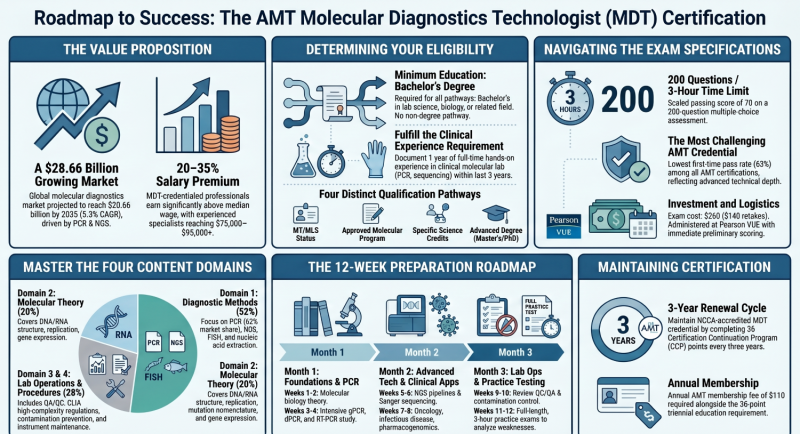
According to Precedence Research, the global molecular diagnostics market is projected to grow from $17 billion in 2025 to $28.66 billion by 2035, a compound annual growth rate of 5.3%. PCR technology alone holds 62% market share, and next-generation sequencing (NGS) is expanding rapidly — both are core competencies on the AMT MDT exam.
The MDT is AMT's most advanced and specialized credential. It requires a bachelor's degree minimum, documented molecular laboratory experience, and passage of a 200-question exam with a 3-hour time limit. At $260, it is also the highest-cost AMT exam — reflecting the advanced knowledge it certifies. This guide covers everything: what the MDT tests, how to qualify, what to expect on exam day, and how to build a study strategy for this technically demanding credential.
What Is the AMT MDT Certification?
The AMT Molecular Diagnostics Technologist (MDT) credential certifies advanced competency in molecular biology laboratory techniques and their clinical applications. Learn more on the AMT MDT certification overview — MedicoExam page. MDT holders perform, interpret, and troubleshoot molecular diagnostic tests used in:
-
Infectious disease: PCR-based detection of pathogens (HIV, HCV, TB, respiratory viruses, STIs)
-
Oncology: KRAS/BRAF mutation testing, HER2 amplification, BCR-ABL quantification, microsatellite instability (MSI)
-
Pharmacogenomics: CYP2D6, CYP2C19, and other drug metabolism gene testing
-
Genetics and inherited conditions: BRCA1/2, cystic fibrosis, fragile X syndrome
-
Transplantation: HLA typing for compatibility, chimerism testing
The MDT is issued by American Medical Technologists (AMT), accredited by the National Commission for Certifying Agencies (NCCA), and administered through Pearson VUE testing centers.
Why Does the MDT Credential Matter Now?
Molecular diagnostics is not a niche — it is the direction clinical laboratory medicine is moving. Market and workforce data confirm the urgency of this credential.
-
Market growth: According to Precedence Research (2025), the global molecular diagnostics market reached $17 billion in 2025 and is projected to reach $28.66 billion by 2035 at 5.3% CAGR.
-
PCR dominance: PCR-based methods hold 62% market share in 2025 — and PCR is a core competency domain of the MDT exam. Understanding quantitative PCR (qPCR), real-time PCR, and digital PCR is not optional for MDT candidates.
-
NGS acceleration: Next-generation sequencing is the fastest-growing technology segment in molecular diagnostics. The MDT exam now includes NGS interpretation and application — a direct response to clinical adoption.
-
COVID-19 legacy: The pandemic demonstrated the essential nature of molecular laboratory infrastructure and accelerated investment in molecular diagnostics capacity across healthcare systems. MDT-credentialed professionals are the workforce that operates this infrastructure.
-
Salary premium: According to the Bureau of Labor Statistics, the median clinical laboratory scientist salary is $61,890 (May 2024). MDT-credentialed professionals typically earn 20–35% above this median, placing experienced MDT specialists in the $75,000–$95,000+ range.
Who Is Eligible for the AMT MDT Exam?
All MDT eligibility pathways require a minimum of a bachelor's degree. The MDT is explicitly an advanced, post-baccalaureate credential:
Pathway 1 — MT/MLS Pathway:
Hold a current, valid AMT MLS (Medical Laboratory Scientist) or MT (Medical Technologist) credential plus 1 year of full-time molecular laboratory experience within the past 3 years in an approved clinical molecular diagnostics laboratory.
Pathway 2 — Molecular Science Program:
Hold a bachelor's degree in laboratory science, biology, biochemistry, or related field, plus completion of an AMT-approved molecular diagnostics training program or a 50-week U.S. military molecular laboratory training program, plus 1 year of molecular laboratory experience within the past 3 years.
Pathway 3 — Laboratory Science Education:
Hold a bachelor's degree with at least 35 semester hours of laboratory science coursework including molecular biology content, plus 1 year of full-time molecular laboratory experience within the past 3 years in an approved facility.
Pathway 4 — Advanced Science Degree:
Hold a master's or doctoral degree in a relevant laboratory science, molecular biology, biochemistry, or genetics field, plus 1 year of molecular laboratory experience within the past 3 years.
Experience requirement clarification: "Molecular laboratory experience" means hands-on performance of molecular diagnostic techniques (PCR, electrophoresis, extraction, sequencing) in a clinical, public health, or research laboratory setting. Experience in a clinical chemistry or hematology laboratory without molecular methods does not qualify.
What Are the AMT MDT Exam Specifications?
The AMT MDT exam is the most demanding in the AMT portfolio: 200 questions in 3 hours, with the highest exam fee ($260) and the lowest first-time pass rate (63%) of all AMT credentials.
| Spec | Detail |
|---|---|
| Total questions | 200 multiple choice |
| Time limit | 3 hours (180 minutes) |
| Passing score | Scaled score of 70 |
| Exam fee | $260 (North America) / $255 (international) |
| Retake fee | $140 |
| Retake wait | 45 days minimum |
| Maximum attempts | 4 |
| Testing platform | Pearson VUE (in-person and remote) |
| Score delivery | Preliminary on-screen result immediately |
The MDT has the highest exam fee ($260) in the AMT portfolio and the second-longest time limit (3 hours, behind the MLS at 3.5 hours). Budget adequate preparation time — AMT has reported a 63% first-time pass rate for the MDT, the lowest of all AMT credentials. This reflects the genuinely advanced and highly technical nature of the exam content.
What Topics Does the AMT MDT Exam Cover?
The MDT exam is organized into 4 content domains. Domain 1 (Diagnostic Methods) accounts for 52% of the exam — more than half — making it the overwhelming study priority. Review the MDT exam syllabus and domain breakdown for the official AMT content outline.
Domain 1: Diagnostic Methods — 52% (104 questions)
The dominant domain — more than half the exam — covers molecular diagnostic techniques in depth:
PCR-based methods (highest frequency):
-
Conventional PCR: reaction components (Taq polymerase, primers, dNTPs, buffer, MgCl2), thermocycling parameters, optimization
-
Real-time quantitative PCR (qRT-PCR): fluorescence detection (SYBR Green, TaqMan probes), amplification curves, Ct values, efficiency calculations
-
Digital PCR (dPCR): droplet digital PCR (ddPCR) principles, absolute quantification, clinical applications
-
Reverse transcription PCR (RT-PCR): RNA isolation, cDNA synthesis, applications (viral load testing, gene expression)
-
Allele-specific PCR and multiplex PCR
Sequencing methods:
-
Sanger sequencing: dideoxy chain termination, capillary electrophoresis, clinical applications (point mutations, BRCA1/2)
-
Next-generation sequencing (NGS): library preparation, sequencing-by-synthesis (Illumina), ion semiconductor sequencing, bioinformatics pipeline basics (FASTQ → alignment → variant calling), clinical interpretation
-
Pyrosequencing and other sequencing platforms
Other molecular techniques:
-
Fluorescence in situ hybridization (FISH): probe types (locus-specific, centromeric, whole chromosome paint), signal patterns (amplification, deletion, translocation), clinical applications (HER2, BCR-ABL)
-
Southern blot and Northern blot: principle, applications, limitations
-
Fragment analysis / capillary electrophoresis: microsatellite instability, STR profiling
-
Microarray: SNP arrays, comparative genomic hybridization (CGH), expression arrays
-
Nucleic acid extraction: principles, manual vs. automated extraction, extraction from different specimen types (fresh tissue, FFPE, blood, CSF)
Clinical application areas by technique:
-
Infectious disease: HIV viral load (RT-qPCR), HCV genotyping, TB detection (GeneXpert), respiratory panel (FilmArray), STI panels
-
Oncology: KRAS/BRAF/EGFR mutation testing, BCR-ABL quantification (IS%), HER2 amplification (FISH), PD-L1 expression
-
Pharmacogenomics: CYP2D6 phenotyping, TPMT, DPYD, VKORC1 — clinical impact on drug dosing
-
Inherited disease: CF mutation panel, fragile X (CGG repeat analysis), spinal muscular atrophy (SMA) copy number
Study priority: This domain is 52% of the exam. Mastery here is non-negotiable. Organize your study by technique first, then by clinical application area. Know the principles behind each method, not just the workflow steps.
Domain 2: General Molecular Diagnostics Theory — 20% (40 questions)
Foundational molecular biology concepts:
-
Nucleic acid structure and function: DNA double helix, base pairing, Watson-Crick rules; RNA types (mRNA, tRNA, rRNA, miRNA, siRNA); codon table and protein synthesis
-
Replication, transcription, translation: Enzyme functions, fidelity mechanisms, error sources
-
Mutation types: Point mutations (missense, nonsense, silent), frameshift, insertions, deletions, copy number variations, chromosomal rearrangements; nomenclature (HGVS)
-
Gene expression regulation: Promoters, enhancers, epigenetics (methylation, histone modification), alternative splicing
-
Genome structure: Human genome organization, introns vs. exons, repetitive elements, single nucleotide polymorphisms (SNPs)
-
Population genetics basics: Hardy-Weinberg equilibrium, allele frequency, carrier frequency calculations
Domain 3: General Laboratory — 18% (36 questions)
Core laboratory operations applicable to the molecular setting:
-
Quality assurance and quality control: Control chart interpretation (Levey-Jennings, Westgard rules), proficiency testing, laboratory accreditation (CAP, CLIA, NYS)
-
Laboratory safety: Biosafety levels (BSL-1 through BSL-4), chemical safety (hazardous materials, SDS sheets), radiation safety for isotopic methods
-
Method validation: Accuracy, precision, analytical sensitivity, analytical specificity, limit of detection (LOD), limit of quantification (LOQ), linearity, carryover studies
-
Proficiency testing: External quality assessment programs, corrective action for failed PT
-
Specimen management: Nucleic acid stability, appropriate collection tubes (EDTA, PAXgene, RNA-protect), transport and storage conditions
-
CLIA regulations: Complexity categories for molecular tests (most are high-complexity), personnel requirements, QC frequency
-
Laboratory information systems: Result reporting standards, critical values in molecular testing
Domain 4: Molecular Laboratory Procedures — 10% (20 questions)
Practical operational knowledge:
- Contamination prevention: Unidirectional workflow design, dedicated pipettes and equipment, UV decontamination, carryover prevention in PCR
- Nucleic acid quantification: Spectrophotometry (A260/A280 ratio), fluorometry (PicoGreen), gel electrophoresis for quality assessment
- Amplicon analysis: Gel electrophoresis for size confirmation, melt curve analysis (HRM)
- Instrument maintenance: Thermal cycler validation, calibration documentation
- Troubleshooting: No amplification (inhibition, primer design failure, template quality), non-specific amplification, contamination investigation
- Pre-analytical considerations: Specimen labeling, rejection criteria for molecular tests (hemolysis, lipemia, timing), FFPE specimen considerations
How Does AMT MDT Compare to Other Molecular Diagnostics Credentials?
A non-NCCA molecular diagnostics credential is sometimes considered as an alternative to the AMT MDT:
| Factor | AMT MDT | Alternative Molecular Diagnostics Credential |
|---|---|---|
| Accreditation | NCCA | Not NCCA-accredited |
| Exam fee | $260 | Verify with the official credentialing body |
| Eligibility | BS minimum + molecular experience | BS or related experience |
| Market recognition | National, employer-recognized | Specialized, regional variation |
| Renewal | Every 3 years + 36 CCPs | Verify renewal requirements with the issuing body |
Recommendation: The AMT MDT carries NCCA accreditation — the gold standard for professional certification. The NCCA accreditation provides stronger third-party validation of exam quality and is more universally recognized by healthcare employers and credentialing committees.
How Long Does It Take to Prepare for the AMT MDT Exam?
Given the 63% first-time pass rate, MDT candidates should plan for at least 10–12 weeks of intensive, domain-specific preparation. This plan is designed for working laboratory scientists with existing molecular experience.
Weeks 1–2: Molecular Biology Foundations (Domain 2)
-
Systematic review of nucleic acid structure, replication, transcription, translation
-
Mutation nomenclature and classification
-
Population genetics: Hardy-Weinberg, allele frequency calculations
-
Gene regulation and epigenetics
Weeks 3–4: PCR Methods (Domain 1, Part 1)
-
Conventional PCR: components, optimization, troubleshooting
-
Real-time qPCR: probe chemistry (TaqMan, SYBR Green), Ct values, efficiency
-
Digital PCR: ddPCR principles and clinical applications
-
RT-PCR: cDNA synthesis, RNA quality requirements
-
Multiplex and allele-specific PCR
Weeks 5–6: Sequencing and Other Techniques (Domain 1, Part 2)
-
Sanger sequencing: complete workflow, clinical applications
-
NGS: library preparation, platforms, bioinformatics pipeline overview, clinical interpretation
-
FISH: probe types, signal interpretation patterns
-
Microarray, fragment analysis, Southern/Northern blot
Weeks 7–8: Clinical Applications (Domain 1, Part 3)
-
Infectious disease molecular testing: HIV, HCV, TB, respiratory panels, STI
-
Oncology molecular testing: KRAS/BRAF, BCR-ABL, HER2, MSI
-
Pharmacogenomics: CYP450 system, key genes and clinical implications
-
Inherited disease testing: CF, fragile X, SMA
Weeks 9–10: Laboratory Operations (Domains 3 and 4)
-
QC/QA: Westgard rules, method validation studies
-
CLIA high-complexity requirements, CAP accreditation standards
-
Contamination control: unidirectional workflow, PCR carryover prevention
-
Troubleshooting scenarios: no amplification, non-specific product, contamination
Week 11: Practice Testing and Analysis
-
Full timed practice exam (200 questions, 3 hours) — use MDT practice questions on MedicoExam for domain-weighted practice
-
Domain breakdown analysis — most candidates are weakest in NGS bioinformatics and pharmacogenomics
-
Focused review of identified gaps
Week 12: Final Preparation
-
High-yield review: qPCR Ct value interpretation, FISH signal patterns, NGS variant classification, Westgard rules, CLIA personnel requirements
-
Second practice exam — target 72%+
-
Confirm exam logistics
Frequently Asked Questions About the AMT MDT Certification
Q1. How many questions are on the AMT MDT exam?
-
200 multiple-choice questions in 3 hours.
Q2. What is the AMT MDT first-time pass rate?
-
AMT reported a 63% first-time pass rate for the MDT in its 2023 pass rate documentation — the lowest first-time pass rate of all AMT credentials. This reflects the genuinely advanced technical content. Structured preparation with domain-specific study is essential.
Q3. What is the AMT MDT exam fee?
-
$260 for the first attempt (North America). Retake exams cost $140.
Q4. Do I need molecular laboratory experience to qualify?
-
Yes. All MDT eligibility pathways require a minimum of 1 year of full-time hands-on molecular laboratory experience within the past 3 years. Work experience in other laboratory sections does not substitute.
Q5. Is a bachelor's degree required for the MDT?
-
Yes. All four eligibility pathways require a minimum bachelor's degree. This is one of the few AMT credentials without a non-degree experience pathway.
Q6. How does the MDT salary compare to the MLS?
-
According to the Bureau of Labor Statistics, the median laboratory scientist wage is $61,890 (May 2024). MDT-credentialed specialists typically earn 20–35% above this median, placing experienced MDT professionals in the $75,000–$95,000+ range depending on specialty area and setting.
Q7. Is AMT MDT better than a non-NCCA molecular diagnostics credential for employment?
-
The AMT MDT carries NCCA accreditation, which provides a higher standard of third-party validation. For most hospital-based and reference laboratory positions, the NCCA-accredited credential is the stronger choice.
Q8. How many CCPs do I need to renew the MDT?
-
36 CCPs over each 3-year renewal cycle (approximately 12 per year), plus an annual AMT membership fee of $110.
Q9. Can I hold both MLS and MDT credentials?
-
Yes. Many laboratory scientists hold both credentials. The AMT MLS + MDT combination is particularly powerful for laboratory professionals in reference laboratory or hospital settings that perform molecular testing. Read the AMT MLS certification guide for the full MLS pathway and how it pairs with the MDT.
- AMT MDT Question Bank |
- AMT MDT Eligibility & Requirements |
- AMT Molecular Diagnostics Technologist Practice Test |
- AMT MDT Exam Cost |
- AMT MDT Registration Process |
- AMT Molecular Diagnostics Technologist Study Guide |
- AMT MDT Recertification |
- AMT MDT Certification Overview |
- AMT Molecular Diagnostics Technologist Syllabus |
- AMT MDT Preparation Time |
- AMT MDT Passing Score |
- AMT MDT Exam Format |
- AMT Molecular Diagnostics Technologist Sample Questions |
- AMT MDT Career Opportunities |
- AMT MDT Exam Difficulty


