
ANCC NI-BC Exam: Informatics Nursing Certification Complete Guide & Study Plan
 The ANCC Informatics Nursing board certification (NI-BC) is the gold-standard credential for registered nurses working at the intersection of healthcare and information technology. The exam contains 150 questions — 125 scored and 25 unscored pretest items — and you have 3 hours to complete it at a Prometric testing center. You need a scaled score of 350 out of 500 to pass, and the certification is valid for 5 years. With employment in health information technology projected to grow 15 percent from 2024 to 2034 according to the Bureau of Labor Statistics, earning the NI-BC has never been more career-relevant.
|
Detail |
Information |
|---|---|
|
Credentialing body |
American Nurses Credentialing Center (ANCC) |
|
Credential awarded |
NI-BC (Nursing Informatics — Board Certified) |
|
Total questions |
150 (125 scored + 25 pretest) |
|
Time limit |
3 hours |
|
Passing score |
350 / 500 scaled |
|
Cost |
$395 non-member · $295 ANA member · $340 ANIA member |
|
Delivery |
Computer-based at Prometric centers |
|
Certification validity |
5 years |
|
Renewal |
75 CE hours + 1 professional development category |
|
Accreditation |
ABSNC and NCCA accredited |
What Is the ANCC NI-BC Certification?
The NI-BC credential validates that a registered nurse possesses entry-level to advanced competence in nursing informatics — the specialty that integrates nursing science, computer science, and information science to manage and communicate healthcare data. Awarded by the American Nurses Credentialing Center (ANCC), the NI-BC is accredited by both the Accreditation Board for Specialty Nursing Certification (ABSNC) and the National Commission for Certifying Agencies (NCCA).
Informatics nurses design clinical workflows, optimize electronic health record (EHR) systems such as Epic and Oracle Health (formerly Cerner), implement clinical decision support tools, and ensure that data standards like HL7 FHIR drive interoperability across platforms. According to the 2023 HIMSS Nursing Informatics Workforce Survey, 60 percent of nurse informaticists earn salaries above $100,000, and 85 percent of those holding the NI-BC specifically earn above that threshold.
Who Is Eligible for the NI-BC Exam?
To sit for the NI-BC exam, you must hold an active RN license and a Bachelor of Science in Nursing (BSN) or higher, plus have at least 2 years of full-time registered nursing practice. You also need 30 continuing education hours in informatics nursing completed within the last 3 years. Beyond those baseline requirements, ANCC mandates that you meet one of three practice-hour pathways:
|
Pathway |
Practice Hours |
Additional Requirement |
|---|---|---|
|
A — Experience only |
2,000 hours in informatics nursing within the last 3 years |
None |
|
B — Experience + graduate credits |
1,000 hours in informatics nursing within the last 3 years |
12 semester hours of graduate-level informatics coursework |
|
C — Graduate program |
200 hours of faculty-supervised practicum |
Completion of a graduate program in informatics nursing |
ANCC accepts unofficial transcripts during the application review stage but requires a final, official transcript — sent directly from the school — before it will issue the certification credential. Once approved, you receive a 120-day testing window to schedule your exam at Prometric.
What Are the 3 NI-BC Exam Content Domains?
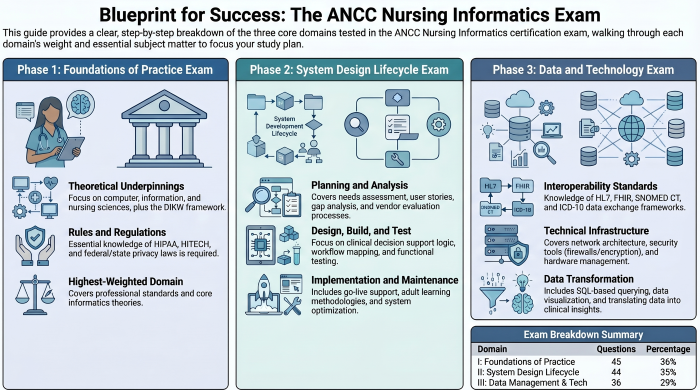
The exam blueprint, drawn from the official ANCC Test Content Outline effective May 3, 2023, divides the 125 scored questions into three domains. No single domain dominates overwhelmingly, but Foundations of Practice carries the highest weight.
|
Domain |
Scored Questions |
Percentage |
|---|---|---|
|
I — Foundations of Practice |
45 |
36% |
|
II — System Design Lifecycle |
44 |
35% |
|
III — Data Management and Healthcare Technology |
36 |
29% |
|
Total |
125 |
100% |
Domain I — Foundations of Practice (45 Questions, 36%)
This domain tests your understanding of the professional, theoretical, and regulatory underpinnings of nursing informatics. Expect questions on:
-
Professional practice: Scope and standards of nursing informatics practice, leadership and management principles, strategic planning, budgeting, policy advocacy, and health equity promotion.
-
Methodologies and theories: Foundations of informatics (computer science, information science, nursing science), the Data-Information-Knowledge-Wisdom (DIKW) framework, change management theories, and project management methodologies.
-
Rules, regulations, and requirements: HIPAA, HITECH, federal and state privacy laws, professional codes of ethics, and compliance standards.
-
Interprofessional collaboration: Stakeholder engagement, communication strategies, conflict resolution, and team-based informatics practice.
Domain II — System Design Lifecycle (44 Questions, 35%)
This domain follows the system development life cycle from planning through evaluation. Key subtopics include:
-
Planning and analysis: Needs assessments, user stories, requirements gathering, gap analysis, feasibility studies, vendor evaluation, and process mapping (current vs. future state).
-
Designing and building: Clinical content building (dashboards, templates, flowcharts), clinical decision support (CDS) logic design, workflow mapping, and prototyping.
-
Testing, training, and implementation: Functional testing (unit, integration, regression), user acceptance testing, test script development, adult learning methodologies, training modalities, conversion from legacy systems, and go-live support.
-
Monitoring, maintaining, supporting, and evaluating: System optimization, issue tracking, change control processes, and outcome evaluation.
Domain III — Data Management and Healthcare Technology (36 Questions, 29%)
This domain addresses the technical backbone of informatics work:
-
Data standards: Standardized nursing terminologies, interoperability standards (HL7, FHIR, SNOMED CT, LOINC, ICD-10), and data exchange frameworks.
-
Data management: Database types, data integration, data warehousing (Big Data), data archiving, patient-generated data (portals, mobile health), data migration, and data integrity monitoring.
-
Data analysis, application, and transformation: The DIKW metastructure, SQL-based querying and reporting, evidence-based practice, data visualization, and translating data into clinical insights.
-
Hardware, software, and peripherals: Network architecture, device management, security tools (firewalls, encryption, digital certificates), and emerging technologies.
How Hard Is the NI-BC Exam?
The NI-BC exam has an approximate 64 percent first-attempt pass rate according to IntelyCare, meaning about one in three candidates does not pass on the first try. The difficulty stems from the exam's breadth: candidates must move fluidly between professional practice, systems analysis, data standards, privacy law, project workflows, and applied technology concepts.
Expert Insight: "The NI-BC isn't about memorizing EHR screenshots. It tests whether you can reason through system design decisions, data governance problems, and workflow optimization scenarios that reflect real informatics practice." — Dr. Laura McKenna, DNP, RN, NI-BC, Clinical Informatics Director
If you do not pass, you may retest after a 60-day waiting period and can attempt the exam up to 3 times within any 12-month period. The retest fee is $270.
How Much Does the NI-BC Exam Cost?
The NI-BC exam costs $395 for non-members. ANA members pay $295, and American Nursing Informatics Association (ANIA) members pay $340. All prices include a $140 non-refundable administrative fee. Discounts must be claimed within 5 business days after ANCC receives your application.
|
Fee Type |
Amount |
|---|---|
|
Non-member exam fee |
$395 |
|
ANA member exam fee |
$295 |
|
ANIA member exam fee |
$340 |
|
Retest fee |
$270 |
|
Non-refundable admin fee (included) |
$140 |
Many employers in hospital IT departments and health systems reimburse certification fees as part of professional development benefits. Check with your organization before paying out of pocket.
What Is the Best NI-BC Study Plan?
A structured 10- to 12-week study plan gives most candidates enough time to cover all three domains without burnout. Allocate study time proportionally to each domain's weight on the exam.
Recommended 12-Week Study Schedule
|
Weeks |
Focus Area |
Activities |
|---|---|---|
|
1–2 |
Orientation & self-assessment |
Review the ANCC Test Content Outline; take a baseline practice test; identify weak areas |
|
3–5 |
Foundations of Practice (36%) |
Study informatics scope/standards, DIKW framework, change management theories, HIPAA/HITECH, interprofessional collaboration |
|
6–8 |
System Design Lifecycle (35%) |
Study SDLC phases, needs assessment, workflow mapping, CDS logic, testing types (unit, integration, UAT), implementation strategies |
|
9–10 |
Data Management & Healthcare Technology (29%) |
Study data standards (HL7, FHIR, SNOMED CT, LOINC), database concepts, SQL basics, hardware/software fundamentals, security |
|
11 |
Integrated review & practice exams |
Take full-length timed practice tests; review weak areas; focus on scenario-based reasoning |
|
12 |
Final review & exam week |
Light review of high-yield topics; rest before exam day |
Key Study Resources
-
ANCC Test Content Outline — The official blueprint is your single most important resource. Download it from nursingworld.org.
-
Nursing Informatics: Scope and Standards of Practice — Published by ANA, this book covers the professional foundations tested in Domain I.
-
ANCC Review Course — ANCC offers a preparation package tailored to the NI-BC exam.
-
Practice exams — Simulation-based testing under timed conditions builds both content recall and pacing discipline. MedicoExam's NI-BC practice tests mirror the real exam's 150-question, 3-hour format.
How Does Epic, Cerner, and FHIR Knowledge Help on the NI-BC?
While the NI-BC exam does not test vendor-specific software, the competencies it measures directly map to the work done on platforms like Epic and Oracle Health (Cerner). Understanding how EHR systems handle clinical decision support, interoperability, workflow design, and structured documentation gives you a practical advantage when answering scenario-based questions.
FHIR (Fast Healthcare Interoperability Resources) is especially relevant to Domain III. The 21st Century Cures Act mandates that EHR vendors support standardized APIs for patient data access, and both Epic and Oracle Health have built major interoperability initiatives around FHIR. Knowing how FHIR differs from older HL7 interfaces, and how standards like LOINC and SNOMED CT support data exchange, can help you interpret questions about integration, dashboards, or data architecture.
Key interoperability concepts to study:
-
HL7 and FHIR — Standards for exchanging electronic health information
-
SNOMED CT and LOINC — Clinical terminology and laboratory coding standards
-
ICD-10 — Diagnostic coding used in data analysis and reporting
-
SMART on FHIR — Application framework for EHR-integrated apps
How Does the NI-BC Compare to NHA CEHRS?
The NI-BC and the NHA Certified Electronic Health Records Specialist (CEHRS) both involve healthcare information technology, but they target very different professionals and skill levels. The NI-BC is an advanced nursing specialty certification, while the CEHRS is an entry-level credential for front-office and health records support roles.
|
Feature |
ANCC NI-BC |
NHA CEHRS |
|---|---|---|
|
Target audience |
Registered nurses (BSN+) in informatics |
Entry-level EHR specialists (HS diploma+) |
|
Prerequisite education |
BSN or higher in nursing |
High school diploma or GED |
|
Experience required |
2 yrs RN + 2,000 hrs informatics (or alternative pathways) |
Training program or 1–2 yrs supervised work |
|
Questions |
150 (125 scored + 25 pretest) |
100 (75 scored + 25 unscored) |
|
Time limit |
3 hours |
1 hour 40 minutes |
|
Focus |
System design, data governance, clinical workflows, informatics theory |
EHR navigation, data entry, basic coding, ROI requests |
|
Certification validity |
5 years |
2 years |
|
Renewal CE requirement |
75 CE hours |
10 CE credits |
|
Cost |
$295–$395 |
~$117 |
For a deeper comparison of health IT certifications — including CAHIMS and CPHIMS — see our ANCC certification hub.
How Do You Renew the NI-BC Certification?
The NI-BC certification is valid for 5 years. To renew, you must complete 75 continuing education contact hours in your informatics specialty, with at least 60 of those hours formally approved (CNE-accredited, AMA PRA Category 1, or Joint Accreditation). You must also complete one of ANCC's professional development categories:
-
Additional 75 CE hours (beyond the mandatory 75)
-
Academic credits (5 semester or 6 quarter credits)
-
Presentations (totaling 5+ hours)
-
Evidence-based practice project, QI project, publication, or research
-
Preceptor hours (120+ hours for academic students)
-
Volunteer professional service (2+ consecutive years)
-
1,000 practice hours in informatics nursing
-
Retake and pass the current exam
Repeat courses are not accepted. Academic coursework can be converted to CE hours at a rate of 1 semester credit = 15 contact hours.
What Career Opportunities Does the NI-BC Unlock?
Earning the NI-BC positions you for high-demand roles across health systems, EHR vendors, consulting firms, and government agencies. According to Nurse.org, informatics nurse salary ranges include:
|
Role |
Salary Range |
|---|---|
|
Clinical Informatics Director |
$109,000–$180,500 |
|
Director of Informatics |
$83,000–$136,000 |
|
Clinical Informatics Specialist |
$75,000–$115,500 |
|
Informatics Analyst |
$69,000–$100,000 |
|
Health Informatics Specialist |
$67,500–$98,500 |
The Bureau of Labor Statistics projects 15 percent job growth for health information technologists from 2024 to 2034, with approximately 3,200 openings per year. As health systems continue to implement interoperability mandates, virtual care infrastructure, clinical analytics, and AI-supported workflows, nurses with validated informatics expertise are likely to remain in strong demand.
If you're exploring other ANCC specialty certifications, compare options like the NE-BC for Nurse Executives, MEDSURG-BC for Medical-Surgical Nursing, or CMGT-BC for Nursing Case Management.
Frequently Asked Questions
Q1: How many questions are on the NI-BC exam?
-
The NI-BC exam contains 150 total questions: 125 scored items and 25 unscored pretest questions. Only the 125 scored questions count toward your pass/fail result.
Q2: What score do I need to pass the NI-BC?
-
You need a scaled score of 350 out of 500 to pass. The exam uses scaled scoring, so this does not correspond to a simple percentage of correct answers.
Q3: Can I take the NI-BC with an ADN instead of a BSN?
-
No. ANCC requires a bachelor's or higher degree in nursing to be eligible for the NI-BC exam. An Associate Degree in Nursing (ADN) does not meet the educational requirement.
Q4: How long should I study for the NI-BC?
-
Most candidates benefit from 10 to 12 weeks of structured preparation, allocating study time proportionally across the three content domains. A baseline practice test early in your study period helps focus your review.
Q5: What is the NI-BC pass rate?
-
The NI-BC has an approximate 64 percent first-attempt pass rate, making it a moderately challenging specialty certification that rewards thorough, domain-balanced preparation.
Q6: How much does the NI-BC exam cost?
-
The exam costs $395 for non-members, $295 for ANA members, and $340 for ANIA members. A $140 non-refundable administrative fee is included in all prices.
Q7: How often do I need to renew the NI-BC?
-
Every 5 years. Renewal requires 75 CE hours (at least 60 formally approved) plus completion of at least one ANCC professional development category activity.
Q8: Is the NI-BC exam offered online?
-
No. The NI-BC exam is delivered as a computer-based test at Prometric testing centers. You must take it in person and should arrive 30 minutes before your appointment time.
Q9: What is the difference between NI-BC and CAHIMS?
-
The NI-BC is a nursing-specific informatics certification requiring a BSN and RN license, while the CAHIMS (Certified Associate in Healthcare Information and Management Systems) is broader and open to candidates without a nursing background.
Q10: Can I retake the NI-BC if I fail?
-
Yes. You may retest after a 60-day waiting period at a cost of $270 per attempt, with a maximum of 3 attempts in any 12-month period. ANCC provides a diagnostic score report after a failed attempt to help guide your study.
Start Your NI-BC Preparation Today
Passing the NI-BC exam requires more than textbook knowledge — it demands the ability to apply informatics principles to realistic clinical scenarios under timed conditions. MedicoExam's NI-BC practice tests simulate the pace, question structure, and domain mix of the official exam so you can build confidence before test day.
For more NI-BC help, explore the ANCC certification hub, the NI-BC FAQ guide, the NI-BC sample questions, or the NI-BC certification overview.
Disclaimer: This article is for informational purposes only and does not guarantee exam results. All exam details are based on publicly available information from ANCC and may change. Always verify current requirements directly with ANCC before applying.
Written by the MedicoExam Content Team — Healthcare Education Specialists at MedicoExam.com
- ANCC NI-BC Question Bank |
- ANCC NI-BC Eligibility & Requirements |
- ANCC Informatics Nursing Practice Test |
- ANCC NI-BC Exam Cost |
- ANCC NI-BC Registration Process |
- ANCC Informatics Nursing Study Guide |
- ANCC NI-BC Recertification |
- ANCC NI-BC Certification Overview |
- ANCC Informatics Nursing Syllabus |
- ANCC NI-BC Preparation Time |
- ANCC NI-BC Passing Score |
- ANCC NI-BC Exam Format |
- ANCC Informatics Nursing Sample Questions |
- ANCC NI-BC Career Opportunities |
- ANCC NI-BC Exam Difficulty


