
ANCC PMGT-BC Exam: Complete Guide & Study Plan
 The ANCC Pain Management Nursing certification (PMGT-BC) validates that a registered nurse possesses entry-level clinical knowledge and skills in pain assessment, multimodal interventions, and professional practice. The computer-based exam consists of 150 questions — 125 scored and 25 unscored pretest items — and candidates have 3 hours to complete it at a Prometric testing center.
With the ongoing opioid crisis reshaping clinical expectations and demand for nurses who can deliver evidence-based, multimodal pain care, the PMGT-BC credential signals specialized competence to employers and patients alike. This guide covers everything you need to know: eligibility requirements, exam content domains, pricing, a 12-week study plan, and frequently asked questions.
| Credential | Pain Management Nurse — Board Certified (PMGT-BC) |
|---|---|
| Certifying Body | American Nurses Credentialing Center (ANCC) |
| Questions | 150 total (125 scored + 25 pretest) |
| Time Limit | 3 hours |
| Passing Score | 350 on a 0–500 scale |
| Cost | $395 (non-member); $295 (ANA member); $340 (ASPMN member) |
| Validity | 5 years |
| Testing | Year-round at Prometric; 120-day scheduling window |
Who Is Eligible for the PMGT-BC Exam?
To sit for the PMGT-BC exam, a candidate must hold a current, active RN license in any U.S. state or territory (or the legally recognized equivalent in another country), have practiced the equivalent of 2 years full-time as a registered nurse, have completed a minimum of 2,000 hours of clinical practice in pain management nursing within the last 3 years, and have earned 30 hours of continuing education (CE) in pain management nursing within the last 3 years. These requirements are outlined on the ANCC Pain Management certification page.
Unlike ANCC's nurse practitioner certifications, the PMGT-BC does not require a graduate degree. A BSN is not mandatory, though many employers prefer it. The certification is accredited by the Accreditation Board for Specialty Nursing Certification (ABSNC).
Eligibility at a Glance
| Requirement | Detail |
|---|---|
| RN License | Current, active in any U.S. state/territory or international equivalent |
| RN Experience | 2 years full-time equivalent |
| Pain Management Hours | 2,000 clinical hours in the last 3 years |
| Continuing Education | 30 CE hours in pain management in the last 3 years |
| Degree | No specific degree required beyond RN |
If you are applying from outside the United States, additional documentation requirements may apply. Check the ANCC FAQs for the latest guidance.
What Does the PMGT-BC Exam Cover?
The PMGT-BC exam is organized into three content domains according to the official Test Content Outline effective February 5, 2024. Of the 125 scored questions, the breakdown is:
| Domain | Scored Questions | Percentage |
|---|---|---|
| I. Fundamentals of Pain | 55 | 44% |
| II. Interventions | 53 | 42% |
| III. Professional Practice | 17 | 14% |
| Total | 125 | 100% |
The remaining 25 pretest questions are embedded throughout the exam and cannot be distinguished from scored items. They do not affect your score but are used by ANCC for future test development.
Domain I: Fundamentals of Pain (44% — 55 Questions)
This is the largest domain and tests your understanding of the science behind pain and your ability to assess it accurately. It includes two major sub-areas:
A. Science of Pain — Knowledge of:
-
Nociceptive, neuropathic, and nociplastic pain classifications
-
Acute, chronic, and persistent pain distinctions
-
Pain management models and theories (e.g., gate control theory, biopsychosocial model)
-
Physiologic mechanisms: transduction, transmission, perception, and modulation
-
Etiology of pain, diagnoses, and syndromes
-
Physiological and psychological effects of uncontrolled pain
B. Assessment — Knowledge and Skill in:
-
Pain descriptors, characteristics, and history-taking
-
Pain assessment techniques, scales, and validated tools (e.g., NRS, VAS, Wong-Baker FACES)
-
Quality-of-life and functional ability evaluation
-
Coping mechanisms and support systems
-
Monitoring and reassessment of pain and functional status
-
Identifying barriers to effective pain management
-
Risk assessment of substance use disorder
Expect questions that ask you to select the most appropriate assessment tool for a given patient population — for example, a nonverbal elderly patient versus an alert adult.
Domain II: Interventions (42% — 53 Questions)
This domain evaluates your ability to plan and implement both pharmacological and non-pharmacological pain management strategies. It is divided into three sub-areas:
A. Plan of Care:
-
Developing patient-centered plans with measurable treatment goals
-
Applying multimodal pain management strategies
-
Interdisciplinary collaboration with physicians, pharmacists, physical therapists, and psychologists
B. Pharmacological Treatment — Knowledge and Skill in:
-
Non-opioid analgesics (NSAIDs, acetaminophen, topical agents)
-
Opioid analgesics (mechanisms, titration, equianalgesic dosing)
-
Adjuvant medications (anticonvulsants, antidepressants, muscle relaxants)
-
Herbs and supplements
-
Routes of administration (oral, IV, epidural, intrathecal, transdermal)
-
Medication safety, misuse prevention, and risk-evaluation strategies
-
Opioid conversion and equivalence calculations
-
Side effect prevention and management (oversedation, respiratory depression, epidural hematoma, local anesthetic toxicity, post-dural puncture headache)
C. Non-Pharmacologic Treatment — Knowledge and Skill in:
-
Physical treatment modalities: exercise, massage, positioning, environmental modifications
-
Cognitive-behavioral modalities: psychotherapy, mindfulness, spirituality
-
Complementary and integrative therapies: biofeedback, acupuncture, reiki, aromatherapy
-
Interventional procedures: implantable devices, nerve blocks, spinal cord stimulation
-
Safety considerations and potential complications of non-pharmacologic interventions
Given the current opioid crisis, expect the exam to emphasize multimodal strategies that reduce opioid reliance. Understanding equianalgesic dose conversions and medication safety protocols is essential.
Domain III: Professional Practice (14% — 17 Questions)
Though the smallest domain by question count, Professional Practice covers areas that are critical to safe, ethical, and culturally competent care:
A. Education and Advocacy:
-
Patient, caregiver, and family education on pain management
-
Therapeutic communication techniques
-
Cultural and demographic considerations that influence pain perception and treatment
B. Ethics and Regulatory Principles:
-
Scope of practice, standards, guidelines, and ethical frameworks
-
Crisis and emergency response (including opioid overdose reversal protocols)
Questions in this domain may present ethical dilemmas — such as balancing a patient's self-reported pain against objective indicators of substance misuse.
How Much Does the PMGT-BC Exam Cost?
The PMGT-BC certification exam costs $395 for non-members, $295 for American Nurses Association (ANA) members, and $340 for American Society for Pain Management Nursing (ASPMN) members. All prices include a $140 non-refundable administrative fee, according to the ANCC certification page.
| Applicant Type | Initial Certification | Renewal |
|---|---|---|
| Non-member | $395 | $350 |
| ANA member | $295 | $250 |
| ASPMN member | $340 | $295 |
Discounts must be claimed within 5 business days of ANCC receiving your application and cannot be combined with other offers. ANA e-membership does not qualify for the member discount.
Cost-saving tip: An ANA membership typically costs $15/month. If you are not currently a member, joining before you apply saves $100 on the initial exam fee — a net savings even after a year of dues.
How Do You Register and Schedule the Exam?
Registration follows a straightforward three-step process as described by ANCC:
-
Review eligibility and pricing — Confirm you meet all requirements and select the applicable membership discount.
-
Apply online — Submit your application through the ANCC portal. You will need to provide documentation of your RN license, clinical hours, and CE credits.
-
Schedule at Prometric — After ANCC approves your application, you receive a 120-day scheduling window. Visit the official Prometric ANCC scheduling page and use your certification number to book a seat.
The exam is offered year-round, giving you flexibility to choose a date and location that works best. Bring a government-issued photo ID to the testing center. Personal items are stored in provided lockers.
What Is the Best Study Plan for the PMGT-BC Exam?
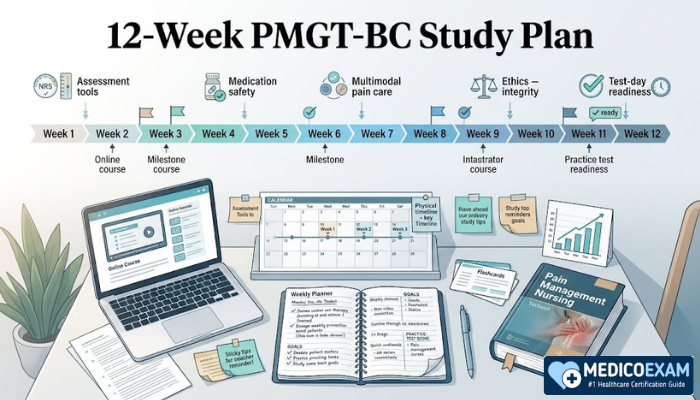
A structured 12-week study plan aligned with the three exam domains ensures thorough coverage without burnout. Dedicate roughly 8–10 hours per week.
12-Week PMGT-BC Study Plan
| Weeks | Focus Area | Key Topics |
|---|---|---|
| 1–2 | Foundation Building | Pain physiology, nociception, gate control theory, biopsychosocial model |
| 3–4 | Pain Classification & Assessment | Acute vs. chronic vs. persistent pain; validated assessment tools; substance use disorder screening |
| 5–6 | Pharmacological Interventions | Opioid and non-opioid analgesics, adjuvant medications, equianalgesic dosing, routes of administration |
| 7–8 | Medication Safety & Opioid Crisis | Side effect management, risk evaluation and mitigation strategies (REMS), naloxone protocols, prescription drug monitoring programs |
| 9–10 | Non-Pharmacologic & Integrative Therapies | Physical modalities, CBT, complementary therapies, interventional procedures |
| 11 | Professional Practice & Ethics | Patient education, cultural competence, scope of practice, regulatory principles |
| 12 | Full-Length Practice & Review | Timed practice exams, weak-area remediation, test-day logistics |
Recommended Study Resources
-
Official ANCC Test Content Outline — Free download from nursingworld.org. Use it as your study roadmap.
-
MedicoExam Practice Tests — Simulation-based practice questions that mirror the PMGT-BC format. Try MedicoExam's ANCC PMGT-BC practice exams to identify gaps before test day.
-
Specialty nursing texts and CE activities — Use pain-management nursing references and continuing education activities for ongoing learning.
Why Does the PMGT-BC Matter in the Opioid Crisis Era?
The PMGT-BC credential has become increasingly relevant as health systems seek nurses trained in evidence-based, multimodal pain management. The ongoing opioid epidemic — which has claimed over 100,000 American lives annually in recent years — has driven a shift away from opioid-centric care toward comprehensive pain programs. Certified pain management nurses are uniquely positioned to lead this transition.
Expert Insight: "Pain management nursing is no longer just about administering medications. Today's certified pain nurse leads interdisciplinary teams, implements multimodal protocols, and serves as the primary advocate for patients navigating complex pain conditions. The PMGT-BC validates that expertise." — Dr. Rebecca Torres, DNP, PMGT-BC, Pain Management Clinical Nurse Specialist
Employers in hospitals, outpatient pain clinics, hospice programs, and rehabilitation centers increasingly prefer or require the PMGT-BC for specialized roles. Pain management nursing roles can offer competitive compensation, especially for experienced nurses working in hospitals, outpatient pain clinics, hospice, oncology, and rehabilitation settings.
How Do You Renew the PMGT-BC Certification?
The PMGT-BC credential is valid for 5 years. To renew, you must complete 75 hours of continuing education relevant to your pain management certification specialty during your certification cycle. At least 60 of these CE hours should be formally approved continuing education credits.
In addition to the mandatory 75 CE hours, you must also fulfill at least one of the following professional development categories:
-
75 additional CE hours (beyond the required 75)
-
5 semester hours or 6 quarter hours of academic credit
-
Presentations totaling at least 5 hours
-
An evidence-based practice or quality improvement project, qualifying publication, or research project
-
120 hours as a preceptor
-
2+ consecutive years of volunteer service with a healthcare-related organization
-
1,000 practice hours
-
Pass the current PMGT-BC exam
Renewal costs $350 for non-members, $250 for ANA members, and $295 for ASPMN members, as listed on the ANCC renewal page. You can submit a renewal application up to 1 year before your expiration date. ANCC recommends tracking your professional development activities in your online account throughout your certification cycle.
How Does the PMGT-BC Compare to Other ANCC Specialty Certifications?
The PMGT-BC shares the same exam format as other ANCC specialty certifications — 150 questions, 3-hour time limit, and a 350 passing score — but its content is uniquely focused on pain science, analgesic pharmacology, and multimodal interventions. Here is a comparison with related specialties:
| Feature | PMGT-BC | MEDSURG-BC | CV-BC |
|---|---|---|---|
| Specialty | Pain Management | Medical-Surgical | Cardiac-Vascular |
| Questions | 150 (125 scored) | 150 (125 scored) | 150 (125 scored) |
| Time | 3 hours | 3 hours | 3 hours |
| Passing Score | 350 | 350 | 350 |
| Largest Domain | Fundamentals of Pain (44%) | Assessment/Diagnosis | Assessment/Diagnosis (25%) |
| Unique Focus | Multimodal pain care, opioid safety | Broad med-surg nursing | Cardiac/vascular conditions |
| Clinical Hours | 2,000 in pain management | 2,000 in med-surg | 2,000 in cardiac-vascular |
If you practice in a surgical or medical unit with a heavy pain management component, the PMGT-BC adds a layer of specialization beyond a generalist MEDSURG-BC. Explore the full range of ANCC credentials on the MedicoExam ANCC hub.
What Are the Top Test-Day Tips for the PMGT-BC?
Passing the PMGT-BC requires both clinical knowledge and smart test-taking strategy. Keep these tips in mind:
-
Know the content weights. Fundamentals of Pain (44%) and Interventions (42%) together make up 86% of scored questions. Prioritize these domains in your study plan.
-
Master equianalgesic conversions. Expect calculation-based questions on opioid dose equivalences (e.g., morphine to hydromorphone, oral to IV ratios).
-
Think multimodal first. The exam emphasizes non-opioid and integrative approaches. When a question asks for the "best" intervention, consider whether a multimodal combination is an option.
-
Use the full 3 hours. That averages to 1 minute and 12 seconds per question. Flag difficult items and return to them after completing easier ones.
-
Read for the ANCC perspective. Choose answers that reflect evidence-based, patient-centered, interdisciplinary care — not necessarily what your specific facility does.
-
Don't overthink pretest questions. You cannot identify which 25 questions are unscored, so treat every question equally.
-
Arrive prepared. Bring a valid government-issued ID. Eat well, sleep well, and arrive at the Prometric center at least 30 minutes early.
Frequently Asked Questions (FAQ)
Q1. How many questions are on the PMGT-BC exam?
The PMGT-BC exam contains 150 total questions: 125 scored questions and 25 unscored pretest questions. Your final score is based only on the 125 scored items, according to the ANCC Test Content Outline.
Q2. What is the passing score for the PMGT-BC?
The passing scaled score is 350 out of a possible 500, as listed on the MedicoExam PMGT-BC syllabus page.
Q3. How much does the PMGT-BC exam cost?
The exam costs $395 for non-members, $295 for ANA members, and $340 for ASPMN members. All fees include a $140 non-refundable administrative fee, per ANCC.
Q4. Do I need a BSN to take the PMGT-BC?
No. The PMGT-BC requires an active RN license, 2 years of full-time RN experience, 2,000 hours of pain management practice in the last 3 years, and 30 pain management CE hours. A BSN is not required by ANCC.
Q5. How long is PMGT-BC certification valid?
The PMGT-BC credential is valid for 5 years from the date you pass. Renewal requires 75 CE hours in pain management plus one additional professional development category, according to ANCC.
Q6. What are the three content domains on the PMGT-BC exam?
The exam covers Fundamentals of Pain (44%, 55 questions), Interventions (42%, 53 questions), and Professional Practice (14%, 17 questions), per the ANCC Test Content Outline.
Q7. Can I take the PMGT-BC exam outside the United States?
Yes. Candidates with the legally recognized equivalent of a U.S. RN license may apply, though additional documentation may be required. Check the ANCC FAQs for international applicant details.
Q8. How long should I study for the PMGT-BC?
Most candidates benefit from 10–12 weeks of focused preparation at 8–10 hours per week. Official ANCC resources and MedicoExam practice exams are popular resources.
Q9. What happens if I fail the PMGT-BC exam?
You may retest according to ANCC's retesting policy. A waiting period and additional fees apply. Visit the ANCC certification page for the current retesting guidelines.
Q10. Is PMGT-BC certification worth it for my career?
Yes. The credential is increasingly preferred by employers in hospitals, outpatient pain clinics, and hospice settings. It also demonstrates specialized competence in an era where multimodal pain management is a healthcare priority.
Start Your PMGT-BC Exam Prep Today
Earning the PMGT-BC credential positions you as a specialist in one of healthcare's most critical fields. Whether you work in acute care, outpatient pain clinics, oncology, hospice, or rehabilitation, this certification validates your expertise and opens doors to advanced roles and higher pay.
Ready to test your knowledge? Try MedicoExam's PMGT-BC simulation-based practice exams to see where you stand — and build confidence before exam day.
Disclaimer: This article is for informational purposes only. MedicoExam is not affiliated with or endorsed by the American Nurses Credentialing Center (ANCC). Always verify current eligibility requirements, pricing, and policies on the official ANCC website. This content does not contain exam recalls, leaked questions, or proprietary ANCC material.
Written by the MedicoExam Content Team — Healthcare Education Specialists at MedicoExam.com
Last Updated: April 2026
- ANCC PMGT-BC Question Bank |
- ANCC PMGT-BC Eligibility & Requirements |
- ANCC Pain Management Nursing Practice Test |
- ANCC PMGT-BC Exam Cost |
- ANCC PMGT-BC Registration Process |
- ANCC Pain Management Nursing Study Guide |
- ANCC PMGT-BC Recertification |
- ANCC PMGT-BC Certification Overview |
- ANCC Pain Management Nursing Syllabus |
- ANCC PMGT-BC Preparation Time |
- ANCC PMGT-BC Passing Score |
- ANCC PMGT-BC Exam Format |
- ANCC Pain Management Nursing Sample Questions |
- ANCC PMGT-BC Career Opportunities |
- ANCC PMGT-BC Exam Difficulty


