
ANCC PMHNP-BC Exam: Eligibility, Format, Study Plan & Career Outlook
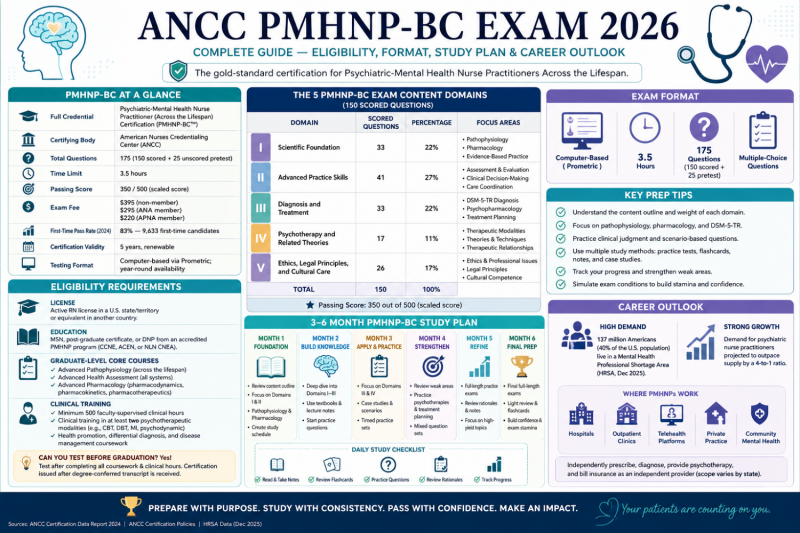
The ANCC PMHNP-BC exam is a 175-question, computer-based certification test that qualifies psychiatric-mental health nurse practitioners to practice across the lifespan. The exam costs $395 for non-members, requires a minimum scaled score of 350 out of 500 to pass, and carries an 83% first-time pass rate according to the 2024 ANCC Certification Data Report. If you are preparing to sit for this board exam — or still deciding between the ANCC PMHNP-BC and the newer AANPCB PMHNP-C — this guide covers everything you need: eligibility requirements, the five content domains, a detailed study plan, and the career outlook that makes this one of the fastest-growing credentials in healthcare.
Key Facts: ANCC PMHNP-BC at a Glance
|
Data Point |
Detail |
|---|---|
|
Full Credential Name |
Psychiatric-Mental Health Nurse Practitioner (Across the Lifespan) Certification (PMHNP-BC™) |
|
Certifying Body |
American Nurses Credentialing Center (ANCC) |
|
Total Questions |
175 (150 scored + 25 unscored pretest) |
|
Time Limit |
3.5 hours |
|
Passing Score |
350 / 500 (scaled score) |
|
Exam Fee |
$395 (non-member); $295 (ANA member); $220 (APNA member) |
|
First-Time Pass Rate (2024) |
83% — 9,633 first-time candidates |
|
Certification Validity |
5 years, renewable |
|
Testing Format |
Computer-based via Prometric; year-round availability |
|
Minimum Clinical Hours |
500 faculty-supervised hours in a PMHNP program |
What Is the PMHNP-BC Certification and Why Does It Matter?
The PMHNP-BC is the gold-standard board certification for psychiatric-mental health nurse practitioners in the United States. Awarded by the American Nurses Credentialing Center (ANCC), it verifies that a nurse practitioner has the entry-level clinical knowledge and skills to provide mental health care across the lifespan — from children and adolescents to adults and older adults.
This credential matters more than ever. According to the U.S. Health Resources and Services Administration (HRSA), approximately 137 million Americans — 40% of the U.S. population — live in a designated Mental Health Health Professional Shortage Area as of December 2025. The PMHNP-BC certification positions nurses to fill this critical gap, with demand for psychiatric nurse practitioners projected to outpace supply by a 4-to-1 ratio.
Holding the PMHNP-BC credential allows you to:
-
Prescribe psychotropic medications independently (scope varies by state)
-
Diagnose psychiatric disorders using DSM-5-TR criteria
-
Deliver psychotherapy across modalities (CBT, DBT, interpersonal therapy)
-
Bill Medicare, Medicaid, and private insurers as an independent provider
-
Practice in hospitals, outpatient clinics, telehealth settings, and private practice
If you are pursuing this credential, MedicoExam's PMHNP-BC practice tests offer simulation-based question banks aligned to the current ANCC content outline.
Who Is Eligible for the PMHNP-BC Exam?
Eligibility for the ANCC PMHNP-BC exam requires meeting education, licensure, and clinical training criteria. According to the ANCC official eligibility page, candidates must satisfy all of the following:
Licensure
You must hold a current, active registered nurse (RN) license in a U.S. state or territory, or the legally recognized equivalent in another country.
Education
You must hold a master's degree (MSN), post-graduate certificate, or Doctor of Nursing Practice (DNP) from a psychiatric-mental health nurse practitioner program accredited by one of the following:
-
Commission on Collegiate Nursing Education (CCNE)
-
Accreditation Commission for Education in Nursing (ACEN)
-
National League for Nursing Commission for Nursing Education Accreditation (NLN CNEA)
Post-graduate certificate applicants must have graduated from an accredited APRN program specifically.
Graduate-Level Core Courses
Your program must include three separate, comprehensive, graduate-level APRN core courses:
-
Advanced physiology/pathophysiology — general principles across the lifespan
-
Advanced health assessment — all human systems, advanced techniques and approaches
-
Advanced pharmacology — pharmacodynamics, pharmacokinetics, and pharmacotherapeutics of all broad categories of agents
Clinical Training Requirements
-
A minimum of 500 faculty-supervised clinical hours in the PMHNP (Across the Lifespan) program
-
Clinical training in at least two psychotherapeutic treatment modalities (e.g., CBT, DBT, motivational interviewing, psychodynamic therapy)
-
Coursework in health promotion, differential diagnosis, and disease management — including pharmacologic and nonpharmacologic interventions
Can You Test Before Graduation?
Yes. The ANCC allows candidates to sit for the exam after completing all coursework and clinical hours, even before formal degree conferral. You must submit a Validation of Education (VOE) form and transcripts. However, ANCC will retain your results and issue the certification only after your final degree-conferred official transcript is received.
Important policy change: Effective January 1, 2026, ANCC requires candidates to pass the certification exam within 5 years of degree completion, according to ANCC certification policy updates.
What Are the Five Content Domains on the PMHNP-BC Exam?
The ANCC PMHNP-BC exam tests five content domains. The official ANCC Test Content Outline (effective April 28, 2023) specifies the following distribution of the 150 scored questions:
|
Domain |
Scored Questions |
Percentage |
|---|---|---|
|
I. Scientific Foundation |
33 |
22% |
|
II. Advanced Practice Skills |
41 |
27% |
|
III. Diagnosis and Treatment |
33 |
22% |
|
IV. Psychotherapy and Related Theories |
17 |
11% |
|
V. Ethics, Legal Principles, and Cultural Care |
26 |
17% |
|
Total |
150 |
100% |
Domain I: Scientific Foundation (33 Questions, 22%)
This domain tests your knowledge of the biological underpinnings of psychiatric illness. Topics include:
-
Advanced pathophysiology
-
Advanced pharmacology (contraindications, interactions, adverse effects)
-
Advanced psychopharmacology (pharmacokinetics, pharmacodynamics, EPS, NMS)
-
Neurodevelopment, neuroanatomy, and neurophysiology
-
Psychogenomics (gene-drug interactions, heritability)
-
Advanced physical assessment (skill component)
Study tip: Focus heavily on psychopharmacology. Expect questions about first-line agents for major depressive disorder, antipsychotic switching strategies, and cytochrome P450 drug interactions.
Domain II: Advanced Practice Skills (41 Questions, 27%)
This is the largest domain and focuses on clinical skills you will use daily in practice:
-
Clinical interviewing (open-ended questions, nonverbal communication, motivational interviewing)
-
Health promotion and disease prevention
-
Mental health screening tool selection and interpretation (PHQ-9, GAD-7, Vanderbilt ADHD)
-
Mental status exam
-
Psychiatric emergency management (suicidal ideation, homicidal ideation)
-
Psychoeducation and recovery/resilience promotion
-
Risk assessment
-
Substance use screening tool interpretation (AUDIT, DAST, CIWA, COWS)
Study tip: Know the validated screening instruments inside and out. Be able to interpret PHQ-9 scores and know when to escalate to a safety assessment.
Domain III: Diagnosis and Treatment (33 Questions, 22%)
This domain evaluates your ability to apply clinical knowledge to real-world patient care:
-
DSM-5-TR diagnostic criteria
-
Complementary and alternative treatments
-
Diagnostic and laboratory test selection and interpretation
-
Differential diagnosis
-
Evidence-based practice (medication dosing, off-label use, psychotherapy selection)
-
Psychopharmacotherapeutic and pharmacotherapeutic management
Study tip: Practice differentiating between conditions with overlapping presentations — bipolar II vs. borderline personality disorder, ADHD vs. anxiety, PTSD vs. complex grief.
Domain IV: Psychotherapy and Related Theories (17 Questions, 11%)
Though it carries the smallest question weight, this domain covers core competencies:
-
Psychotherapy principles (CBT, humanistic, interpersonal, behavioral therapies)
-
Change theories (Transtheoretical Model, Lewin's Change Theory)
-
Developmental theories and family theories
-
Therapeutic alliance development and management (empathy, boundaries, trauma-informed approach)
Study tip: Know the stages-of-change model and be able to match psychotherapy modalities to specific diagnoses.
Domain V: Ethics, Legal Principles, and Cultural Care (26 Questions, 17%)
This domain tests professional practice knowledge:
-
Patient's Bill of Rights and informed consent
-
Scope of confidentiality (HIPAA, Tarasoff, mandated reporting)
-
ANA Scope and Standards of Practice for Psychiatric-Mental Health Nursing
-
Equity, diversity, and inclusion across specific populations
-
Ethics in clinical decision making (involuntary treatment, least restrictive care, decision-making capacity)
-
Patient advocacy (educational accommodations, disabilities, FMLA)
Study tip: Review state-specific involuntary commitment laws and duty-to-warn statutes. These appear frequently on the exam.
How Does the ANCC PMHNP-BC Compare to the AANPCB PMHNP-C?
Since April 2024, psychiatric-mental health NP graduates have had two certification options. The AANPCB launched its PMHNP-C exam, giving candidates a choice for the first time. Here is how the two certifications compare:
|
Feature |
AANPCB PMHNP-C |
|
|---|---|---|
|
Certifying Body |
American Nurses Credentialing Center |
American Academy of Nurse Practitioners Certification Board |
|
Total Questions |
175 (150 scored, 25 pretest) |
150 (135 scored, 15 pretest) |
|
Time Limit |
3.5 hours |
3 hours |
|
Question Types |
Multiple choice, multiple response, drag-and-drop, hotspot |
Multiple choice only |
|
Scoring |
0–500 scale; 350 to pass |
200–800 scale; 500 to pass |
|
Exam Fee (Non-member) |
$395 |
$315 |
|
Exam Fee (Member) |
$295 (ANA) / $220 (APNA) |
$240 (AANP member) |
|
First-Time Pass Rate (2024) |
83% (9,633 candidates) |
82% (699 candidates) |
|
Certification Validity |
5 years |
5 years |
|
NCCA Accredited |
Yes |
Yes (as of June 2025) |
|
ABSNC Accredited |
Yes |
Yes (as of January 2025) |
|
Content Focus |
Includes professional role, ethics, policy, research |
More clinically focused |
Sources: ANCC certification data, AANPCB exam information, and official certification-board pricing pages
Which One Should You Choose?
Choose ANCC PMHNP-BC if:
- Your state board of nursing requires or prefers ANCC certification
- You want the more established, longer-standing credential
- You are comfortable with diverse question formats (drag-and-drop, hotspot)
- You value broader content coverage including research and healthcare policy
Choose AANPCB PMHNP-C if:
- You prefer a shorter, purely multiple-choice exam
- You want a lower exam fee
- Your employer accepts both certifications equally
- You prefer a more clinically focused test
Both certifications are accepted for state licensure in all 50 states, Medicare reimbursement, and Magnet hospital designation. Check with your state board of nursing for any specific preference.
What Does the PMHNP-BC Exam Format Look Like on Test Day?
The PMHNP-BC exam is delivered via computer at Prometric testing centers nationwide. Here is what to expect:
Before the Exam
-
Apply online through the ANCC website and submit your Validation of Education form
-
Processing time: approximately 2 weeks for electronic applications; up to 8 weeks for mailed applications
-
Receive your Authorization to Test (ATT) and schedule at Prometric within your 120-day testing window
During the Exam
-
Total time: 3.5 hours (210 minutes)
-
Total questions: 175
-
Scored questions: 150
-
Pretest questions: 25 (unidentified; do not affect your score)
-
Question types: Multiple choice (single best answer), multiple response, drag-and-drop, and hotspot
-
Bring two forms of valid identification (one with photo and signature)
-
No personal items, notes, or electronic devices permitted in the testing room
-
A tutorial and optional break are provided
After the Exam
-
You receive a preliminary pass/fail result at the testing center
-
Official results and score report are available within 2–4 weeks via your ANCC online account
-
If you pass, your PMHNP-BC credential is issued for 5 years
-
If you do not pass, you may retest after a 60-day waiting period with a reduced retake fee
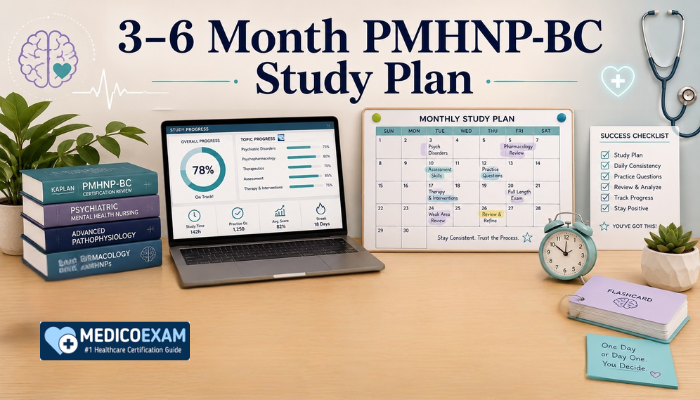
How Should You Build a 3–6 Month PMHNP-BC Study Plan?
A structured study plan is essential for the PMHNP-BC exam. Below is a recommended timeline based on domain weight and difficulty. Adjust the pace based on your clinical experience and time availability.
6-Month Study Plan
|
Month |
Focus Area |
Weekly Hours |
Activities |
|---|---|---|---|
|
Month 1 |
Scientific Foundation (Domain I) |
10–12 hrs |
Review psychopharmacology, neuroanatomy, pathophysiology; begin flashcards |
|
Month 2 |
Advanced Practice Skills (Domain II) |
10–12 hrs |
Study screening tools (PHQ-9, GAD-7, AUDIT), clinical interviewing, risk assessment |
|
Month 3 |
Diagnosis and Treatment (Domain III) |
10–12 hrs |
Review DSM-5-TR criteria, differential diagnosis, evidence-based treatment protocols |
|
Month 4 |
Psychotherapy + Ethics (Domains IV & V) |
10–12 hrs |
Psychotherapy modalities, change theories, legal and ethical principles, cultural care |
|
Month 5 |
Comprehensive Review + Practice Tests |
12–15 hrs |
Take full-length PMHNP-BC practice exams on MedicoExam; review weak areas |
|
Month 6 |
Final Review + Test Readiness |
10–12 hrs |
Timed practice tests, focus on lowest-scoring domains, light review during final week |
3-Month Accelerated Plan
If you are a recent graduate with strong clinical experience:
|
Weeks |
Focus Area |
Activities |
|---|---|---|
|
Weeks 1–3 |
Domains I & III (Scientific Foundation + Diagnosis/Treatment) |
Psychopharmacology, DSM-5-TR, differential diagnosis |
|
Weeks 4–6 |
Domains II & V (Advanced Practice Skills + Ethics) |
Screening tools, risk assessment, legal principles |
|
Weeks 7–9 |
Domain IV + Comprehensive Review |
Psychotherapy theories, full-length practice tests |
|
Weeks 10–12 |
Test Preparation |
Timed exams, weak-area remediation, test-day logistics |
Study Resources
-
ANCC PMHNP-BC Test Prep Essentials ($399; $299.25 for APNA members)
-
Psychiatric-Mental Health Nurse Practitioner Review and Resource Manual, 4th Edition (ISBN 978-1935213796)
-
Kaplan & Sadock's Synopsis of Psychiatry, 12th Edition — essential reference for psychopathology
-
Stahl's Essential Psychopharmacology — the definitive psychopharmacology resource
-
MedicoExam PMHNP-BC Practice Questions — simulation-based practice aligned to the ANCC content outline
Benchmark for Readiness
Aim to score 85% or higher consistently on full-length practice exams before scheduling your test date. If you are scoring below 75%, consider extending your study timeline by 4–6 weeks and focusing additional time on your weakest domains.
What Is the PMHNP Salary and Career Outlook in 2026?
The PMHNP career outlook is among the strongest in healthcare. Psychiatric-mental health nurse practitioners command premium salaries and face extraordinary demand driven by the national mental health crisis.
Salary Data
According to BLS-aligned salary analyses of nurse practitioner compensation, the average PMHNP salary is $151,588 per year nationally. This places PMHNPs well above the general nurse practitioner median of $129,210, as reported by the Bureau of Labor Statistics.
| Metric | Data |
|---|---|
| Average PMHNP Salary (National) | $151,588/year |
| General NP Median Salary | $129,210/year |
| PMHNP Premium Over General NP | ~$22,378/year (17% higher) |
| Entry-Level PMHNP Salary | ~$120,000/year |
| Top-Paying State (Idaho) | $205,080/year |
| Highest-Paying Setting | Residential Mental Health Facilities: $164,290/year |
Sources: Bureau of Labor Statistics and current healthcare salary analyses
Top-Paying States for PMHNPs
|
Rank |
State |
Average Annual Salary |
|---|---|---|
|
1 |
Idaho |
$205,080 |
|
2 |
New Jersey |
$182,022 |
|
3 |
California |
$176,451 |
|
4 |
Rhode Island |
$175,530 |
|
5 |
Washington |
$173,331 |
Source: Bureau of Labor Statistics and current healthcare salary analyses
Job Growth Projections
The Bureau of Labor Statistics projects nurse practitioner employment to grow 40% from 2024 to 2034 — making NPs one of the fastest-growing occupations in the United States, according to BLS-aligned employment projections. Within the NP field, psychiatric-mental health is the fastest-growing specialty.
The HRSA State of the Behavioral Health Workforce report (December 2025) projects a shortage of 15,000 psychiatric nurse practitioners in the coming years under moderate demand scenarios, with demand outpacing supply growth by 4-to-1.
Mental Health Workforce Crisis: Why PMHNPs Are in Demand
The numbers paint a stark picture of why PMHNP-BC holders are in such high demand:
-
137 million Americans (40% of the U.S. population) live in Mental Health HPSAs as of December 2025 (HRSA)
-
65% of nonmetropolitan counties completely lack a psychiatrist (healthcare workforce shortage analyses)
-
Only 26.4% of mental health workforce needs are currently being met in designated shortage areas (healthcare workforce shortage analyses)
-
The ANCC certified 9,633 first-time PMHNP-BC candidates in 2024 alone — a dramatic increase from just 1,550 in 2016, representing over 520% growth in testing volume over 8 years (ANCC certification data and certification-history analyses)
-
Only 4 U.S. states meet more than 50% of their mental health workforce needs, according to national mental health workforce shortage reporting
Expert Insight: What Board-Certified PMHNPs Say About the Exam
"The PMHNP-BC exam is broad — it does not just test your medication knowledge. Many candidates underestimate the weight of advanced practice skills and the ethics questions. My best advice is to really learn your screening tools, know the legal nuances of involuntary commitment, and get comfortable with psychotherapy theories. If you studied psychopharmacology inside and out but cannot answer a question about when to break confidentiality under Tarasoff, you are going to struggle." — Dr. Kathy Baldridge, DNP, FNP-BC, FAANP, Nurse Practitioner Education Specialist
This insight reinforces why your study plan should allocate time proportionally across all five domains — not just the clinical and pharmacology sections.
How Do You Renew the PMHNP-BC Certification?
The PMHNP-BC credential is valid for 5 years. To renew, you must meet the following ANCC renewal requirements:
Mandatory Requirements
-
Maintain a current, active RN license
-
Complete 75 continuing education (CE) hours related to your certification specialty
Additional Renewal Pathways (Choose at Least One)
|
Pathway |
Requirement |
|---|---|
|
Additional CE Hours |
75 more hours in your specialty |
|
Academic Credits |
5 semester credits (or 6 quarter credits) |
|
Presentations |
1 or more presentations totaling 5 clock hours |
|
Publications/Research |
Evidence-based practice project, QI project, publication, or completed research |
|
Preceptor Hours |
120 hours supervising APRN, medical, PA, or pharmacy students |
|
Professional Service |
2+ consecutive years of volunteer service with a healthcare organization |
|
Practice Hours |
Minimum 1,000 hours at an advanced practice level in your certification specialty |
|
Re-examination |
Pass the PMHNP-BC exam again before your credential expires |
Renewal Costs
-
Non-member: $375
-
ANA member: $275
-
APNA member: $250
You can submit your renewal application up to 1 year before your certification expires. Track CE activities through your ANCC online account.
What Are Common Mistakes That Lead to PMHNP-BC Exam Failure?
With an 83% first-time pass rate, approximately 1 in 6 candidates does not pass on the first attempt. Common pitfalls include:
-
Over-focusing on psychopharmacology at the expense of other domains. While medication knowledge is critical, Advanced Practice Skills (27%) and Ethics/Legal/Cultural Care (17%) together account for 44% of scored questions.
-
Ignoring question format variety. The ANCC uses drag-and-drop, hotspot, and multiple-response questions. Practice with these formats before test day.
-
Underestimating psychotherapy content. Even though Domain IV has only 17 questions, the concepts (CBT techniques, stages-of-change model, therapeutic alliance) appear throughout other domains.
-
Not taking enough full-length practice tests. Simulation-based practice builds test stamina and time management skills. Use MedicoExam's timed PMHNP-BC practice exams to simulate the 3.5-hour testing experience.
-
Poor time management. You have approximately 1 minute and 12 seconds per question. Candidates who spend too long on difficult items often run out of time for easier questions later.
-
Not reviewing the official ANCC content outline. The free ANCC Test Content Outline PDF is the definitive blueprint for the exam. Every item on the test maps back to this document.
How Does PMHNP-BC Compare to Other ANCC NP Certifications?
If you are deciding which NP specialty to pursue, here is how the PMHNP-BC stacks up against other ANCC certifications:
|
Certification |
Questions (Scored) |
Time |
Pass Rate (2024) |
First-Time Candidates (2024) |
Median Salary |
|---|---|---|---|---|---|
|
PMHNP-BC |
175 (150) |
3.5 hrs |
83% |
9,633 |
~$151,588 |
|
FNP-BC |
175 (150) |
3.5 hrs |
83% |
7,751 |
~$128,000 |
|
AGPCNP-BC |
175 (150) |
3.5 hrs |
85% |
921 |
~$120,000 |
|
AGACNP-BC |
175 (150) |
3.5 hrs |
83% |
2,784 |
~$125,000 |
Sources: ANCC certification data and BLS/salary data
The PMHNP-BC is notable for having the highest testing volume growth of any ANCC NP certification. The 9,633 first-time PMHNP-BC candidates in 2024 represent a surge from 7,476 in 2022 — growth driven by the mental health workforce crisis and expanding PMHNP program enrollment. For more on NP certifications offered by ANCC, visit MedicoExam's ANCC section.
If you are interested in the family nurse practitioner path, see MedicoExam's FNP-BC practice tests or the AGPCNP-BC practice questions.
Frequently Asked Questions (FAQ)
1. How many questions are on the PMHNP-BC exam?
The PMHNP-BC exam contains 175 total questions. Of those, 150 are scored and 25 are unscored pretest items used for future exam development. Pretest questions are not identified during the exam, so you should answer every question to the best of your ability.
2. What is the passing score for the PMHNP-BC?
You need a scaled score of 350 out of 500 to pass. The scaling process adjusts for difficulty variations across different test forms, ensuring fairness for all candidates regardless of which version they receive.
3. How much does the PMHNP-BC exam cost?
The exam costs $395 for non-members, $295 for ANA members, and as low as $220 for American Psychiatric Nurses Association members, according to the ANCC pricing page. All prices include a $140 non-refundable administrative fee.
4. What is the PMHNP-BC pass rate?
The first-time pass rate is 83% based on the 2024 ANCC Certification Data Report, with 9,633 first-time candidates tested. This is consistent with other ANCC NP exams.
5. How long should I study for the PMHNP-BC exam?
Most candidates need 3 to 6 months of dedicated study at 10–15 hours per week. Recent graduates with strong clinical experience may be ready in 3 months, while those returning to testing after time away from school should plan for 5–6 months.
6. Can I take the PMHNP-BC exam before graduating?
Yes. ANCC allows candidates to test after completing all coursework and clinical hours, even before degree conferral. Your certification will be issued only after your final official transcript with degree conferral is received by ANCC.
7. What happens if I fail the PMHNP-BC exam?
You must wait 60 days before retesting. Review your score report to identify weak domains, adjust your study plan, and aim for 85%+ on practice tests before rescheduling. See more about retake strategies on the MedicoExam blog.
8. Is the AANPCB PMHNP-C accepted in all states?
The AANPCB PMHNP-C received ABSNC accreditation in January 2025 and NCCA accreditation in June 2025, according to AANPCB. While acceptance is expanding, some state boards of nursing may still specifically require the ANCC PMHNP-BC. Check with your state board before choosing.
9. How much do PMHNPs earn?
The average PMHNP salary is approximately $151,588 per year nationally, according to BLS-aligned salary data. Top-paying states include Idaho ($205,080), New Jersey ($182,022), and California ($176,451).
10. How often do I need to renew the PMHNP-BC?
The PMHNP-BC must be renewed every 5 years. Renewal requires 75 CE hours plus completion of at least one additional professional development category (additional CE hours, academic credits, publications, practice hours, etc.). The renewal fee is $375 for non-members or $250 for APNA members.
Ready to Pass the PMHNP-BC? Start Practicing Today
The PMHNP-BC exam is your gateway to one of the most rewarding and in-demand careers in healthcare. With 137 million Americans living in mental health shortage areas and psychiatric NP salaries averaging over $151,000, the return on your certification investment is substantial.
Do not leave your exam preparation to chance. MedicoExam's PMHNP-BC practice tests feature simulation-based questions aligned to the current ANCC content outline, timed test modes that replicate the 3.5-hour exam experience, and detailed rationales for every answer. Whether you are 6 months out or in the final weeks of preparation, structured practice with realistic exam simulation is the proven path to a first-attempt pass.
Start your PMHNP-BC practice tests now →
Disclaimer: This guide is for informational and educational purposes only. MedicoExam does not provide exam recalls, leaked questions, or proprietary ANCC content. All exam details are sourced from publicly available information published by ANCC and other official sources. Verify current exam requirements directly with ANCC before applying.
Written by the MedicoExam Content Team — Healthcare Education Specialists at MedicoExam.com
Last Updated: April 2026
- ANCC certification Practice Exam |
- ANCC PMHNP-BC Mock Test |
- ANCC PMHNP-BC Online Test |
- ANCC PMHNP-BC Practice Exam |
- ANCC PMHNP-BC Sample Questions |
- ANCC PMHNP-BC Simulation |
- ANCC PMHNP-BC Study Guide |
- ANCC Psychiatric-Mental Health Nurse Practitioner (Across the Lifespan) Certification Practice Exam |
- ANCC Psychiatric-Mental Health Nurse Practitioner Practice Test |
- ANCC Psychiatric-Mental Health Nurse Practitioner-Board Certified (PMHNP-BC) Preparation |
- ANCC Certification Syllabus |
- ANCC PMHNP-BC Exam Guide |
- ANCC PMHNP-BC Exam Syllabus |
- ANCC PMHNP-BC Exam Topics |
- ANCC PMHNP-BC Syllabus |
- ANCC Psychiatric-Mental Health Nurse Practitioner (Across the Lifespan) Certification Syllabus |
- ANCC Certification Sample Questions |
- ANCC PMHNP-BC Exam Questions |
- ANCC PMHNP-BC Practice Test |
- ANCC Psychiatric-Mental Health Nurse Practitioner (Across the Lifespan) Certification Sample Questions |
- ANCC Psychiatric-Mental Health Nurse Practitioner-Board Certified (PMHNP-BC) Exam Preparation |
- PMHNP-BC Practice Questions


