
Beyond the Protocol: Passing the ACRP-MDP Device Exam
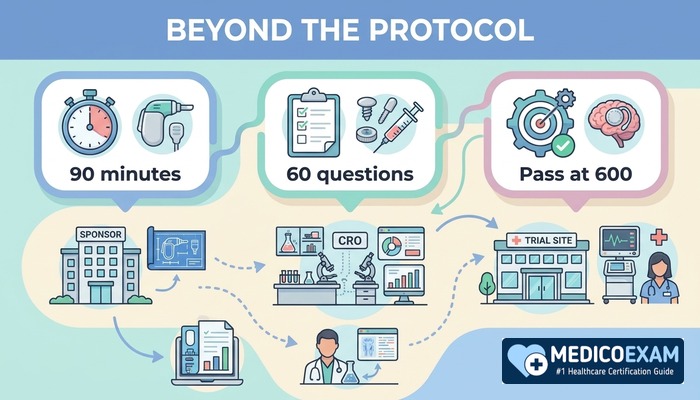
The ACRP Medical Device Professional (ACRP-MDP) exam has 60 questions, gives you 90 minutes and requires a scaled score of 600, where results run from 200 up to 800. It is a specialty credential for clinical research professionals who already hold an ACRP certification and work on medical device trials.
Device studies ask different things of a research team than drug studies do, and this exam is built around that difference. If you are weighing whether to book it, the sections below explain the format, who may sit, the five weighted areas and a preparation method. Once you are ready to test yourself, start the ACRP-MDP practice test and compare your result with the area weights further down.
How is the ACRP-MDP exam structured, scored and priced?
The exam has 60 questions, and 50 of them are scored while the other 10 are pretest items. ACRP uses pretest items to trial new questions, and nothing marks them out for you, so give each question your full attention. You have 90 minutes in total, which averages 90 seconds per question. That is a brisk pace for scenario questions that describe a site, a device and a decision, so reading speed matters as much as knowledge.
Results are reported as a scaled score between 200 and 800, with 600 as the line you must reach. Our records note that this equals roughly 67%, but a scaled score is not a simple percentage of correct answers, so treat that figure as a rough guide only. Because pretest items sit among the scored ones, there is no value in trying to guess which questions count.
As of November 2026, ACRP lists the fee at $250 for ACRP members and $300 for nonmembers. Membership therefore brings a saving of $50 on the exam fee, which is worth weighing against what joining costs if you are not yet a member. ACRP's page states that there are no application fees for this specialty exam, though it is wise to confirm that on the day you register.
| Fact | Value |
|---|---|
| Credential | ACRP Medical Device Professional (ACRP-MDP) |
| Awarded by | Association of Clinical Research Professionals (ACRP) |
| Questions | 60 (50 scored items and 10 pretest items) |
| Time limit | 90 minutes |
| Passing score | A scaled score of 600 (results run 200 to 800) |
| Fee, November 2026 | $250 for ACRP members, $300 for nonmembers |
| Credential validity | 2 years, according to MedicoExam's records |
| How it is delivered | Computer-based, at a PSI test center or with live remote proctoring |
The exam is delivered by computer. You can sit it at a PSI test center or through PSI live remote proctoring, so the choice comes down to whether you prefer a controlled room outside your home or your own desk with a proctor watching over the internet. Whichever you choose, rehearse in the same conditions beforehand: the same screen size, the same quiet, the same 90-minute block.
Read the details on ACRP's ACRP-MDP page before you plan your calendar. The page spreads the rules across tabs for exam content, how to apply, preparing and testing, and what happens after your exam, and the rules there override anything summarized here.
Who is allowed to sit the ACRP-MDP exam?
You must currently hold an ACRP certification before you can register. ACRP's page names four that qualify: Certified Clinical Research Coordinator (CCRC), Certified Principal Investigator (CPI), ACRP Certified Professional (ACRP-CP) and ACRP Certified Clinical Research Associate (CCRA). Holding one of these is the gate, and nothing else on the page replaces it.
That makes the ACRP-MDP an add-on rather than a starting point. A coordinator, an investigator, a monitor or a clinical research professional in a broader role earns one of the four base credentials first, and then adds device expertise on top. If you do not hold any of them yet, your first task is to choose which base certification fits your role, and the device exam comes afterward.
The word currently matters. The page requires you to hold the base certification at the time you apply, so a lapsed credential is a problem to fix before you pay for anything. Check your own status in your ACRP account instead of assuming it, particularly if your certificate was issued some years ago.
MedicoExam's syllabus page describes the people this credential is aimed at as medical device clinical research professionals, clinical operations professionals, and regulatory and quality professionals. They work at medical device sponsors and manufacturers, contract research organizations and clinical research sites. If your day job touches device trials in any of those settings, the exam content will feel familiar rather than abstract.
When can you sit the exam, and how does booking work?
Candidates choose between two annual sitting periods. Spring spans February 15 to May 15, while fall spans July 15 to October 15. You cannot sit outside those dates, so a missed window means waiting for the next one. As of early November 2026, the fall window has closed, and the spring window is the next one the page lists.
Registration closes before the window does. The page gives October 20 to April 30 for spring and May 20 to September 30 for fall. Count backward from your target date: if you want a late spring sitting, your registration has to be done by the end of April, and the earlier you register, the more choice you have among test center and remote slots.
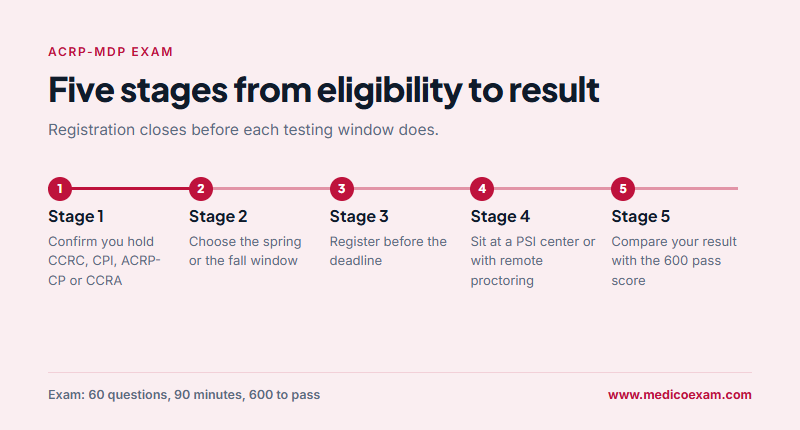
A sensible order is to confirm your base certification first, pick a window second, register third and book your slot straight away. The reason to move quickly is simple: a fixed date is the best protection against the open-ended studying that drags on for months. Pick a window that leaves you a realistic number of weeks to prepare, then work backward from it.
After the exam, ACRP publishes further rules under its after-your-exam tab. The rules for retaking and for keeping the credential are held there too, and MedicoExam's records show the credential as valid for 2 years. The page we reviewed does not spell out a renewal procedure, so read ACRP's current rules or use the contact link on ACRP's certification pages before you plan beyond the first sitting.
What does the ACRP-MDP exam actually test?
The exam content is organized into five topic areas with published weights: ethical and participant safety considerations at 25%, investigational product and device regulation at 10%, clinical trial operations (GCPs) at 30%, study and site management at 30%, and scientific concepts and research design at 5%. Together they total 100%.
The common thread is applied judgment inside a device study. The task statements in the outline begin with verbs such as evaluate, identify, manage, verify and comply, which tells you the questions ask what you would do or check rather than what you can recite. Memorizing definitions gets you part of the way, but you also need to rehearse decisions.
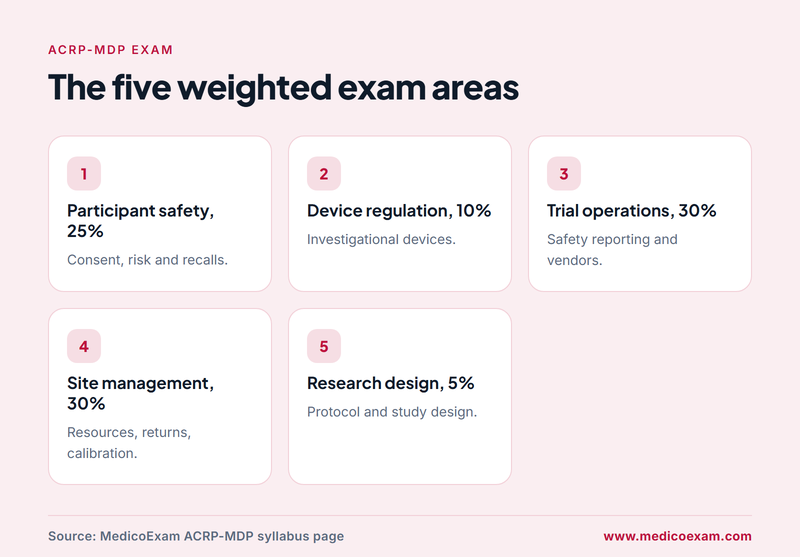
The first area, ethical and participant safety considerations, carries a quarter of the exam. Its tasks include reviewing the safety and performance of the investigational device using the instructions for use or investigator's brochure, developing the informed consent form and the process for obtaining consent, and comparing clinical care with the clinical management of research participants. It also covers privacy and human subject protection under different national and international regulations, confirming that inclusion and exclusion criteria protect subjects, and weighing benefits against risks.
The same area covers unblinding procedures, conflicts of interest, device recalls, study holds and safety alerts, and subject registries with long-term follow-up and continued access. In practice, almost every question in this group asks you to put the participant first and then show that you know which document or process proves it.
The area on investigational product and device regulation is weighted at 10%. The outline MedicoExam holds lists no task detail under it, so rely on ACRP's exam-content tab for the current scope. The weight is small, but regulation also threads through safety reporting and documentation in the larger areas, so do not skip it.
Clinical trial operations (GCPs) is worth 30%. The tasks include evaluating how a trial is conducted against its protocol, study plan, monitoring plan and data management plan, and controlling the storage, shipment and dispensing of the investigational device. You are also expected to tell apart adverse events, device effects and device deficiencies, and to follow the safety reporting rules before and after approval.
The rest of that list is practical: verifying that consent was documented, assessing the qualifications of the site, staff and principal investigator, training teams on the protocol and the device, spotting issues that may need a protocol amendment, and overseeing vendors such as core labs, IRBs or ethics committees and CROs. Essential regulatory documents, randomization procedures, recalls and the critical elements of an investigator agreement complete the area.
Study and site management is also worth 30%. It concerns the resources a study needs, including finances, timelines and cross-disciplinary staff, along with feasibility, contracts, budgets and indemnification or insurance. It also covers protocol compliance by visits, procedures and reporting, calibration and maintenance of study devices and diagnostic equipment, expiration and relabeling, device returns after recalls or explants, device deficiency reporting and accurate data records.
The smallest area, scientific concepts and research design at 5%, covers judging whether a protocol can practically be carried out, using risk management strategies for subjects, the device and data handling, and describing the study design. It is the lightest part of the exam, but its ideas tend to show up as context inside questions from the larger areas.
Which area deserves the most study time?
Start with arithmetic. Clinical trial operations and study and site management together make up 60% of the exam, and ethical and participant safety adds a further 25%. Only regulation, at 10%, and scientific concepts and research design, at 5%, are left. A study plan that gives those two small areas the same share of hours as the big three spends the least valuable hours on the smallest slice of marks.
Weight is not the only thing to look at. Your own background decides where the gaps are. A coordinator who handles consent and visits daily may be comfortable with participant safety and site management but weak on vendor oversight, protocol amendments and device accountability. A monitor or a sponsor-side professional often has the opposite profile: strong on documents and oversight, rustier on consent procedure and subject follow-up.
A simple approach is to take a mixed set of practice questions cold, file every miss under one of the five areas, and compare the counts with the weights. If 40% of your misses come from an area weighted at 10%, that is a signal to fix the area quickly, but the larger areas still decide your result. Re-test after each study block and track whether the same area keeps appearing.
Devices bring their own vocabulary. Terms such as device deficiency, adverse device effect, instructions for use, explant and study hold appear in the outline's task list, so treat them as exam language and make sure you can explain each in a sentence. If two of them blur together for you, write the difference down; confusing a deficiency with an adverse event is exactly the kind of slip a scenario question is designed to expose.
What real-world scenarios should you expect?
ACRP's outline is written as tasks, and each task converts naturally into a scenario. MedicoExam does not publish live exam questions, and no legitimate resource can, so the examples below are practice prompts built from the task list, written to show the style of thinking rather than to predict specific items.
Consent and participant protection. A site staff member proposes changing the way consent is documented for a device study. The task asks you to assess compliance and documentation of the consent process, so the correct reasoning goes back to the approved process and the document that records it. Expect answers that look equally convenient and differ only in whether they protect the participant and keep the record verifiable.
Safety events and reporting. A participant experiences an event during a device study. The outline expects you to differentiate between an adverse event, a device effect and a device deficiency, to manage the situation and to comply with the reporting rules of the regulatory agencies. The practice habit here is to classify first, then report, because the type of event decides the route.
Device accountability and returns. The study team finds that a shipment of investigational devices is nearly at its expiration date, or that unused devices need to go back. Tasks on control, storage, shipment, dispensing, relabeling, resupply and returns all apply. The strongest answers keep a clear chain of custody and follow the study plan rather than improvising.
Site and vendor oversight. A core lab or technology vendor misses a deadline. The outline asks you to oversee vendors, to assess investigator and site compliance with the protocol and to decide whether an issue needs a protocol amendment. The reasoning is about proportion: document the problem, find the cause, and escalate the way the monitoring plan says to escalate.
Feasibility and resources. A sponsor asks whether your site can take on a new device study. You are expected to evaluate feasibility, confirm that staff, facilities, supplies and equipment will stay available, and check that contracts, budgets and indemnification are in place before work starts. Good answers tie each claim to something you can verify, not a feeling that the site will cope.
Notice what these prompts share: none of them asks you to give clinical advice, and none is about a single correct number. They test whether you pick the compliant, documented, participant-protecting action when several options look plausible. Practice questions that train that habit are far more useful than a list of facts.
How should you prepare for the ACRP-MDP exam?
Begin with ACRP's own material. The exam-content tab on its ACRP-MDP page is the authority on scope, and the preparing-and-testing tab explains the testing rules. Read both first so that you know what you are studying, then compare them with the ACRP-MDP syllabus outline, which sets out the five areas with their weights and task lists in one place.
Next, turn the outline into a checklist. Under each of the five areas, write the tasks in your own words and mark each one as confident, shaky or unknown. This takes less than an hour and tells you more than rereading a textbook. Items marked unknown are your first study targets, but only the ones in the 25%, 30% and 30% areas should get the longest sessions.
Then practice in the exam's style. MedicoExam's premium practice exam for the ACRP-MDP offers 235+ scenario-based questions with two months of access, timed mock exams, a result book and a question-level result history, with the current price shown on the product page. It is an independent practice resource and is not affiliated with ACRP, but it lets you rehearse the 60-question, 90-minute shape of the real sitting. A free demo is available on the product page, so you can try the interface before you decide.
Practice sessions only help if you review them properly. For each miss, write down why you missed it: you did not know the term, you misread the scenario, you chose the convenient option over the compliant one, or you ran out of time. The cause matters more than the topic, because a reading mistake is cured by slowing down while a knowledge gap needs study. Group your errors by cause every week and change your plan to match.
Finally, rehearse the clock. Sit at least two full 60-question blocks in 90 minutes under conditions close to the real thing, whether at a test center or on a remote-proctored setup. Aim for a first pass at about 90 seconds per question, flag the hard items and return to them. Book the exam when your timed scores stay comfortably above the pass level across several sittings, not after a single lucky result.
What mistakes cost candidates the most, and is the credential worth it?
The first mistake is studying device trials as if they were drug trials. The outline repeatedly names device-specific items: instructions for use, device deficiencies, calibration of study devices, explants and device returns. If your experience is mostly in drug studies, give these terms their own study time instead of assuming that your existing knowledge transfers.
The second is ignoring the small areas altogether. The 10% and 5% areas are easy to skip, but they are the cheapest marks to win because few candidates revise them. The third is choosing answers that are efficient rather than compliant. In scenario questions, the option that saves time but weakens documentation or participant protection is usually the trap.
The fourth is treating this article, or any third-party summary, as final. Fees, windows and rules can change, and the only source that counts on exam day is ACRP. Confirm every date and price on its page before you register, and keep a screenshot of what you saw.
Is the credential worth sitting? That depends on your role. ACRP describes it as recognizing clinical research professionals with specialized knowledge in medical device clinical trials, and it describes itself as an organization with more than 22,000 members, founded in 1976. We do not quote salary or hiring figures here because we have no source you can open for them. The practical test is whether device studies are, or will become, a real part of your work. If they are, the specialty mark is a credible way to show it.
To summarize the plan: confirm you hold one of the four base certifications, pick a testing window and register before the deadline, weight your study toward trial operations, site management and participant safety, practice with scenario questions under a clock, and verify every detail on ACRP's page. Do that, and the 60 questions become a familiar task rather than a surprise.
Frequently Asked Questions
How many questions are on the ACRP-MDP exam?
Sixty questions make up the exam: 50 scored items plus 10 pretest items. Nothing flags the pretest ones, so answer every question as if it counts. You have 90 minutes, which averages 90 seconds per question, and the exam is delivered by computer.
What score do I need to pass the ACRP-MDP exam?
You need a scaled score of 600, and results run from 200 up to 800. MedicoExam's records put this at roughly 67%, but a scaled score is not a straight percentage of correct answers. Aim to finish practice sessions well above that level before booking.
How much does the ACRP-MDP exam cost?
As of November 2026, ACRP lists the exam at $250 for ACRP members and $300 for nonmembers. ACRP's page states there are no application fees for this specialty exam. Prices change, so confirm the current figure on ACRP's ACRP-MDP page before you register.
Who can take the ACRP-MDP exam?
You must currently hold one of four ACRP certifications: CCRC, CPI, ACRP-CP or CCRA. The ACRP-MDP is a specialty credential added on top of one of them, so candidates without a base ACRP certification cannot register for it. Check that your base certification is current in your ACRP account before you apply.
When can I sit the ACRP-MDP exam?
There are two sitting periods each year: February 15 to May 15 in spring, and July 15 to October 15 in fall. Registration closes April 30 for spring and September 30 for fall, so register by the deadline, not by the start of the period.
What does the ACRP-MDP exam cover?
Five areas carry published weights, and the two largest, clinical trial operations and study and site management, hold 30% each. Participant safety follows at 25%. Questions test applied judgment in device trials, such as consent, safety reporting and device accountability.
- ACRP-MDP Question Bank |
- ACRP-MDP Eligibility & Requirements |
- ACRP Medical Device Professional Practice Test |
- ACRP-MDP Exam Cost |
- ACRP-MDP Registration Process |
- ACRP Medical Device Professional Study Guide |
- ACRP-MDP Recertification |
- ACRP-MDP Certification Overview |
- ACRP Medical Device Professional Syllabus |
- ACRP-MDP Preparation Time |
- ACRP-MDP Passing Score |
- ACRP-MDP Exam Format |
- ACRP Medical Device Professional Sample Questions |
- ACRP-MDP Career Opportunities


