
COBGC Practice Test Prep: Where OB/GYN Coders Lose Marks
The AAPC Certified Obstetrics Gynecology Coder (COBGC) exam asks 100 questions over 240 minutes and you pass with 70%. One attempt cost $325 in October 2026, and a pair of attempts cost $399. Most marks are lost not on obscure codes but on small slips in maternity packages, modifiers and documentation.
This guide shows how the paper is built, what its four syllabus areas ask, where capable coders trip, and a preparation routine that fits around a full-time job. To learn where you stand today, sit the COBGC practice test before you read further and treat the first score as a map, not a verdict.
How is the COBGC exam structured, scored and priced?
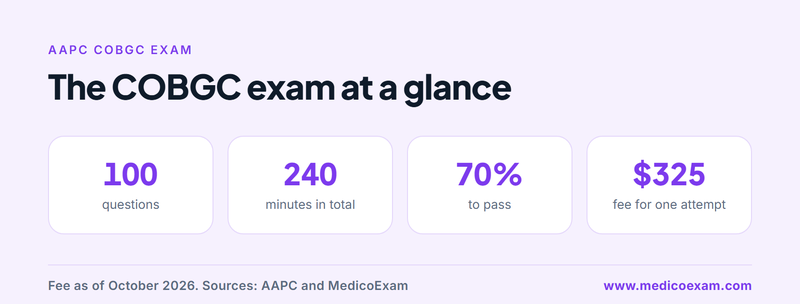
Split 240 minutes across 100 questions and each one gets 144 seconds. The pass mark of 70% equals 70 correct answers out of 100. You choose the setting: AAPC lets you test from home under a live remote proctor, or in a testing center. Available dates and times appear only after you have bought an exam voucher, and the syllabus page on this site notes that one exam attempt can be scheduled at a time.
AAPC showed the voucher starting at $325 in October 2026, while our own records also list a $399 package of two tries. The sources we hold never split the 100 questions into counted and trial items, so answer every question and assume each counts. For a working coder, four hours is a comfortable allowance. The usual problem is skimming a long scenario and missing the one detail that changes the answer.
| Item | Detail |
|---|---|
| Credential name | AAPC Certified Obstetrics Gynecology Coder (COBGC) |
| Awarded by | AAPC |
| Number of questions | 100 |
| Time limit | 240 minutes |
| Pass mark | 70% |
| Fee, October 2026 | From $325 for one attempt; $399 buys two exam attempts |
| Where you sit it | Remote proctoring from your own room, or a testing center |
| Validity | A two-year cycle, renewed through membership and CEUs |
Check the fee and the booking rules on AAPC's COBGC page before you pay, because both can change. AAPC additionally offers an online self-paced course that began at $660 in October 2026. Whether it earns its price depends on how much obstetrics and gynecology coding you already do. For the topic list in plain language, the COBGC syllabus overview on this site puts it all in one place.
Who is the COBGC for, and is there an eligibility rule?
AAPC describes the COBGC as proof of advanced skill in obstetrics and gynecology coding. It says the credential shows proficiency across the three code sets (ICD-10-CM, CPT®, HCPCS Level II) as they apply to women's health, prenatal and postpartum care and gynecologic procedures, within current guidelines and payer requirements. The people it names are coders in OB/GYN practices, women's health clinics, multispecialty groups and hospitals, along with billers who handle OB/GYN claims, and auditors and compliance staff who check documentation.
AAPC's page does not set a minimum number of years in the job. It describes the background it expects instead: a high-level knowledge of ob/gyn terminology, anatomy and pathophysiology, plus a sound grasp of how procedure, supply and diagnosis codes are applied together. If that does not sound like you yet, AAPC recommends its COBGC exam preparation course first.
What does the credential change at work?
Women's health coding spans a long stretch of a patient's life, from contraception through pregnancy to surgery. A single practice might bill a routine visit, a delivery and a hysterectomy in one week, each with different payer expectations. AAPC lists accurate reimbursement and reduced compliance risk among the reasons to hold the credential, and it points to openings in auditing and compliance as well as coding.
Should a generalist coder bother with it?
It depends on your claim mix. If most of your day is OB/GYN, the exam mostly formalizes what you already know. If obstetrics is only a slice of your work, you will study more, yet you also stand to gain more, because maternity rules reward careful reading. Think of the credential as depth in one field that rests on a broad coding base.
Which four areas make up the COBGC syllabus?
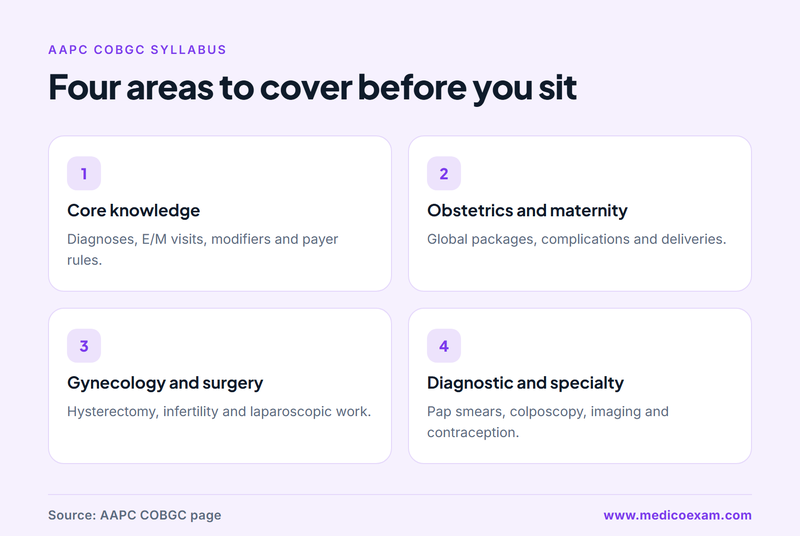
AAPC arranges the content into four areas and, on the page we reviewed, publishes no percentage weight for any of them. No one can therefore honestly say an area is worth a set number of questions. Aim to be competent in all four. The table below paraphrases the areas as AAPC lists them.
| Syllabus area | What it covers |
|---|---|
| Core knowledge areas | Diagnosis codes for obstetric conditions, normal and high-risk pregnancies and gynecologic disorders; E/M selection for preventive, prenatal and postpartum visits; modifiers and payer-specific guidelines |
| Obstetrics and maternity care | Global obstetric coding across antepartum, delivery and postpartum services; high-risk pregnancy, multiple gestation and complications; Cesarean, vaginal and assisted deliveries |
| Gynecology and surgical procedures | Hysterectomies, oophorectomies and myomectomies; infertility, sterilization and reproductive health procedures; minimally invasive and laparoscopic surgery |
| Diagnostic and specialty services | Pap smears, colposcopy and cervical biopsy; ultrasound and diagnostic imaging for OB/GYN; contraceptive management including device insertions and removals |
Core knowledge: diagnoses, E/M and modifiers
Everything else rests on this block. You assign ICD-10-CM codes for obstetric conditions, for normal and high-risk pregnancies and for gynecologic disorders, which means reading the provider's wording for detail rather than taking the first plausible entry. You also choose E/M services for women's health: preventive visits, prenatal visits and postpartum visits each have their own reporting logic.
Modifiers and payer-specific guidelines complete the block. One modifier may signal that a service was distinct, that a procedure was bilateral, or that only part of the care was delivered by one clinician. Expect short scenarios that ask which modifier, if any, belongs on a line, and what a payer rule changes about the answer.
Obstetrics and maternity care
This area is the heart of the credential. Global obstetric coding bundles antepartum care, delivery and postpartum care, so you need to know what the package includes, what falls outside it and how to report services when the patient does not stay with one practice from start to finish. The questions test whether you can read a timeline of visits and decide what is billed together and what is billed on its own.
Then come the complications. AAPC lists high-risk pregnancy management, multiple gestation and pregnancy complications, followed by Cesarean sections, vaginal deliveries and assisted deliveries. Each delivery route changes the procedure choice, and a complication changes the diagnosis sequence. Practice tracing a note from the first prenatal visit to the delivery summary, and write down which details drive each code you pick.
Gynecology and surgical procedures
Surgical coding in this field turns on the operative report. Hysterectomies, oophorectomies and myomectomies are named by AAPC, along with procedures related to infertility, sterilization and reproductive health. The approach matters as well: AAPC lists minimally invasive and laparoscopic gynecologic surgery, so an open and a laparoscopic version of similar work can lead you to different codes. Read what the surgeon actually did, not what the title of the case implies.
Diagnostic and specialty services
This last area collects the services that fill a clinic day. AAPC names Pap smears, colposcopy and cervical biopsy, ultrasound and diagnostic imaging specific to obstetrics and gynecology, and contraceptive management, including device insertions and removals. These items look simple, which is why they punish haste. A biopsy done during a colposcopy, or an insertion billed with a visit, invites questions about what is separately reportable.
What does a COBGC-style scenario look like?
The sources we hold do not publish sample questions, so what follows is an invented teaching example of the reasoning involved, not an exam item. Imagine a note that records a patient's prenatal visits at one practice, a delivery by a clinician from that same practice, and a postpartum visit six weeks later. The first question is whether the care was delivered as one package. The second is which diagnoses the note supports at each stage. The third is whether any service in the note stands outside the package and needs its own line.
Now change one fact: the patient moves away before delivery and a different practice takes over. The same note now supports a different answer, because the package was split. This is the kind of single-detail change that scenario questions are built around. When you practice, rewrite your own scenarios by altering one fact at a time and see which answers move. That exercise trains the habit of reading the stem for the detail that matters, which no list of rules can replace.
The same method works for gynecologic surgery. Take an operative report, then ask what changes if the approach was laparoscopic instead of open, if a second procedure was performed in the same session, or if the documentation leaves out a key finding. Each variation tests a different part of the syllabus, and together they show whether you understand the rules or have only memorized outcomes.
Where do OB/GYN coders lose marks on the COBGC?
The slips below are patterns, not data from AAPC. They come from how the syllabus is built and from the kind of judgment scenario-based questions reward. Each one is worth a deliberate check during practice.
- Treating the global package as a single idea. Candidates remember that antepartum, delivery and postpartum care are bundled, then forget to ask what happens when care is split or a service falls outside the package. Always ask who delivered which part of the care.
- Letting the diagnosis lag behind the note. A pregnancy can be normal, high risk, a multiple gestation or complicated, and the wording decides it. If the stem names a complication, the diagnosis should reflect it.
- Choosing a modifier from habit. Your own office may append the same modifier almost every time. The exam asks what the documentation supports in this one case.
- Ignoring the surgical approach. Open and laparoscopic work, or a procedure that includes another, can change the code set. The approach sits in the report, so find it before you choose.
- Billing a bundled service separately. A visit, an ultrasound or a biopsy that was part of a larger service may not stand alone. Check whether it was distinct before you add a line.
- Overlooking payer-specific rules. AAPC names payer requirements in its core knowledge list, so a scenario may hinge on a guideline that your own practice never meets.
A useful habit is to attach a one-line reason to every answer you give in practice. If your reason starts with 'we always do it this way', you have found a risk. If it starts with 'the note says', you are reasoning the way the exam wants you to.
How should you prepare, step by step?
The exam is long, so build stamina as well as knowledge. A calm routine beats a late scramble, and the steps below do not depend on how many weeks you have, because they work in order rather than by date.
Step 1: take a baseline
Before studying, answer a mixed set of questions cold. Sort every miss into one of the four syllabus areas. Two or three misses in a single area tell you where the first week of study goes. MedicoExam's COBGC practice exam lists 195+ exam-aligned practice questions and 2 months of access to the question bank on its product page, which gives you enough material to repeat this check more than once.
Step 2: study the area, then the cases
Read the guidelines for one area, then work scenarios from it straight away. Reading without applying produces false confidence, and applying without reading produces guesses. Alternate them, and keep a short log of the rule behind each answer you got wrong.
Step 3: practice the paper as a whole
Run at least one full timed paper of 100 questions in 240 minutes. Notice where your attention drops and whether you rush the last quarter. Because the paper mixes all four areas, finish your study of the individual areas before you sit a complete mock.
Step 4: review by reason, not by score
After each mock, read every explanation, including the ones you got right. A correct answer reached for a poor reason is a future miss. Group your errors by cause: a misread stem, a missing rule, or a habit from your own practice. Fixing a cause repairs many questions at once.
Step 5: book when practice supports it
Purchase the voucher once your recent practice papers sit comfortably above the pass mark, and keep a margin for exam-day nerves. Because only one attempt can be scheduled at a time, go in prepared rather than hoping to retry immediately. Choose between remote proctoring and a testing center on the basis of which environment keeps you calmer for four hours.
If you want a structured course first, AAPC offers one, and you can read about it on AAPC's COBGC preparation course page. Pair it with scenario practice, because a course teaches the rules while practice teaches how the exam applies them.
How do you keep the COBGC credential active?
AAPC states two conditions. First, keep your AAPC annual membership in good standing; second, earn 36 continuing education units (CEUs) per two-year cycle, and 8 of those units must be ob-gyn specific. The Master record we hold gives the credential a validity of 2 years, which matches that cycle.
Treat the 8 specialty units as the ones to plan early. General CEUs can come from many sources over two years, yet the specialty requirement narrows your choices. Write each unit in a log the day you gain it, and pace the work over the whole cycle so renewal is calm.
Is there a practice test for the COBGC, and what should it do?
AAPC's COBGC page, as rendered for this article, shows an exam voucher and a self-paced course. It does not show a practice exam of its own, so a candidate who wants timed scenario practice looks to other providers. MedicoExam sells a practice exam for the COBGC, and it is not AAPC material. Its product page describes timed mock exams, scenario-based questions, a personal result book and regular updates.
Judge any practice test, ours included, by three questions. Do the items resemble the scenarios in the syllabus areas above? Do the explanations teach the rule behind each answer? Can you time yourself on a full paper? If the answer to all three is yes, the test is doing its job. You can try the demo first, then decide whether to open the full practice exam.
Final checklist before you book the COBGC
- You can state the pass mark, the number of questions and the time allowed without looking.
- You can name the four syllabus areas and describe two topics inside each.
- You have taken a full timed paper and reviewed every explanation.
- Your weakest area has been revisited at least twice since your baseline.
- You have chosen between remote proctoring and a testing center.
- You know the renewal rule: membership plus 36 CEUs every two years, 8 of them ob-gyn specific.
The COBGC rewards careful reading more than memorized lists. Learn the four areas, test yourself on whole scenarios, find the reason behind each miss, and book only when mock results show you are prepared.
Frequently Asked Questions
How many questions are on the COBGC exam?
One sitting contains 100 questions with a 240-minute limit, about 144 seconds apiece. Most are brief OB/GYN cases where you pick a code, a modifier or the correct way to report a service, so slow, attentive reading pays off more than speed.
What is the passing score for the COBGC exam?
The pass mark is 70%, equal to 70 right answers out of 100. On the page we reviewed, AAPC sets no separate cut-off for individual areas and lists no weighting, which is why preparation should spread across all four syllabus areas and not rely on one strong subject.
How much does the COBGC exam cost?
As of October 2026, AAPC's voucher started at $325 for a single try, and MedicoExam's records show $399 for a package of two. AAPC's separate training course begins at $660. Prices can move, so read AAPC's own page before you pay.
What does the COBGC exam cover?
The paper has four parts: core knowledge, obstetrics and maternity care, gynecology and surgical procedures, and diagnostic and specialty services. In every part you apply the three code sets to the visit or operative documentation in front of you and decide what is reportable.
Can I take the COBGC exam online?
Yes, AAPC allows a remote-proctored session from home, and a testing center is the alternative. Dates and times show only once a voucher is purchased, so settle how much preparation time you need first, and which setting keeps you calmer for four hours.
How do I keep the COBGC credential active?
Keep your AAPC annual membership active and collect 36 CEUs across every two-year cycle, of which 8 must be in ob-gyn topics. Note every unit as you earn it and space them through the cycle so that renewal arrives without pressure.
- AAPC COBGC Question Bank |
- AAPC COBGC Eligibility & Requirements |
- AAPC Obstetrics Gynecology Coder Practice Test |
- AAPC COBGC Exam Cost |
- AAPC COBGC Registration Process |
- AAPC Obstetrics Gynecology Coder Study Guide |
- AAPC COBGC Recertification |
- AAPC COBGC Certification Overview |
- AAPC Obstetrics Gynecology Coder Syllabus |
- AAPC COBGC Preparation Time |
- AAPC COBGC Passing Score |
- AAPC COBGC Exam Format


