
What Does the CGSC Exam Really Test? A General Surgery Coder's Guide
Passing the AAPC Certified General Surgery Coder (CGSC) exam means scoring 70% on a paper of 100 questions that runs for 240 minutes. A single attempt was priced at $325 in October 2026, and a bundle of two was $399. What it tests is whether you can turn operative documentation for abdominal, breast, endocrine, soft tissue and trauma surgery into correct codes and modifiers.
This guide explains how the paper is built, what each of its four syllabus areas asks of you, where capable coders lose marks and how to prepare without wasting weeks. To find your starting point, take the CGSC practice test early and treat your first result as a starting point.
How is the CGSC exam structured, scored and priced?
Divide 240 minutes by 100 questions and you get 144 seconds a question. The cut-off is 70%, which equals 70 right answers from 100. Where you sit is your choice: AAPC offers a remote-proctored session from your own room, or an appointment at a testing center. Dates and times become visible once an exam voucher has been bought.
The fee AAPC advertised in October 2026 started at $325, and our records add a $399 option covering two exam attempts. Nothing we hold splits the 100 questions into scored and unscored items, so assume every one counts and answer all of them. Four hours is generous for most working coders. Pacing is seldom the problem; reading a report too fast is.
| Item | Detail |
|---|---|
| Credential name | AAPC Certified General Surgery Coder (CGSC) |
| Issued by | AAPC |
| Question count | 100 |
| Allowed time | 240 minutes |
| Required score | 70% |
| Price as of October 2026 | $325 for a single attempt, $399 for two exam attempts |
| Where you sit it | At home under remote proctoring, or at a testing center |
| Validity | 2 years, maintained through continuing education |
Confirm the current fee and the booking rules on AAPC's CGSC page first, since both can change. AAPC also sells a self-paced preparation course, advertised from $660 in October 2026. Whether you need it depends on how much general surgery coding you already handle at work. For a plain-language outline of the topics, the CGSC syllabus overview on this site sets them out in one place.
Who is the CGSC credential for, and is there an eligibility rule?
AAPC presents the CGSC as proof of advanced skill in general surgery coding. The three code sets involved are ICD-10-CM, CPT® and HCPCS Level II, and the credential says you can apply them to surgical procedures while following current guidelines and payer requirements. It suits coders in surgical practices, ambulatory surgical centers and hospitals. AAPC names medical billers who manage surgical claims, and auditors who check surgical documentation, as well.
AAPC's page sets no minimum number of years of experience. What it describes is the background it expects: a high-level grasp of general surgery terminology, anatomy and pathophysiology, together with sound use of procedure and supply codes and diagnosis codes. Anyone who does not yet match that description is pointed to AAPC's exam preparation course.
What does the credential change at work?
General surgery is broad. One operative day can include a hernia repair, a gallbladder removal and a soft tissue excision, each with its own diagnosis logic and its own modifier questions. An employer who sees the CGSC knows you have been tested on that breadth. AAPC lists accurate reimbursement and lower compliance risk among the reasons to hold it.
Is it worth sitting if you code several specialties?
The answer depends on your volume. A coder who sees surgical claims every day mostly formalizes what the job already demands. A generalist who meets surgery occasionally has more to learn, but also more to gain, because bundling rules and modifier choices reward careful study. Think of the CGSC as evidence of depth in a single specialty that sits on top of a broad coding foundation.
Which four areas make up the CGSC syllabus?
AAPC groups the content into four areas. It does not publish a percentage weight for each one, so no one can honestly tell you that an area is worth a fixed number of questions. Plan to be competent in all four. The list below follows AAPC's own wording.
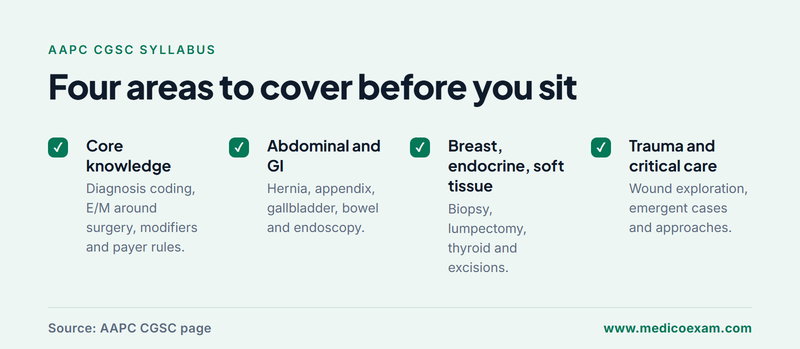
| Syllabus area | What it covers |
|---|---|
| Core knowledge areas | Diagnoses for general surgery conditions, E/M coding for surgical consultations, preoperative evaluations and post-operative follow-ups, and modifiers with payer-specific requirements |
| Abdominal and gastrointestinal procedures | Hernia repairs, appendectomies, cholecystectomies, small bowel and colon resections, exploratory laparotomies, adhesiolysis and endoscopic procedures |
| Breast, endocrine and soft tissue surgeries | Breast biopsy, lumpectomy and mastectomy, thyroidectomy and parathyroidectomy, and excision of soft tissue tumors and cysts |
| Trauma, critical care and other surgical services | Trauma-related surgery and wound explorations, critical care and emergent procedures, and open versus laparoscopic approaches with their documentation requirements |
Core knowledge: diagnoses, E/M and modifiers
Every other area sits on this one. You must assign ICD-10-CM codes for abdominal, gastrointestinal, endocrine and soft tissue disorders treated through surgery, which means reading the provider's wording for specificity and laterality instead of grabbing the first matching code. You must also code evaluation and management services around surgery: the consultation that leads to an operation, the preoperative evaluation, and the follow-up visits afterward.
Modifiers and payer rules complete this block. A modifier can show that a service was separate, that a procedure was bilateral, or that a surgeon performed only part of the care. Choosing it correctly changes payment and compliance, so expect questions that give you a short scenario and ask which modifier, if any, belongs on the line.
Abdominal and gastrointestinal procedures
This area covers the operations most people picture when they hear general surgery. Hernia repairs, appendectomies and cholecystectomies sit beside resections of the small bowel and colon, exploratory laparotomies and adhesiolysis. Endoscopic work such as colonoscopy and esophagogastroduodenoscopy (EGD) is listed too, along with related interventions.
The skill being measured is selection from the operative report. When a surgeon explores, divides adhesions and then repairs a hernia, you have to decide what is separately reportable and what is part of the main procedure. Questions often hinge on a single detail in the report, such as what was removed, how much was done or why.
Breast, endocrine and soft tissue surgeries
Here the list moves from the abdomen to smaller, more specific operations. AAPC names breast biopsy, lumpectomy and mastectomy, thyroidectomy and parathyroidectomy, and the excision of soft tissue tumors, cysts and other skin and subcutaneous procedures done in general surgery.
Precision matters because similar-sounding procedures carry different codes. A report can describe removal of a lesion, a biopsy or a wider excision, and the difference decides the code family. Practice reading the verbs in a note and linking each one to the procedure it truly describes.
Trauma, critical care and other surgical services
The last area covers trauma-related surgical interventions and wound explorations, critical care and emergent general surgical procedures, and the comparison of laparoscopic and open approaches. The documentation requirements for each approach are part of what AAPC lists, so be ready to decide whether the record supports the code you want.
Emergent cases are often documented under pressure, with a plan that changes mid-operation. A scenario might start as a laparoscopic procedure and end as an open one. Reading the whole report before choosing a code is the habit that protects you here.
What kinds of scenarios should you expect?
The MedicoExam syllabus page summarizes the assessed skills as operative note abstraction, specialty CPT®, HCPCS Level II and ICD-10-CM code assignment, and modifier and Medicare rule application. That wording tells you the shape of the paper. You will be handed a clinical situation and asked to apply rules, not to recite a definition.
Typical prompts look like a short operative summary followed by a question about the best code, the right diagnosis, the correct modifier or the point at which two services can be reported together. Several answers may look plausible. The best answer is the one that fits the documentation exactly and follows the guideline for that service.
Three habits that help in every scenario
First, read the whole stem before you glance at the options, because the final sentence often changes what the question is really asking. Second, underline the nouns and verbs that matter in the report: the organ, the action, the approach and the reason. Third, name the guideline before you choose the code. If you cannot say which rule supports your answer, you are guessing.
A worked way of thinking about a surgical report
Take a report that describes an exploration of the abdomen, the release of adhesions and the repair of a hernia. A rushed reader codes all three. A careful reader asks what the surgeon's main purpose was, whether the exploration led to the finding or was simply part of reaching the site, and whether the payer or the code set treats the release of adhesions as separate work. That questioning habit, applied calmly, is what the exam measures.
Where do capable coders lose marks on the CGSC exam?
Candidates who already work in surgery lose marks in a few predictable ways. The first is reading speed. A familiar-looking scenario invites you to answer from memory instead of from the page, and one changed detail turns a right answer into a wrong one.
The second is modifier habit. Many coders apply the modifiers their own practice uses most and are caught when the question describes a different arrangement. The third is documentation. If the record does not support a service, the exam expects you to see that, and a code you could defend in conversation may still be the wrong choice on paper.
The fourth is thin coverage of the less common areas. Someone who codes mostly abdominal cases may have little recent contact with endocrine or breast work, or with trauma and critical care. Because AAPC publishes no weighting, a weak area cannot be written off as unimportant. Find it early and give it steady attention.
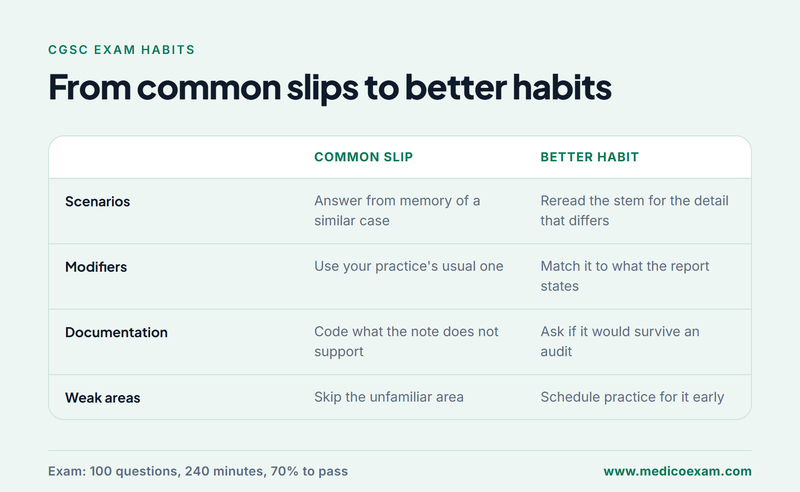
| Common slip | A better habit |
|---|---|
| Answering from memory of a similar case | Reread the stem and find the one detail that differs |
| Applying your practice's usual modifier | Match the modifier to what the report actually states |
| Coding a service the note does not support | Ask whether the documentation would survive an audit |
| Skipping the less familiar area | Give it scheduled practice from the start |
How should you prepare for the CGSC exam?
AAPC does not prescribe a preparation time, and the right length depends on how much general surgery coding you do today. A method works better than a calendar. The one below uses three passes and can be stretched or shortened to fit your week.
Pass one: a timed baseline
Sit a full-length timed set before you study anything, using the references you rely on at work and checking AAPC's rules on what you may use in the exam. Group every miss under its syllabus area, not its position on the paper. Whichever area collects the most errors gets your first block of study time, and the pattern of misses tells you whether the cause is knowledge, reading or pace.
Pass two: rotate through all four areas
Work through core knowledge, abdominal and gastrointestinal procedures, breast, endocrine and soft tissue surgery, and trauma and critical care in turn. For each area, read the guideline text behind your misses and code fresh scenarios from scratch. Build a reference sheet in your own handwriting that lists code families, the purpose of each modifier you use and the payer habits that surprised you. Writing it forces recall in a way that rereading does not.
Pass three: rehearse the sitting
Finish with timed attempts under realistic conditions. MedicoExam's premium CGSC practice exam offers 195+ scenario-based practice questions, enough material to rehearse pacing and the choose-the-best-answer style of reasoning. Nothing can promise a pass, so let your latest couple of scores, not the hours you logged, tell you when you are ready.
If you want guided instruction too, look at AAPC's CGSC preparation course. Experienced coders who have been away from timed papers for years often benefit more from rehearsal than from extra books.
How to review a missed question
Each wrong answer teaches something only when you can say what went wrong. File it under a cause: a rule you never learned, a scenario you misread, payer logic you misapplied, or concentration that slipped late in the session. Rule gaps need study, misreadings need a slower pace, payer errors need a summary sheet, and fading focus needs shorter, more frequent practice. Count the causes after every attempt and a pattern appears within days.
What to do just before the exam
Stop learning new material a couple of days before. Reread your reference sheet, complete a brief mixed set so you stay warm, and confirm your voucher and identification. For an online sitting, check your room and your equipment ahead of time. Walk in with a plan for the first scenario: read the whole stem, find the documented action, then choose.
How do you keep the CGSC credential after you pass?
Two things keep the CGSC current, according to AAPC. One is paying for AAPC membership every year. The other is earning 36 continuing education units (CEUs) in each two-year period, 8 of which must be general surgery specific. That rhythm matches the 2-year validity in our data. Space your CEUs across the period rather than cramming them into its last month.
Pick education that extends the exam topics: yearly code set updates, payer policy changes for surgical services and lessons from audits of your own claims. File each certificate as you earn it so reporting takes minutes. Look at AAPC's CGSC page again ahead of every renewal, because rules can change.
What does a good study week look like for a working coder?
Most candidates fit preparation around a job, so the schedule must be small enough to survive a busy week. Short, frequent sessions beat one long weekend push, because coding rules are retained through repeated retrieval. Aim for a regular block on most days and keep one slot for a timed mixed set.
A useful split is one session on a syllabus area, one on reviewing last week's errors, and one on a mixed timed set. Rotate the area each time so that no part of the syllabus goes cold. When a session ends, write down in one line what you would still get wrong, because that line becomes your next session.
Use real operative reports whenever your employer's privacy rules allow it, and practice scenarios from a question bank when they do not. Never copy patient details into notes you keep. What matters is the habit of finding the documented action, the approach and the reason in unfamiliar wording.
If you share a coding department with colleagues who hold the credential, ask them to quiz you on modifier choices. Explaining why one modifier fits and another does not is a fast way to find holes. You can also teach a colleague one area each week, since teaching exposes gaps that quiet reading hides.
Is the CGSC exam the right next step for you?
Sit it if surgical claims are already part of your week, if you want a specialty credential that employers in surgical practices, ambulatory surgical centers and hospitals can recognize, or if you aim for auditing and compliance work built on surgical documentation. Wait if the vocabulary of operative reports still slows you down, and use that time to build it.
Whichever you choose, start with a timed baseline. It costs a few hours and replaces guesswork with evidence about your weakest area. You can then spend your study time where it will change the result, and book the exam when your practice scores say you are ready.
Frequently Asked Questions
How many questions are on the CGSC exam?
The CGSC paper holds 100 questions, and the clock allows 240 minutes, close to 144 seconds each. Expect short general surgery situations that ask for a code, a modifier or a reporting decision, so a careful read is worth more than a fast click.
What is the passing score for the CGSC exam?
You pass with 70%, which is 70 questions right from the 100 asked. AAPC's CGSC page gives no minimum for individual areas and no weighting, so prepare for all four syllabus areas rather than relying on a single strength.
How much does the CGSC exam cost?
AAPC advertised the CGSC exam from $325 for one attempt in October 2026, and our data lists $399 for two exam attempts. Its own preparation course costs extra, starting at $660. Fees move, so check AAPC's page before buying a voucher.
What does the CGSC exam cover?
Four areas: core knowledge (diagnoses, E/M and modifiers), abdominal and gastrointestinal procedures, breast, endocrine and soft tissue surgeries, and trauma, critical care and other surgical services. Each one asks you to use ICD-10-CM, CPT and HCPCS Level II correctly.
Can I take the CGSC exam online?
Yes, AAPC offers a live remote-proctored sitting at home as well as testing-center appointments. A voucher comes first, and scheduling options show up after you buy it, so decide how long you need to prepare before picking a date.
How do I keep the CGSC credential active?
Renew your AAPC membership each year and collect 36 CEUs every two years, with 8 of them tied to general surgery. Record each unit when you earn it and spread the work over the whole cycle, so renewal never turns into a last-minute rush.
- AAPC CGSC Question Bank |
- AAPC CGSC Eligibility & Requirements |
- AAPC General Surgery Coder Practice Test |
- AAPC CGSC Exam Cost |
- AAPC CGSC Registration Process |
- AAPC General Surgery Coder Study Guide |
- AAPC CGSC Recertification |
- AAPC CGSC Certification Overview |
- AAPC General Surgery Coder Syllabus |
- AAPC CGSC Preparation Time |
- AAPC CGSC Passing Score |
- AAPC CGSC Exam Format


