
CPEDC: Is the Pediatrics Coder Credential Worth Sitting?
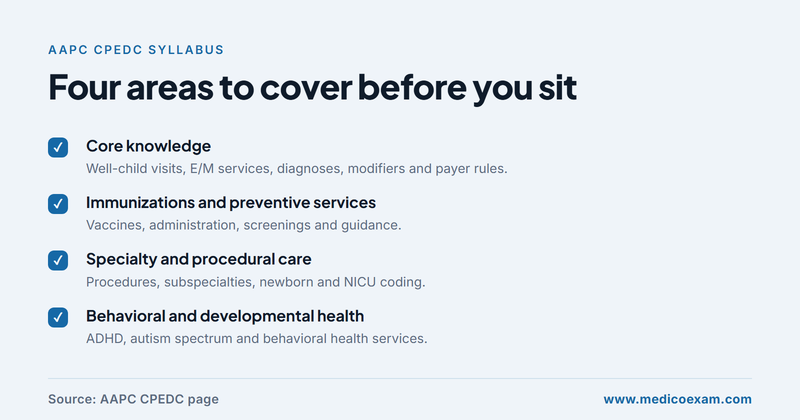
The AAPC Certified Pediatrics Coder (CPEDC) exam gives you 100 questions across 240 minutes and requires 70% to pass. It examines how you assign ICD-10-CM diagnoses, CPT® procedures and HCPCS Level II items for patients from birth through adolescence, in four areas: core knowledge, immunizations and preventive services, specialty and procedural care, and behavioral and developmental health.
If you code for a pediatric practice or a children's hospital, this credential asks you to prove that depth rather than general skill. Before you read on, try the CPEDC practice test so that you know your starting point, then use the sections below to decide where your study time should go.
How is the CPEDC exam built, scored and priced?
Expect one sitting of 100 questions inside a 240-minute window, so each question gets roughly 144 seconds if you pace evenly. To pass you need 70%, meaning 70 correct answers. AAPC offers two settings: your own room with a live proctor watching remotely, or a physical test center. You see the available slots only after paying for a voucher.
Our own records show $399 covering two exam attempts as of October 2026, and this site's syllabus page notes that attempts are scheduled singly once AAPC sends a Notice to Schedule. AAPC sells the voucher on its own CPEDC page, where the live price appears. Training is sold separately: AAPC's self-paced course begins at $660. Because fees change, read AAPC's page again on the day you buy.
Our sources are silent on two points: how many of the 100 items are unscored trial questions, and whether any single area has its own cut-off. Plan as if every item counts and as if only your overall result matters, which means a weak area cannot hide behind a strong one forever.
| Fact | Value |
|---|---|
| Credential | AAPC Certified Pediatrics Coder (CPEDC) |
| Issuer | AAPC |
| Questions | 100 |
| Allowed time | 240 minutes |
| Needed to pass | 70% |
| Price, October 2026 | $399 for two exam attempts, per MedicoExam's records |
| Setting | Home with a remote proctor, or a testing center |
| Renewal cycle | Every two years, through membership and CEUs |
Read the booking details on AAPC's CPEDC page before you commit, since it is the body that sets the rules. If you only want the topic list in plain words, the CPEDC syllabus overview on this site gathers it in one place.
Who is the CPEDC meant for, and what experience does AAPC expect?
AAPC describes the CPEDC as a credential for coders whose daily work is pediatric. It names professional coders in pediatric practices, children's hospitals, family medicine groups, multispecialty practices and outpatient facilities that treat young patients. It also names hospital coders, revenue cycle professionals and auditors who focus on pediatric units, and billing managers who oversee pediatric services, urgent care or community clinics.
AAPC's page names no required length of service. It describes the knowledge it expects: pediatrics-related medical terminology, anatomy and pathophysiology at a high level, together with solid skill at combining CPT® procedures, HCPCS Level II supplies and ICD-10-CM diagnoses on one claim. If that sounds like a stretch, AAPC suggests taking its CPEDC preparation course first.
What does AAPC say the credential does for a career?
The reasons AAPC gives are practical. It says the credential helps you stand out to pediatric practices and hospitals, shows you can code across the full range of pediatric services from well-child visits to complex subspecialty procedures, and deepens your understanding of preventive medicine guidelines, developmental and behavioral health coding and vaccine administration rules. It also links the credential to openings in pediatric coding, auditing and compliance. Those are AAPC's claims about its own product, not a promise of any salary or job offer, and we quote no pay figure because none of our sources provides one.
Is it worth it if you code more than pediatrics?
That depends on your claim mix. A coder whose caseload is mostly children will find the exam formalizes daily habits and fills small gaps. A coder with a mixed caseload has more to learn, yet pediatric rules reward the effort, because age, development and preventive schedules change the answer more often than they do for adult care. Think of the credential as depth built on a broad coding base, not as a replacement for it.
What do the four CPEDC syllabus areas cover?
AAPC groups the content into four areas. On the pages we reviewed, none of them carries a published percentage weight, which means no honest source can tell you how many questions each area contributes. Cover all four. In the table that follows, each row restates one of AAPC's headings in shorter words.
| Area | Topics inside it |
|---|---|
| Core knowledge areas | Well-child visits and preventive medicine coding; pediatric E/M services for acute, chronic, urgent and hospital care; ICD-10-CM diagnosis coding for neonatal, infant and child conditions; pediatric-specific modifiers and payer compliance guidelines |
| Immunizations and preventive services | Pediatric vaccinations including combination vaccines; vaccine administration with counseling and documentation requirements; preventive screenings and anticipatory guidance |
| Pediatric specialty and procedural care | Surgical and procedural services including ENT, urology and orthopedics; subspecialty coding in cardiology, neurology, gastroenterology and pulmonology; newborn, neonatal and NICU coding for complex conditions |
| Behavioral and developmental health | Coding for ADHD, autism spectrum disorders and other developmental conditions; pediatric behavioral and mental health evaluation and treatment services |
Core knowledge: well-child visits, E/M and modifiers
The rest of the paper leans on this first block. A well-child visit follows its own reporting logic, and a problem addressed during that same appointment may justify a second service with its own support. Beyond that, you pick evaluation and management services for acute, chronic, urgent and hospital settings and attach diagnoses for newborns, infants and older children. The provider's precise wording counts, since the diagnosis that looks right at first glance is frequently not the most specific one.
Modifiers and payer guidance close out the block. Different modifiers signal a distinct service, a reduced one or work on a single side, and payers disagree about when they want them. Questions here are brief: given this note, does a modifier belong on this line, and does the payer's guideline alter that answer? A habit from your workplace carries no weight. Only the documentation does.
Immunizations and preventive services
Vaccines look simple and are not. AAPC names combination vaccines, and a combination product raises a different question from a single antigen: what exactly was given, and how is it reported? Separate from the product is the act of giving it. AAPC lists vaccine administration with counseling and documentation requirements, so you need to know when counseling is part of the administration and what the note must show for the claim to hold up.
Preventive screenings and anticipatory guidance complete the area. These are the routine parts of a child's checkup, and they tempt candidates to code from memory. Practice by taking a visit note and listing every service performed, then deciding which are reportable on their own and which belong to the visit. That list, built from the note, is the habit the area rewards.
Pediatric specialty and procedural care
This area stretches across body systems. AAPC names surgical and procedural services in ENT, urology and orthopedics, and subspecialty coding in cardiology, neurology, gastroenterology and pulmonology. You are not expected to practice every specialty, but you are expected to read an operative or procedure note from an unfamiliar one and pick the right codes from what is written. The skill is reading closely, not recalling a specialty's whole code range.
Newborn, neonatal and NICU coding is listed separately, and AAPC ties it to complex conditions. These records are dense, with several diagnoses and services stacked over a stay, so you need a method for working through them: identify the encounter, list the diagnoses in the order the note supports, then match each service to the right line.
Behavioral and developmental health
AAPC names ADHD, autism spectrum disorders and other developmental conditions, together with behavioral and mental health evaluation and treatment services for children. Documentation is the main risk in this area. A diagnosis may be recorded loosely, and a service may be described in general terms, so your task is to decide what the note supports and what it leaves open. This is a coding skill, not a clinical one; the exam asks how to report what a provider documented, never how to diagnose or treat anyone.
What does a pediatric coding scenario look like on the exam?
AAPC publishes no sample questions that we could read, so treat this as a made-up illustration of the thinking involved and not a real item. A child arrives for a scheduled checkup. While there, the provider also deals with a fresh complaint and administers two vaccines, one of which is a combination product. Start by listing every service the note describes. Next, decide which of those the payer would see as separate from the checkup. Finally, check that the wording of the note supports each line you want to bill.
Then alter a single detail. Suppose the provider did no extra work for the new complaint, or the counseling that goes with the vaccines was never written down. The claim you can defend shrinks. Exam writers love this move, because one changed fact can flip an answer. Make your own versions of every practice case, change one fact at a time, and observe what happens to your answer.
Procedure notes respond to the same treatment. Imagine the identical operation performed on an infant in a hospital rather than on an older child in an office, or paired with a second procedure in the same session, or documented without a key finding. Every twist exercises a different corner of the syllabus, and your reactions reveal whether you hold the rules or merely remember past answers.
Where do pediatric coders lose marks on the CPEDC?
What follows comes from reading the syllabus and thinking about how scenario questions work. It is not statistics from AAPC. Use each pattern as a prompt to double-check yourself during practice sessions.
- Billing the headline and missing the rest. A preventive visit may carry screenings, vaccines or a separate problem. Some candidates stop at the main service; others add a line the note never earned.
- Handling a combination vaccine like a single antigen. What was given and how it was administered are two questions. Answer each from the note.
- Reaching for a familiar modifier. Office routine is not evidence. The documentation in the question stem is.
- Settling for a general diagnosis. Conditions in newborns, infants and children often have a more specific option, and the provider's words decide which one fits.
- Drifting through a long NICU record. When many services pile up across one stay, go through the note in sequence and tie each service to a line before choosing codes.
- Overlooking a payer rule. AAPC puts payer compliance guidelines inside its core knowledge area, so a question can depend on a rule your own employer never applies.
One trick pays off quickly: write a single sentence of justification beside each practice answer. When that sentence begins "we always do it this way", you have spotted a weak point. When it begins "the note says", you are thinking like the exam.
How should you prepare for the CPEDC, step by step?
Four hours is a long sitting, which means stamina matters alongside knowledge. These stages follow one another instead of following a calendar, so they suit a plan of several weeks or several months fitted around paid work.
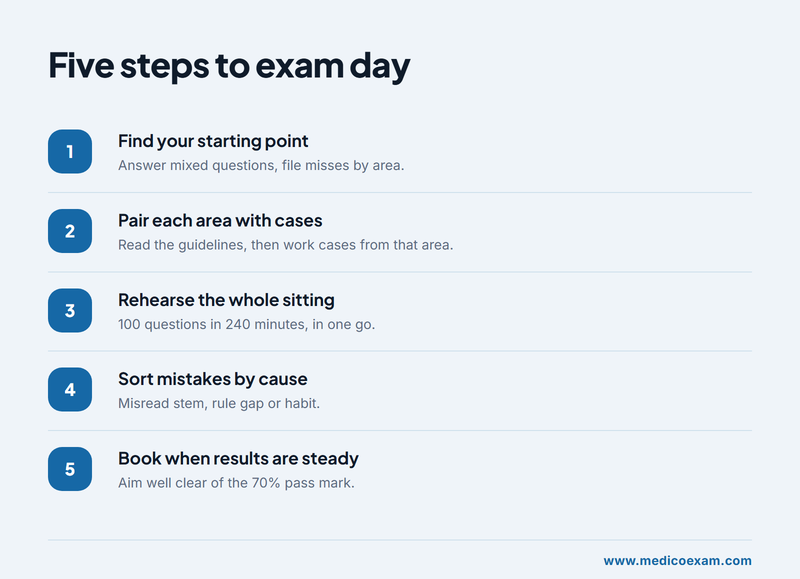
Step 1: find your starting point
Answer a mixed batch of questions before you open any book, then file each miss under one of the four syllabus areas. A cluster of misses in one area decides how week one is spent. Run the same exercise again later to see whether the cluster has shrunk.
Step 2: pair each area with cases
Take one area, read its guidelines, and straight away work cases drawn from it. Reading alone produces confidence you have not earned, while cases alone produce lucky guesses. Keep a running note of the rule that sits behind every answer you got wrong.
Step 3: rehearse the whole sitting
At least once, complete all 100 questions inside 240 minutes, in one go. Watch for the point where concentration slips and whether the final quarter gets rushed. Since the real paper blends all four areas, leave the full rehearsal until each area has had its own round of study.
Step 4: sort mistakes by their cause
After a rehearsal, read each explanation, including those for questions you got right, because a correct guess hides a weakness. Label every error as a misread stem, a gap in a rule, or a carry-over from how your employer does things. Fixing one cause tends to repair several questions together.
Step 5: book once results are steady
Buy your voucher when recent rehearsals land well clear of 70%, leaving room for exam-day nerves. Because the exam is scheduled one attempt at a time, enter ready rather than planning on an instant second try. Choose home proctoring or a test center by asking which gives you the calmer four hours.
Some candidates want teaching before practice. AAPC runs a CPEDC exam preparation course, and its price is on AAPC's page. Whichever route you take, keep scenario practice in the mix, because teaching explains rules and practice shows how a question bends them.
How do you keep the CPEDC credential active?
AAPC sets two requirements. Your AAPC membership must stay current each year, and every two years you must log 36 continuing education units (CEUs), of which 8 have to relate to pediatrics. Master lists the credential as valid for two years, in step with that cycle.
Give the 8 pediatrics units your attention first. Ordinary units are easy to find across many topics, but the specialty portion limits where they can come from. Log each one as soon as you complete it and space them over the whole two years, so that renewal day brings no surprises.
Is there a practice test for the CPEDC, and what should it do for you?
On the AAPC page we read, there is a voucher and a self-paced course, but no practice exam. Candidates after timed scenario work will therefore turn to other publishers. MedicoExam sells a practice exam for this credential; it is our own product, not AAPC material. Its product page describes what it includes.
Whoever makes it, test a practice exam against three questions. Do its items mirror the scenarios in the four areas above? Does each explanation teach the reason behind the answer? Can you run a whole timed paper? Three yeses mean it earns its place in your plan.
A last checklist before you book the CPEDC
- The pass mark, the question count and the time limit come to mind without a glance at notes.
- You can list all four syllabus areas and two topics belonging to each.
- One full timed rehearsal is behind you, with every explanation read.
- Your weakest area has had at least two return visits since the first baseline.
- You know whether you will sit at home or in a testing center.
- You can state the renewal rule from memory: membership, plus 36 CEUs every two years with 8 in pediatrics.
Careful reading beats rote lists on this exam. Know the four areas, practice with complete cases, trace every wrong answer to its cause, and book your date only when the rehearsal scores say you are ready.
Frequently Asked Questions
How many questions does the CPEDC exam contain?
There are 100 questions to finish within 240 minutes, which leaves about 144 seconds per item. Expect brief pediatric cases that ask you to select a code, decide on a modifier, or judge how a service should be reported. Careful reading outweighs speed.
What score do I need to pass the CPEDC exam?
You need 70%, so 70 of the 100 answers must be right. The pages we reviewed show no separate cut-off for any single area and no weighting. Spread your study over all four areas and do not lean on one strong subject.
How much does the CPEDC exam cost?
As of October 2026, MedicoExam's records list $399 for two exam attempts. AAPC's separate online course starts at $660. Prices can change, so check AAPC's own CPEDC page for the current voucher price before you buy anything.
What does the CPEDC exam cover?
It has four parts: core knowledge, immunizations and preventive services, pediatric specialty and procedural care, and behavioral and developmental health. In each part you work from pediatric documentation and decide which diagnoses, procedures and supplies are reportable.
Can I take the CPEDC exam online?
Yes, with a live remote proctor watching from afar. AAPC also lets you choose a physical testing center. You see open dates only after buying a voucher, so first work out your preparation time and which environment suits a four-hour sitting.
How do I keep the CPEDC credential active?
Keep your AAPC annual membership and earn 36 CEUs every two years, 8 of which must be pediatrics specific. Record each unit when you earn it and spread them through the cycle, so renewal arrives as a routine task and not a rush.
- AAPC CPEDC Question Bank |
- AAPC CPEDC Eligibility & Requirements |
- AAPC Pediatrics Coder Practice Test |
- AAPC CPEDC Registration Process |
- AAPC Pediatrics Coder Study Guide |
- AAPC CPEDC Certification Overview |
- AAPC Pediatrics Coder Syllabus |
- AAPC CPEDC Preparation Time |
- AAPC CPEDC Passing Score |
- AAPC CPEDC Exam Format |
- AAPC CPEDC Certification Practice Exam


