
Ready for the CFPC? A Readiness Check for Primary Care Coders
The AAPC Certified Family Practice Coder (CFPC) exam puts 100 questions in front of you against a 240-minute clock, and you need 70% to pass. It checks how you report diagnoses, procedures and supplies from primary care documentation for patients of every age, using four groupings of content that AAPC publishes.
Most coders ask one question before paying for a voucher: am I ready, or am I about to learn the hard way? This guide turns that question into a checklist you can answer honestly. Try the CFPC practice test first to see where you stand, then let the sections below tell you which topics deserve your hours.
How is the CFPC exam built, scored and priced?
You sit the whole exam in one go. Divide the clock by the number of items and each gets roughly 144 seconds, which is comfortable for a simple lookup but tight for a long scenario that makes you hold several guidelines in mind. The pass mark is 70%, which works out to 70 correct answers. AAPC gives you two ways to sit: from your own room while a proctor watches live over the internet, or in person at a testing center. Dates and times become visible only once you have bought a voucher.
On its CFPC page, AAPC shows the exam starting at $325, and its self-paced online training course starting at $660. MedicoExam's own records, as of November 2026, list $325 for one attempt and $399 for two exam attempts, so the second attempt adds $74 to the bundle price. Fees change, so read AAPC's current page on the day you buy rather than trusting any article, this one included.
The pages we reviewed are silent on a few things. They do not reveal whether some of the items are unscored, and they publish no percentage weighting for the four areas or a separate pass mark for any one of them. Plan on every item counting and on a single overall result, which means a strong area cannot hide a weak one for long.
| Fact | Value |
|---|---|
| Credential | AAPC Certified Family Practice Coder (CFPC) |
| Awarded by | AAPC |
| Number of items | 100 |
| Time limit | 240 minutes |
| Pass mark | 70% |
| Fee, November 2026 | $325 for a single attempt or $399 for two, according to MedicoExam's records |
| Where you sit it | Your own room under live online supervision, or a physical site |
| Renewal | Ongoing AAPC membership and CEUs, on a two-year cycle |
The booking details, the voucher and the scheduling rules sit on AAPC's CFPC page. Read it once before you plan your calendar, because the order in which you buy, schedule and sit can change what you are allowed to do.
Who should sit the CFPC, and how much experience does AAPC assume?
AAPC designed the credential for coders who work in family practices, multispecialty groups, community health centers and outpatient clinics. It also names medical billers and reimbursement specialists who handle family practice claims, auditors and compliance professionals who review primary care documentation, and experienced coders who want to specialize in family practice coding.
The experience requirement is a standard rather than a number of years. AAPC expects advanced familiarity with family practice terminology, anatomy and pathophysiology, plus real fluency in applying three code sets: ICD-10-CM for diagnoses, CPT® for procedures, and HCPCS Level II for procedures and supplies. In other words, the exam assumes you already code for a living and want the specialty on your record, not that you are learning what a modifier is.
A useful test is to picture a normal day in your queue. If you can move between a toddler's well visit, an adult's follow-up for several long-term conditions, a same-day sick visit and a small in-office procedure without reaching for a reference on every chart, you are the person this credential describes. If one of those four feels foreign, that is information about where to study, and AAPC itself suggests a preparation course for candidates who are not ready yet.
Primary care is also the specialty where the same patient can bring all four kinds of visit in a single year. That breadth is why the exam is organized around kinds of service rather than around body systems, and why a coder with deep experience in one narrow clinic setting can still find gaps.
What do the four CFPC syllabus areas cover?
AAPC lists four content areas on its certification page, and the MedicoExam syllabus overview repeats them without percentages. Here is what each one contains, in AAPC's own terms.
Core knowledge areas. This is the diagnosis and evaluation layer. AAPC places here the diagnosis coding of conditions that family practices see all the time, naming hypertension, diabetes, asthma, infections and musculoskeletal disorders as examples. Choosing the right E/M service for preventive, problem-oriented, urgent and chronic disease visits belongs here too, as does applying modifiers, payer-specific rules and compliance regulations in primary care.
Preventive and wellness services. The exam then turns to well visits and age-specific preventive medicine coding across pediatric, adolescent, adult and geriatric patients. It adds vaccinations and immunization administration, including combination vaccines and counseling requirements, and the coding of routine screenings such as lipid panels, mammograms, colon cancer screenings and annual wellness visits.
Chronic and acute care management. This area covers the long-term management of conditions such as diabetes, cardiovascular disease and COPD, same-day urgent visits for infections, injuries and other acute conditions, and the coordination services that wrap around them: care coordination, transitional care management and chronic care management.
Minor procedures and in-office services. The last area covers wound care, laceration repair and abscess drainage, plus joint injections, skin lesion removals and other minor procedures performed in the office.
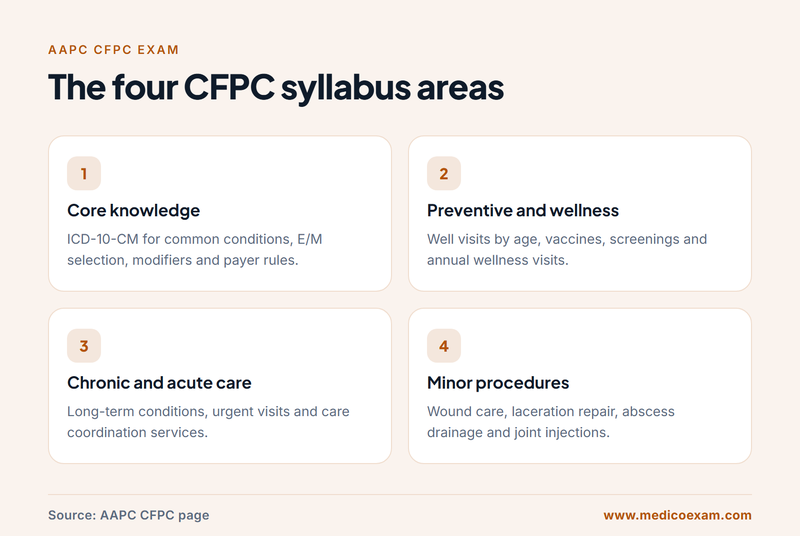
Notice what the list is built from. Each area mixes diagnosis coding, service selection and rules. A question about a diabetes follow-up may test the diagnosis code, the visit level and the payer rule in one scenario. Study the areas as clusters of decisions, not as isolated code ranges, and you will recognize the question shapes faster. For the topic list in table form, open the CFPC syllabus overview.
What does a family practice coding scenario look like on the exam?
The exam is about applying codes to documentation, so expect short descriptions of a visit followed by a question about what should be reported. This section describes the shape of that task without quoting any real question, because the exam content is not published and no honest article can reproduce it.
A typical scenario gives you a setting, a patient group, the services that were provided and one wrinkle. The wrinkle is where the marks are. It may be a second service on the same day that raises a modifier question, a preventive visit during which a separate problem was addressed, a vaccine given with counseling, or a minor procedure that a payer may bundle into the visit. Your task is to find the wrinkle first and the code second.
Work the reasoning in a fixed order. First decide what kind of encounter it was: preventive, problem-oriented, urgent, chronic care management or procedural. Second, decide which services are reportable on their own. Third, check whether a modifier or payer rule changes how they combine. Fourth, pick the diagnosis codes that support each service. Coders who skip the first step often choose a correct code for the wrong kind of encounter.
For visit level, note that AAPC now lets the complexity of the physician's decision making, or the time spent that day, determine the level. A thorough history and examination no longer earn a higher level by themselves. If your habits date from the older rules, deliberately unlearn them before you start timed practice.
Where do family practice coders lose marks?
No score breakdown is published, so these are the slips worth guarding against based on how the four areas are built, not claims about what candidates actually miss. Treat them as a self-audit.
Treating a bundle as a list. Primary care visits often include more than one service. Candidates who list every service they see, rather than asking which are separately reportable, drift into wrong answers on modifier and bundling questions. AAPC specifically names modifiers and bundling rules in its description of what the CFPC proves.
Mixing up the age groups. The preventive area spans pediatric, adolescent, adult and geriatric patients. A habit built entirely on adult medicine will slow you down on a child's well visit, and the reverse is just as true. Practice one age group at a time, then mix them.
Ignoring the payer layer. The syllabus names payer-specific rules and compliance regulations, which means the correct answer can depend on who is paying. If you only ever code for one payer, read the guidance for the others before you sit.
Forgetting the coordination services. Care coordination, transitional care management and chronic care management are easy to push aside because they are not visits in the usual sense. They are named in the syllabus, so give each one a study session.
Running out of care, not time. With about 144 seconds per question, time is rarely the problem on a single item. The risk is rushing the early questions and reading the later ones slowly out of fatigue. Practice full sittings so that your attention holds for the last stretch.
Assuming the chart tells you everything. Real documentation is messy, and exam scenarios compress it into a few lines. If a detail you would normally confirm with a provider is missing, the question usually expects you to answer from what is stated. Practice choosing the best-supported answer from the facts given, not the answer you would reach after a query.
A short habit helps against all of these slips: after every practice set, pick the single question you were most sure about and got wrong. Overconfident errors point to a rule you have misunderstood, and they are worth more study time than the questions you guessed and missed.
How should you prepare for the CFPC, step by step?
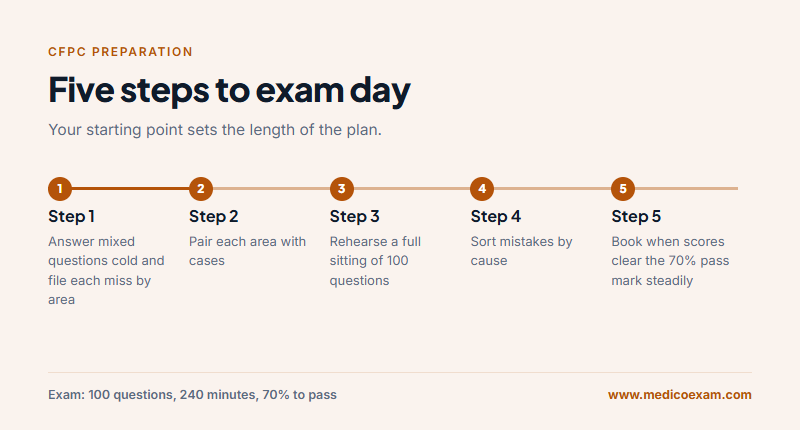
A good plan has five parts, and none of them needs a fixed number of weeks. Your own starting point decides the length, and a plan that ignores it is a guess.
Find your starting point. Answer a mixed set of questions cold, without references, and label each miss with the syllabus area it belongs to. The goal is a map, not a score. Two or three areas will usually stand out as thin.
Pair each area with cases. For each syllabus area, read the relevant guidelines and then work cases from that area straight away. Reading without applying leaves you with recognition, and the exam asks for recall under a time limit.
Rehearse the whole sitting. Do at least one full run of 100 questions in 240 minutes without breaks that the real exam would not give you. Note where your concentration drops and which question types you hurry.
Sort mistakes by cause. For every wrong answer, write down why: you misread the stem, you did not know the rule, or you followed an office habit that the guidelines do not support. Each cause needs a different fix, and the third is the hardest to see without a written note.
Book when results are steady. Schedule once your scores sit comfortably above the 70% pass mark across several different sets, not after one good day. Because the pass mark applies to the whole exam, a margin on your weakest area matters more than a perfect score on your strongest.
If you want structured teaching rather than self-study, AAPC sells a self-paced online course; see the CFPC exam preparation course on AAPC's site. If you prefer to practice with scenario-based questions, MedicoExam's practice exam for this credential is a separate resource and is not an AAPC product.
Build your study calendar around your working week rather than against it. Coders who sit this exam usually hold a full-time job, so short, regular sessions on one area at a time tend to hold up better than rare marathon days. Keep one session a week for mixed questions, so that you keep switching between visit types the way the exam makes you.
Keep a single reference sheet of the rules you keep forgetting, written in your own words. Reviewing that sheet before each practice set costs only minutes, and the act of writing the rule down makes it easier to recall under the clock. Retire items from the sheet only when you have answered several questions on them correctly without looking.
How do you keep the CFPC credential active?
The credential is not permanent. AAPC's CFPC page sets two continuing duties: stay an AAPC member each year, and log 36 CEUs in every two-year period, with 8 of that total tied specifically to family practice. Confirm both figures on that page before planning your learning, because requirements can change.
Treat renewal as part of the decision to sit the exam. A credential with an ongoing requirement costs time and money after the exam, and the specialty units push you to keep learning about primary care. If your employer pays for membership or training, ask about it before you book, so that you know who is responsible when the two-year cycle ends.
Is there a practice test for the CFPC, and what should it do for you?
AAPC's CFPC page offers the exam voucher and the training course, and it does not present a question bank of its own. That is why many candidates look elsewhere for timed practice. MedicoExam offers a practice exam for the CFPC with a free demo, and you can open the free demo on the product page to try the interface before you decide. It is an independent resource, not an AAPC product, and it does not contain real exam questions.
Whatever you use, judge a practice test by three things. It should present scenarios rather than bare code lookups, because the exam asks you to apply codes to documentation. It should explain why each wrong answer is wrong, because the explanation is where the learning happens. And it should be timed, so that you build the pacing the 240-minute limit demands. A set that fails any of the three will make you feel ready without making you ready.
Use practice results the way you used your starting-point map. Track scores by syllabus area, and let the weakest area decide the next study session. A score that creeps up overall while one area stays flat is a warning, not a success.
A readiness checklist before you book the CFPC
Answer these honestly, and book only when most of them are a clear yes.
Can you separate a preventive visit from a problem-oriented visit, and decide when both are reportable on the same day? Can you explain how modifiers change the way two services combine? Can you code a long-term condition follow-up and the care coordination around it without a reference? Do you know the immunization administration rules, including combination vaccines and counseling? Can you handle a minor in-office procedure and decide whether it stands apart from the visit? Have you finished at least one full-length timed set and stayed focused to the end?
If several answers are no, you have learned something cheaply. Go back to the area that matched, work cases there, and test again. If most answers are yes and your practice scores clear the pass mark in more than one set, you are ready to buy the voucher from AAPC and choose a date.
The CFPC is a specialty credential that rewards breadth within primary care. Prepare for the whole span of visit types, keep your habits current with the guidelines, and let your own practice data, not your confidence, tell you when to sit.
Frequently Asked Questions
How many questions does the CFPC exam have?
Candidates answer 100 questions inside 240 minutes, which works out to roughly 144 seconds each. Expect brief family practice scenarios in which you choose a code, weigh a modifier or decide how several services fit together. Reading carefully counts for more than working fast.
What score do I need to pass the CFPC exam?
The pass mark is 70%, so you need 70 correct answers out of the 100. The pages we reviewed publish no separate pass mark for any single syllabus area. Study all four areas so that one weak area does not pull down your overall result.
How much does the CFPC exam cost?
As of November 2026, AAPC shows the exam starting at $325, and MedicoExam's records list $325 for one attempt and $399 for two. AAPC's online course starts at $660. Fees change, so confirm the current voucher price on AAPC's CFPC page before buying.
What does the CFPC exam cover?
AAPC groups the content into core knowledge, preventive and wellness, chronic and acute care, and minor in-office procedures. Across them you apply diagnosis, procedure and supply codes for patients of every age in family practice and similar primary care settings.
How do I keep the CFPC credential after passing?
AAPC requires continuing membership plus 36 CEUs per two-year period, and 8 of those must relate to family practice. Look at AAPC's CFPC page for the rules in force when you renew, since they can change.
Can I take the CFPC exam from home?
Yes, AAPC offers a remote option in which a live proctor watches you online, alongside in-person testing centers. Open slots appear only after you buy a voucher from AAPC, so the decision between the two comes at checkout.
- AAPC CFPC Question Bank |
- AAPC CFPC Eligibility & Requirements |
- AAPC Family Practice Coder Practice Test |
- AAPC CFPC Exam Cost |
- AAPC CFPC Registration Process |
- AAPC Family Practice Coder Study Guide |
- AAPC CFPC Recertification |
- AAPC CFPC Certification Overview |
- AAPC Family Practice Coder Syllabus |
- AAPC CFPC Preparation Time |
- AAPC CFPC Passing Score |
- AAPC CFPC Exam Format |
- AAPC CFPC Certification Practice Exam


