CDIP Certification Guide: AHIMA CDIP Exam, Career Value, and Preparation Roadmap
 A stronger clinical record can change the way a patient story is understood, coded, measured, reimbursed, and improved. That is the real power behind the CDIP credential. For healthcare professionals who already understand documentation, coding, compliance, clinical terminology, or patient care workflows, the AHIMA Certified Documentation Integrity Practitioner certification can become a meaningful career step.
CDIP stands for Certified Documentation Integrity Practitioner, a professional credential offered by AHIMA for individuals who work with clinical documentation integrity, coding accuracy, provider communication, compliance, and health record quality. The AHIMA CDIP exam evaluates whether candidates can apply CDI knowledge in real healthcare scenarios, not simply memorize definitions.
For nurses, HIM professionals, coders, documentation specialists, revenue cycle professionals, medical educators, and allied health students, CDIP preparation can feel intense at first. The exam connects clinical reasoning, coding rules, provider queries, metrics, leadership, and compliance. But with a structured plan, domain-based study, and realistic practice, the AHIMA CDIP exam becomes manageable.
This guide explains the CDIP certification, exam structure, content domains, career value, study strategy, common mistakes, and preparation steps in a practical, professional way.
What Is CDIP?
CDIP is AHIMA’s Certified Documentation Integrity Practitioner credential for healthcare professionals involved in improving the accuracy, completeness, and compliance of clinical documentation. It validates knowledge in clinical coding practice, documentation review, provider clarification, CDI metrics, leadership, and compliance.
The CDIP credential is designed for professionals who help ensure that the health record accurately reflects patient severity, quality indicators, diagnoses, procedures, and clinical care. In practical terms, CDIP professionals often serve as a bridge between providers, coders, compliance teams, quality departments, and revenue cycle operations.
According to AHIMA’s official certification information, CDIP holders are recognized for clinical and coding competency, leadership skills, and commitment to documentation excellence. The credential may be relevant for health information professionals, nurses, physicians, coders, CDI specialists, and others working in documentation-focused roles.
In a hospital setting, a CDIP professional may review a patient record and identify whether a diagnosis is clearly supported, whether the principal diagnosis is correctly reflected, or whether a provider query is needed. In an outpatient or health system environment, CDI expertise may support coding quality, compliance audits, physician education, or documentation improvement initiatives.
AHIMA CDIP Exam Details
The AHIMA CDIP exam includes 140 total questions, of which 106 are scored and 34 are pretest items. Candidates receive three hours to complete the exam, and the passing score is 300. The exam is computer-based and may be available through approved testing options depending on candidate location and AHIMA policy.
The AHIMA CDIP exam is not just a terminology test. It measures whether you can apply CDI principles in realistic situations. Candidates should expect questions that require judgment around coding guidelines, documentation gaps, compliant queries, physician communication, metrics interpretation, and operational CDI processes.
Key exam facts include:
| Credential | Certified Documentation Integrity Practitioner |
|---|---|
| Certifying body | AHIMA |
| Exam name | AHIMA Certified Documentation Integrity Practitioner |
| Total questions | 140 |
| Scored questions | 106 |
| Pretest questions | 34 |
| Time allowed | Three hours |
| Passing score | 300 |
| Primary exam focus | Clinical documentation integrity |
| Major content areas | Five domains |
| Retake rule | Candidates typically must submit a new application and observe AHIMA’s stated waiting period before retesting |
Because policies may change, candidates should always confirm current eligibility, scheduling, pricing, testing, refund, and retake details on the official AHIMA CDIP certification page before applying.
For a structured overview of exam objectives, candidates can review the AHIMA CDIP syllabus breakdown alongside the official AHIMA content outline. This helps convert broad domains into a practical study checklist.
Who Should Pursue the CDIP Certification?
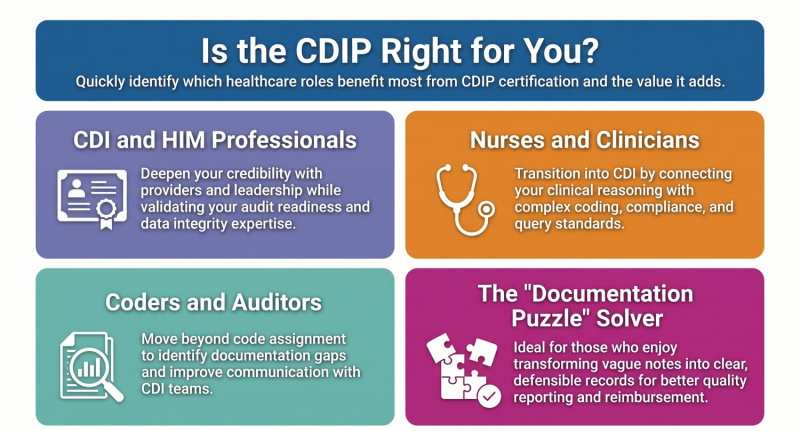
CDIP is suitable for healthcare professionals who want to demonstrate expertise in clinical documentation integrity, coding-related documentation quality, compliant query practices, CDI metrics, and healthcare record accuracy. It is especially useful for professionals who work at the intersection of clinical care, coding, compliance, and reimbursement.
The credential may be valuable for:
-
Clinical Documentation Integrity specialists
CDI professionals can use CDIP to validate their experience and deepen their credibility with providers, coding teams, and leadership. -
Health Information Management professionals
HIM professionals who manage coding quality, data integrity, audit readiness, or documentation improvement can benefit from CDIP preparation. -
Nurses and clinicians transitioning into CDI
Nurses often bring strong clinical reasoning, but CDIP preparation helps connect that clinical knowledge with coding, compliance, and query standards. -
Medical coders and coding auditors
Coders who understand documentation gaps can better communicate with CDI teams and support accurate code assignment. -
Allied health and healthcare students
Students planning careers in HIM, CDI, coding, or healthcare compliance can use CDIP knowledge to understand how documentation affects care quality and data reporting. -
Healthcare educators and trainers
Instructors who teach coding, documentation, compliance, or revenue cycle topics can use CDIP concepts to design applied, workplace-relevant learning. -
Career changers entering healthcare operations
Professionals with backgrounds in healthcare administration, quality, or data analytics may find CDI a meaningful path if they are willing to build clinical and coding knowledge.
The CDIP journey is especially rewarding for people who enjoy solving documentation puzzles. A vague note, unclear diagnosis, missing acuity, or unsupported complication can affect coding, quality reporting, reimbursement, and compliance. CDIP professionals help make the record clearer, more complete, and more defensible.
CDIP Eligibility and Recommended Background
AHIMA lists eligibility pathways for CDIP candidates, including holding an associate degree or higher, completing certain approved HIM certificate academic requirements, or holding qualifying AHIMA credentials such as CCS, CCS-P, RHIT, or RHIA. AHIMA also recommends, though may not require, CDI experience and coursework in medical terminology, anatomy and physiology, pathology, and pharmacology.
This matters because the AHIMA CDIP exam assumes candidates can interpret clinical documentation and connect it with coding and compliance rules. A candidate with strong clinical experience but limited coding exposure may need extra time with ICD-10-CM/PCS guidelines. A coder with limited patient care background may need more review of disease processes, clinical indicators, and documentation nuance.
A realistic self-assessment should ask:
-
Can I identify principal and secondary diagnoses from documentation?
-
Do I understand how DRGs relate to inpatient coding and reimbursement?
-
Can I recognize when documentation supports a compliant provider query?
-
Do I understand how CDI metrics are used in department performance?
-
Can I explain documentation issues to physicians without leading them?
-
Do I know how compliance affects query wording, retention, and workflow?
If the answer is “not yet,” that is not a failure. It simply shows where your study plan should begin.
Key Content Domains and Topics
The CDIP exam is organized around five official domains. Each domain represents a percentage range of exam content. Candidates should use these domains as the backbone of their preparation plan.
Domain 1: Clinical Coding Practice
Clinical Coding Practice covers approximately 15–18% of the exam. This domain focuses on code assignment resources, diagnosis and procedure sequencing, coding conventions, guidelines, DRG understanding, and collaboration with coding or HIM staff.
This domain tests whether candidates understand the coding impact of documentation. You may need to recognize whether documentation supports a principal diagnosis, whether a secondary diagnosis affects severity, or whether discrepancy resolution is needed between working and final DRGs.
Study priorities include:
-
ICD-10-CM diagnosis coding concepts
-
ICD-10-PCS procedure coding awareness
-
Principal diagnosis selection
-
Secondary diagnosis reporting
-
Coding conventions and official guidelines
-
Working DRG versus final DRG differences
-
Communication with coding and HIM teams
For reference-grade coding support, candidates can consult the CDC’s ICD-10-CM resources, CMS ICD-10 resources, and WHO classification information. These are useful for understanding how diagnostic classification supports healthcare data, reporting, and standardization.
Real-world example: A patient is admitted with sepsis, acute kidney injury, and pneumonia. The documentation must clearly support diagnosis sequencing, clinical indicators, and any complications or comorbidities. A CDIP professional should understand when clarification is appropriate and when the existing record already supports coding.
Domain 2: Education and Leadership Development
Education and Leadership Development covers approximately 21–26% of the exam. This domain evaluates the candidate’s ability to promote CDI efforts, build relationships, support multidisciplinary collaboration, develop policies, and educate providers and staff.
This is where many technically strong candidates underestimate the exam. CDI is not only about finding documentation gaps. It is also about influencing behavior, building trust, explaining documentation impact, and creating sustainable processes.
Study priorities include:
-
CDI program promotion
-
Provider education strategies
-
Physician champion collaboration
-
CDI policies and procedures
-
Query escalation processes
-
Multidisciplinary teamwork
-
Documentation improvement projects
-
Communication with administration and clinical leaders
A strong CDIP candidate understands that provider education cannot feel punitive. Physicians and clinicians are more likely to respond when education is specific, respectful, clinically relevant, and tied to patient story accuracy.
Common mistake: Studying only coding rules and ignoring leadership scenarios. The CDIP exam may ask about workflow, education, collaboration, and policy decisions. Prepare for “best next step” questions, not just definition-based items.
Domain 3: Record Review and Document Clarification
Record Review and Document Clarification is the largest domain, covering approximately 27–33% of the exam. This domain focuses on reviewing health records, identifying documentation gaps, prioritizing cases, developing compliant queries, and ensuring provider responses are documented.
This is the operational heart of CDI work. Candidates must know how to evaluate whether documentation is complete, consistent, clinically supported, and clear enough for accurate coding and reporting.
Study priorities include:
-
Clinical documentation review
-
Case prioritization
-
Documentation gaps affecting quality, coding, or reimbursement
-
Query development
-
Provider response follow-up
-
Clinical validation opportunities
-
Present on Admission indicators
-
Acuteness, chronicity, complications, and specificity
-
Post-discharge query opportunities
A strong record review process does not simply ask, “Can we code more?” It asks, “Does the record accurately reflect the patient’s condition and care?” That distinction matters for compliance and professional integrity.
For candidates who want to test their readiness with realistic question patterns, CDIP-style sample questions can help identify whether they can apply concepts under exam conditions.
Domain 4: CDI Metrics and Statistics
CDI Metrics and Statistics covers approximately 8–11% of the exam. Although it is the smallest domain, it is still important because CDI departments rely on data to evaluate performance, provider engagement, workflow, and program impact.
This domain tests whether candidates can interpret CDI dashboards, monitor departmental performance, evaluate audits, track query trends, compare benchmarks, and use metrics to improve workflow.
Study priorities include:
-
CDI dashboard metrics
-
Query response rate
-
Query agreement rate
-
Review rate
-
Case mix index awareness
-
Provider benchmarking
-
Quality audits
-
Internal and external benchmarking
-
Workflow adjustment based on data
Real-world example: If a CDI team has a high query volume but low provider agreement, the issue may not be productivity. It may be query quality, provider education, clinical support, or unclear escalation processes. A CDIP-level thinker looks beyond the number and asks what the metric means operationally.
Domain 5: Compliance
Compliance covers approximately 18–23% of the exam. This domain evaluates knowledge of ethical CDI practice, regulatory awareness, compliant queries, clinical validation, technology-related risks, second-level reviews, and query retention policies.
Compliance is where professional judgment becomes essential. A CDI query must be clear and clinically supported without being leading. Documentation practices must align with organizational policy and applicable standards. Technology tools, including electronic health records and computer-assisted coding, can improve workflow but also introduce risk if used without oversight.
Study priorities include:
-
Ethical CDI practices
-
AHIMA guidance and industry standards
-
Regulatory awareness
-
Non-compliant query recognition
-
Clinical validation queries
-
Second-level review
-
Query retention and workflow policies
-
EHR, NLP, and computer-assisted coding risks
-
Privacy and security considerations
For broader compliance context, candidates may refer to the HHS Office for Civil Rights HIPAA resources and AHRQ patient safety materials. These sources help candidates understand how documentation connects to privacy, quality, safety, and trustworthy healthcare operations.
How to Prepare for the AHIMA CDIP Exam
A successful CDIP study plan should be domain-based, practice-driven, and connected to real documentation scenarios. The goal is not to memorize every term. The goal is to think like a documentation integrity professional.
Use this six-step preparation roadmap:
-
Start with the official AHIMA content outline
Download or review the official content outline and convert each domain into a checklist. Mark each topic as strong, moderate, or weak. This prevents overstudying familiar areas while ignoring difficult ones. -
Build a baseline with sample questions
Before deep study, attempt a small set of practice questions. Your score is less important than your error pattern. Are you missing coding concepts, query compliance, metrics, or leadership scenarios? -
Study one domain at a time
Do not jump randomly between topics. Spend focused time on each domain. For example, dedicate one week to clinical coding practice, then one week to record review and query development. -
Connect every topic to a real chart scenario
When studying sepsis, malnutrition, respiratory failure, acute kidney injury, or complications, ask how the condition appears in documentation, what clinical indicators support it, and when clarification may be appropriate. -
Practice decision-making questions
The AHIMA CDIP exam often requires choosing the best answer, not just a correct-sounding answer. Practice eliminating options that are leading, non-compliant, too narrow, or operationally unrealistic. -
Simulate exam timing
With 140 questions in three hours, pacing matters. Build stamina with timed practice sessions. Review rationales carefully and rewrite missed concepts in your own words.
Candidates who want a more organized practice path can use the CDIP certification practice exam resource to reinforce domain knowledge, improve pacing, and become more comfortable with scenario-based questions before the actual test.
Suggested 8-Week CDIP Study Plan
An eight-week plan works well for many working professionals, although preparation time depends on experience. Candidates new to CDI or coding may need longer.
| Week | Focus | Activities |
|---|---|---|
| Week 1 | Orientation and baseline | Review AHIMA eligibility and exam rules; Read the content outline; Take a short diagnostic practice set; Create a domain tracker |
| Week 2 | Clinical coding practice | Review diagnosis selection; Study principal and secondary diagnosis logic; Revisit ICD-10-CM/PCS guideline concepts; Practice DRG-related scenarios |
| Week 3 | Record review basics | Study documentation gap identification; Practice case prioritization; Review common CDI conditions; Learn how documentation affects quality and coding |
| Week 4 | Query development | Study compliant query structure; Compare leading versus non-leading wording; Practice provider clarification scenarios; Review post-discharge query concepts |
| Week 5 | Education and leadership | Study CDI program communication; Review provider education strategies; Learn escalation and chain-of-command principles; Practice leadership-based questions |
| Week 6 | Metrics and statistics | Learn dashboard terms; Interpret query and review metrics; Study benchmarking and trends; Practice data-based decision questions |
| Week 7 | Compliance | Review ethical CDI practice; Study clinical validation; Review technology and EHR risks; Practice compliance scenarios |
| Week 8 | Final review | Complete timed practice sets; Review weak domains; Revisit official outline; Prepare test-day pacing and confidence strategy |
The emotional challenge is real. Many candidates study after long shifts, family responsibilities, or demanding clinical workloads. The best plan is not the most aggressive one. It is the one you can follow consistently.
Common CDIP Preparation Mistakes
Many candidates are capable of passing the CDIP exam but lose points because their preparation is unbalanced. Avoid these common mistakes:
-
Memorizing without applying
CDI is practical. If you cannot apply a rule to a chart scenario, you may struggle with exam questions. -
Ignoring the leadership domain
Education, collaboration, and policy development represent a significant part of the exam. Do not treat them as soft topics. -
Studying coding but not compliance
A query can be clinically reasonable but non-compliant if worded poorly. Learn the difference. -
Avoiding metrics
CDI metrics may seem less exciting than clinical review, but they are essential for program performance and exam readiness. -
Practicing too late
Waiting until the final week to use practice questions is risky. Practice should guide your study from the beginning. -
Not reviewing rationales
The explanation behind a question is often more valuable than the score. Review why the correct option is best and why the other options are weaker. -
Depending only on workplace habits
Local workflow may differ from exam expectations. Always align preparation with AHIMA’s content outline and recognized CDI principles.
Career Value of CDIP
The CDIP credential can strengthen career credibility for professionals working in clinical documentation, coding quality, HIM, compliance, revenue cycle, auditing, physician education, and healthcare operations. It signals that the professional understands both clinical documentation and its downstream impact.
Career value may include:
-
Stronger CDI role eligibility
-
Improved credibility with providers and coding teams
-
Better preparation for CDI leadership responsibilities
-
Enhanced understanding of compliance and documentation risk
-
Greater confidence in audits, education, and workflow discussions
-
A clearer path for nurses, coders, and HIM professionals moving into CDI
The credential does not guarantee a job or promotion. No certification can do that. However, CDIP can help demonstrate commitment, structured knowledge, and professional readiness in a field where accurate documentation affects quality reporting, reimbursement, patient safety data, and organizational integrity.
For global candidates, the exact job title may vary by country or healthcare system. Some organizations may use terms such as clinical documentation specialist, CDI specialist, documentation improvement analyst, coding quality specialist, utilization review documentation specialist, or HIM quality professional. The underlying skill set remains valuable wherever accurate health records matter.
FAQs
Q1. What is CDIP certification?
CDIP certification is AHIMA’s Certified Documentation Integrity Practitioner credential. It validates knowledge in clinical documentation integrity, coding-related documentation quality, provider queries, CDI metrics, leadership, and compliance. It is commonly pursued by CDI specialists, HIM professionals, nurses, coders, auditors, educators, and healthcare professionals who work with health record accuracy.
Q2. Is the AHIMA CDIP exam difficult?
The AHIMA CDIP exam can be challenging because it tests applied judgment, not simple memorization. Candidates must understand coding concepts, clinical documentation gaps, compliant queries, metrics, and CDI operations. The exam is more manageable when preparation follows the official content domains and includes regular practice with scenario-based questions.
Q3. How long should I study for the CDIP exam?
Many candidates prepare for about six to twelve weeks, depending on their CDI, coding, nursing, or HIM background. Experienced CDI professionals may need less time, while career changers may need longer. A practical plan should include domain review, coding guideline refreshers, query practice, metrics review, and timed question sets.
Q4. What is the format of the AHIMA CDIP exam?
The AHIMA CDIP exam includes 140 total questions, with 106 scored questions and 34 pretest questions. Candidates have three hours to complete the exam. The passing score is 300. Candidates should always verify current format, scheduling, and testing policies through AHIMA before registering.
Q5. What topics are covered on the CDIP exam?
The CDIP exam covers five domains: Clinical Coding Practice, Education and Leadership Development, Record Review and Document Clarification, CDI Metrics and Statistics, and Compliance. The largest area is Record Review and Document Clarification, so candidates should spend significant time practicing chart review and compliant query scenarios.
Q6. What happens if I fail the CDIP exam?
If a candidate does not pass, AHIMA typically requires a new application and exam fee before retesting. CDIP candidates must also observe AHIMA’s stated waiting period before a retake can be scheduled. Because policies can change, candidates should confirm the current retake process directly with AHIMA.
Q7. Are CDIP practice tests useful?
Yes, CDIP practice tests are useful when they include scenario-based questions and clear rationales. They help candidates identify weak domains, improve pacing, and learn how exam questions are structured. Practice tests should support official content outline study rather than replace it.
Q8. Can nurses take the CDIP exam?
Nurses may pursue CDIP if they meet AHIMA’s eligibility requirements. Nursing experience can be especially helpful because CDI work often requires clinical reasoning, disease process knowledge, and provider communication. However, nurses should also study coding concepts, DRG impact, query compliance, and CDI metrics before attempting the exam.
Q9. Is CDIP valuable for medical coders?
CDIP can be valuable for coders who want to move into CDI, auditing, documentation quality, or coding leadership roles. Coders often understand guidelines and sequencing, but CDIP preparation expands their knowledge of provider queries, clinical validation, documentation improvement, and CDI program operations.
Q10. Does CDIP certification expire?
CDIP certification must be maintained through AHIMA’s recertification process. Requirements typically include continuing education and applicable fees within a defined certification cycle. Candidates and credential holders should check AHIMA’s current recertification guidance because maintenance rules, CEU requirements, and timelines may vary over time.
Conclusion
CDIP is more than another set of letters after your name. It represents the ability to protect the integrity of the patient story, support accurate coding, strengthen compliance, improve provider communication, and contribute to better healthcare data.
The AHIMA CDIP exam rewards candidates who can think across disciplines. You need clinical awareness, coding knowledge, documentation review skill, ethical judgment, and operational understanding. That may sound demanding, but it is also what makes the credential meaningful.
Start with the official AHIMA content outline. Study each domain with intention. Practice realistic questions early. Review your mistakes without discouragement. Build confidence one scenario at a time.
For healthcare professionals who want to grow in CDI, HIM, coding quality, compliance, or documentation leadership, CDIP can be a powerful step toward a more specialized and respected career path.
- AHIMA CDIP Question Bank |
- AHIMA CDIP Eligibility & Requirements |
- AHIMA Documentation Integrity Practitioner Practice Test |
- AHIMA CDIP Exam Cost |
- AHIMA CDIP Registration Process |
- AHIMA Documentation Integrity Practitioner Study Guide |
- AHIMA CDIP Recertification |
- AHIMA CDIP Certification Overview |
- AHIMA Documentation Integrity Practitioner Syllabus |
- AHIMA CDIP Preparation Time |
- AHIMA CDIP Passing Score |
- AHIMA CDIP Exam Format |
- AHIMA Documentation Integrity Practitioner Sample Questions |
- AHIMA CDIP Career Opportunities |
- AHIMA CDIP Exam Difficulty


