Complete CCMA Study Guide & Practice Test Strategy
 Preparing for the CCMA exam is not just about memorizing facts—it is about proving that you are ready to function confidently in real clinical environments. Every year, thousands of aspiring medical assistants face anxiety, time pressure, and self-doubt while preparing for the NHA Certified Clinical Medical Assistant exam. With the right structure, mindset, and study strategy, this challenge becomes manageable and rewarding.
This guide is written from the perspective of an experienced healthcare professional who understands the realities of patient care, certification pressure, and career growth. It will walk you through everything you need to know from exam format and content domains to proven practice test strategies and career outcomes.
What Is the NHA CCMA Certification?
The CCMA certification is a nationally recognized credential awarded by the National Healthcareer Association (NHA) to medical assistants who demonstrate competency in clinical, administrative, and patient care skills. It validates professional readiness for entry-level and mid-level healthcare roles
The NHA Certified Clinical Medical Assistant (CCMA) credential confirms that you can safely perform both front-office and clinical tasks in medical facilities. According to the official NHA website, this certification is accepted by hospitals, clinics, and outpatient centers worldwide.
The CCMA is especially valuable for:
-
Entry-level medical assistants
-
Nursing and allied health students
-
Career changers entering healthcare
-
Clinical support professionals
CCMA Exam Format, Cost, and Passing Requirements
The NHA CCMA exam is a computer-based multiple-choice test with approximately 180 questions, lasts about three hours, and requires a minimum score of 390 out of 500 to pass.
|
Category
|
Details
|
|---|---|
|
Exam Fee
|
$160 – $165 USD per attempt
|
|
Total Questions
|
~180 (150 scored + 30 unscored)
|
|
Duration
|
Approximately 3 hours
|
|
Passing Score
|
390 out of 500
|
|
Format
|
Multiple-choice, computer-based exam
|
The exam is administered through authorized testing centers and online proctoring platforms, as outlined on Certified Clinical Medical Assistant certification.
Ccma Certification Cost
The typical ccma certification cost includes:
-
Registration fee
-
Practice materials (optional)
-
Retake fees (if applicable)
-
Study resources
Students should budget approximately $250–$400 including preparation resources.
CCMA Exam Content Domains Explained
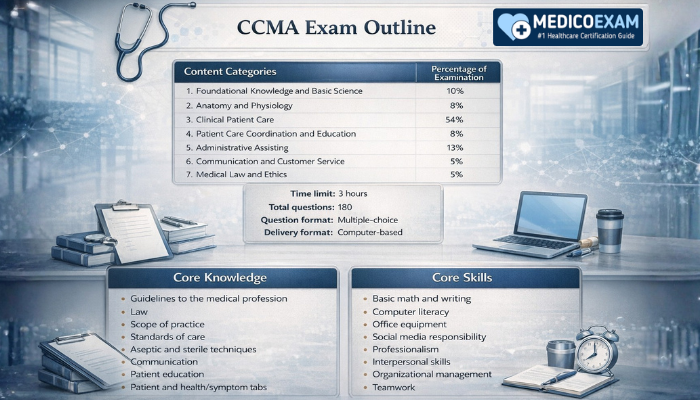
The CCMA exam evaluates candidates across six major domains covering medical knowledge, clinical procedures, administration, ethics, and patient communication.
1. Foundational Knowledge & Basic Science
This section tests your understanding of:
-
Medical terminology
-
Infection control principles
-
Pharmacology basics
-
Pathophysiology
-
Human biology
You must recognize how diseases affect body systems and how medications interact with physiology.
2. Anatomy and Physiology
Expect questions related to:
-
Cardiovascular system
-
Respiratory system
-
Digestive system
-
Musculoskeletal system
-
Nervous system
Focus on functional relationships rather than rote memorization.
3. Clinical Patient Care
This is the highest-weighted domain.
Includes:
-
Measuring vital signs
-
Phlebotomy techniques
-
EKG placement
-
Specimen collection
-
Wound care
-
Assisting with procedures
Practical understanding is critical here.
4. Patient Care Coordination and Education
You will be tested on:
-
Patient instructions
-
Care plans
-
Health education
-
Cultural sensitivity
-
Documentation
Communication accuracy is essential for safety.
5. Administrative Assisting
Covers:
-
Appointment scheduling
-
Medical billing basics
-
Insurance processing
-
Electronic Health Records (EHR)
-
Medical coding fundamentals
Administrative efficiency directly impacts patient experience.
6. Medical Law, Ethics, and Professionalism
Includes:
-
HIPAA compliance
-
Informed consent
-
Scope of practice
-
Documentation standards
-
Ethical dilemmas
Refer to guidelines from trusted sources like the U.S. Department of Health & Human Services.
From clinical experience, most candidates struggle with:
-
Scenario-based questions
-
Multi-step procedures
-
Ethical decision-making
-
Time management
Success depends on realistic practice and structured revision.
Step-by-Step CCMA Study Plan (8–10 Weeks)
An effective CCMA study plan combines weekly content review, clinical skill practice, and regular full-length practice exams.
1–2 Weeks : Foundation Building
-
Review anatomy and terminology
-
Learn medical abbreviations
-
Study infection control
-
Begin light practice questions
3–4 Weeks : Clinical Focus
-
Master vital signs
-
Practice phlebotomy theory
-
Study EKG basics
-
Review specimen handling
5–6 Weeks : Administration and Ethics
-
Study HIPAA regulations
-
Learn insurance processing
-
Practice documentation
-
Review professionalism standards
7–8 Weeks : Assessment Phase
-
Take full-length mock exams
-
Analyze weak areas
-
Revise clinical protocols
-
Improve time management
Optional 9–10 Weeks : Final Polishing
-
Focus on high-error topics
-
Revise flashcards
-
Practice recall drills
Using Practice Tests the Right Way
CCMA certification practice tests help candidates identify knowledge gaps, improve timing, and build exam confidence when used systematically.
Random testing does not produce results. Strategic testing does.
Effective Practice Strategy
-
Take diagnostic test first
-
Identify weak domains
-
Study targeted content
-
Retest after revision
-
Simulate exam conditions
High-quality mock exams available at MedicoExam allow candidates to experience realistic exam pressure and detailed performance analysis.
Why Practice Exams Matter
-
Improve accuracy
-
Reduce anxiety
-
Train stamina
-
Enhance recall
-
Develop pacing skills
Common Mistakes CCMA Candidates Make
Most CCMA exam failures result from inconsistent practice, poor time management, and weak clinical scenario interpretation.
Frequent Errors
-
Memorizing without understanding
-
Ignoring administrative topics
-
Skipping ethics revision
-
Avoiding full-length tests
-
Overstudying before exam day
In clinical settings, judgment matters more than memorization. Exams reflect this reality.
CCMA Salary and Career Opportunities
CCMA-certified professionals typically earn competitive entry-level to mid-level salaries depending on region, experience, and employer.
Ccma Salary Overview
According to the U.S. Bureau of Labor Statistics:
-
Median salary: $38,000+ annually (US)
-
Entry-level: $30,000+
-
Experienced: $45,000+
Internationally, salaries vary by healthcare system and certification recognition.
Career Roles
-
Clinical Medical Assistant
-
Outpatient Care Technician
-
Phlebotomy Assistant
-
Patient Care Coordinator
-
Clinical Support Specialist
Certification improves employability and promotion opportunities.
Emotional Reality of CCMA Preparation
Preparing for the CCMA exam while managing work, studies, and personal responsibilities is emotionally demanding. Many candidates experience burnout, self-doubt, and fear of failure.
What separates successful candidates is persistence.
Every practice test you complete strengthens your clinical judgment, Every revision session improves patient safety, Every mistake teaches resilience.
This certification is not only about passing an exam it is about becoming a dependable healthcare professional.
Final Preparation Checklist
Before exam day, confirm that you have:
-
Completed at least 5 full mock exams
-
Reviewed all weak domains
-
Practiced timing strategies
-
Prepared identification documents
-
Planned transportation and logistics
Confidence comes from preparation.
Frequently Asked Questions (FAQs)
1. How hard is the CCMA exam for beginners?
-
The CCMA exam is moderately difficult for beginners. It requires understanding clinical procedures, ethics, and administration. With 6–10 weeks of structured study and consistent practice tests, most candidates can prepare effectively and pass on their first attempt.
2. How long should I study for the CCMA exam?
-
Most candidates study for 6 to 12 weeks, depending on background and schedule. Students with clinical training may need less time, while career changers usually benefit from longer preparation focused on anatomy, procedures, and documentation.
3. Can I take the CCMA certification online?
-
The CCMA certification test is offered through approved testing centers and, in some regions, online proctored platforms. Availability varies by location and provider, so candidates should confirm options directly with the NHA.
4. What happens if I fail the CCMA exam?
-
If you fail, NHA typically allows retakes after a waiting period, subject to policies. Additional fees apply. Candidates should review score reports, focus on weak domains, and complete targeted practice exams before reattempting.
5. Are practice tests really useful for CCMA preparation?
-
Yes. High-quality CCMA certification practice tests improve time management, identify knowledge gaps, and build confidence. They are most effective when followed by structured review and targeted content revision.
6. How much does CCMA certification cost in total?
-
The exam fee is usually $160–$165. Additional costs may include study materials, practice exams, and retake fees. Total preparation expenses typically range from $250 to $400.
7. What score do I need to pass the CCMA exam?
-
You must score at least 390 out of 500 to pass. This reflects competency across all major domains rather than perfection in one area.
8. Is CCMA certification worth it for career growth?
-
Yes. CCMA certification improves employability, supports salary growth, and provides access to more clinical responsibilities. Many employers prefer or require nationally certified medical assistants.
9. How many questions are on the CCMA exam?
-
The exam contains approximately 180 questions. About 150 are scored, and 30 are unscored pretest items. All questions are multiple-choice.
10. Do employers verify CCMA certification?
-
Most healthcare employers verify certification through official NHA databases. Certification status may affect hiring, promotion, and compliance requirements.
Conclusion: Your Path to CCMA Success
The CCMA certification represents your commitment to professional excellence, patient safety, and lifelong learning. With structured preparation, reliable practice exams, and disciplined revision, passing the NHA Certified Clinical Medical Assistant exam becomes achievable.
Use authoritative resources, apply practical reasoning, and stay consistent. Certification is not a shortcut—it is proof of your readiness to serve patients with skill and integrity.
Your healthcare journey begins here.


