
Complete NHA Certification Guide: Cost, Format, Domains & Career Paths
 The National Healthcareer Association (NHA) offers eight NCCA-accredited certifications spanning clinical, administrative, and pharmacy careers in allied health. NHA has awarded over 1 million certifications since its founding in 1989 and remains the largest allied health certification agency in the United States. This guide compares every NHA exam — CCMA, CET, CPCT/A, CPT, CBCS, CEHRS, CMAA, and CPhT — across cost, format, domains, eligibility, salary, and career trajectory so you can choose the right credential for your goals.
|
Founded |
1989, headquartered in Leawood, Kansas |
|---|---|
|
Total certifications awarded |
Over 1 million |
|
Number of credentials |
8 NCCA-accredited exams |
|
Accreditation |
National Commission for Certifying Agencies (NCCA) |
|
Testing options |
School-sponsored, PSI testing center, or live remote proctoring |
|
Scoring system |
Scaled 200–500; passing score of 390 on all exams |
|
Renewal cycle |
Every 2 years, 10 CE credits required (free CE courses for current holders) |
What Are the 8 NHA Certifications?
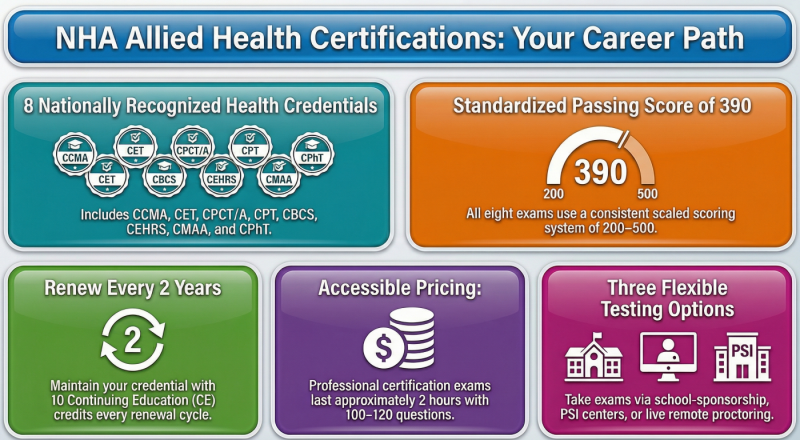 The National Healthcareer Association offers eight nationally recognized certifications that cover the full spectrum of allied health careers — from direct patient care to pharmacy operations to administrative and billing roles. All eight NHA exams are accredited by the National Commission for Certifying Agencies (NCCA), the gold standard for professional certification in the United States. Each credential uses the same scaled scoring system (200–500, with 390 required to pass), the same renewal cycle (every 2 years with 10 CE credits), and the same three testing options: school-sponsored, PSI testing center, or live remote proctoring.
The eight credentials are:
-
CET — Certified EKG Technician
-
CPhT — Certified Pharmacy Technician (via ExCPT exam)
How Do All 8 NHA Exams Compare Side-by-Side?
The master comparison table below shows every NHA certification with its exam cost, question count, time limit, and content domains. Exam fees range from $117 to $155, all exams use multiple-choice format, and time limits run from 110 minutes to 2 hours and 10 minutes.
Master NHA Certification Comparison Table
|
Certification |
Full Name |
Exam Cost |
Total Questions |
Scored Questions |
Time Limit |
Number of Domains |
|---|---|---|---|---|---|---|
|
CCMA |
Certified Clinical Medical Assistant |
$155 |
120 |
100 + 20 pretest |
2 hours |
3 |
|
CET |
Certified EKG Technician |
$129 |
100 |
100 MCQ |
2 hours |
2 |
|
CPCT/A |
Certified Patient Care Technician/Assistant |
$155 |
120 |
100 + 20 pretest |
2 hours |
5 |
|
CPT |
Certified Phlebotomy Technician |
$129 |
120 |
100 + 20 pretest |
2 hours |
5 |
|
CBCS |
Certified Billing & Coding Specialist |
$117 |
110 |
100 + 10 pretest |
110 minutes |
4 |
|
CEHRS |
Certified Electronic Health Records Specialist |
$129 |
100 |
75 + 25 pretest |
125 minutes |
4 |
|
CMAA |
Certified Medical Administrative Assistant |
$117 |
100 |
75 + 25 pretest |
125 minutes |
7 |
|
CPhT |
Certified Pharmacy Technician (ExCPT) |
$125 |
120 |
100 + 20 pretest |
2 hrs 10 min |
5 |
Note: Pretest questions are unscored items used by NHA for future exam development. You will not know which questions are pretest items during the exam.
What Does Each NHA Exam Cover?
Each NHA certification tests a distinct set of competencies. Below is a domain breakdown for all eight exams, organized by career category.
Clinical Certifications
-
CCMA — Certified Clinical Medical Assistant Three domains: Clinical Duties, Administrative Duties, and General knowledge. Covers vital signs, injections, EKG, phlebotomy basics, scheduling, medical records, and EHR documentation. The CCMA is the most versatile NHA clinical credential.
-
CET — Certified EKG Technician Two domains: EKG Monitoring (60%, 60 questions) and Patient Care (40%, 40 questions). Covers 12-lead EKG placement, rhythm interpretation, artifact troubleshooting, patient identification, vital signs, and infection control. See the full CET exam guide.
-
CPCT/A — Certified Patient Care Technician/Assistant Five domains: Patient Care (30%), Infection Control (20%), Safety & Compliance (20%), Phlebotomy (16%), and EKG (14%). A Fall 2026 blueprint update will shift Patient Care to 45–49% and add a new Care Management domain (15–19%). Visit the CPCT/A page for current details.
-
CPT — Certified Phlebotomy Technician Five domains: Safety & Compliance, Patient Preparation, Routine Blood Collection, Special Collections, and Processing. Requires 30 venipunctures and 10 capillary sticks before testing. First-time pass rate: approximately 76% (2024 NHA data). See the CPT exam guide.
Administrative Certifications
-
CBCS — Certified Billing & Coding Specialist Four domains: Billing (32%), Regulatory Compliance (24%), Claims Processing (22%), and Front End Duties (22%). Open-book exam — candidates may bring ICD-10-CM, CPT, and HCPCS coding manuals. Read the CBCS exam guide.
-
CEHRS — Certified Electronic Health Records Specialist Four content areas: EHR software navigation, data entry/management, patient privacy, and regulatory compliance. Valuable as healthcare systems adopt interoperable platforms like Epic and Cerner. Learn more on the CEHRS page.
-
CMAA — Certified Medical Administrative Assistant Seven domains: medical office operations, scheduling, medical records, insurance/billing basics, HIPAA, EHR navigation, and communication. The broadest administrative NHA credential. See the CMAA exam guide.
Pharmacy Certification
-
CPhT — Certified Pharmacy Technician (ExCPT Exam) Five domains: Role & General Duties (15 items), Laws (15 items), Drugs & Drug Therapy (13 items), Dispensing Process (43 items), and Medication Safety & Quality Assurance (14 items). The Dispensing Process domain accounts for 43% of scored questions. Visit the CPhT page.
What Are the Eligibility Requirements for Each NHA Exam?
All NHA certifications require a high school diploma or GED as a baseline. Beyond that, each exam accepts either formal training or supervised work experience. The table below summarizes the eligibility pathways.
|
Certification |
Education Pathway |
Experience Pathway |
Special Requirements |
|---|---|---|---|
|
CCMA |
HS diploma + CMA training program (within 5 yrs) |
HS diploma + 1–2 yrs supervised MA experience |
None |
|
CET |
HS diploma + EKG training program (within 5 yrs) |
HS diploma + 1–2 yrs supervised EKG experience |
None |
|
CPCT/A |
HS diploma + PCT training program (within 5 yrs) |
HS diploma + 1–2 yrs supervised PCT experience |
None |
|
CPT |
HS diploma + phlebotomy training (within 5 yrs) |
HS diploma + 1–2 yrs supervised experience |
30 venipunctures + 10 capillary sticks |
|
CBCS |
HS diploma + billing/coding training (within 5 yrs) |
HS diploma + 1 yr supervised experience |
Open-book exam; bring coding manuals |
|
CEHRS |
HS diploma + EHR training program |
HS diploma + 1–2 yrs supervised EHR experience |
None |
|
CMAA |
NHA-approved MAA training program |
1–2 yrs supervised MAA experience |
None |
|
CPhT |
HS diploma + pharmacy tech training (within 5 yrs) |
HS diploma + 1 yr/1,200 hrs supervised pharmacy work |
None |
How Much Does Each NHA Certification Cost?
NHA exam fees range from $117 to $155 depending on the credential. All certifications share the same renewal structure: a 2-year cycle requiring 10 continuing education credits. NHA provides free CE courses to current certification holders, which significantly reduces long-term maintenance costs.
NHA Certification Cost Summary
|
Certification |
Exam Fee |
Renewal Fee |
Renewal Cycle |
CE Credits Required |
|---|---|---|---|---|
|
CCMA |
$155 |
~$185 |
Every 2 years |
10 |
|
CET |
$129 |
~$185 |
Every 2 years |
10 |
|
CPCT/A |
$155 |
~$185 |
Every 2 years |
10 |
|
CPT |
$129 |
~$185 |
Every 2 years |
10 |
|
CBCS |
$117 |
~$185 |
Every 2 years |
10 |
|
CEHRS |
$129 |
$185 |
Every 2 years |
10 |
|
CMAA |
$117 |
~$185 |
Every 2 years |
10 |
|
CPhT |
$125 |
$55 |
Every 2 years |
20 (incl. 1 hr law, 1 hr patient safety) |
Budget tip: The CBCS and CMAA are the most affordable NHA exams at $117 each. The CPhT (ExCPT) has the lowest renewal fee at $55 but requires 20 CE credits instead of 10. NHA's free CE library for active credential holders can save $200+ per renewal cycle across all certifications.
What Salary Can You Earn with Each NHA Certification?
Salary varies by credential, work setting, geographic location, and experience level. The table below uses Bureau of Labor Statistics (BLS) May 2024 data matched to the closest occupational category for each NHA certification.
NHA Certification Salary Comparison (BLS May 2024)
|
Certification |
BLS Occupational Category |
Median Annual Salary |
Entry-Level (10th %) |
Experienced (90th %) |
|---|---|---|---|---|
|
CCMA |
Medical Assistants |
$44,200 |
$35,020 |
$57,830 |
|
CET |
Cardiovascular Technologists & Technicians |
$67,260 |
$37,890 |
$108,900 |
|
CPCT/A |
Nursing Assistants |
$39,530 |
$30,020 |
$48,780 |
|
CPT |
Phlebotomists |
$43,660 |
$34,860 |
$57,750 |
|
CBCS |
Medical Records Specialists |
$50,250 |
$35,780 |
$80,950 |
|
CEHRS |
Medical Records Specialists |
$50,250 |
$35,780 |
$80,950 |
|
CMAA |
Medical Secretaries & Administrative Assistants |
$43,380 |
$31,900 |
$58,340 |
|
CPhT |
Pharmacy Technicians |
$43,460 |
$35,100 |
$59,450 |
Sources:
Important: The CET salary figure reflects the broader BLS category of cardiovascular technologists and technicians, which includes echocardiography and vascular technology roles that typically require an associate's degree. Entry-level EKG technicians with only NHA CET certification may start closer to $38,000–$46,000, with advancement potential as they gain specialized skills.
Which NHA Certification Is Right for You?
Choosing the right NHA certification depends on your career interests, preferred work environment, and long-term goals. Use this decision guide to narrow your options.
By Interest Area
|
If You Enjoy... |
Consider |
Why |
|---|---|---|
|
Hands-on patient care in clinics |
CCMA |
Most versatile clinical role — combines vitals, injections, EKG, phlebotomy, and admin duties |
|
Heart rhythms and cardiac monitoring |
CET |
Specialized EKG focus for cardiology clinics and hospital telemetry units |
|
Bedside care in hospitals |
CPCT/A |
Broadest clinical scope — patient care, phlebotomy, and EKG combined |
|
Drawing blood and lab work |
CPT |
Focused phlebotomy skills for hospitals, labs, and blood banks |
|
Medical billing and insurance claims |
CBCS |
Revenue cycle management and claims processing — open-book exam |
|
Health IT and electronic records |
CEHRS |
EHR software, data management, and health information exchange |
|
Front-desk office management |
CMAA |
Full front-office workflow — scheduling, records, insurance, communication |
|
Pharmacy and medication dispensing |
CPhT |
Pharmacy operations, dispensing, and medication safety |
By Work Setting
-
Physician offices and outpatient clinics: CCMA, CMAA, CEHRS
-
Hospitals and inpatient facilities: CPCT/A, CET, CPT
-
Laboratories and blood banks: CPT
-
Cardiology practices and telemetry units: CET
-
Billing offices and insurance companies: CBCS
-
Retail and hospital pharmacies: CPhT
-
Remote and work-from-home positions: CBCS, CEHRS
What Are the Best NHA Credential Stacking Strategies?
Credential stacking — earning multiple NHA certifications — increases your versatility and earning potential. According to the NHA, 75–93% of employers require or recommend professional certification for allied health roles. Stacking complementary credentials makes you more competitive in the job market.
Recommended Stacking Combinations
-
Clinical Stack: CCMA + CPT + CET This combination covers the full clinical skill set: medical assisting, phlebotomy, and EKG monitoring. It is ideal for candidates who want maximum flexibility in physician offices, urgent care centers, and outpatient clinics. Total exam investment: $413.
-
Hospital Patient Care Stack: CPCT/A + CPT The CPCT/A already includes phlebotomy (16%) and EKG (14%) content, but adding a standalone CPT credential signals dedicated phlebotomy expertise to hospital lab managers. Total exam investment: $284.
-
Administrative Stack: CMAA + CEHRS + CBCS This trio covers every non-clinical healthcare office function — front desk operations, EHR management, and billing/coding. It positions you for supervisory and office management roles. Total exam investment: $363.
-
Bridge Stack: CCMA + CBCS Combining clinical and billing skills creates a dual-competency profile valuable in small practices where staff handle both patient care and insurance claims. Total exam investment: $272.
Expert Insight: "The healthcare industry is moving toward multi-skilled professionals who can flex between clinical and administrative tasks. An NHA-certified medical assistant who also holds a billing credential can fill two roles in a small practice — and that versatility commands higher pay." — Healthcare Workforce Development Specialist
What Should You Know About NHA Exam Day and Scoring?
All NHA exams use the same testing infrastructure and scoring methodology. Exams are delivered through three channels: school-sponsored testing, PSI testing centers, or live remote proctoring from any location with a stable internet connection.
-
Scoring: Every NHA exam uses a scaled scoring system ranging from 200 to 500 points. A score of 390 is required to pass all eight exams. Scaled scoring adjusts for question difficulty, meaning your raw number of correct answers is converted to account for the specific mix of questions on your exam form.
-
Results timeline: For online exams, NHA posts official certification results to your account within two business days of scoring.
-
Retake policy: Candidates who do not pass may retake the exam. A waiting period and full exam fee apply for each retake attempt.
-
What to bring: A valid, government-issued photo ID. No personal calculators, notes, or electronic devices are permitted (the CBCS exam allows coding manuals). For remote proctoring, you need a computer with a webcam, microphone, and stable internet connection.
Frequently Asked Questions
Q1. How many NHA certifications are there?
-
NHA offers eight NCCA-accredited certifications: CCMA, CET, CPCT/A, CPT, CBCS, CEHRS, CMAA, and CPhT. All eight exams use the same 200–500 scaled scoring system with a passing score of 390.
Q2. What is the cheapest NHA certification?
-
The CBCS (Certified Billing & Coding Specialist) and CMAA (Certified Medical Administrative Assistant) are tied as the most affordable NHA exams at $117 each. The CPhT (ExCPT) costs $125, while the CET, CPT, and CEHRS cost $129. The CCMA and CPCT/A are the most expensive at $155.
Q3. What is the passing score for NHA exams?
-
All NHA exams require a scaled score of 390 on a 200–500 scale to pass. The scaled scoring system adjusts for question difficulty, so the exact number of correct answers needed may vary slightly between exam forms.
Q4. How long is an NHA certification valid?
-
All NHA certifications are valid for 2 years from the date of issuance. To renew, you must complete 10 continuing education credits (20 for CPhT) and pay the renewal fee. NHA offers free CE courses to current certification holders.
Q5. Can I take NHA exams online?
-
Yes. All NHA exams can be taken through live remote proctoring in addition to school-sponsored testing and PSI testing centers. Remote proctoring requires a computer with a webcam, microphone, and reliable internet connection.
Q6. What is the hardest NHA certification exam?
-
Difficulty is subjective and depends on your background, but the CPT (Certified Phlebotomy Technician) has a documented first-time pass rate of approximately 76% (2024 NHA data), suggesting it is among the more challenging exams. The CPCT/A is also considered demanding due to its five-domain scope covering patient care, infection control, safety, phlebotomy, and EKG.
Q7. Can I stack multiple NHA certifications?
-
Yes. Many healthcare professionals hold two or more NHA credentials. Popular combinations include CCMA + CPT (clinical + phlebotomy), CPCT/A + CET (patient care + cardiac), and CMAA + CBCS (admin + billing). Each credential requires separate exam fees and renewal.
Q8. Does NHA certification expire if I don't renew?
-
Yes. If you do not complete your 10 CE credits and pay the renewal fee within the 2-year cycle, your certification lapses. NHA typically allows a reinstatement window, but after that period you must retake the full exam.
Q9. Are NHA certifications nationally recognized?
-
Yes. All eight NHA certifications are accredited by the National Commission for Certifying Agencies (NCCA). According to NHA, 75–93% of employers require or recommend NHA certification for allied health positions.
Q10. How do I prepare for an NHA exam?
-
Start with the official NHA test plan for your certification to understand domain weights. Use a combination of official NHA study materials, textbook review, and simulation-based practice tests. Allocate study time proportionally to domain weights — for example, the ExCPT Dispensing Process domain accounts for 43% of scored questions and deserves the most preparation time.
Start Preparing for Your NHA Certification Today
Whether you are pursuing your first healthcare credential or stacking certifications for career advancement, NHA offers an accessible, NCCA-accredited pathway into allied health. With exam fees starting at just $117, free continuing education for credential holders, and flexible testing options including remote proctoring, there has never been a better time to earn your certification.
Ready to practice? MedicoExam offers simulation-based practice tests for NHA certifications including the CCMA, CET, CPCT/A, CPT, CBCS, CEHRS, CMAA, and CPhT. Each practice exam mirrors the real NHA format with timed sessions, domain-weighted questions, and detailed answer explanations to maximize your exam-day confidence.
Disclaimer: This article is for informational purposes only. Exam details, fees, and policies may change — always verify current information on the official NHA website. MedicoExam.com is an independent test preparation platform and is not affiliated with or endorsed by the National Healthcareer Association.
Written by the MedicoExam Content Team — Healthcare Education Specialists at MedicoExam.com


