
NHA CPT Exam: Unlock Your Phlebotomy Career Potential
 The NHA Certified Phlebotomy Technician (CPT) exam is a nationally recognized credential that validates a professional’s expertise in collecting blood samples, a crucial skill in healthcare. This certification is essential for individuals aspiring to excel as phlebotomists, demonstrating their proficiency in patient identification, venipuncture, specimen handling, and safety protocols. For those looking to establish a credible career path in phlebotomy, passing the CPT exam offered by the National Healthcareer Association (NHA) is a significant step, signaling readiness for various clinical settings. This comprehensive guide will illuminate the exam’s purpose, preparation pathways, and the professional growth opportunities it unlocks.
Defining the Role of a Certified Phlebotomy Technician
A Certified Phlebotomy Technician (CPT) plays a vital role in patient care, primarily responsible for drawing blood from patients for tests, transfusions, donations, or research. This critical task requires precision, adherence to safety standards, and excellent interpersonal skills to comfort patients. The NHA CPT exam validates these competencies, ensuring that certified professionals can perform their duties ethically and efficiently. Securing this credential not only boosts a technician's confidence but also assures employers of their adherence to industry best practices, making the NHA CPT certification a benchmark for quality in the field.
Fulfilling NHA CPT Certification Requirements
Before embarking on the NHA CPT exam journey, candidates must meet specific eligibility criteria to ensure they possess the foundational knowledge and practical experience. These requirements typically include completing an NHA-approved phlebotomy program or accumulating a certain number of hours of relevant work experience in the field. Prospective candidates should meticulously review the official NHA guidelines to confirm their eligibility. Understanding these prerequisites is the crucial first step toward preparing for the exam and ultimately achieving your NHA Certified Phlebotomy Technician credential, setting the stage for a rewarding career. For specific exam details and eligibility criteria, visit the official exam details page.
Dissecting the NHA CPT Exam Structure
Gaining clarity on the NHA CPT exam format is fundamental for effective preparation. This certification assessment is meticulously designed to evaluate a candidate’s practical knowledge and decision-making abilities in real-world phlebotomy scenarios. The exam’s structure, question distribution, and scoring methodology provide a clear roadmap for candidates to focus their study efforts.
Exam Blueprint Overview
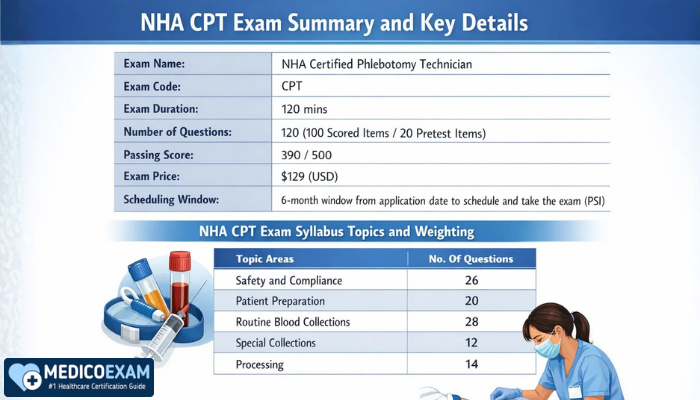
The NHA Certified Phlebotomy Technician exam is a timed assessment, designed to be completed within 120 minutes. It consists of 120 questions in total, where 100 items are scored, and 20 are pretest items that do not count towards the final score. Candidates must achieve a scaled score of 390 out of 500 to pass, demonstrating a solid grasp of core phlebotomy principles and practices.
Key Exam Details
-
Exam Name: NHA Certified Phlebotomy Technician
-
Exam Code: CPT
-
Exam Price: $129 (USD)
-
Duration: 120 mins
-
Number of Questions: 120 (100 Scored Items / 20 Pretest Items)
-
Passing Score: 390 / 500
This clear understanding of the exam's mechanics is invaluable for developing a strategic study plan and approaching the examination confidently.
Mastering the Core Knowledge Domains for Phlebotomy
A thorough understanding of the NHA CPT exam syllabus is non-negotiable for success. The exam covers a range of critical topics that reflect the day-to-day responsibilities and knowledge required of a proficient phlebotomy technician. Each domain is essential for ensuring patient safety, accurate specimen collection, and compliance with healthcare regulations. Focusing on these areas during your NHA CPT exam prep will build a strong foundation.
Essential Syllabus Topics
The NHA CPT exam assesses competence across five primary knowledge domains:
-
Safety and Compliance: Emphasizes infection control, personal protective equipment (PPE), standard precautions, and regulatory guidelines like OSHA and HIPAA.
-
Patient Preparation: Covers patient identification, communication techniques, site selection, and preparation procedures.
-
Routine Blood Collections: Details venipuncture, capillary puncture, blood culture collection, and proper order of draw.
-
Special Collections: Includes specific procedures for arterial blood gas, therapeutic phlebotomy, and glucose tolerance tests.
-
Processing: Focuses on specimen handling, labeling, transportation, storage, and common laboratory tests.
Deep diving into each of these NHA CPT exam topics will ensure you are well-prepared for any question the examination may present.
Crafting Your NHA CPT Exam Prep Strategy
Effective preparation for the NHA CPT exam requires more than just memorization; it demands a strategic approach to learning and consistent practice. Developing a structured study plan is key to covering all the necessary material and building confidence. This proactive approach will streamline your study efforts and increase your chances of passing the CPT exam on your first attempt.
Developing a Study Routine
-
Begin by creating a realistic study schedule that allocates dedicated time for each syllabus topic. Consistency is more important than long, infrequent study sessions. Break down complex subjects into smaller, manageable chunks to avoid feeling overwhelmed.
Utilizing Diverse Resources
-
Don't rely on a single study guide. Combine textbooks, online courses, flashcards, and practical lab experience. Engage with interactive content like a phlebotomy procedure guide to enhance understanding and retention.
Practice and Review
-
Regularly test your knowledge with quizzes and practice questions. Identify areas of weakness and revisit those topics. Repetition and spaced learning are powerful tools for long-term retention of critical information.
Maximizing Your Study Resources
Selecting the best NHA CPT study materials can significantly impact your preparation effectiveness. With numerous resources available, discerning which ones offer the most value is crucial. A balanced approach combining official NHA resources with supplementary study aids can provide a comprehensive review and bolster your understanding of complex phlebotomy procedures.
Official NHA Resources
-
The NHA offers official study guides and practice tests that align directly with the exam blueprint. These resources are invaluable as they reflect the type and difficulty of questions you can expect on the actual exam. They are an essential starting point for any serious candidate.
Supplementary Study Aids
-
Beyond official materials, consider incorporating anatomy and physiology textbooks, medical terminology guides, and online video tutorials. These can provide deeper contextual understanding and visual learning experiences. For additional practice and to gauge your readiness, exploring a comprehensive set of practice questions can be highly beneficial.
Leveraging Practice Tests
-
Taking a CPT NHA practice exam is one of the most effective ways to prepare. It helps you become familiar with the exam format, identify your strengths and weaknesses, and manage your time effectively under simulated test conditions. MedicoExam offers a range of practice tests designed to mirror the actual exam experience, allowing you to refine your knowledge and test-taking strategies before the big day.
Approaching NHA CPT Exam Questions Strategically
Facing the NHA CPT exam questions requires more than just knowing the answers; it demands a strategic approach to problem-solving and critical thinking. Many questions will present scenarios that require you to apply your knowledge rather than simply recall facts. Developing effective test-taking strategies can significantly improve your performance.
Understanding Question Types
-
The NHA CPT exam typically features multiple-choice questions, often presented in clinical vignettes or scenario-based formats. Practice analyzing these scenarios, identifying the core issue, and selecting the best course of action based on safety and best practices.
Time Management During the Exam
-
With 120 minutes for 120 questions, you have approximately one minute per question. Practice pacing yourself during mock exams. If you encounter a challenging question, make an educated guess, flag it for review if time permits, and move on. Don't dwell excessively on a single item.
Minimizing Test Anxiety
-
Test anxiety can hinder performance. Practice relaxation techniques, ensure you get adequate rest before the exam, and arrive early on test day. Trust in your preparation and focus on one question at a time. A calm and focused mindset is your greatest asset.
Navigating the Financial Aspects of Certification
Investing in your professional development through the NHA CPT certification involves certain costs. Understanding the Certified Phlebotomy Technician exam cost upfront helps in financial planning. Beyond the direct exam fee, consider expenses for study materials, practice tests, and potentially phlebotomy program tuition. However, this investment often yields significant returns in terms of career opportunities and earning potential.
Exam Cost and Associated Expenses
-
The NHA CPT exam price is $129 (USD). This fee covers your registration and sitting for the examination. Factor in costs for quality study guides, online courses, and practice exams, which can vary widely. While these add to the initial outlay, they are crucial for thorough preparation.
Salary Expectations for Certified Professionals
-
Obtaining your Certified Phlebotomy Technician salary can vary based on experience, location, and healthcare setting. Generally, certified phlebotomists earn a competitive wage, with certification often leading to higher earning potential compared to uncertified peers. The NHA CPT credential demonstrates a commitment to excellence that is highly valued by employers, making it a worthwhile investment for a stable and growing career path.
Sustaining Your NHA CPT Credential Through Renewal
The NHA CPT certification is not a one-time achievement; it requires periodic renewal to ensure that certified professionals maintain current knowledge and skills in the ever-evolving healthcare landscape. Understanding the NHA CPT certification renewal process is crucial for long-term career viability and demonstrates a commitment to continuous professional development.
The Renewal Cycle
-
NHA certifications typically require renewal every two years. This ensures that phlebotomists stay updated on the latest techniques, safety protocols, and regulatory changes within the field. Failing to renew your certification can result in it becoming inactive, potentially impacting your employment opportunities.
Continuing Education Requirements
-
To renew, certified professionals usually need to complete a certain number of continuing education (CE) credits. These credits can be earned through various approved activities, such as workshops, online courses, and professional development programs. The NHA provides resources and guidance on acceptable CE activities to help you fulfill these requirements seamlessly. Regularly tracking your CE hours will make the renewal process smooth and straightforward.
Frequently Asked Questions
1. What does NHA CPT certification validate for phlebotomists?
-
The NHA CPT certification validates a phlebotomist's proficiency in core competencies such as patient identification, venipuncture, capillary puncture, specimen collection and handling, and adherence to safety and compliance protocols. It signifies that an individual meets national standards for safe and effective phlebotomy practice.
2. What are the main steps to prepare for the NHA CPT exam?
-
Key steps for NHA CPT exam preparation include reviewing the official NHA exam blueprint and syllabus, developing a structured study plan, utilizing NHA-approved study guides and practice tests, reinforcing knowledge with supplementary materials, and practicing time management during simulated exams.
3. How much does the NHA CPT exam cost?
-
The NHA CPT exam costs $129 (USD). This fee covers the registration and administration of the examination. Additional costs may include study materials, practice tests, and any required educational programs to meet eligibility.
4. How long is the NHA CPT certification valid, and how do I renew it?
-
The NHA CPT certification is typically valid for two years. To renew, certified professionals must complete a specific number of continuing education (CE) credits within their renewal cycle and submit an application with the required fee to the NHA.
5. What career opportunities can the NHA CPT certification open?
-
NHA CPT certification opens doors to roles as phlebotomy technicians in various healthcare settings, including hospitals, clinics, diagnostic laboratories, blood donation centers, and nursing homes. It enhances employability, often leads to higher earning potential, and provides a clear career path in allied health.
Conclusion
The NHA CPT Exam serves as a critical gateway to a rewarding career as a Certified Phlebotomy Technician. By understanding the exam structure, mastering the core syllabus, and employing effective study strategies, you can confidently approach this certification. This credential not only validates your skills but also enhances your professional standing, opening doors to diverse opportunities in the healthcare sector. Your dedication to preparation will pave the way for a successful and impactful career in phlebotomy.
Embark on your journey to becoming an NHA Certified Phlebotomy Technician today. Equip yourself with the best resources and a solid study plan to unlock your full potential. For comprehensive preparation insights and additional detailed study resources to guide you every step of the way, visit detailed study resources.
- NHA Phlebotomy Technician Practice Test |
- NHA CPT Question Bank |
- NHA CPT Eligibility & Requirements |
- NHA CPT Exam Cost |
- NHA CPT Registration Process |
- NHA Phlebotomy Technician Study Guide |
- NHA CPT Recertification |
- NHA CPT Certification Overview |
- NHA Phlebotomy Technician Syllabus |
- NHA CPT Preparation Time |
- NHA CPT Passing Score |
- NHA CPT Exam Format |
- NHA Phlebotomy Technician Sample Questions |
- NHA CPT Career Opportunities |
- NHA CPT Exam Difficulty


