
How to Pass the CPHON Exam: A Step-by-Step Study Plan
The ONCC Certified Pediatric Hematology Oncology Nurse (CPHON) exam has 165 multiple-choice questions, a 180-minute time limit and a pass mark of 55 on a scale of 25 to 75. Symptom management and supportive care is the heaviest of its six content areas at 26 percent, so a sound study plan starts there and works outward.
Ready to see where you stand? Take the CPHON practice test first, write down your result in each content area, and then follow the plan below to decide where your next study sessions should go.

How is the CPHON exam structured?
The Oncology Nursing Certification Corporation (ONCC) describes the CPHON certification test as a three-hour, 165-question multiple-choice exam. Only 125 of those 165 items count toward your score; the other 40 are unscored. Nothing on screen separates the two groups, so give each question your full attention. The exam is built from the CPHON Test Content Outline, which ONCC based on a role delineation study of basic pediatric hematology oncology nursing practice carried out in 2021.
ONCC reports your result as a scaled score between 25 and 75, with 55 as the pass mark. MedicoExam's syllabus summary puts that at roughly 73 percent. Treat the percentage as a rough guide only: the scaled score is what ONCC reports, and how it maps to a number of correct answers is decided by ONCC. ONCC also notes that candidates receive results on the same day they test, which shortens the wait considerably.
Two details shape how you prepare. First, ONCC uses only generic drug names on its tests, so your revision should be built around generic names rather than brand names. Second, the exam is computer based and delivered through PSI test centers, according to the MedicoExam syllabus summary, with year-round testing in the United States, its territories and Canada.
What are the exam facts at a glance?
The table below gathers the published figures in one place, with fees shown in US dollars as of November 2026. ONCC can change fees and procedures, so confirm the current numbers on the CPHON page at ONCC before you apply.
| Detail | CPHON exam |
|---|---|
| Questions | 165 in total, made up of 125 scored items and 40 unscored items |
| Time allowed | Three hours (180 minutes) |
| Pass mark | A score of 55 on ONCC's 25 to 75 scale, about 73 percent |
| Fee for ONS or APHON members | $300 |
| Fee for non-members | $420 |
| Testing window | 90 days, opened by the Authorization to Test |
| Certification validity | Four years once you pass |
Notice the fee gap. Membership of ONS or APHON lowers the fee from $420 to $300, a difference of $120. If you are not yet a member, compare the cost of joining against that saving before you decide, because the saving may or may not cover membership for you.
Who is eligible to sit the CPHON exam?
ONCC states that every eligibility criterion has to be satisfied at the time of application and again at the exam. The published requirements are practical and easy to check against your own records, so do that before you spend anything.
- license: a current, active and unencumbered registered nurse license in the United States, its territories or Canada.
- Practice hours: at least 2,000 hours of pediatric hematology oncology nursing practice within the 48 months before you apply. Practice can be clinical, administrative, educational, research or consultation work.
- Experience: at least 24 months of experience as a registered nurse within the 48 months before you apply.
- Continuing education: at least 10 contact hours of oncology nursing education, or an academic elective in oncology nursing, within the 36 months before you apply. A maximum of five of those 10 hours may be continuing medical education in oncology or hematology, or continuing pharmacy education.
The education hours need to be provided or formally approved by an accredited body for continuing nursing education or professional development. If your hours came through Joint Accreditation or interprofessional continuing education, ONCC says the certificate has to state hours awarded by ANCC, ACCME or ACPE, or it will not be accepted. Collect those certificates early, because a missing document is the most common reason an application stalls.
This credential suits nurses whose daily work involves children and adolescents with blood disorders or cancer, and the MedicoExam syllabus summary also lists nursing administrators, educators, researchers and consultants who work in those settings. It is a measure of specialty knowledge, and it is only worth the effort if your practice genuinely sits in this field.
How do you apply, and what happens after you apply?
The application runs through your ONCC account. You gather your documentation, click Apply Now, log in or create an account, select the CPHON application and then provide the information, documents and fee. ONCC says incomplete applications are not processed until everything is received, and that an incomplete application is deleted after 60 days of inactivity. You will receive an email confirming that the application arrived, though ONCC points out that this confirms receipt only and does not confirm that you are eligible.
ONCC asks for a few pieces of information, including your nursing license number, the name and phone number of your supervisor and proof of your continuing education. From January 2025 it also asks for the last four digits of your social security number and your NCSBN ID, which it uses to confirm your licensure. ONCC states that those digits are not stored in its system. If you need your NCSBN ID, ONCC's page explains how to find it using the QuickConfirm option on Nursys.
Once approved, you receive an Authorization to Test by email. ONCC says it usually arrives within four to six weeks of applying and that you should contact ONCC if it has not come within six weeks. That authorization starts a 90-day testing window, and the exam has to be taken before it closes. Because the window starts almost immediately, apply when you are close to ready rather than hoping to finish revising afterwards.
What does the CPHON exam actually test?
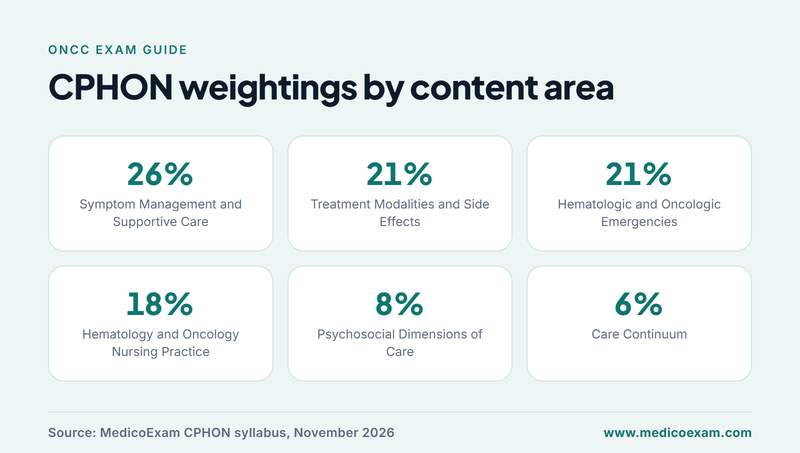
The syllabus has six content areas, and their weightings add up to 100 percent. The table lists them in the order they appear on the MedicoExam CPHON syllabus page.
| Content area | Weighting |
|---|---|
| Care Continuum | 6 percent |
| Pediatric Hematology and Oncology Nursing Practice | 18 percent |
| Treatment Modalities and Side Effects | 21 percent |
| Symptom Management and Supportive Care | 26 percent |
| Pediatric Hematologic and Oncologic Emergencies | 21 percent |
| Psychosocial Dimensions of Care | 8 percent |
Three areas carry most of the marks. Symptom management and supportive care (26 percent), treatment modalities and side effects (21 percent) and emergencies (21 percent) are the three largest areas, and each outweighs any of the other three. That split is the single most useful fact for planning, because it tells you where a fixed amount of study time earns the most.
The exam tests applied nursing knowledge, not memorized lists. A question may describe a situation and ask what a nurse should recognize, prioritise or teach, so you need to understand why something happens as well as what it is called. Here you will find what the exam covers and how to prepare. It contains no clinical advice, and nothing here should be used to make decisions about any patient's care.
What belongs in the Symptom Management and Supportive Care area?
This is the largest area at 26 percent, and the syllabus splits it into three strands. The first covers system-specific acute, chronic and late effects across the neurological, respiratory, cardiovascular, gastrointestinal, renal and genitourinary, musculoskeletal, integumentary, endocrine, reproductive, hematological, immunological, ophthalmological, otological and lymphatic systems. The second covers general acute, chronic and late effects, namely pain, sleep disturbance, fatigue and mental health. The third covers supportive care.
Supportive care, as the syllabus lists it, includes medical devices such as venous access devices, pumps, shunts and tubes, blood product administration, colony-stimulating factors, interdisciplinary care, palliative care and complementary and integrative modalities. Late effects deserve particular attention, because pediatric survivors can face problems long after treatment ends, and a question may ask you to link a past therapy with a later effect.
A practical way to study this area is to build one page per body system with three columns: the effect, how it is recognized and what the nurse teaches the child and family. Fill in the page from your textbook, then test yourself by covering two columns at a time. Because the area is so broad, you will not master it in one pass, so plan to return to it repeatedly.
How should you study Treatment Modalities and Side Effects?
This area is worth 21 percent and is organized into hematology and oncology. Under hematology, the syllabus lists chemotherapy, biotherapy, immunotherapy, blood product therapy, hematopoietic stem cell transplantation, surgery and coagulation therapy. Under oncology, it lists chemotherapy, biotherapy, immunotherapy, blood product therapy such as leukapheresis, cellular therapies such as CAR-T, radiation therapy such as I-131-MIBG and proton beam radiation, hematopoietic stem cell transplantation and surgery.
Group your revision by modality instead of by disease. For each modality, make sure you can explain what it is for, what the common side effects are, which side effects are urgent and what the family needs to be taught. Remember that ONCC uses generic drug names only, so practice recalling a drug by its generic name and the class it belongs to. A simple two-column drug sheet, with the generic name on one side and the class and key concerns on the other, is far more useful on exam day than a long set of notes.
Cellular therapies and newer radiation approaches appear by name in the syllabus, so do not skip them because they feel specialised. If your own unit rarely uses them, read about them from the references ONCC lists, because the exam is written for the specialty as a whole and not for any one hospital.
What should you know about Pediatric Hematologic and Oncologic Emergencies?
Emergencies carry 21 percent, the same as treatment modalities, and the syllabus lists them by category. Infection includes sepsis and typhlitis. Gastrointestinal topics are pancreatitis and bowel obstruction. Metabolic topics are diabetes insipidus, syndrome of inappropriate antidiuretic hormone, tumor lysis syndrome and cytokine release syndrome.
The vascular group is long: disseminated intravascular coagulation, hemorrhage, hyperleukocytosis, sinusoidal obstructive syndrome, splenic sequestration, vaso-occlusive crisis, stroke, joint bleed in conditions such as hemophilia, and thrombosis. Cardiopulmonary topics are acute chest syndrome, respiratory distress such as that caused by a mediastinal mass, pleural effusions and arrhythmias. Neurology covers increased intracranial pressure, seizures, posterior reversible encephalopathy syndrome and spinal cord compression. Hypersensitivity reactions and extravasation complete the list.
For each emergency, prepare a short card that answers four questions in your own words: what is happening, what signs would a nurse notice first, what is the priority nursing concern and what happens next in the team's response. Emergency questions often reward recognizing early warning signs and knowing what to escalate, so practice reading a short scenario and naming the most urgent concern before you look at the answer options.
What do the three smaller areas ask?
Pediatric Hematology and Oncology Nursing Practice is worth 18 percent and is easy to underestimate. It covers pediatric cancers and hematologic disorders, including clinical presentation, anatomy, physiology and pathophysiology, genetics including genomics, diagnostic testing, diagnosis and prognosis. It also covers clinical trials, including phases and informed consent, and professional performance, including scope and standards of practice, patient and family education, ethical principles, professional practice guidelines and regulatory standards.
The Care Continuum area is worth 6 percent. It covers transition of care, primary care, levels of care such as rehabilitation, home and outpatient settings, end-of-life care, health promotion and maintenance and survivorship. The Psychosocial Dimensions of Care area is worth 8 percent and covers family dynamics, the effects of acute and chronic illness on the patient and family, caregiver support, fitting care into family, school, work, camp and social life, growth and development, grief and bereavement, cultural considerations, sexuality and gender identity, socioeconomic issues and community resources.
Each of these three areas is individually smaller than any of the big three. They are less memory-heavy than the clinical areas, so they are often where steady reading and common sense recover marks. Do not neglect them to spend extra hours on the largest area, because a few well-prepared questions here can offset a few missed ones elsewhere.
How do you build a CPHON study plan that works?
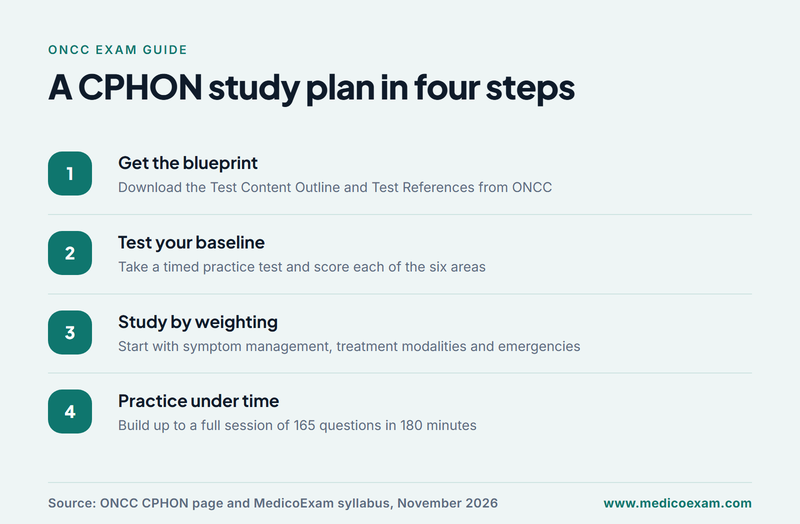
A plan needs an honest starting point. Begin with a timed practice test, then record your result for each of the six areas. The gaps tell you what to study, and the weightings tell you how much each gap matters. A weak result in a 26 percent area is a bigger problem than a weak result in a 6 percent area, and your plan should reflect that.
- Get the source documents. Download the CPHON Test Content Outline and the CPHON Test References that ONCC links from its exam page, and keep them beside you while you study.
- Take a baseline practice test. Do it under timed conditions and note which areas cost you the most marks.
- Rank your gaps by weighting. Start with weak areas that carry the most marks, which in this exam means symptom management, treatment modalities and emergencies.
- Study one area at a time. Read, make short notes in your own words and test yourself on that area before you move on.
- Practise with scenarios. Applied questions are the norm, so practice reading a situation and choosing the best response.
- Run timed sets. Build up to a full-length session so that the three-hour format feels familiar.
- Review mistakes, not just scores. For every wrong answer, write down why the right answer was better.
- Taper before the exam. Stop adding new material in the last days and concentrate on weak points and rest.
How long this takes depends on your background. A nurse who works every day with children on active treatment may need less revision in some areas than a nurse who works mainly in education or research, who may need more clinical review. Be honest about which group you belong to, and give yourself enough time to cover the heavy areas twice.
How do practice questions help, and how should you use them?
Practice questions do two jobs. They show you what you do not yet know, and they teach you the question style, including how distractors are built. Use them in short, focused sets after studying an area, and in longer timed sets as the exam approaches. MedicoExam offers a CPHON practice test that you can use for this purpose, and ONCC itself links practice tests and sample test questions from its exam page.
The danger is memorising answers. If you see the same question twice and answer it correctly because you remember the option, you have learned nothing about the topic. After each set, explain every answer aloud, including why the wrong options are wrong. If you cannot do that, return to the area and study it again before you test yourself further.
Track your results by area, not just as an overall percentage. An overall score can hide a serious gap in a heavily weighted area. A simple table of area, date and score will show whether your weakest areas are improving, and it will tell you when it is time to book.
How should you pace yourself on exam day?
With 165 questions in 180 minutes, you have an average of about 65 seconds per question. Treat that average as a rough pacing aid. Move briskly through easy items, keep the time you save for longer scenario questions and avoid spending several minutes on a single question. Because 40 of the 165 items are unscored, one hard question is never worth panic. Since you cannot tell which items are unscored, give each one your best answer and move on.
Start with the last line of a question to see what it asks, and then scan the scenario for the details that decide the answer. Eliminate options you can rule out, choose the best remaining one and mark anything you want to revisit. If time remains at the end, return to marked items with a fresh mind.
Prepare the practical side as well. Confirm the location of your test center, the identification you must bring and your appointment time well before the day, using the instructions in your Authorization to Test email. A rested night does more for your score than a last-minute chapter, so finish revising the day before and arrive with time to settle.
What happens if you do not pass?
Not every candidate passes first time, and ONCC has planned for it. Its DoubleTake option provides a retake if you do not pass the test on the first attempt, while avoiding a second full payment of the test fee. Read the current terms on ONCC's website before you apply, so that you know exactly what it offers and what it costs. Knowing a safety net exists can lower the pressure on the day.
If you do need to sit again, start with the score report. ONCC publishes a sample results report, which shows the kind of feedback you can expect. Use whatever area-level feedback you receive to decide where to focus, and resist the urge to restart all your revision from the beginning. A targeted retake plan is quicker and usually more effective than a full restart.
Is the CPHON credential worth the effort and the fee?
That depends on your goals, and nobody can answer it for you with a number. ONCC describes the certification as a way to be recognized for specialty knowledge in oncology nursing, and it is an NCCA Accredited Certification Program. Once you pass, certification is valid for four years, which gives you a defined period before you need to renew. This article does not quote salary or pass-rate figures because none are published in the sources used here.
Weigh the costs honestly: the fee, the time needed to prepare, and the education and practice hours you must already hold. Weigh them against what the credential gives you, such as professional recognition and the discipline of studying the whole field. For many nurses in this specialty, a structured review of the content outline is valuable in its own right, even before the result arrives.
A final word on preparing for the CPHON exam
The CPHON blueprint rewards a plan that follows its weightings. Symptom management (26 percent), treatment modalities (21 percent) and emergencies (21 percent) lead the blueprint, and the three smaller areas trail behind. Plan your hours in the same proportions, and use timed scenario practice to judge your readiness honestly.
Take a practice test, fill in your six area scores and begin with the largest weak area. Confirm each figure on ONCC's website before booking, because fees and procedures may change, and apply only when your eligibility documents are in order and your preparation is close to complete.
Frequently Asked Questions
How many questions are on the CPHON exam?
The exam has 165 multiple-choice items; 125 of them are scored and 40 are not. You have 180 minutes, which is three hours. Nothing marks the unscored items, so treat every question as if it counts toward your result and answer each one carefully.
What is the passing score for the CPHON exam?
ONCC reports a scaled result from 25 to 75, and 55 passes. Our syllabus page puts that at approximately 73 percent. How the scaled score maps to a number of correct answers is decided by ONCC, so use the percentage only as a rough guide.
How much does the CPHON exam cost?
As of November 2026, ONCC lists the test fee at $300 for ONS/APHON members against $420 for nonmembers, a difference of $120. Fees can change, so confirm the current amount on ONCC's CPHON page before you apply and pay for your application.
Which CPHON content area carries the most weight?
Symptom Management and Supportive Care carries the most weight at 26 percent. Treatment Modalities and Side Effects and Pediatric Hematologic and Oncologic Emergencies follow at 21 percent each. Those three areas are the largest on the blueprint, so they should receive most of your study hours.
Who can apply for the CPHON exam?
You need an active, unencumbered registered nurse license, at least 2,000 hours of pediatric hematology oncology nursing practice and 24 months of RN experience within the past 48 months, plus 10 oncology contact hours within 36 months. ONCC requires every criterion to be met at application and at testing.
When must you sit the exam once you are approved?
Once approved, ONCC sends an Authorization to Test, usually within four to six weeks of applying. It starts a 90-day testing window that you cannot extend by waiting. Passing gives you a certification that is valid for four years.
- CPHON practice test |
- CPHON practice questions |
- CPHON practice exam |
- ONCC CPHON exam |
- Certified Pediatric Hematology Oncology Nurse certification |
- CPHON syllabus |
- CPHON exam content outline |
- CPHON exam topics |
- CPHON passing score |
- CPHON sample questions |
- free CPHON practice questions |
- CPHON exam questions and answers


