
CPC or CRC? Choosing Between General Coding and Risk Adjustment
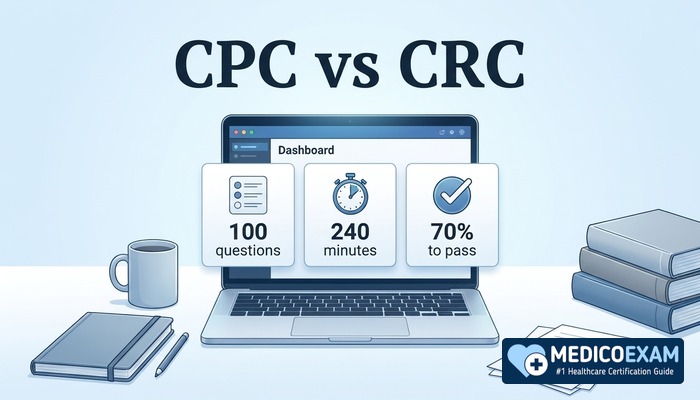
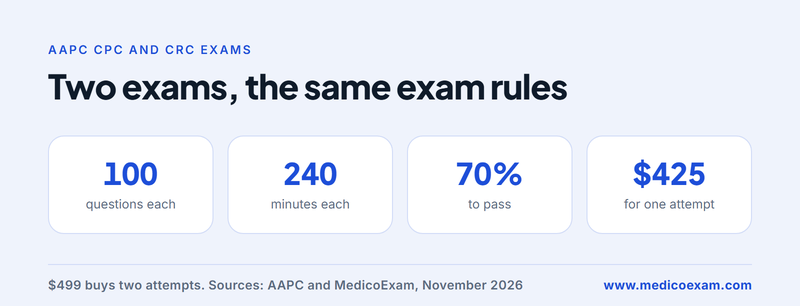
The AAPC Certified Professional Coder (CPC) and the AAPC Certified Risk Adjustment Coder (CRC) share a certifying body, an exam fee, a time limit and a pass mark, so the choice between them is about the work you want to do and not about the exam rules. Each exam has 100 questions in 240 minutes and needs 70 percent. The CPC covers procedures and services in outpatient and physician settings; the CRC covers diagnosis coding for risk-adjusted payment.
If you already know which way you lean, you can jump to the practice exams: CPC and CRC each come with a MedicoExam practice test. If you are still undecided, keep reading. Every figure below comes from the exam data sheet MedicoExam maintains, from AAPC's own pages, from the MedicoExam syllabus and product pages, or from simple arithmetic on those numbers.
Is the CPC or the CRC the right AAPC credential for you?
AAPC calls the CPC its flagship coding credential and the best place to start, because the base it builds carries over to inpatient work, risk adjustment, compliance, auditing and specialty credentials. It describes the CRC as a credential for starting or growing a risk adjustment coding career, aimed at value-based care models.
That difference in framing is the heart of the decision. The CPC is a broad credential that tests you across body systems, procedure code ranges and payer rules. The CRC is a narrower credential that goes deep on one task: reading provider documentation and reporting the diagnoses that affect a risk score. A reader who wants the widest range of job titles tends to lean towards the broad credential, while a reader who already works with health plans or value-based contracts may find the focused one fits the job in front of them.
This guide ranks neither above the other. It lays out what each exam demands, so you can line it up with your own situation. The purpose is exam preparation alone, and nothing here is clinical or medical guidance.
How do the CPC and CRC exams compare at a glance?
Here is a side-by-side view of the published exam details. Question count, time limit, fee and pass mark come from the MedicoExam Master record, and AAPC's own pages show the same starting fee.
| Detail | CPC | CRC |
|---|---|---|
| Questions | 100 | 100 |
| Time allowed | 240 minutes | 240 minutes |
| Passing score | 70%, or 70 correct answers | 70%, or 70 correct answers |
| Exam fee | $425 single attempt, $499 two attempts | $425 single attempt, $499 two attempts |
| How it is taken | Remote proctoring from home, or a test site | Remote proctoring from home, or a test site |
| Valid for | 2 years | 2 years |
| Renewal | Yearly AAPC membership plus 36 CEUs per cycle | Yearly AAPC membership plus 36 CEUs per cycle |
| AAPC training course, from | $2,799 | $1,495 |
Look closely at two points. The exams match on the outside, so logistics cannot settle the choice: fee, length and pass mark do not separate them. The one figure that differs is the price of AAPC's own training course, which begins at $2,799 for the CPC and $1,495 for the CRC. That gap hints at a bigger syllabus on the CPC side, as the next sections show. A course is not a condition of sitting either exam, because the voucher is sold separately.
Who is each credential built for?
The CPC is pointed by AAPC at four groups: newcomers starting out in medical coding, uncertified coders with experience who want proof of their skill, administrative or clinical support staff changing into coding, and people planning a long career who want a base for advanced or specialty credentials. The MedicoExam syllabus page lists the roles it targets as professional coders, medical coding specialists and physician-based coding professionals, working in physician practices, outpatient provider organizations, and revenue cycle and coding departments.
The CRC is aimed at new entrants who want to start in risk adjustment and value-based care, experienced but uncertified coders, certified coders who want to add risk adjustment and HCC coding, and healthcare professionals who work with payers, provider groups or organizations in value-based care models. The MedicoExam syllabus page lists risk adjustment coders, medical coders, and coding compliance and documentation review professionals, in settings such as health plans, provider organizations with risk-based contracts and healthcare vendors.
For both, AAPC expects strong working knowledge of medical terminology, anatomy and pathophysiology. Its CPC page says that if you lack medical experience or working knowledge of those subjects, it offers prerequisite courses. Its CRC page says that if you are not ready yet, it recommends its CRC preparation course. Neither page sets a degree or a years-of-experience gate for taking the exam.
What does each exam actually cover?
The CPC is a breadth exam. AAPC says it validates comprehensive knowledge of medical coding across outpatient and physician services, including ICD-10-CM diagnosis codes, CPT procedure codes and HCPCS Level II codes, compliance, payer rules and reimbursement. The MedicoExam syllabus page breaks the 100 questions into these areas:
- Medical terminology and anatomy: 4 questions each.
- Compliance and regulatory: 3 questions on Medicare Parts A to D, place of service, fraud and abuse, RVUs, ABNs, HIPAA, and the NCDs, LCDs and NCCI edits.
- Coding guidelines: 7 questions on modifier use, CPT parenthetical notes and the ICD-10-CM reporting guidelines.
- ICD-10-CM: 5 questions. HCPCS Level II: 3 questions.
- The CPT surgical series, 10000 to 60000: 6 questions for each series, across the integumentary, musculoskeletal, respiratory and cardiovascular, digestive, urinary and reproductive, and nervous systems.
- Radiology, pathology and laboratory, medicine, and E/M get six questions apiece; anesthesia gets 4.
- Cases: 10 questions, each asking you to code from medical record documentation using CPT, ICD-10-CM and HCPCS Level II.
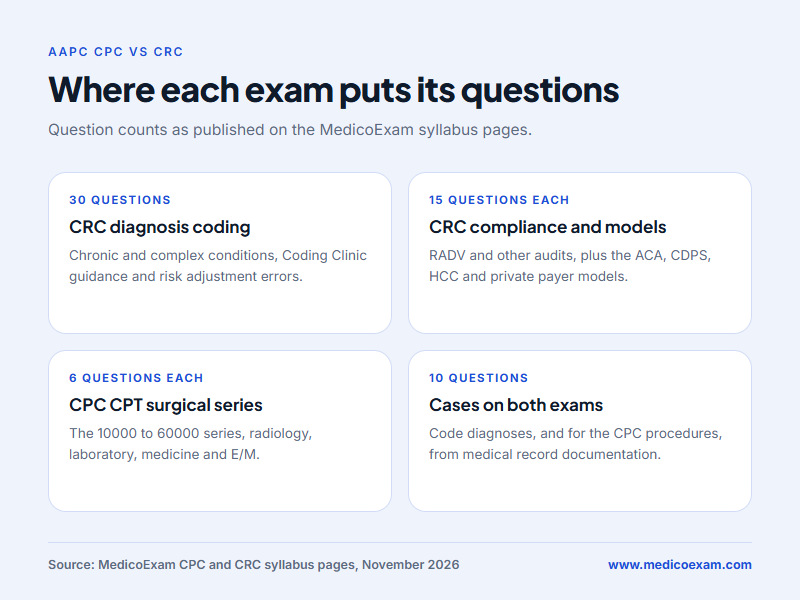
The CRC is a depth exam. AAPC says it validates expertise in risk adjustment coding, and in applying ICD-10-CM diagnosis codes to capture the complete health status of patients in value-based care models. There are no CPT procedure ranges at all. The MedicoExam syllabus page spreads the 100 questions like this:
- Diagnosis coding: 30 questions, the largest area, covering Coding Clinic guidance, common risk adjustment errors, and conditions such as CHF, CKD, COPD, stroke, dementia, depression, neoplasms, pressure ulcers and amputations.
- Compliance: 15 questions, covering prospective, retrospective and RADV audits and the coding errors RADV audits find.
- Risk adjustment models: 15 questions, covering the ACA, CDPS, HCC and private payer models and the elements of a risk score.
- Documentation improvement: 12 questions, on spotting and raising documentation discrepancies with providers.
- Purpose and use of risk adjustment models: 10 questions, including data mining, predictive modeling and trumping in the hierarchy.
- Cases: 10 questions. Pathophysiology, medical terminology and anatomy: 5 questions. Quality of care: 3 questions, on HEDIS and STAR ratings.
Read side by side, the two blueprints show where your study hours go. A CPC candidate spreads effort across many code sets and body systems, with no one area worth more than 10 questions. A CRC candidate puts nearly a third of the exam into diagnosis coding and about another third into compliance and models, so a weak spot in chronic-condition coding costs far more than it would on the CPC.
What will exam day feel like for each credential?
On the clock, they are the same: 240 minutes for 100 questions leaves 144 seconds for each question if you spend the time evenly. In practice you will not spend it evenly. The ten cases on each exam need you to read a record and code it, and those take far longer than a single-answer question, so the quick questions are where you bank time.
The content is what changes the feel. On the CPC you switch constantly: an anesthesia question, then a radiology one, then a modifier, then an E/M level. Your challenge is range and fast navigation through your code books. On the CRC you stay inside one world, diagnosis codes, documentation and risk models, so the challenge is precision. You must know which diagnoses risk adjust, how conditions interact, and what a record must say before a code can be reported.
For both exams, AAPC lets you test from home with a proctor watching live over the internet, or sit in a testing center. The CPC voucher, according to the MedicoExam syllabus page, is valid for one year from purchase, and AAPC's CPC page says you must register three weeks before the exam date. Check AAPC's current rules for the CRC before you plan your date, because its page does not repeat that notice.
What do the exams cost, and what keeps each credential valid?
The exam fee is identical. The MedicoExam Master record lists $425 with a single attempt and $499 with two, and AAPC's pages show the same starting price of $425. The difference in a two-attempt bundle is $74 over a single attempt, which is a sensible hedge if you expect to need a second try and a poor one if you are confident. The bigger spend is preparation. AAPC's course price is from $2,799 for the CPC against from $1,495 for the CRC, in self-paced and virtual instructor-led formats.
After you pass, renewal works the same way for both. Per AAPC, the credential stays valid while your yearly AAPC membership is current and you log 36 continuing education units (CEUs) in each two-year period. That is a recurring cost and a recurring habit, so factor it in whichever credential you pick. Holding both credentials does not double the CEUs; confirm with AAPC how CEUs are counted across more than one credential before you rely on it.
How do you decide between the CPC and the CRC?
Take these questions one at a time; the first one with a clear answer settles it.
- Where do you work, or want to work? Physician practices, outpatient clinics and same-day surgical centers point to the CPC. Health plans, provider groups with risk-based contracts and value-based care programs point to the CRC.
- Do you want procedures or diagnoses? If you want to code procedures, services and supplies as well as diagnoses, the CPC is the match. If your interest is capturing the full health status of patients through diagnosis codes, choose the CRC.
- How much ground can you cover? The CPC syllabus spans nearly twenty areas, each worth a handful of questions. The CRC syllabus has eight areas, with two of them worth 30 and 15 questions.
- Which credential do you want next? AAPC describes the CPC as the base for inpatient, risk adjustment, compliance, auditing and specialty paths, and it adds that certified coders can widen their skills into risk adjustment and HCC coding. If you plan to do both, many readers start with the broader credential, though AAPC does not require that order.
- What is your budget? The exam fee is identical, so the only gap is training: from $2,799 against from $1,495 for AAPC's courses.
If two answers point each way, take a short MedicoExam demo for each exam. The demo shows the question style, and the way you react to it, comfortable or frustrated, is useful information.
What do the exam cases and common mistakes look like?
Each exam closes its blueprint with ten cases, and the cases are where the two credentials feel most alike: you read a record and report what the documentation supports. The CPC cases ask for CPT, ICD-10-CM and HCPCS Level II codes. The CRC cases ask you to code diagnoses and to report the ones that risk adjust. In both, the habit that costs marks is coding from memory or from the problem list instead of from what the record actually documents.
On the CPC, the usual slips come from range and speed. Candidates lose time paging through unfamiliar sections, forget that modifiers change how a service is reported, or treat evaluation and management as a guessing exercise. AAPC says For E/M, the level is set by medical decision making or by total time, so study that rule. On the CRC, the usual slips come from precision: reporting a condition that the record only mentions in passing, missing the link between a condition and its manifestation, or overlooking how a hierarchy lets one diagnosis outrank another.
A simple drill works for both. Take a short, de-identified sample record from your study material, write down every code you think it supports, and then underline the exact words in the record that justify each one. Anything you cannot underline does not belong in your answer. Repeat until you do it without thinking, because the exam rewards the coder who reads closely, not the coder who recalls fastest. This is a study technique for the exam and not clinical guidance.
How do the syllabus areas connect to real coding work?
It helps to read each blueprint as a description of a working day. The CPC blueprint describes a coder in a physician practice or outpatient organization who receives a day of encounters across many specialties. That coder reads each note, picks the procedure and service codes, attaches the diagnoses that justify them, applies modifiers, and checks the claim against payer rules before it goes out. The breadth of the syllabus, from anesthesia to radiology to laboratory work, mirrors that variety.
The CRC blueprint describes a coder reviewing charts for a health plan, a provider group or a vendor, where the question is which diagnoses the documentation supports for the year. That coder checks that each reported condition is supported, notes where a provider could add specificity, and raises a documentation query when something is missing. The audit questions on the exam, including RADV audits, exist because the work is reviewed after the fact, so accuracy and support for every reported diagnosis matter.
If one of those two days sounds more like a job you would enjoy, give that more weight than any comparison of exam logistics. The exams share their rules, so your interest in the daily work is the strongest signal you have.
How should you study after you pick one?
Start from the blueprint, not from a book. Print the syllabus areas for your exam, rate yourself from one to five on each, and give the most time to the heaviest area where you are weakest. For the CRC that is almost always diagnosis coding; for the CPC it is usually the cases and the CPT series you rarely touch at work.
Next, build the habits the exam rewards. For the CPC, practice looking things up quickly in your code books and reading a documented case from start to finish before coding it. For the CRC, practice reading a short record and listing which diagnoses are supported, which are not, and what query you would send to the provider. Then finish with timed full-length sessions of 240 minutes for 100 questions, so that pacing is no surprise.
MedicoExam's practice exams follow those blueprints. The CPC and CRC practice exams each list 195 or more exam-aligned questions, at $41.30 with two months of access. Every attempt shows your chosen answers beside the correct ones and keeps a result history, which makes patterns easy to spot. They come from MedicoExam, not AAPC, so use them alongside AAPC's own materials, and remember that no resource can guarantee a pass.
AAPC publishes the current details for each exam on its own pages, so read AAPC's CPC page and AAPC's CRC page before you buy a voucher, because fees, rules and delivery options can change.
Which credential suits which reader?
The CPC suits the reader who wants a wide foundation: procedures, services, supplies and diagnoses, across physician and outpatient settings, with room to branch into auditing, compliance, inpatient or specialty coding later. It asks you to cover many areas lightly and to handle four hours of mixed material.
The CRC suits the reader who wants to specialize in risk adjustment: diagnosis coding for chronic and complex conditions, documentation review and audits in health plan and value-based care settings. It asks you to go deeper on fewer topics and to master how a risk score is built.
Neither choice closes a door. Both credentials share the same fee, length, pass mark, two-year cycle and CEU requirement. Choose the exam that fits the job you want next, check the details with AAPC, and take a practice test first so your plan rests on your own scores.
Frequently Asked Questions
Is the CPC or the CRC harder?
AAPC publishes no ranking of them by difficulty, and the two test different abilities. Both have 100 questions in 240 minutes, which is 144 seconds a question. The CPC asks you to cover many code ranges and body systems, while the CRC goes deep on diagnosis coding, documentation and risk models. Judge difficulty by your own practice scores on each blueprint.
How much do the CPC and CRC exams cost?
Both cost $425 for one attempt and $499 for two attempts, and AAPC shows a starting price of $425 for each. AAPC sells its own prep courses too: the CPC one is from $2,799 and the CRC one from $1,495. Confirm current fees with AAPC before paying.
What score do you need to pass the CPC and the CRC?
Each exam needs 70%, which on 100 questions comes to 70 right answers. Because the pass mark matches, the two exams differ in content and not in scoring.
Can you hold both the CPC and the CRC?
Yes. AAPC describes the CPC as a base that can be expanded into risk adjustment, and the CRC page lists certified coders who want to expand into risk adjustment and HCC coding as an audience. Each credential has its own two-year cycle with annual membership and 36 CEUs, so check with AAPC how CEUs apply when you hold more than one.
How long do the CPC and CRC credentials last?
Both run on a two-year cycle. AAPC states that you keep the credential by renewing your membership each year and logging 36 CEUs within the cycle.
Is this guide medical advice?
No. It compares two coding certification exams and suggests how to study for them. Nothing here is clinical advice, and no pass or job result is promised. Check each requirement with AAPC before applying.
- AAPC CPC Exam Cost |
- AAPC CPC Passing Score |
- AAPC Professional Coder Study Guide |
- AAPC CPC Recertification |
- AAPC CPC Exam Format |
- AAPC CPC Certification Overview |
- AAPC CPC Question Bank |
- AAPC CPC Eligibility & Requirements |
- AAPC Professional Coder Practice Test |
- AAPC CPC Registration Process |
- AAPC Professional Coder Syllabus |
- AAPC CPC Preparation Time |
- AAPC CRC Question Bank |
- AAPC CRC Eligibility & Requirements |
- AAPC Risk Adjustment Coder Practice Test |
- AAPC CRC Exam Cost |
- AAPC CRC Registration Process |
- AAPC Risk Adjustment Coder Study Guide |
- AAPC CRC Recertification |
- AAPC CRC Certification Overview |
- AAPC Risk Adjustment Coder Syllabus |
- AAPC CRC Preparation Time |
- AAPC CRC Passing Score |
- AAPC CRC Exam Format


