
Ready for the ACHPN Exam? Weightings, Fees and a Study Plan
The Hospice and Palliative Credentialing Center (HPCC) Advanced Certified Hospice and Palliative Nurse (ACHPN) exam has 175 questions, a time limit of 210 minutes and a passing score of 500 on a scale of 200 to 800. Of its four content areas, Assessment and Data Collection weighs most at 29 percent, which makes it the natural first stop in any study plan.
Want a quick read on your starting point? Begin with the ACHPN practice test, record how you score in each of the four areas, and let those scores steer the plan that follows.
How is the ACHPN exam structured?
The ACHPN exam is a computer-based test of 175 questions with 210 minutes to answer them. Divide the time by the questions and you get roughly 72 seconds for each one, which is a useful number to keep in mind when you practise. A question that takes much longer than a minute and a quarter is a question to flag and return to, not one to wrestle with while the clock runs.
Results are expressed on a scale running from 200 up to 800, with 500 as the passing score. That figure is not a raw percentage, and HPCC alone decides how scaled results relate to answers marked correct, so no study site can convert it for you. Treat 500 as the figure you are aiming to clear, and judge your practice results by the content areas rather than by one overall percentage.
The exam is delivered at PSI test centres or through Live Remote Proctoring (LRP), according to the MedicoExam syllabus summary. HPCC offers its exams in four testing windows each year, covering March 1 to 31, June 1 to 30, September 1 to 30 and December 1 to 31. Pick the window that leaves you enough weeks to finish your preparation, then work backwards to set your study dates.
The credential is intended for experienced hospice and palliative advanced practice registered nurses. Once earned, it is valid for four years, so the exam is the start of a defined certification cycle rather than a one-off event. The renewal rules sit on HPCC's own pages under its recertification section, and you should read them before you sit the exam so that nothing about the next cycle comes as a surprise.
Which ACHPN numbers should you know before you book?
Here are the figures candidates ask about most, drawn from the exam's listing on the MedicoExam syllabus page and from HPCC's own ACHPN page. Fee amounts are US dollars and were checked in November 2026.
| Item | Detail |
|---|---|
| Credential | Advanced Certified Hospice and Palliative Nurse (ACHPN) |
| Certifying body | Hospice and Palliative Credentialing Center (HPCC) |
| Number of questions | 175 |
| Exam duration | 210 minutes |
| Passing score | 500 on a scale of 200 to 800 |
| Initial certification fee | $515 for non-members, $355 for HPNA members |
| reTEST Assured fee | $135 |
| Validity | 4 years |
Two cautions apply to every figure in the table. First, HPCC may revise its fees, so look up the amount on its page before you pay. Second, the member price is for members of the Hospice and Palliative Nurses Association (HPNA), so check your membership status before you apply.
Who is eligible to sit the ACHPN exam?
HPCC sets four eligibility requirements, and it is worth checking all four before you spend money on preparation. You must hold a current, unrestricted active APRN licence in the United States, its territories, or the equivalent in Canada. Without that licence the application cannot go forward, whatever your experience.
You must also have completed an accredited graduate, postgraduate or doctoral Nurse Practitioner (NP) or Clinical Nurse Specialist (CNS) programme. The programme can be from a U.S. school, or from a Canadian province's NP or CNS programme approved by the Canadian Council of Registered Nurse Regulators (CCRNR).
The application must include an official academic record or transcript showing the graduate degree and the date it was conferred. HPCC says the transcript must demonstrate the key elements of APRN preparation. These are three separate comprehensive graduate-level courses in advanced pathophysiology, advanced health assessment and advanced pharmacology, plus a clinical practicum of at least 500 hours. Request your transcript early, because a registrar's office can take longer than you expect.
The last requirement concerns recent practice. You must be functioning as an NP or CNS in hospice and palliative advanced nursing practice for 500 hours in the most recent 12 months, or 1,000 hours in the most recent 24 months, before you apply. Keep a simple record of your hours so that you can answer this part of the application with confidence.
How do you apply, and what support does HPCC offer?
HPCC runs the application and scheduling online, and its ACHPN page links to each step: the online application and scheduling, confirming or rescheduling an exam, accessing your Live Remote Proctoring exam, and important application instructions. Candidates who need special arrangements can use the page's link for requests for special examination accommodations.
The same page lists a Candidate Handbook, a Detailed Content Outline and a set of HPCC study tips. Download the handbook and the outline before anything else. The outline is the document the exam is built around, and it is the most reliable guide to what you should study. HPCC also publishes a page of exam statistics and a page on how to recertify, which are worth reading while you are deciding when to test.
HPCC runs a reTEST Assured programme, priced at $135, and the page links to a description of how it works. If you want to understand what it covers, read HPCC's own explanation rather than relying on a summary from a third party. Cost is a real factor for many nurses, and the Hospice and Palliative Nurses Foundation (HPNF) provides scholarships to nurses nationwide to cover certification fees. HPNF says its scholarships are valid for those earning a new HPCC certification or renewing a current one, and that it accepts applications on an ongoing basis.
For full details of every step, go to HPCC's ACHPN page, which is the authoritative source and the one to trust if anything here differs from it.
What does the ACHPN exam actually test?
The MedicoExam syllabus page lists four topic areas with weightings. Assessment and Data Collection leads at 29 percent, Professionalism and Practice follows at 25 percent, Education and Communication carries 24 percent and Intervention and Management carries 21 percent. The graphic below shows the same figures side by side.
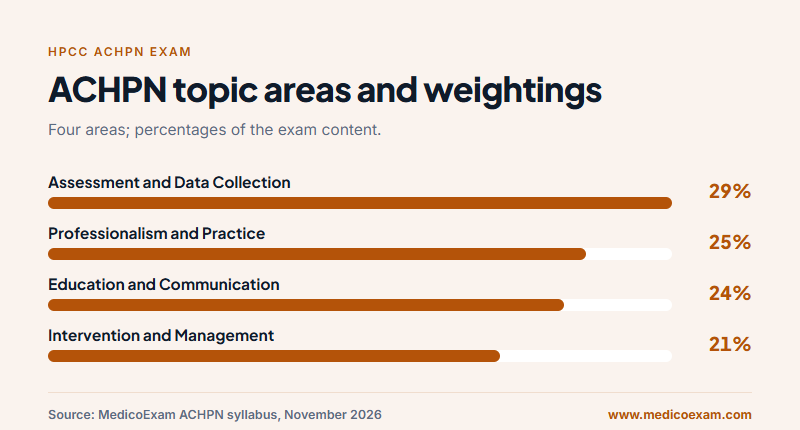
Read the weightings as a guide to where marks are available, not as a promise of how many questions you will see on a given day. The two largest areas together are 54 percent of the blueprint, so Assessment and Data Collection and Professionalism and Practice deserve the biggest share of your hours. The two smaller areas still matter, because each is a fifth or more of the exam, and a weak area can pull a strong result down.
It also helps to remember who the exam is written for. It targets advanced practice nurses, so questions ask what a clinician in an NP or CNS role should recognise, decide and communicate, and not simply what a textbook defines. Your preparation should therefore combine content review with practice at making judgements, and the sections below take each area in turn.
What belongs in the Assessment and Data Collection area?
At 29 percent this is the largest area, and its topic list is long. It covers medical history and review of systems, physical examination, functional assessment, psychosocial and spiritual assessment, and standardised assessment and prognostic tools. It also covers the signs and symptoms of serious illness, advance care planning, disease progression and prognostication, the signs of imminent death, and the unique needs of specific populations.
A practical way to study the list is to group it. One group is gathering information: history, review of systems, the examination, functional assessment and the psychosocial and spiritual picture. A second group is interpreting it: standardised tools, prognostication and disease progression. A third group is planning with the patient and family: advance care planning and the needs of particular populations. Ask yourself of each topic what you would collect, what the findings would tell you and what you would discuss with the patient.
Practice questions in this area usually put you in a short scenario and ask for your next step or your best interpretation. When you review a missed question, write down which of the three groups it belonged to. Over a few weeks, the pattern of your misses will show whether the trouble is collecting information, interpreting it or planning around it.
How should you study Intervention and Management?
This is the smallest of the four areas at 21 percent, yet its topic list is broad. The syllabus names diagnostic tests and procedures, pharmacologic therapies, non-pharmacologic interventions, complementary and alternative interventions, the disease process and plan of care, hospice and palliative care emergencies, palliative sedation and life support devices.
Because the list is broad, a one-page map works better than long notes. Put the headings on a single sheet and write the three or four ideas you most need to recall under each. Then test yourself from a blank sheet. Gaps show up quickly when you cannot fill a heading from memory, and they show up long before an exam question exposes them.
MedicoExam prepares you for the exam and does not provide clinical guidance. For the clinical detail behind each heading, use your graduate coursework, the references in HPCC's Detailed Content Outline and the guidelines you use in practice, and treat practice questions as a way to rehearse recall and judgement under time pressure.
What do Education and Communication ask?
Education and Communication carries 24 percent, and the syllabus lists five topics: age-appropriate teaching methods, communication theory and principles within the context of hospice and palliative care, strategies to overcome communication barriers, cultural and spiritual competence, and grief, loss and bereavement.
Candidates with a strong clinical background sometimes underrate this area because it feels like common sense. Exam items, however, tend to reward a precise choice among several reasonable-sounding responses. Practise telling apart an answer that is kind from an answer that is both kind and effective, for example one that checks understanding, respects the person's values and gives the family something concrete to do next.
Build short revision cards for the five topics and add one or two real examples from your own practice to each, with identifying details removed. Real examples are easier to recall on the day than abstract definitions, and they help you decide between two close answer options.
What belongs in Professionalism and Practice?
The 25 percent weighting makes this the second-largest area. Its topics include the principles of biomedical ethics, professional boundaries, scope of practice, opioid stewardship, national hospice and palliative care standards and guidelines, self-care covering burnout, compassion fatigue and moral distress, clinical decision making, continuous quality improvement, hospice criteria and professional development.
Two features make this area different from the others. First, it mixes ethics and scope-of-practice questions, which depend on judgement, with questions on standards and hospice criteria, which depend on recall. Study the two kinds differently: reason through ethics scenarios aloud, and revisit the standards and criteria with flashcards. Second, it includes self-care, which candidates sometimes skip. The topic names burnout, compassion fatigue and moral distress, so know what each term means and how they differ.
A good habit is to read each ethics scenario twice, first for the facts and then for the question actually being asked. Many wrong answers are correct statements that answer a different question, and the second reading is where you catch them.
How do you build an ACHPN study plan that works?
A plan starts with a baseline. Sit a timed practice test early, score each of the four areas separately, and write the results down. That record is the most useful document you will make, because it tells you where hours will earn the most. Then build the weeks around the weightings, giving the largest areas the most time without ignoring the others.
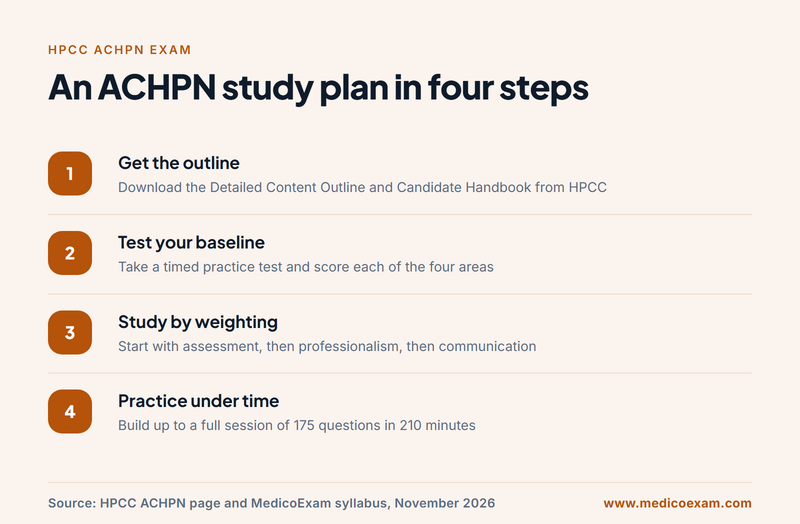
One simple pattern works for many candidates. In the first phase, read the Detailed Content Outline and map every topic to a note or a reference. In the second phase, study area by area, starting with Assessment and Data Collection, then Professionalism and Practice, then Education and Communication, then Intervention and Management. In the third phase, move to mixed timed sets, since the live exam never says which area a question belongs to.
Match your timetable to the testing windows. If you plan to test in a given window, set your baseline test at least a couple of months earlier, so you have time to respond to what it shows. Because you are an experienced clinician, you may be tempted to rely on practice knowledge alone. Resist that, since the exam is built from a defined outline and your daily work may emphasise some parts of it more than others.
Short, regular sessions beat rare marathons. Aim for sessions you can repeat on most days, finish each with a few minutes of recall from a blank page, and keep a running list of the questions you missed and why. Review that list weekly, and the same mistakes will stop appearing.
What do practice questions add to your preparation?
Questions serve three purposes. They show you the format, so that nothing about the interface or the wording is new on the day. They train your pace, since 72 seconds a question is a real constraint. And they reveal which content areas need work. They do not replace the study of the outline itself, so use them alongside it and not instead of it.
When you review a set, spend more time on the questions you got wrong or guessed right than on the ones you answered confidently. For each, write why the correct option is best and why each other option fails. That habit trains the comparison skill the exam rewards, where several options sound plausible and only one is best.
Take at least a few full-length timed sessions of 175 questions in 210 minutes before the real attempt. Stamina matters on a three-and-a-half-hour exam, and a full rehearsal shows whether your pace holds up. MedicoExam's ACHPN practice test is built for exactly this kind of timed rehearsal.
How do you manage the clock on exam day?
Start with a pace target. At about 72 seconds a question, you should be roughly halfway through the 175 questions when half of the 210 minutes have passed. Check yourself at a few points rather than constantly, because watching the clock all the time costs focus.
Read the final sentence of each question stem before the scenario, so you know what to look for as you read. Rule out the options you can, pick the best of those left and move on. If a question is taking too long, flag it, pick your best option and continue; a flagged question can be revisited if time remains, but an unanswered one cannot score.
Look after the basics too. Check your identification and the testing arrangements ahead of time, whether you will be at a PSI test centre or using Live Remote Proctoring, and read HPCC's instructions for your delivery method. A calm start saves mental energy for the questions themselves.
What should you do if you do not pass?
A result below 500 is information, not a verdict. Use whatever feedback HPCC gives you to see which areas were weakest, and compare that with your own practice records. Then rebuild your plan around those areas instead of restarting everything from the beginning. Aim your next attempt at the weak areas instead; that usually works faster than revising everything again.
Read HPCC's description of the reTEST Assured programme, and its retesting rules in the Candidate Handbook, before you decide when and how to try again. Plan the next attempt around one of the four testing windows, and set aside enough weeks to correct the weakest area properly.
Is the ACHPN credential worth the effort and the fee?
Only you can answer that, and nobody can give you a figure for it. HPCC describes the exam as designed for experienced hospice and palliative advanced practice registered nurses, and the credential is valid for four years. No salary or pass-rate numbers appear here, since none of the sources behind this guide publish them.
Count the costs: the $515 non-member fee or the $355 member fee, the time to prepare, and the licence, education and practice requirements you must already meet. Set them against the benefits, which include professional recognition and the habit of reviewing the whole field against a defined outline. For many advanced practice nurses in this specialty, a structured review is valuable in its own right.
A final word on preparing for the ACHPN exam
A study plan for ACHPN should mirror the blueprint's weightings. Assessment and Data Collection at 29 percent, Professionalism and Practice at 25 percent and Education and Communication at 24 percent make up most of the exam, with Intervention and Management at 21 percent completing it. Divide your hours in similar proportions and measure your readiness with timed scenario sets.
Sit a practice test, record four area scores and start with the biggest gap. Check every figure against HPCC's parent site before you book, as fees and procedures can be revised, and apply once your documents are ready and your preparation is nearly done.
Frequently Asked Questions
How many questions are on the ACHPN exam?
The ACHPN exam has 175 questions, and you have 210 minutes to answer them. That works out to roughly 72 seconds a question. Practise at that pace in timed sets, because pacing is a real skill on a test that runs three and a half hours.
What is the passing score for the ACHPN exam?
The passing score is 500 on a scale of 200 to 800. This is a scaled score and not a simple percentage of correct answers, and HPCC decides how scaled results relate to answers marked correct. Use 500 as your target and judge practice results by content area.
How much does the ACHPN exam cost?
As of November 2026, HPCC lists initial certification at $515 for non-members and $355 for HPNA members. The reTEST Assured fee is $135. Amounts may be revised, so check the current figures on HPCC's ACHPN page before you apply and pay.
Which ACHPN content area carries the most weight?
Assessment and Data Collection carries the most weight at 29 percent. Professionalism and Practice follows at 25 percent, then Education and Communication at 24 percent and Intervention and Management at 21 percent. Give your largest blocks of study time to the first two areas.
Who can apply for the ACHPN exam?
Applicants need a valid APRN licence with no restrictions, a completed NP or CNS graduate programme, a transcript showing the required courses and a 500-hour practicum, and recent hospice and palliative advanced practice hours as HPCC specifies.
When can I take the ACHPN exam?
Testing happens in four windows a year, one each in March, June, September and December, and each covers the whole month. Candidates sit at a PSI test centre or take the exam online with Live Remote Proctoring. Check HPCC's page for current deadlines before fixing a date.
- ACHPN practice test |
- ACHPN practice questions |
- ACHPN practice exam |
- HPCC ACHPN exam |
- Advanced Certified Hospice and Palliative Nurse certification |
- ACHPN syllabus |
- ACHPN exam content outline |
- ACHPN exam topics |
- ACHPN passing score |
- ACHPN sample questions |
- free ACHPN practice questions |
- ACHPN exam questions and answers


