
Legal Nurse Consultant Study Guide: How to Pass the ALNCCB Exam

The Legal Nurse Consultant credential validates your ability to interpret medical records, identify standards-of-care deviations, and support litigation teams with clinical expertise. For nurses who want intellectual challenge beyond bedside care, the LNCC certification administered by American Association of Legal Nurse Consultants (AALNC) through American Legal Nurse Consultant Certification Board (ALNCCB) offers structured recognition of that expertise.
This comprehensive Legal Nurse Consultant study guide blends exam strategy with career insight—written from a risk and compliance mindset so you not only pass the LNCC exam but build a defensible professional path.
What Is a Legal Nurse Consultant?
A Legal Nurse Consultant is a registered nurse who applies clinical knowledge to legal cases, including malpractice, personal injury, regulatory compliance, and risk management. They analyze medical records, assess standards of care, prepare chronologies, and assist attorneys in interpreting healthcare documentation.
Unlike expert witnesses who testify, legal nurse consultants may work behind the scenes or serve as testifying experts depending on credentials and experience.
Authoritative background on the profession can be explored through:
-
American Association of Legal Nurse Consultants
-
American Nurses Association
-
National Council of State Boards of Nursing
-
U.S. Bureau of Labor Statistics
-
National Institutes of Health
These institutions reinforce the regulatory and practice framework underpinning Legal Nurse Consultant certification.
LNCC: ALNCCB Certification Overview
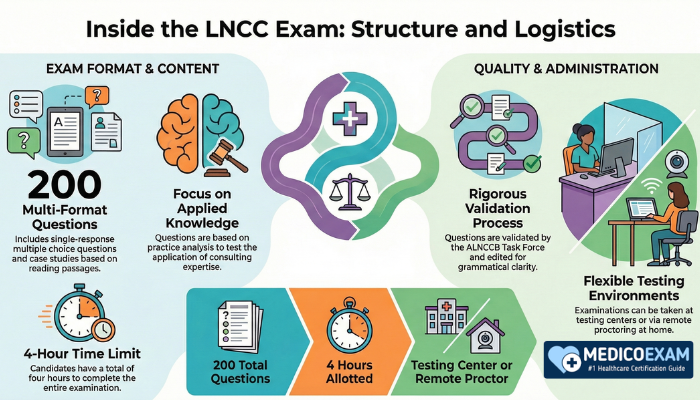
The LNCC (Legal Nurse Consultant Certified) exam is administered by the American Legal Nurse Consultant Certification Board.
The LNCC exam consists of 200 multiple-choice questions, including case studies, completed in four hours. It tests applied legal nurse consulting knowledge across ten major content domains. Initial testing fees are $360 for AALNC members and $495 for non-members.
Official exam details are published in the LNCC Candidate Handbook available through AALNC’s certification portal.
LNCC Exam Format
-
200 questions
-
Single-response multiple choice
-
Case-study-based questions
-
Four-hour testing window
-
Practice-analysis driven blueprint
This exam tests application, not memorization. Expect scenarios requiring risk analysis, standards-of-care interpretation, and documentation critique.
Legal Nurse Consultant Certification Cost
Initial LNCC testing fees:
-
AALNC Member: $360
-
Non-Member: $495
Additional costs may include:
-
Study materials
-
Continuing education
-
Renewal fees
-
Potential retake fees (if applicable)
Always verify current pricing via official ALNCCB materials.
Legal Nurse Consultant Salary Expectations
According to workforce data from the U.S. Bureau of Labor Statistics, nurses transitioning into consulting roles often command higher hourly rates compared to traditional clinical roles.
While salaries vary globally, typical ranges may depend on:
-
Geographic location
-
Independent vs. firm employment
-
Litigation specialization
-
Testifying expert status
-
Case volume
Many experienced consultants earn significantly more on a per-case basis compared to standard RN wages, particularly in medical malpractice and complex litigation cases.
How to Get Legal Nurse Consultant Certification
Step-by-step roadmap:
-
Hold an active RN license.
-
Gain clinical experience (typically 5 years recommended).
-
Accumulate legal nurse consulting experience.
-
Apply for LNCC eligibility.
-
Prepare using a structured Legal Nurse Consultant study guide.
-
Pass the ALNCCB certification exam.
Detailed eligibility criteria are outlined in the LNCC Candidate Handbook.
Key LNCC Content Domains
Each domain below includes a direct-answer summary for AEO optimization.
1. Medical Malpractice (19–23%)
-
Medical malpractice questions assess your ability to evaluate breaches in standard of care, causation, damages, and documentation integrity. Expect case-based analysis of negligence claims and deviation from clinical protocols.
Core competencies:
-
Standard-of-care identification
-
Documentation review
-
Causation analysis
-
Expert witness coordination
2. Personal Injury (12–14%)
-
Personal injury cases involve trauma assessment, medical record evaluation, and long-term impact forecasting. You must link injury mechanisms to clinical outcomes.
Focus areas:
-
Accident reconstruction insights
-
Treatment timelines
-
Prognosis evaluation
-
Damage assessment support
3. Long-Term Care Litigation / Elder Law (8–10%)
-
This domain addresses nursing home negligence, elder abuse, and regulatory compliance in long-term care settings.
Common pitfalls:
-
Failure to recognize pressure injury documentation gaps
-
Medication management inconsistencies
-
Inadequate staffing documentation
4. Product Liability (7–9%)
-
Covers medical device failure, pharmaceutical complications, and equipment malfunction.
You’ll analyze:
-
Adverse event reports
-
FDA reporting frameworks
-
Documentation inconsistencies
5. Toxic Tort (5–7%)
-
Exposure-related litigation requires understanding pathophysiology, environmental factors, and long-term medical impact.
6. Workers’ Compensation (6–9%)
-
Tests your understanding of occupational injury documentation, disability ratings, and employer compliance.
7. Risk Management (6–8%)
-
Risk mitigation principles overlap with hospital compliance and internal audits.
As someone with a governance mindset, treat this domain like a control assessment:
-
Incident reporting systems
-
Root cause analysis
-
Policy adherence
8. Life Care Planning (5–7%)
-
Involves cost forecasting for long-term medical care needs. Accuracy and defensibility are essential.
9. Regulatory Compliance (5–8%)
-
Expect questions referencing healthcare regulations and documentation standards. Understanding frameworks from bodies like the Centers for Medicare & Medicaid Services can strengthen this area.
10. Medicare Set-Aside (4–6%)
-
Requires knowledge of future medical expense allocation to protect Medicare’s interests.
Legal Nurse Consultant Study Guide Strategy
Phase 1: Diagnostic Assessment
Before deep study, simulate exam conditions using structured practice questions.
A structured preparation pathway is available through the MedicoExam ALNCCB preparation resource, where candidates can attempt scenario-driven assessments aligned with the official blueprint. You can explore the structured online preparation system here: Legal Nurse Consultant Study Guide
Use this early to identify weak domains.
Phase 2: Domain-by-Domain Mastery
For each domain:
-
Study legal definitions.
-
Review case law concepts.
-
Analyze real malpractice examples.
-
Create error logs.
Avoid passive reading. LNCC is application-heavy.
Phase 3: Legal Nurse Consultant Practice Test Simulation
Timed practice is essential.
Case-study questions often:
-
Include multi-paragraph clinical summaries.
-
Require isolating legally relevant details.
-
Present distractors based on minor documentation details.
Structured simulation helps reduce cognitive fatigue during the 4-hour exam.
Common Mistakes Candidates Make
-
Overemphasizing medical knowledge but ignoring legal framing.
-
Memorizing definitions without applying them to scenarios.
-
Ignoring time management during 200-question simulations.
-
Underestimating Medicare Set-Aside calculations.
-
Skipping risk management documentation review.
Emotional Reality of Exam Preparation
Preparing for Legal Nurse Consultant certification can feel overwhelming. You’re balancing clinical work, possibly family obligations, and learning legal frameworks that feel foreign.
The stress is normal.
Structured preparation reduces uncertainty. Clarity reduces anxiety. Practice reduces panic.
Career Value of Certified Legal Nurse Consultant Certification
Holding LNCC signals:
-
Applied litigation competence
-
Risk evaluation expertise
-
Medical-legal documentation proficiency
-
Professional credibility
In global markets, healthcare litigation continues expanding. Certified consultants stand out in competitive markets.
Legal Nurse Consultant Salary Growth Path
Income progression often correlates with:
-
Years of consulting experience
-
Specialization (malpractice vs toxic tort)
-
Expert witness credentials
-
Business development capability
Entrepreneurial consultants may significantly increase earnings through independent practice.
Retake Policy & Renewal Considerations
Retake policies and renewal cycles may vary depending on current ALNCCB regulations. Always consult the latest Candidate Handbook through AALNC resources for up-to-date guidance.
Frequently Asked Questions
1. Is the LNCC exam difficult?
-
The LNCC exam is considered moderately to highly challenging because it tests applied legal reasoning, not just clinical knowledge. Case-study questions require interpreting documentation within legal contexts. Candidates who combine structured study with timed practice tests typically perform better.
2. How long should I prepare for Legal Nurse Consultant certification?
-
Most candidates prepare for three to six months, depending on experience in legal settings. Nurses without prior consulting exposure may need additional time to understand litigation terminology and documentation standards.
3. What is the legal nurse consultant salary range?
-
Legal nurse consultant salary varies by region, experience, and consulting model. Independent consultants may earn higher per-case fees, while employed consultants earn structured salaries. Earnings generally exceed traditional RN wages in many markets.
4. Is ALNCCB certification worth it?
-
ALNCCB certification enhances credibility, validates competency, and may improve earning potential. Employers and attorneys often prefer certified consultants due to standardized knowledge verification.
5. Can I take a Legal Nurse Consultant practice test before the real exam?
-
Yes. Practice tests simulate case-based questions and help improve time management. Structured practice platforms aligned with the exam blueprint are strongly recommended.
6. What happens if I fail the LNCC exam?
-
Candidates may typically retake the exam after meeting waiting period requirements defined by the certification body. Policies can change, so verify with official ALNCCB guidance.
7. Do I need prior legal experience to qualify?
-
Eligibility generally requires RN licensure and professional experience. Direct legal experience strengthens preparation but may not always be mandatory depending on eligibility criteria.
8. How much does Legal Nurse Consultant certification cost?
-
Initial LNCC exam fees are $360 for AALNC members and $495 for non-members. Additional expenses may include study materials and renewal fees.
9. Is the LNCC recognized internationally?
-
While administered in the United States, the credential is respected globally in medical-legal contexts, particularly in countries with structured healthcare litigation systems.
10. Does certification guarantee higher income?
-
Certification enhances professional credibility but income depends on market demand, networking, specialization, and business strategy.
Final Thoughts: Building a Defensible Career
The Legal Nurse Consultant path combines clinical expertise with analytical precision. Passing the ALNCCB LNCC exam is not simply about certification—it’s about positioning yourself as a trusted interpreter between medicine and law.
Approach preparation like a risk assessment project:
-
Identify vulnerabilities.
-
Strengthen weak controls.
-
Simulate stress scenarios.
-
Validate readiness.
Structured preparation, strategic practice, and disciplined execution will move you from candidate to certified professional.
For structured LNCC-aligned preparation resources and exam simulation tools, explore the MedicoExam certification preparation portal and review additional FAQs.
Your clinical experience already carries weight. Certification adds legal authority.


