
Unpacking C-ELBW Practice Questions: Truths & Myths
 The National Certification Corporation (NCC) C-ELBW certification serves as a critical credential for registered nurses and advanced practice registered nurses providing care to extremely low birth weight (ELBW) neonates. This specialized certification, the Care of the Extremely Low Birth Weight Neonate (C-ELBW), validates a professional's expertise in the complex and delicate care required for this vulnerable patient population. This article will delve into the truths and myths surrounding C-ELBW practice questions, guiding aspiring candidates through essential preparation insights and clarifying common misconceptions to ensure a focused and effective study approach.
Understanding the C-ELBW Certification Process
Achieving the C-ELBW certification signifies a nurse’s deep understanding and proficiency in managing the unique challenges associated with extremely low birth weight (ELBW) neonates. Specifically, the examination, designated by the National Certification Corporation as C-ELBW, rigorously assesses competencies across multiple domains. In doing so, it ensures that certified professionals possess the knowledge required to deliver optimal, evidence-based care. Typically, candidates for this certification include neonatal nurses, nurse practitioners, and clinical nurse specialists who are actively involved in the direct care of these fragile infants. Ultimately, earning this credential reflects both advanced clinical expertise and a strong commitment to improving outcomes for one of the most vulnerable patient populations.
The C-ELBW examination is designed to test a broad spectrum of knowledge, from initial assessment to long-term outcomes. Understanding the structure and requirements of this crucial exam is the first step toward successful certification. Here's a breakdown of the key examination details:
-
Exam Name: NCC Care of the Extremely Low Birth Weight Neonate
-
Exam Code: C-ELBW
-
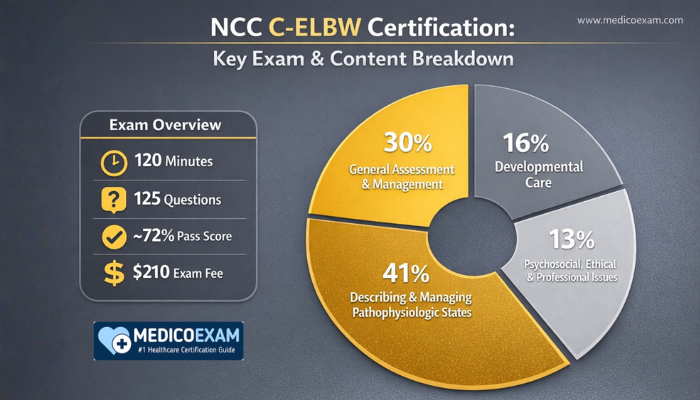
Exam Price: $210, which includes a $50 non-refundable application submission cost and a $160 testing fee.
-
Duration: Candidates are allotted 120 minutes to complete the examination.
-
Number of Questions: The exam comprises 125 questions.
-
Passing Score: The NCC uses a pass/fail system, with an approximate passing score of 72%.
Examining the C-ELBW Syllabus Domains
The NCC C-ELBW certification exam covers four main content areas, each weighted to reflect its importance in the comprehensive care of ELBW neonates. A thorough understanding of these domains is paramount for structuring your study plan and targeting areas where you might need more focus. Ignoring specific syllabus topics or underestimating their weight can significantly impact exam performance.
The syllabus defines the knowledge base required for certified practitioners, ensuring they are competent in all critical aspects of ELBW care. These domains encompass a wide range of clinical scenarios and theoretical knowledge:
General Assessment and Management:
-
This domain accounts for 30% of the exam content. It focuses on the initial evaluation, stabilization, and ongoing general care strategies for ELBW neonates, covering aspects like fluid and electrolyte balance, thermoregulation, and nutritional support.
Developmental Care:
-
Making up 16% of the exam, this section emphasizes strategies and interventions aimed at promoting optimal neurodevelopmental outcomes and minimizing environmental stress for ELBW infants, including positioning, sensory stimulation, and family-centered care.
Describing & Managing Pathophysiologic States:
-
The largest section, at 41%, this domain tests knowledge of various disease processes and acute conditions common in ELBW neonates. It includes respiratory distress syndrome, chronic lung disease, patent ductus arteriosus, necrotizing enterocolitis, intraventricular hemorrhage, and sepsis, along with their respective management strategies.
Psychosocial, Ethical, and Professional Issues and Outcomes with ELBW Neonates and Families:
-
This final domain, representing 13% of the exam, addresses the complex ethical dilemmas, psychosocial support needs, and professional responsibilities associated with caring for ELBW infants and their families, including end-of-life care discussions and long-term follow-up considerations.
Distinguishing C-ELBW Practice Questions: Truths & Myths
Many candidates approach C-ELBW practice questions with preconceived notions that can either help or hinder their preparation. Separating truth from myth is crucial for effective study. Genuine practice questions simulate the exam environment and question format, providing invaluable feedback on knowledge gaps and test-taking strategies. Conversely, relying on unreliable sources or believing common myths can lead to misguided efforts and frustration.
Addressing Common Misconceptions
Myth: Practice questions are exactly what will be on the exam.
-
Truth: While practice questions mirror the exam's structure and content areas, they are not verbatim copies of actual exam questions. Their purpose is to familiarize you with the question style, depth of knowledge required, and time management, not to provide "answers" for memorization.
Myth: More practice questions are always better, regardless of quality.
-
Truth: The quality of practice questions far outweighs the quantity. High-quality questions from reputable sources, like those provided by the National Certification Corporation or trusted educational platforms, are designed to test your critical thinking and application of knowledge, not just recall.
Myth: Focusing only on difficult questions prepares you adequately.
-
Truth: A balanced approach is best. While challenging questions help identify weaknesses, ensuring a solid grasp of fundamental concepts is equally vital. The C-ELBW exam assesses a comprehensive range of topics, requiring proficiency across all difficulty levels.
Leveraging Reliable Practice Resources
Reliable practice questions are instrumental in gauging your readiness for the C-ELBW exam. They offer a window into the types of clinical scenarios and theoretical concepts you will encounter. Seek out resources that align closely with the official NCC exam content outline and syllabus.
Official NCC Resources:
-
The NCC website is the primary source for accurate exam information, including content outlines and sometimes sample questions. Always refer to the NCC official page for the most up-to-date guidance.
Reputable Study Guides and Courses:
-
Many educational providers offer comprehensive study guides and prep courses tailored to the C-ELBW exam. These resources often include well-vetted practice questions designed to mimic the actual exam.
Peer Review and Study Groups:
-
Discussing practice questions with peers in a study group can offer diverse perspectives and deepen understanding of complex topics, helping to identify areas where your interpretation might differ from the expected answer.
Mastering Effective Preparation Strategies for C-ELBW
Passing the C-ELBW certification exam requires more than just memorizing facts; it demands strategic preparation. Effective study methods involve a combination of structured learning, active recall, and consistent practice. Developing a personalized study plan that integrates these elements will optimize your chances of success.
Structuring Your Study Routine
-
A well-organized study routine is the cornerstone of effective exam preparation. It helps manage the vast amount of information and ensures comprehensive coverage of all syllabus domains.
Content Outline Review:
-
Begin by thoroughly reviewing the NCC C-ELBW exam content outline. This document is your roadmap, detailing the specific topics and their respective weights.
Diagnostic Assessment:
-
Take a full-length practice exam early in your preparation. This will serve as a diagnostic tool, highlighting your strengths and weaknesses across the different domains.
Focused Study:
-
Allocate study time based on the syllabus weighting and your diagnostic results. Dedicate more time to areas where you scored lower or to the larger percentage domains like "Describing & Managing Pathophysiologic States."
Active Learning Techniques:
-
Instead of passive reading, engage in active learning. This includes summarizing concepts in your own words, teaching topics to others, or creating flashcards for key terms and definitions.
Integrating Practice Questions Ethically
While practice questions are invaluable, their ethical use is paramount. Relying on "exam dumps" or unauthorized materials not only violates professional integrity but also undermines the true purpose of certification to validate genuine knowledge and skill. Always prioritize learning over memorization of specific answers.
Understand Rationales:
-
For every practice question, whether answered correctly or incorrectly, review the rationale. Understanding why an answer is correct or incorrect reinforces learning and helps apply principles to similar scenarios.
Simulate Exam Conditions:
-
As you get closer to the exam, take full-length practice tests under timed conditions. This helps build stamina, manage anxiety, and refine your pacing, preparing you for the actual 120-minute duration.
Review Performance:
-
After each practice test, analyze your performance. Identify patterns in your incorrect answers are they consistently from a specific domain? Or related to a particular type of question (e.g., application vs. recall)? This analysis will inform subsequent study sessions.
Recognizing the C-ELBW Certification's Professional Value
Earning the NCC C-ELBW certification from the National Certification Corporation offers significant professional benefits for nurses working with extremely low birth weight neonates. In addition to being a personal achievement, it enhances professional credibility, opens doors to career advancement, and demonstrates a strong commitment to excellence in a highly specialized field. Furthermore, this credential underscores a nurse’s dedication to maintaining the highest standards of care. Ultimately, such expertise directly benefits the vulnerable patients they serve while strengthening the nurse’s role within neonatal healthcare teams.
Advancing Your Neonatal Nursing Career
Certification often translates into tangible career advantages. Employers frequently seek out certified professionals, recognizing their validated expertise and commitment to specialized practice. The C-ELBW can distinguish you in competitive job markets and lead to greater responsibilities or leadership roles.
Enhanced Credibility:
-
Certification formally recognizes specialized knowledge, signaling to colleagues, employers, and patients that you meet rigorous standards of competence in ELBW care.
Career Progression:
-
Many healthcare systems use certification as a criterion for promotion, salary increases, or eligibility for advanced practice roles. It can be a catalyst for pursuing roles as a neonatal educator, clinical nurse specialist, or advanced practice registered nurse.
Professional Development:
-
The preparation process itself is a powerful form of professional development, deepening your understanding of evidence-based practices and current guidelines in ELBW care. Continue your learning journey with additional resources like those found on NCC C-ELBW sample questions.
Evaluating C-ELBW Exam Difficulty and Preparedness
The C-ELBW exam is known for its comprehensive scope and requires a significant level of clinical expertise and theoretical knowledge. Candidates often wonder about the C-ELBW exam difficulty level. While individual experiences vary, the rigorous nature of the content and the critical thinking required make it a challenging yet attainable goal for dedicated professionals. Successful candidates are typically those who engage in systematic and sustained preparation.
Assessing your preparedness involves more than just passing a few practice questions; it requires a holistic evaluation of your knowledge, critical thinking skills, and test-taking readiness. The approximate passing score of 72% indicates that a strong command of the material across all domains is essential.
Building Confidence for Test Day
Confidence on test day stems from thorough preparation and a clear understanding of the exam format. Addressing potential anxiety and ensuring you are physically and mentally ready are crucial components of your overall strategy.
Review Weak Areas:
-
Dedicate final study time to reviewing topics identified as weaknesses during practice tests. Don't try to cram new information, but solidify existing knowledge.
Manage Test Anxiety:
-
Practice relaxation techniques. Ensure you get adequate sleep the night before and arrive at the test center early to avoid rushing.
Understand Question Nuances:
-
Pay close attention to keywords in exam questions (e.g., "first," "most important," "contraindicated"). The C-ELBW exam often requires selecting the best answer among several plausible options, necessitating careful analysis.
Optimal Health:
-
Prioritize your physical health in the days leading up to the exam. A healthy diet, adequate sleep, and moderate exercise can significantly impact your mental clarity and endurance during the test. For more details on certification overview, refer to external resources like C-ELBW certification overview.
Maximizing Outcomes Post-Certification
Earning the C-ELBW certification is not the end of the journey but a significant milestone in a nurse's professional development. Maximizing outcomes involves continuously applying the acquired knowledge, staying current with evidence-based practices, and leveraging the credential for ongoing career growth. The certification empowers nurses to advocate for the best care for ELBW neonates and their families, fostering improved patient outcomes.
Sustaining Expertise and Impact
The field of neonatal critical care is constantly evolving. Maintaining your C-ELBW certification requires ongoing engagement with the latest research, clinical guidelines, and professional development opportunities. This commitment ensures that your expertise remains relevant and impactful.
Continuing Education:
-
Participate in workshops, conferences, and online courses focused on neonatal critical care and ELBW neonates to fulfill continuing education requirements for certification renewal and to deepen your knowledge base.
Mentorship and Leadership:
-
Use your advanced certification to mentor less experienced nurses, lead clinical initiatives, or contribute to policy development within your institution, further elevating the standard of care for ELBW infants.
Advocacy:
-
Leverage your specialized knowledge to advocate for resources, research, and practices that improve the health and well-being of extremely low birth weight neonates and their families. Continuous engagement with the C-ELBW candidate guide ensures adherence to professional standards.
Frequently Asked Questions
Q1. What is the C-ELBW certification and who is it for?
-
The C-ELBW is a specialized certification offered by the National Certification Corporation for registered nurses and advanced practice registered nurses. Specifically, it validates expertise in the care of extremely low birth weight (ELBW) neonates. Typically, this credential is pursued by professionals working in neonatal intensive care units or similar high-acuity clinical settings. Ultimately, earning the C-ELBW certification demonstrates advanced knowledge, specialized clinical competence, and a strong commitment to delivering high-quality neonatal care.
Q2. How long is the C-ELBW exam and how many questions are there?
-
The C-ELBW exam has a duration of 120 minutes and consists of 125 multiple-choice questions. Candidates must answer approximately 72% correctly to achieve a passing score, though exact pass percentages can vary slightly by exam version.
Q3. What are the main content areas covered by the C-ELBW exam?
-
The exam covers four primary domains. First, General Assessment and Management accounts for 30% of the exam. Next, Developmental Care represents 16%. Most importantly, Describing & Managing Pathophysiologic States makes up the largest portion at 41%, indicating a strong emphasis on understanding complex neonatal conditions. Finally, Psychosocial, Ethical, and Professional Issues and Outcomes with ELBW Neonates and Families contributes the remaining 13%. Overall, the largest focus is on pathophysiologic states, highlighting the importance of mastering clinical knowledge related to neonatal health conditions.
Q4. Are C-ELBW practice questions identical to the actual exam questions?
-
No, practice questions are not identical to actual exam questions. They are designed to simulate the format, content, and difficulty level of the C-ELBW exam, helping candidates familiarize themselves with the style and assess their knowledge gaps, rather than providing exact answers to memorize.
Q5. What are the benefits of obtaining C-ELBW certification?
-
Obtaining C-ELBW certification enhances a nurse's professional credibility, demonstrates specialized expertise in ELBW care, and can lead to career advancement opportunities such as promotions or eligibility for advanced practice roles. It also signifies a commitment to maintaining high standards of patient care.
Conclusion
Unpacking the C-ELBW practice questions reveals that success hinges on a blend of accurate information, strategic preparation, and ethical study habits. By dispelling myths and embracing effective learning techniques, nurses can confidently pursue this vital certification. The credential not only validates specialized expertise but also enhances career trajectories and, most importantly, elevates the quality of care for the most vulnerable of patients.
Ready to validate your expertise in caring for extremely low birth weight neonates? Begin your comprehensive preparation today by exploring detailed study resources and practice examinations. Visit our platform for extensive guidance and to access C-ELBW exam FAQs and preparation guides designed to support your journey towards certification.
- NCC C-ELBW Question Bank |
- NCC C-ELBW Eligibility & Requirements |
- NCC Extremely Low Birth Weight Neonate Practice Test |
- NCC C-ELBW Exam Cost |
- NCC C-ELBW Registration Process |
- NCC Extremely Low Birth Weight Neonate Study Guide |
- NCC C-ELBW Recertification |
- NCC C-ELBW Certification Overview |
- NCC Extremely Low Birth Weight Neonate Syllabus |
- NCC C-ELBW Preparation Time |
- NCC C-ELBW Passing Score |
- NCC C-ELBW Exam Format |
- NCC Extremely Low Birth Weight Neonate Sample Questions |
- NCC C-ELBW Career Opportunities |
- NCC C-ELBW Exam Difficulty


