
Strategic BCEN CBRN: Evidence-Based Exam Performance
The BCEN Certified Burn Registered Nurse (CBRN) credential stands as a pivotal benchmark for nursing professionals dedicated to excellence in burn care. This advanced certification, offered by the Board of Certification for Emergency Nursing (BCEN), rigorously validates a registered nurse's specialized knowledge and expertise across the entire spectrum of burn patient management. Targeting experienced RNs who desire to demonstrate their commitment to the highest standards in burn care, this article provides a comprehensive, evidence-based guide covering the exam's structure, content, preparation strategies, and the significant professional benefits of achieving this distinction.
Advancing Clinical Competence in Burn Care
The BCEN CBRN certification is specifically designed for registered nurses providing direct patient care to burn patients, from initial injury through rehabilitation. Achieving this credential signifies a deep understanding of burn pathophysiology, advanced clinical practice, and the multifaceted psychosocial considerations unique to burn recovery. It serves as a testament to a nurse's specialized skill set, enhancing their ability to deliver optimal outcomes in a challenging and complex care environment.
Examination Structure and Assessment Metrics
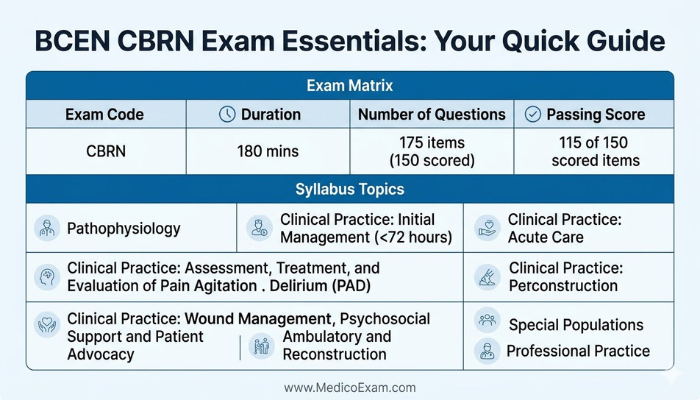
The BCEN CBRN examination, identified by exam code CBRN, is a comprehensive assessment lasting 180 minutes. Candidates are presented with a total of 175 items, comprising 150 scored questions and an additional 25 unscored pretest items used for future exam development. A passing score of 115 correct answers out of the 150 scored items is required to earn the certification. The investment for this rigorous evaluation varies, reflecting different membership statuses and additional offerings:
| Fee Type | Amount |
|---|---|
| Initial Exam Fee | $380 |
| ABA Member Initial Exam | $285 (reflecting a discount for American Burn Association members) |
| Military Discount | $195 (a reduced rate for military personnel) |
| Initial Exam with BCEN Test Assurance | $450 (includes an assurance program for retest opportunities) |
| ABA Member with BCEN Test Assurance | $355 |
| Military with BCEN Test Assurance | $265 |
| Retest Fee | $200 (for candidates needing to retake the exam) |
These various pricing tiers underscore BCEN's commitment to supporting burn care professionals from diverse backgrounds. Understanding these details is a crucial first step for any candidate considering this certification.
Mastering Core Content Domains for Burn Nursing
The CBRN certification exam evaluates a nurse's proficiency across nine critical domains of burn care, ensuring a holistic understanding of the patient journey. A thorough review of these content areas is essential for effective preparation. The domains are structured to cover both foundational knowledge and practical application in various burn scenarios. For a comprehensive overview, candidates are encouraged to consult the BCEN CBRN Content Outline.
Essential Knowledge Areas
-
Pathophysiology: This foundational domain covers the physiological responses to burn injury, including systemic effects, wound healing mechanisms, and metabolic changes. A deep understanding here forms the basis for all subsequent clinical interventions.
-
Clinical Practice: Initial Management (<72 hours): Focuses on the immediate care of burn patients, including fluid resuscitation, airway management, hypothermia prevention, and initial wound assessment and care. This phase is critical for patient survival and minimizing secondary injury.
-
Clinical Practice: Acute Care: Addresses ongoing management beyond the initial phase, encompassing infection control, nutritional support, organ system monitoring, and complications management in the acute hospital setting.
-
Clinical Practice: Assessment, Treatment, and Evaluation of Pain Agitation Delirium (PAD): Emphasizes the complex challenges of pain, agitation, and delirium in burn patients, requiring specialized assessment tools and tailored pharmacological and non-pharmacological interventions.
-
Clinical Practice: Wound Management: Details various wound care techniques, dressing selections, debridement methods, and surgical interventions such as skin grafting. Effective wound management is central to healing and functional recovery.
-
Psychosocial Support and Patient Advocacy: Recognizes the profound psychological and social impact of burn injuries on patients and their families. This section covers strategies for providing emotional support, addressing body image issues, and advocating for patient rights and needs throughout recovery.
-
Ambulatory and Reconstruction: Covers the continuum of care post-hospitalization, including outpatient management, scar management, rehabilitation strategies, and reconstructive surgical considerations to optimize long-term outcomes and quality of life.
-
Special Populations: Focuses on the unique considerations for specific patient groups, such as pediatric, geriatric, and pregnant burn patients, as well as those with pre-existing conditions that may complicate burn care.
-
Professional Practice: Addresses ethical considerations, legal aspects, professional standards, and quality improvement initiatives relevant to burn nursing. This domain ensures nurses practice within a professional and ethical framework.
Each domain requires a nuanced understanding and the ability to apply evidence-based practices to diverse clinical scenarios.
Enhancing Professional Standing with BCEN CBRN
Obtaining the BCEN CBRN certification is more than just passing an exam; it represents a significant commitment to professional growth and contributes substantially to a nurse's career trajectory. This credential demonstrates specialized expertise, which can translate into various tangible and intangible benefits within the demanding field of burn care.
Tangible Career Advantages
-
Increased Credibility and Recognition: The CBRN credential is a nationally recognized mark of excellence. It signals to employers, colleagues, and patients that a nurse possesses advanced, validated skills in burn nursing, setting them apart in a competitive healthcare landscape.
-
Enhanced Career Opportunities: Certified burn nurses are often preferred candidates for specialized roles, leadership positions, and educational opportunities within burn centers or units. The certification can open doors to new responsibilities and career pathways, including roles as clinical educators, advanced practice nurses, or burn unit managers.
-
Potential for Salary Advancement: While specific salary increases vary by institution and region, specialized certifications like the CBRN frequently correlate with higher earning potential. Employers often recognize and reward the enhanced skill set and dedication demonstrated by certified nurses.
-
Contribution to Patient Outcomes: Nurses with specialized knowledge are better equipped to implement evidence-based practices, anticipate complications, and provide superior care, directly impacting patient recovery and reducing adverse events in burn populations.
Beyond these, the certification fosters a deeper sense of professional pride and confidence, knowing one's capabilities have been independently validated by a respected organization like BCEN.
Navigating Eligibility Requirements for Certification
Before embarking on the BCEN CBRN exam journey, understanding and meeting the specific eligibility criteria is paramount. BCEN maintains strict requirements to ensure that only qualified and experienced registered nurses are granted this specialized credential, thereby upholding the integrity and value of the certification.
Key Eligibility Criteria
To be eligible for the BCEN CBRN examination, candidates must meet the following fundamental conditions:
-
Active Registered Nurse (RN) License: Applicants must hold a current, unrestricted registered nurse license in the United States or its territories, or a comparable license in Canada. This ensures that all candidates possess the foundational legal authority to practice nursing.
-
Clinical Experience: While BCEN does not mandate a specific number of years or hours in burn care to apply for the exam, it strongly recommends that candidates have significant experience (typically at least two years) in an acute burn care setting. This recommendation is based on the exam's advanced content, which requires practical application and critical thinking derived from direct patient experience.
Candidates are responsible for verifying their own eligibility before applying. BCEN provides detailed information regarding these requirements on its official BCEN resources page, which should be the primary reference point for all applicants. Failure to meet these criteria will result in an inability to sit for the exam.
Strategic Exam Readiness and Preparation
Effective preparation for the BCEN CBRN examination demands a multifaceted, evidence-based approach that transcends rote memorization. Candidates should develop a structured study plan incorporating diverse resources to build a robust understanding of burn care principles and practices. A comprehensive strategy is key to success, integrating official BCEN study materials with supplementary resources.
Developing an Effective Study Regimen
-
Utilize the BCEN CBRN Study Guide: Begin with the official content outline provided by BCEN. This document is the blueprint for the exam, detailing the percentage of questions from each domain. It helps prioritize study efforts.
-
Engage with BCEN CBRN Practice Questions: Regular practice is crucial. Incorporate a variety of practice questions from reputable sources to familiarize yourself with the exam format, question styles, and time management. This helps identify areas needing further review.
-
Consider a BCEN CBRN Exam Review Course: For structured learning and expert guidance, an accredited exam review course can be invaluable. These courses often break down complex topics, provide test-taking strategies, and offer interactive learning environments.
-
Leverage the Best BCEN CBRN Study Materials: Compile a library of reliable resources, including textbooks on burn care, clinical practice guidelines, and peer-reviewed articles. Supplementing official materials with well-regarded textbooks ensures a deeper understanding.
-
Form Study Groups: Collaborating with peers preparing for the same exam can provide different perspectives, facilitate discussion of challenging concepts, and offer mutual support and accountability.
-
Create a BCEN CBRN Test Bank: Systematically work through a large volume of practice questions. Analyzing incorrect answers is as important as getting correct ones, as it helps identify knowledge gaps and refine test-taking skills.
It is imperative to maintain ethical study practices. The use of "exam dumps" or unauthorized materials undermines the integrity of the certification process and can lead to severe consequences. Focus on genuine learning and comprehension, which ultimately benefits patient care.
Navigating Exam Day and Scoring Outcomes
Understanding the logistics of the BCEN CBRN exam day and how scores are determined is essential for managing expectations and reducing test anxiety. The process is standardized to ensure fairness and accuracy for all candidates.
Examination Format and Scoring
The BCEN Certified Burn Registered Nurse exam format is a computer-based test administered at various testing centers. As mentioned, it consists of 175 multiple-choice questions, where 150 are scored and 25 are pretest items that do not affect your final score. These pretest items are indistinguishable from scored questions, so candidates should approach every question with equal effort. The passing score, 115 out of 150, is a scaled score that accounts for slight variations in exam difficulty over time. The BCEN CBRN pass rate is not publicly disclosed by BCEN, which is common for many high-stakes certification exams. Candidates receive a pass/fail result immediately after completing the exam, followed by a detailed score report. This report can be particularly useful for those who do not pass, highlighting areas where further study may be needed for retesting.
Pre-Exam Preparation and During the Exam Tips
To optimize performance on exam day, consider these BCEN CBRN certification exam tips:
-
Familiarize Yourself with the Testing Center: If possible, visit the testing center beforehand to know the route, parking, and facility layout. This eliminates potential stressors on the day of the exam.
-
Arrive Early: Plan to arrive at least 30 minutes before your scheduled appointment to allow for check-in procedures and to settle in calmly.
-
Bring Required Identification: Ensure you have the necessary forms of identification as specified by BCEN. Without proper ID, you may be denied entry to the exam.
-
Manage Your Time Effectively: With 180 minutes for 175 questions, allocate roughly one minute per question. Do not spend too much time on a single difficult question; mark it for review and return later if time permits.
-
Read Questions Carefully: Pay close attention to keywords and exclusionary terms (e.g., "except," "least likely"). Ensure you understand what each question is truly asking before selecting an answer.
-
Avoid Second-Guessing: Often, your first instinct is correct. Only change an answer if you have a strong, logical reason based on deeper recall or re-evaluation.
These strategies, combined with thorough content preparation, significantly enhance a candidate's readiness to perform optimally.
Sustaining Your Credential: Recertification Requirements
Maintaining the BCEN CBRN certification is a continuous process that reflects a commitment to ongoing professional development and current practice in burn care. BCEN establishes specific BCEN CBRN recertification requirements to ensure that certified nurses remain competent and up-to-date with evolving standards and advancements in the field.
Pathways for Renewal
Certified burn nurses have several options for how to renew BCEN CBRN certification, typically on a four-year cycle. These pathways are designed to accommodate various professional activities and learning preferences:
-
Continuing Education (CE) Hours: The most common pathway involves accumulating a specified number of continuing education hours relevant to burn care. These hours must be earned from accredited sources and align with the CBRN content outline.
-
Clinical Practice Hours: Nurses actively working in burn care can also use a combination of clinical practice hours and fewer CE hours to meet recertification requirements. This pathway acknowledges the value of continuous hands-on experience.
-
Re-examination: As an alternative, certified nurses can choose to retake and pass the CBRN examination. This option ensures that their knowledge remains current by validating it against the latest exam blueprint.
It is crucial for certificants to track their CE hours and clinical practice accurately and to submit their recertification application well in advance of their certification expiration date. Early planning prevents lapses in certification and ensures continuous recognition of specialized expertise.
Advancing Burn Care Careers with BCEN CBRN
The BCEN CBRN certification acts as a catalyst for career advancement and professional recognition within the specialized domain of burn nursing. Nurses holding this credential often find themselves in a stronger position to influence care standards, take on leadership roles, and secure positions with greater responsibility and compensation. The BCEN Certified Burn Registered Nurse job outlook remains positive, driven by the ongoing need for specialized care in trauma and critical care settings.
Impact on Career Trajectory and Compensation
-
Enhanced Job Prospects: The BCEN Certified Burn Registered Nurse job outlook benefits from the increasing complexity of patient care and the demand for specialized expertise. Hospitals, burn centers, and trauma units actively seek out certified nurses who can demonstrate a higher level of competency.
-
Leadership and Mentorship Opportunities: Certified nurses are often seen as subject matter experts, making them ideal candidates for mentorship roles, charge nurse positions, or participation in clinical practice committees. They play a vital role in shaping the future of burn care.
-
Competitive BCEN CBRN certification salary: While not a guaranteed increase, data generally indicates that nurses with specialty certifications tend to earn more than their non-certified counterparts. This is a reflection of their advanced skills, dedication, and the value they bring to their organizations.
Beyond direct career progression, the certification fosters a network of highly skilled professionals, encouraging collaboration and the sharing of best practices that continually elevate the standard of burn nursing globally.
Conclusion
The BCEN CBRN certification is a profound testament to a burn nurse's expertise, dedication, and unwavering commitment to exceptional patient care. It is a credential that not only validates specialized knowledge but also significantly enhances professional credibility, opens doors to advanced career opportunities, and ultimately contributes to improved outcomes for burn patients. The rigorous preparation, successful examination, and ongoing recertification process underscore a continuous pursuit of excellence in a challenging yet deeply rewarding field.
For nursing professionals ready to elevate their standing and impact in burn care, pursuing the CBRN credential is a strategic investment in their future and the health of their patients. Take the decisive step towards advanced recognition and validate your expertise with expert-led resources. Discover comprehensive study tools and preparation materials to support your journey by visiting advanced study materials on MedicoExam.
FAQs
1. What is the primary purpose of the BCEN CBRN certification?
The BCEN CBRN certification is designed to validate the specialized knowledge and expertise of registered nurses in the field of burn patient care, recognizing their ability to provide advanced, evidence-based care across the continuum of burn injury management.
2. What are the key eligibility requirements for the CBRN exam?
Candidates must hold a current, unrestricted registered nurse license in the U.S. or Canada. While specific clinical hours are not mandated, significant experience in an acute burn care setting is strongly recommended due to the exam's advanced content.
3. How should I prepare effectively for the BCEN CBRN examination?
Effective preparation involves utilizing the official BCEN content outline, engaging with practice questions, considering a review course, studying relevant burn care textbooks, and potentially forming study groups to cover the comprehensive syllabus domains.
4. What are the options for renewing my BCEN CBRN certification?
Recertification can typically be achieved through accumulating a specified number of continuing education hours, combining clinical practice hours with fewer CE hours, or by retaking and passing the CBRN examination within the four-year cycle.
5. How does CBRN certification impact a nurse's career?
CBRN certification enhances professional credibility, opens doors to advanced career opportunities in specialized burn units or leadership roles, and may correlate with increased earning potential, reflecting the nurse's validated expertise and commitment to the field.
- BCEN CBRN Question Bank |
- BCEN CBRN Eligibility & Requirements |
- BCEN Burn Registered Nurse Practice Test |
- BCEN CBRN Exam Cost |
- BCEN CBRN Registration Process |
- BCEN Burn Registered Nurse Study Guide |
- BCEN CBRN Recertification |
- BCEN CBRN Certification Overview |
- BCEN Burn Registered Nurse Syllabus |
- BCEN CBRN Preparation Time |
- BCEN CBRN Passing Score |
- BCEN CBRN Exam Format |
- BCEN Burn Registered Nurse Sample Questions |
- BCEN CBRN Career Opportunities |
- BCEN CBRN Exam Difficulty


