Why Nearly Half the CBCN Exam Sits in Two Domains
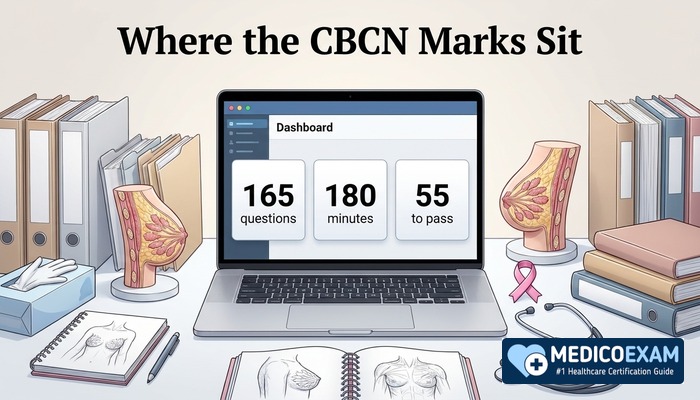
The ONCC Certified Breast Care Nurse (CBCN) exam is a 180-minute test of 165 multiple-choice questions, of which 125 are scored and 40 are unscored. You need a scaled score of 55 on a 25-75 scale, which MedicoExam's exam data puts at roughly 73%. It is open only to registered nurses.
If you work in breast care and are weighing this credential, begin with a quick CBCN practice test to learn where you stand, then let the sections that follow guide how you spend your revision time.
How is the CBCN exam built, scored and priced?
One sitting gives you 180 minutes for 165 questions. Divide the clock by the question count and you get about 65 seconds per item, which is brisk for scenario-style nursing questions that often give a short patient picture before they ask anything. The exam is delivered by computer at PSI test centers, and ONCC says results are available the same day you test.
The 165 questions are not all counted. Of them, 125 are scored and 40 are unscored, and the sensible response is to treat every question as if it counts, because a question you skip over as a probable trial item may well be a scored one. Marking is reported on a scale of 25 to 75, and the pass point is 55. MedicoExam's exam data converts that to approximately 73%, but the scale, not the percentage, is the figure ONCC reports.
The fee depends on membership. As of November 2026, ONCC lists $300 for ONS/APHON members and $420 for non-members, a gap of $120. If you are weighing whether membership is worth it for this purpose alone, compare that gap with the membership cost on the society's own pages before you apply, since the fee has to be paid at the time of application.
| Fact | Value |
|---|---|
| Credential | ONCC Certified Breast Care Nurse (CBCN) |
| Issuer | Oncology Nursing Certification Corporation (ONCC) |
| Questions | 165 (125 scored and 40 unscored) |
| Time allowed | 180 minutes |
| Passing score | 55 on a scale of 25-75 |
| Fee, November 2026 | $300 for ONS/APHON members, $420 for non-members |
| Testing window | 90 days from the Authorization to Test |
| Validity after passing | Four years |
Read the live fee and rules on ONCC's CBCN page before you commit, because the certifying body, not a third-party site, sets them. ONCC also notes that only generic drug names appear on its tests, so if your daily routine uses brand names, practise translating them.
Who can sit the CBCN, and what must you show ONCC?
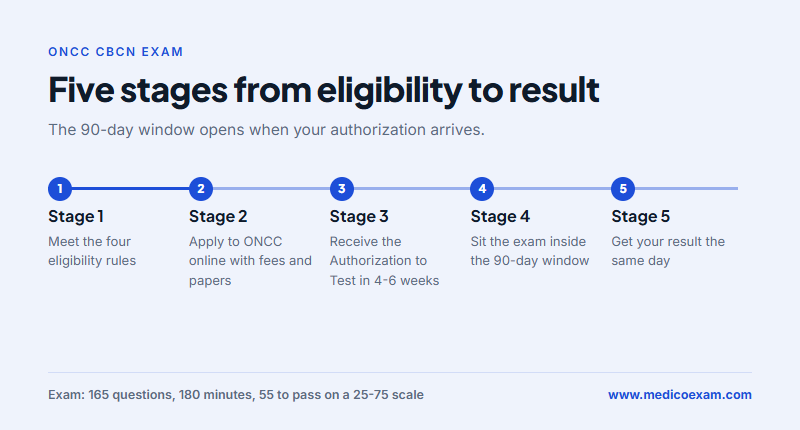
ONCC states that every eligibility criterion has to be met both when you apply and when you take the exam. There are four. First, you need a current, active, unencumbered license as a registered nurse in the US, its territories or Canada. Second, you need at least 2,000 hours of breast care nursing practice within the four years (48 months) before you apply. Third, you need at least two years (24 months) of experience as an RN within those same four years. Fourth, you need at least 10 contact hours of continuing nursing education in breast care nursing, or an academic elective in breast care nursing, within the three years (36 months) before you apply.
The practice hours are broader than bedside work. ONCC accepts nursing practice in clinical care, nursing administration, education, research or consultation. That matters for navigators, educators and managers who may not touch patients every shift but still spend their working week on breast care.
The contact hours have a quirk worth reading twice. They must come from an accredited provider or approver of continuing nursing education. Up to five of the 10 hours, which is half, may be continuing medical education in breast care or continuing pharmacy education. Education accredited through Joint Accreditation or IPCE must specify hours awarded by ANCC, ACCME or ACPE to be accepted. If your certificates do not say that plainly, ask the provider for a corrected one before you apply, not after your application stalls.
ONCC describes the CBCN as the only nationally accredited breast care nursing certification that is available exclusively to registered nurses and that covers the whole spectrum of breast care nursing practice. That is ONCC's own description, and it explains why the exam reads more like a tour of the whole patient journey than a test of one skill.
How long does the route from application to result take?
Plan the calendar backwards from the date you want the letters after your name, because the process has fixed waiting periods that you cannot rush. After you gather your documents and apply through your ONCC account, ONCC sends a confirmation that the application has been received. That email does not confirm you are eligible. The message that matters is the Authorization to Test, which ONCC says arrives within 4-6 weeks and which comes from a PSI address.
The Authorization to Test opens a 90-day testing window, and you must take the exam inside it. Treat the window as a deadline you set yourself in advance: pick your study end date when the authorization arrives, not weeks later. If an application sits incomplete for 60 days, ONCC deletes it from the online registration system, so submit everything in one go.
You will also need identifiers for the licensure check. ONCC asks for your license number, your supervisor's name and phone number and your continuing education documentation, and it asks for your NCSBN ID as part of confirming licensure. ONCC's page shows how to look that ID up through the Nursys QuickConfirm option. Do this before you sit down to apply, so the form does not stall you halfway through.
What does the CBCN exam test, domain by domain?
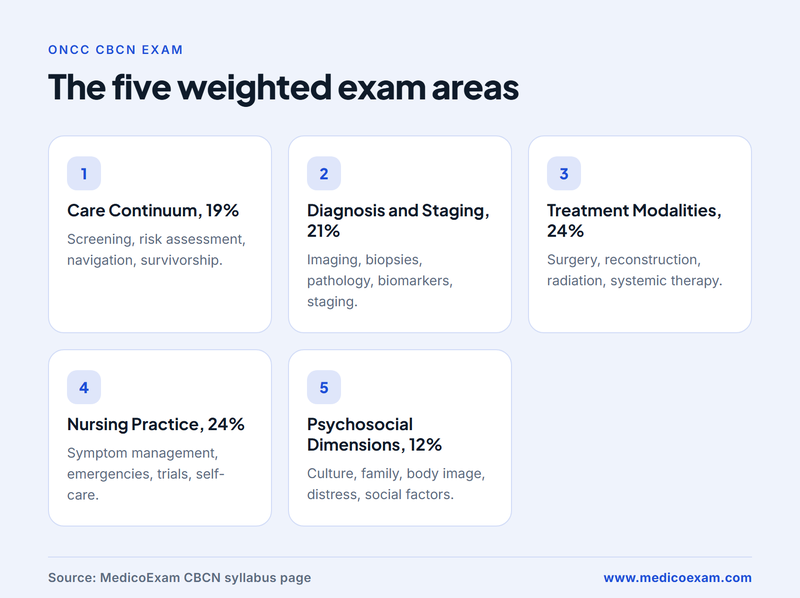
The test follows a Test Content Outline built from a role delineation study of basic breast care nursing practice that ONCC ran in 2020. It names five subject areas, each with a percentage. MedicoExam's CBCN syllabus page reproduces them, and they add up to 100%.
Care Continuum (19%) covers the stretch from a healthy breast to long-term follow-up. The outline lists breast health and screening, including anatomy and physiology, benign conditions, imaging results and the clinical breast exam. It lists cancer risk assessment, with risk prediction models such as Tyrer-Cuzick and the Breast Cancer Risk Assessment Tool, genetic counseling and testing, and risk reduction. It also covers patient navigation, with advocacy, barriers to care and interprofessional collaboration, and surveillance and survivorship, with psychosocial and physical issues.
Diagnosis and Staging (21%) covers carcinogenesis, diagnostic evaluation, pathology and staging. Expect imaging modalities and what the results mean, biopsy types such as fine needle aspiration, core and surgical, and pathology features such as type, grade, histology and proliferation index. Biomarkers, including ER/PR and HER2, and genomic testing sit here, as do clinical and pathologic staging and the additional studies used in staging.
Treatment Modalities and Considerations (24%) is the largest block, shared with nursing practice. It includes breast and axillary surgery, reconstruction (expander or implant, autologous and oncoplastic), radiation therapy, and systemic treatment such as endocrine therapy, chemotherapy and bispecific antibodies. It also names specific conditions, including triple-negative disease, HER2-positive disease, inflammatory breast cancer, Paget disease, phyllodes tumor and angiosarcoma, and treatment considerations for special populations such as male patients, young adults, and gender and sexual minorities.
Nursing Practice (24%) covers symptom management and supportive care, which the outline splits by cause: surgical, medical, radiation, complementary and integrative, and rehabilitation. It adds oncologic emergencies, professional practice such as guidelines and shared decision-making, clinical trials, and self-care, including burnout and substance use.
Psychosocial Dimensions of Care (12%) is the smallest area. It covers the influence of culture, spirituality, identity, age and disparities, family and caregiver dynamics, altered body image, reproductive and sexual health, psychosocial distress and its management, and social determinants of health related to screening, diagnosis, treatment and follow-up.
This article describes what the exam covers so that you can plan your study. It is not clinical guidance, and nothing here replaces the references ONCC lists or your employer's protocols.
Why does nearly half the CBCN exam sit in two domains?
Treatment Modalities and Considerations and Nursing Practice each carry 24%, so together they account for 48% of the outline. Add Diagnosis and Staging at 21% and three areas hold 69% between them. The two areas ranked below, Care Continuum at 19% and Psychosocial Dimensions at 12%, make up the remaining 31%.
Those numbers should change how you split your time, but not in a way that lets you ignore anything. A domain's weight tells you how many of the scored questions are likely to come from it, not how hard they are. Nurses who work in navigation often feel at home in Care Continuum and Psychosocial Dimensions, which together make up 31%, while those who work in infusion or surgical settings may find the opposite. Whichever way your job leans, the 48% is the block where a gap hurts most.
A useful way to apply the weights is to build a simple table for yourself. List the five domains, write the percentage beside each, and add a column for your honest confidence. A domain with a high weight and low confidence goes to the top of the list. A domain with a low weight and high confidence gets a light review. That one habit prevents the common error of spending most of your time on the topic you enjoy.
Notice too that the Nursing Practice domain contains topics that feel different from the others. Professional practice, clinical trials and self-care are about how a nurse works, not about disease. Candidates who revise only from oncology content sometimes leave those subjects thin, even though they sit inside a 24% block. Give them their own short sessions.
How should you prepare for the CBCN?
Start with ONCC's own materials, because they define the exam. Its CBCN page lists the Test Content Outline, the Test References, practice tests, sample test questions, study tips, review courses and a Results Report Sample. MedicoExam's syllabus page also points to the 2026 CBCN Test References. Read the outline first and use it as the table of contents for everything else you do.
After that, a five-step method works for most working nurses.
- Measure where you are today. Take a varied question set with no notes, then sort each wrong answer into the domain it belongs to. The tally shows where you stand more honestly than any feeling of readiness.
- Study by weight. Give the largest share of your sessions to Treatment Modalities and Nursing Practice, then Diagnosis and Staging, and keep short regular sessions on the smaller two areas so they do not fade.
- Turn topics into scenarios. For each outline bullet, ask what a nurse would be asked to recognize, teach or escalate. The exam rewards applied judgment, so reading a list of facts is not enough.
- Rehearse the full sitting. Do at least one timed run of 165 questions in 180 minutes so that the pace of about 65 seconds per question is familiar before test day.
- Review your errors by cause. Sort each wrong answer into misread question, knowledge gap or second-guessing a correct first choice. Each cause needs a different fix.
For question practice, MedicoExam's premium CBCN practice exam includes 325+ exam-aligned questions, two months of unlimited access, timed mock exams and a result history that shows performance at question level. The product page lists its current price and describes a money-back guarantee. It supports your own preparation, it is not an ONCC product, and it does not replace ONCC's outline and references.
When your mixed-set scores stop moving around and stay at a level that you are comfortable with across all five domains, you are ready to book. If a single domain keeps dragging the total down, delay the booking, since the 90-day window starts only once your Authorization to Test arrives and you can plan around that.
Which mistakes cost candidates marks on the CBCN?
The patterns below are habits to avoid, drawn from how the exam is built rather than from any published pass-rate data, which neither ONCC's page nor MedicoExam's data provides.
Studying only what you do at work. A nurse in a surgical clinic can know the operative side deeply and still be thin on radiation effects, systemic therapy or survivorship. The outline gives all of those a place, and the exam does not care what your unit does.
Skipping the smaller domains. Psychosocial Dimensions of Care is only 12%, but it is a subject where a careful reader can gain points that harder topics will not give. Altered body image, caregiver dynamics and social determinants are reasoning questions more than memory questions.
Spending the clock unevenly. With about 65 seconds per question, one stubborn item can take the time of three. Mark it, move on and come back if time allows.
Treating unscored items as skippable. You cannot tell which 40 questions are unscored, so any decision to skip a question rests on a guess you cannot check.
Ignoring the application details. Contact hours that do not state the accrediting body, a license that is not active at the date of the exam, or an application that sits incomplete for 60 days can all delay you for reasons that have nothing to do with knowledge.
Using brand names. ONCC says only generic drug names are used, so learn the generic name first and treat the brand name as secondary.
What happens if you do not pass the first time?
ONCC describes a DoubleTake option that gives you a retake if you do not pass on your first attempt, without paying the full test fee again. Its page presents this for candidates who worry that test anxiety could cost them a second fee. The page does not set out the price or conditions of the retake in the text we reviewed, so read the DoubleTake terms on ONCC's site before you apply, and decide then whether it suits you.
If you do not pass, ONCC's Results Report Sample is a useful guide to what a score report looks like, and your own error log from practice gives you a head start on what to repair. Build the retake plan from the domains where you were weakest, not from a repeat of the whole syllabus.
When you do pass, ONCC says the certification is valid for four years. The renewal route is covered on ONCC's site under its renewal pages, and the rules there are the ones to follow, not any summary written elsewhere.
Is the CBCN the right exam for you now?
The CBCN suits a registered nurse who already has the hours and the contact education, and who wants a nationally accredited credential tied to breast care in particular. It does not suit someone who is still collecting the hours, because the eligibility rules have to be met when you apply and again when you sit the test.
If you meet the rules, the decision comes down to timing. Work out how many hours you can give to study each week, subtract the waiting time for your Authorization to Test, and choose a testing date well inside the 90-day window. Then take a timed mixed set, sort the misses by domain, and let the weights decide where you work first. The CBCN syllabus overview on this site keeps the five domains and their percentages on one page, so you can check your plan against it as you go.
Frequently Asked Questions
How many questions are on the CBCN exam?
The CBCN has 165 multiple-choice questions to answer in 180 minutes. Of these, 125 are scored and 40 are unscored. Because you cannot tell which items are unscored, treat each one as if it counts, and pace yourself at roughly 65 seconds per question.
What score do I need to pass the CBCN exam?
You need 55 on a scale of 25-75, which MedicoExam's exam data lists as approximately 73%. ONCC reports results on the scaled score, so use that number as your target. Results are available the same day you test, according to ONCC.
How much does the CBCN exam cost?
ONCC charges members of ONS or APHON $300 and everyone else $420, so membership saves $120 at the November 2026 rates. Fees can change; confirm the amount on ONCC's CBCN page before applying.
What does the CBCN exam cover?
It covers five weighted areas: Care Continuum at 19%, Diagnosis and Staging at 21%, Treatment Modalities and Considerations at 24%, Nursing Practice at 24% and Psychosocial Dimensions of Care at 12%. Together they describe the whole breast care nursing journey from screening to survivorship.
Who is eligible to take the CBCN exam?
You need an active RN license in the US, its territories or Canada, 2,000 hours of breast care nursing practice and two years as an RN within the prior four years, plus 10 breast care contact hours in the prior three years. All criteria must hold at application and at the exam.
How long is the CBCN certification valid?
ONCC says the certification is valid for four years after you pass. The renewal requirements are set out on ONCC's own site, so follow those rules rather than a third-party summary, and start tracking your qualifying activities well before the end date.
- ONCC CBCN Question Bank |
- ONCC CBCN Eligibility & Requirements |
- ONCC Breast Care Nurse Practice Test |
- ONCC CBCN Exam Cost |
- ONCC CBCN Registration Process |
- ONCC Breast Care Nurse Study Guide |
- ONCC CBCN Recertification |
- ONCC CBCN Certification Overview |
- ONCC Breast Care Nurse Syllabus |
- ONCC CBCN Preparation Time |
- ONCC CBCN Passing Score |
- ONCC CBCN Exam Format


