
Your Official AHIMA RHIT Pathways: A Complete Guide

The AHIMA Registered Health Information Technician (RHIT) certification validates the technical skills of professionals who ensure the accuracy, completeness, and accessibility of patient health information. This credential signifies proficiency in managing health information, providing essential support for healthcare operations, and maintaining data integrity. Achieving the AHIMA RHIT certification is a pivotal step for those aiming to establish a robust career in health information management (HIM). This comprehensive guide outlines the pathways, requirements, preparation strategies, and career opportunities associated with the AHIMA RHIT (RHIT) exam, offering clear, directional, and advisory insights for prospective candidates.
Unveiling the AHIMA RHIT Certification
The AHIMA Registered Health Information Technician (RHIT) certification serves as a nationally recognized standard for health information professionals, distinguishing individuals competent in various aspects of health data management. Professionals holding this certification are integral to the healthcare ecosystem, bridging the gap between clinical care and administrative efficiency. The RHIT credential confirms an individual's ability to analyze and interpret medical records, manage data systems, and ensure compliance with healthcare regulations. It is particularly suitable for individuals who possess an associate degree or higher from a program accredited by the Commission on Accreditation for Health Informatics and Information Management Education (CAHIIM), demonstrating their foundational knowledge in health information technology. This certification is crucial for entry to mid-level roles that demand precision in data handling and a commitment to patient privacy. To explore specialized RHIT pathways and preparation resources, consider visiting detailed certification overviews.
The core purpose of the RHIT credential extends beyond technical competency; it fosters a workforce dedicated to upholding ethical standards and regulatory mandates within the evolving healthcare landscape. Certification holders are equipped to contribute significantly to an organization's data governance, ensuring that health information is accurate, accessible, and secure. This foundation empowers them to support critical decision-making processes, from patient care to public health initiatives. The RHIT is a testament to an individual's readiness to tackle complex health information challenges and drive operational excellence.
Driving Data Integrity in Healthcare
At its heart, the AHIMA RHIT certification is about maintaining the integrity of patient data, which is paramount in an era of digital health records. Health information technicians are responsible for ensuring that all medical information is accurately recorded, classified, and stored. This includes managing electronic health records (EHRs), performing quality control, and ensuring that all data adheres to legal and ethical standards. Their work directly impacts patient safety, treatment efficacy, and organizational compliance.
-
Data Accuracy: Validating patient records for completeness and precision.
-
System Management: Overseeing health information systems and technology infrastructure.
-
Regulatory Adherence: Ensuring compliance with HIPAA, HITECH, and other data privacy laws.
-
Interoperability: Facilitating the seamless exchange of health information across different platforms.
Understanding the RHIT Examination Layout
The AHIMA Registered Health Information Technician (RHIT) examination evaluates a candidate's practical knowledge and skills across crucial domains within health information management. Administered by AHIMA, the exam serves as a gateway to professional recognition, verifying that candidates possess the necessary competencies to excel in the field. Understanding the structure of this assessment is fundamental for effective preparation, allowing candidates to strategically allocate study time and focus their efforts. The RHIT exam is designed to be comprehensive, covering a broad spectrum of topics essential for the modern health information technician.
Candidates are provided 210 minutes to complete 150 questions, comprising 130 scored items and 20 pretest items. A passing score of 300, on a scale of 100-400, is required to achieve certification. The exam costs $229 (USD) for AHIMA members and $299 (USD) for non-members. This structure demands not only a deep understanding of the content but also efficient time management during the test. For more details, candidates should consult the official AHIMA certification page to stay informed on any updates or specific requirements.
Key Examination Details
-
Exam Name: AHIMA Registered Health Information Technician
-
Exam Code: RHIT
-
Exam Price: AHIMA members - $229 (USD), AHIMA non-members - $299 (USD)
-
Duration: 210 minutes
-
Number of Questions: 150 (130 Scored Items / 20 Pretest Items)
-
Passing Score: 300 (on a scale of 100-400)
The examination format typically includes multiple-choice questions, which assess a candidate's ability to recall facts, apply concepts, and make informed decisions based on real-world scenarios in health information management. Familiarity with the question types and the overall test environment can significantly reduce exam-day anxiety and improve performance. Practicing with timed mock exams can help simulate these conditions and refine strategic test-taking skills.
Exploring RHIT Foundational Knowledge
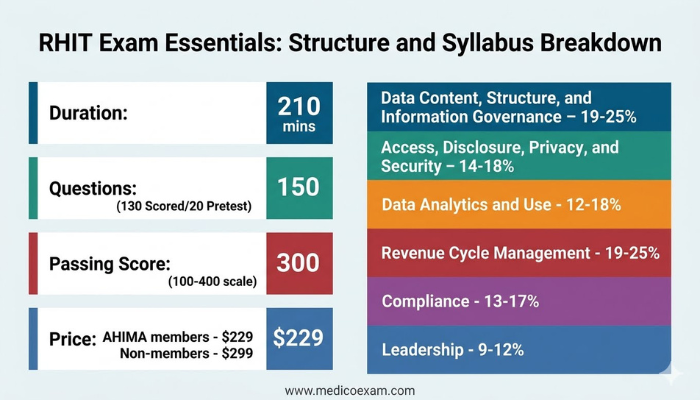
The AHIMA RHIT certification assesses proficiency across six critical domains, each weighted to reflect its importance in the daily responsibilities of a health information technician. A thorough understanding of these syllabus topics is paramount for successful exam preparation and practical application in a professional role. These domains cover the breadth of health information management, from data governance to leadership, ensuring that certified professionals are well-rounded and capable.
Candidates should review each domain carefully, recognizing that some areas carry a higher percentage weight, suggesting they may feature more prominently in the exam questions. This structured approach to learning the content outline, detailed in the AHIMA RHIT content outline, provides a clear roadmap for study focus.
AHIMA RHIT Syllabus Domains
-
Data Content, Structure, and Information Governance: (19-25%) This domain covers the core principles of health data management, including data collection, maintenance, integrity, and the policies governing its use.
-
Access, Disclosure, Privacy, and Security: (14-18%) Focuses on the legal and ethical considerations surrounding patient health information, emphasizing HIPAA regulations, privacy breaches, and secure data handling practices.
-
Data Analytics and Use: (12-18%) Explores the application of health data for reporting, research, quality improvement, and decision-making, including basic statistical analysis and data visualization.
-
Revenue Cycle Management: (19-25%) Addresses the financial aspects of healthcare, including coding, billing, reimbursement methodologies, and compliance with payer requirements.
-
Compliance: (13-17%) Encompasses various regulatory frameworks beyond privacy and security, such as accreditation standards, fraud prevention, and external audits relevant to health information.
-
Leadership: (9-12%) Covers essential managerial skills, including staff training, project management, communication, and ethical leadership within a health information department.
Each domain builds upon foundational knowledge, requiring candidates to not only memorize facts but also apply them to complex scenarios. For instance, understanding data content isn't merely about definitions but about how data flows through various systems and how its quality is maintained under information governance policies. Similarly, revenue cycle management requires knowledge of coding guidelines and their impact on financial outcomes, making it a critical area for anyone involved in healthcare operations.
Maximizing Your Career with AHIMA RHIT
Earning the AHIMA RHIT certification signifies a profound commitment to the health information management (HIM) profession, opening doors to a multitude of career benefits and enhanced opportunities. This credential serves as a powerful differentiator in a competitive job market, assuring employers of a candidate's validated expertise and dedication to professional standards. The value of an RHIT goes beyond a mere qualification; it represents a professional benchmark, validating the skills necessary to navigate complex health data environments.
From increased earning potential to greater job security, the advantages of holding an AHIMA RHIT are substantial. Certified professionals often command higher salaries compared to their non-certified counterparts, reflecting the specialized knowledge and critical responsibilities they undertake. Furthermore, the healthcare industry continues to expand and evolve, placing a premium on skilled HIM professionals, thereby ensuring a steady demand for RHIT-certified individuals. This certification elevates a technician's standing and contributes significantly to their long-term career trajectory.
Enhanced Earning Potential and Job Security
One of the most immediate benefits of obtaining the AHIMA RHIT certification is the potential for a higher salary. Employers recognize the specialized skill set and comprehensive knowledge base that RHITs bring to the table, often compensating them accordingly. This credential can lead to advanced roles and greater responsibilities, which are typically associated with improved compensation packages. Beyond salary, job security is a significant advantage. The healthcare sector is one of the most stable industries, and the demand for qualified health information professionals remains consistently high due to ongoing regulatory changes and technological advancements. RHITs are essential in ensuring data integrity, compliance, and efficient operations, making them indispensable assets to healthcare organizations.
-
Competitive Salaries: RHITs often earn more than uncertified HIM professionals.
-
Stable Employment: High demand for HIM skills ensures job security in a growing industry.
-
Career Advancement: Opens pathways to supervisory and management positions.
Professional Credibility and Industry Recognition
The AHIMA RHIT certification confers a significant level of professional credibility. It signals to peers, employers, and clients that an individual has met rigorous national standards of competence in health information management. This recognition can lead to enhanced networking opportunities, professional growth, and leadership roles within the field. Being part of the AHIMA community also provides access to valuable resources, continuing education, and a supportive professional network. The credential demonstrates a commitment to lifelong learning and adherence to the ethical principles governing health information.
Moreover, the RHIT certification is recognized across various healthcare settings, including hospitals, clinics, long-term care facilities, and government agencies. This broad acceptance facilitates career mobility and offers flexibility in choosing diverse work environments. It is a testament to an individual's readiness to contribute meaningfully to any organization handling sensitive patient data, ensuring that they are seen as an expert in their domain.
Comparing AHIMA RHIT and CCS Credentials
When considering a career in health information management, prospective professionals often encounter various certification options offered by AHIMA, each designed for specific roles and skill sets. Two prominent credentials, the Registered Health Information Technician (RHIT) and the Certified Coding Specialist (CCS), frequently come into comparison. While both are highly valued and demonstrate expertise in HIM, they cater to distinct areas of specialization. Understanding these differences is crucial for making an informed decision about which pathway aligns best with individual career aspirations and current skill sets.
The RHIT certification is broader in scope, focusing on the overall management of health information, including data quality, privacy, security, and information governance. It's ideal for those interested in roles that oversee data systems, ensure compliance, and manage information flow within healthcare organizations. In contrast, the CCS certification is highly specialized in medical coding, specifically designed for professionals who classify medical diagnoses and procedures for reimbursement, data collection, and research. This credential requires an in-depth understanding of various coding systems, such as ICD-10-CM/PCS and CPT.
Distinguishing Core Responsibilities
The fundamental distinction between an RHIT and a CCS lies in their primary job functions. An RHIT professional typically works with the entire patient record, managing its integrity, accessibility, and security. Their responsibilities might include:
-
Data Analysis: Reviewing patient records for accuracy and completeness.
-
System Management: Maintaining and optimizing electronic health record (EHR) systems.
-
Compliance Audits: Ensuring adherence to healthcare regulations and standards.
-
Information Release: Managing requests for patient health information while maintaining privacy.
Conversely, a CCS professional's role is centered on translating medical documentation into standardized alphanumeric codes. Their tasks are highly specialized and typically include:
-
Accurate Coding: Assigning correct ICD-10-CM/PCS and CPT codes for diagnoses and procedures.
-
Payer Compliance: Ensuring codes comply with insurance and government payer rules for reimbursement.
-
Clinical Documentation Improvement (CDI): Working with physicians to clarify documentation for optimal coding.
Educational Background and Exam Focus
The educational prerequisites and examination content also vary significantly. The RHIT typically requires an associate degree from a CAHIIM-accredited program in health information technology. The RHIT exam covers a wide array of topics, including data content, information governance, privacy, security, data analytics, revenue cycle management, compliance, and leadership. This broad coverage prepares candidates for a generalist role in HIM.
For the CCS, while formal education in health information or medical coding is highly recommended, it is not strictly required if a candidate has substantial coding experience. The CCS exam is intensely focused on coding principles, guidelines, and applications across various healthcare settings, requiring extensive knowledge of medical terminology, anatomy, physiology, and pharmacology. Choosing between RHIT and CCS depends on whether one prefers a comprehensive management role or a specialized coding expertise.
Developing a Comprehensive RHIT Study Plan
Preparing for the AHIMA RHIT exam requires a structured and disciplined approach to ensure comprehensive coverage of all syllabus domains. A well-crafted study plan is the cornerstone of success, guiding candidates through the vast amount of information and helping them identify areas of strength and weakness. Effective preparation involves more than just memorizing facts; it demands a deep understanding of health information management principles and their practical application. Candidates should begin by reviewing the official AHIMA RHIT content outline to gain a clear perspective on the topics and their respective weights, which will help in prioritizing study efforts.
Establishing a realistic timeline is also critical. Given the extensive syllabus, rushing through the material is counterproductive. A study schedule that allocates dedicated time for each domain, incorporating regular review sessions and practice exams, is highly recommended. It's also beneficial to identify preferred learning styles—whether visual, auditory, or kinesthetic—and integrate resources that align with these preferences. This personalized approach can significantly enhance comprehension and retention, making the study process more efficient and less daunting.
Strategizing Your Study Approach
Effective RHIT exam preparation hinges on a strategic approach that breaks down the complex syllabus into manageable components. Start by conducting a self-assessment to gauge your current knowledge level across the six domains. This initial step can help pinpoint areas that require more attention versus those where you already possess a strong foundation. Leverage textbooks, online courses, and study guides specifically designed for the AHIMA RHIT exam to ensure that your learning materials are relevant and up-to-date. Focus on understanding the "why" behind concepts, not just the "what."
Consider forming study groups with fellow candidates. Collaborating can provide different perspectives, clarify difficult topics, and maintain motivation. Teaching concepts to others is an excellent way to solidify your own understanding. Regular breaks and self-care are equally important to prevent burnout; a refreshed mind is more capable of absorbing and processing information. Setting mini-goals throughout your study period can also provide a sense of accomplishment and keep you on track toward your ultimate objective.
Utilizing Quality Preparation Resources
Access to high-quality study resources is indispensable for AHIMA RHIT exam success. Beyond textbooks, consider official AHIMA-approved study guides and reference manuals that align directly with the exam blueprint. Online preparation courses often offer structured learning paths, video lectures, and interactive quizzes that can simulate the exam environment. These courses frequently cover each domain in depth, providing clear explanations and real-world examples.
Practice questions are a non-negotiable component of any robust study plan. They help familiarize candidates with the exam format, question types, and time constraints. Regularly working through effective practice questions can significantly improve recall and application skills. Furthermore, MedicoExam offers comprehensive comprehensive AHIMA RHIT resources, including practice tests that help evaluate readiness and highlight areas needing further review. Incorporating a variety of resources ensures a well-rounded and thorough preparation experience, building confidence for exam day.
Navigating the RHIT Exam Successfully
The AHIMA RHIT exam can be challenging, but with the right mindset and strategic test-taking techniques, candidates can significantly improve their chances of success. Beyond thorough preparation of the syllabus, understanding how to approach the exam itself is a critical skill. Many candidates find the time constraint to be a major hurdle, underscoring the importance of practicing time management during study sessions. The exam's difficulty often stems from its comprehensive nature, requiring candidates to integrate knowledge from various domains to answer scenario-based questions.
One common challenge is distinguishing between similar-sounding options in multiple-choice questions. This requires not just rote memorization but a deep conceptual understanding of the principles of health information management. Candidates who take the time to understand the nuances of each topic, rather than simply recalling definitions, are better equipped to handle these types of questions. Furthermore, managing stress and anxiety on exam day plays a vital role in performance. Adopting relaxation techniques and ensuring adequate rest before the exam can help maintain focus and clarity.
Effective Test-Taking Strategies
Approaching the RHIT exam with a set of proven test-taking strategies can make a significant difference. Start by reading each question carefully, paying close attention to keywords and phrases that might alter the meaning. Eliminate obviously incorrect answers first to narrow down the choices, increasing your probability of selecting the correct response. For questions that present a complex scenario, break down the situation into smaller, more manageable parts before attempting to answer.
Pacing yourself is crucial. With 150 questions in 210 minutes, you have approximately 1 minute and 24 seconds per question. If you encounter a particularly difficult question, flag it and move on, returning to it later if time permits. Avoid dwelling on any single question for too long. Trust your initial instincts, but be prepared to revisit answers if new information or a fresh perspective emerges during the exam. Utilizing all available time, including reviewing answers, can help catch any overlooked errors. For a deeper dive into common challenges and preparation best practices, refer to a detailed RHIT preparation guide.
Maintaining Composure and Focus
Maintaining composure throughout the exam is just as important as your knowledge base. High levels of stress can impair cognitive function, making it harder to recall information or think clearly. Before entering the exam room, engage in light stretching or deep breathing exercises to calm your nerves. During the exam, if you feel overwhelmed, take a brief moment to close your eyes, take a few deep breaths, and refocus. Remember that a few difficult questions do not define your entire performance.
Ensure you are well-rested and nourished before the exam. A good night's sleep and a healthy breakfast can significantly impact your mental stamina and concentration. Avoid cramming in the hours leading up to the test, as this can increase anxiety without substantially improving your knowledge retention. Instead, focus on light review and reinforcing confidence in your preparation. Believe in the effort you've put in, and approach the exam with a calm and confident demeanor.
Sustaining Your RHIT Professional Standing
Achieving the AHIMA RHIT certification is a significant milestone, but it also marks the beginning of a commitment to ongoing professional development. To ensure that certified professionals remain current with the dynamic healthcare landscape and uphold the integrity of the credential, AHIMA requires regular renewal. This process, centered around continuing education units (CEUs), emphasizes the importance of lifelong learning and adherence to evolving industry standards. Renewal requirements are designed to keep RHITs proficient in new technologies, regulatory changes, and best practices in health information management.
The specific requirements for AHIMA RHIT certification renewal typically involve accumulating a certain number of CEUs within a designated cycle, usually two years. These CEUs can be earned through a variety of professional development activities, including attending workshops, webinars, conferences, completing academic courses, writing articles, or participating in professional association activities. Staying informed about these requirements and proactively planning for CEU accumulation is crucial for maintaining active certification status and preserving your professional standing.
Adhering to Renewal Requirements
To renew the AHIMA RHIT certification, professionals must complete specific continuing education requirements. AHIMA mandates that RHIT-credentialed professionals earn 20 CEUs every two years. Of these, at least 10 CEUs must be earned from an AHIMA-approved program, and all 20 CEUs must be related to health information management. It is the responsibility of the certified individual to track their CEU activities and submit them through the AHIMA certification management system.
Proactive engagement in professional development is key. Waiting until the last minute to accumulate CEUs can lead to a scramble and potential lapse in certification. Many employers support their staff in obtaining CEUs, offering internal training programs or covering the cost of external educational opportunities. Engaging with AHIMA's online resources, journals, and local chapters also provides accessible avenues for earning relevant CEUs and staying connected to the professional community.
The Value of Continuous Professional Growth
Beyond the mandatory renewal, continuous professional growth offers immense value to RHIT-certified individuals. The healthcare industry is constantly evolving, driven by technological advancements, shifts in regulatory policies, and emerging public health challenges. Staying abreast of these changes ensures that RHITs remain effective and relevant in their roles. Engaging in continuous learning deepens expertise, enhances problem-solving capabilities, and opens doors to new opportunities within specialized areas of HIM, such as informatics, data privacy, or analytics.
Investing in ongoing education also demonstrates dedication to personal and professional excellence, which can lead to promotions, leadership roles, and increased influence within an organization. It fosters a growth mindset, enabling professionals to adapt to new tools and methodologies effortlessly. Ultimately, maintaining an active and well-supported RHIT certification through continuous learning solidifies one's position as a valuable and knowledgeable expert in the vital field of health information management.
Shaping Your Future: AHIMA RHIT Career Paths
The AHIMA Registered Health Information Technician (RHIT) certification provides a strong foundation for a diverse and impactful career in health information management. Professionals holding this credential are equipped to take on various critical roles across different healthcare settings, contributing significantly to the efficiency, integrity, and compliance of health data. The demand for skilled RHITs continues to grow as the healthcare industry increasingly relies on accurate and accessible patient information for everything from direct patient care to strategic decision-making and public health initiatives.
An RHIT's expertise is valuable in hospitals, physician offices, long-term care facilities, mental health facilities, home health agencies, health insurance companies, government agencies, and even consulting firms. These roles often involve managing patient records, ensuring data quality, assisting with coding, and safeguarding patient privacy. The flexibility and breadth of opportunities available to RHIT-certified individuals make it an attractive pathway for those looking to build a stable and meaningful career in healthcare, without direct patient contact but with a profound impact on patient outcomes.
Key Job Roles and Responsibilities
RHITs are highly versatile and can perform a wide array of functions, making them indispensable members of the healthcare team. Their responsibilities typically revolve around the lifecycle of health information, from creation to ultimate disposition. Common job titles and their associated duties include:
-
Health Information Technician: Manages patient health records, ensuring accuracy, completeness, and compliance with regulations.
-
Medical Records Coder: Assigns diagnostic and procedural codes for billing, research, and statistical purposes. (Note: While RHITs can code, CCS is a coding specialist credential.)
-
Data Quality Manager: Implements and monitors data quality initiatives to ensure integrity and reliability of health information.
-
Release of Information Specialist: Processes requests for patient records in accordance with privacy laws and organizational policies.
-
Clinical Documentation Improvement (CDI) Assistant: Supports CDI specialists by reviewing documentation for clarity and accuracy to improve coding and data quality.
These roles require a meticulous eye for detail, strong organizational skills, and a comprehensive understanding of medical terminology, anatomy, and physiology. The ability to work with various software systems and databases is also crucial, as health information management is heavily reliant on technology. Each role plays a vital part in the broader goal of maintaining an efficient, secure, and compliant healthcare information system.
The Expanding Scope of Health Information
The landscape of health information management is constantly evolving, driven by advancements in technology, stricter regulatory requirements, and the increasing volume of health data. RHITs are at the forefront of this evolution, adapting to new electronic health record (EHR) systems, embracing telemedicine data, and navigating complex data analytics tools. This expanding scope means that the career paths for RHITs are not static; they are dynamic and offer opportunities for specialization and growth.
As healthcare systems become more integrated and data-driven, RHITs can pursue advanced roles in areas like health informatics, which combines HIM principles with information science to optimize data use. They can also specialize in areas like cybersecurity within healthcare, focusing on protecting sensitive patient information from breaches. The continuous evolution of the field ensures that an AHIMA RHIT certification is not just a qualification for today's jobs but a foundation for the careers of tomorrow, offering continuous challenges and opportunities for professional development.
Conclusion
The AHIMA Registered Health Information Technician (RHIT) certification offers a clear and definitive pathway into the vital field of health information management. It validates an individual's expertise in handling, protecting, and analyzing critical health data, ensuring the smooth operation and compliance of healthcare organizations. From understanding the rigorous exam structure and mastering the diverse syllabus domains to leveraging strategic preparation methods and comprehending the vast career opportunities, the journey to becoming an RHIT is both challenging and profoundly rewarding. This credential not only boosts earning potential and job security but also establishes a professional's credibility and commitment to the highest standards of data integrity in healthcare.
Embracing the RHIT certification is an investment in a future where precision in health information is paramount. It equips professionals with the foundational skills to navigate complex regulatory environments, contribute to data-driven decision-making, and uphold patient privacy. For those dedicated to a career that blends healthcare knowledge with technical acumen, the AHIMA RHIT serves as an indispensable stepping stone toward a fulfilling and impactful role within the ever-evolving healthcare industry. Secure your place at the forefront of health information management. Begin your journey toward professional distinction and explore the comprehensive support available for your certification goals. For those ready to advance their expertise, finding an expert preparation platform is the next crucial step in mastering the RHIT exam and achieving your career aspirations.
FAQs
1. What is the AHIMA RHIT certification?
The AHIMA RHIT (Registered Health Information Technician) certification is a nationally recognized credential for professionals who manage health information. It validates skills in data accuracy, completeness, accessibility, and compliance within healthcare settings, typically for those with an associate degree from a CAHIIM-accredited program.
2. How long does it typically take to prepare for the AHIMA RHIT exam?
The preparation time for the AHIMA RHIT exam varies based on individual background and study habits. Most candidates spend several months to a year, engaging in structured study, reviewing official materials, and practicing with sample questions to cover the extensive syllabus domains comprehensively.
3. Is the AHIMA RHIT exam considered difficult?
The AHIMA RHIT exam is considered challenging due to its comprehensive nature, covering six broad domains of health information management. Success requires not just memorization but also the ability to apply concepts to real-world scenarios, effective time management, and thorough preparation.
4. What are the career prospects for an AHIMA Registered Health Information Technician?
AHIMA RHIT professionals have strong career prospects across various healthcare settings, including hospitals, clinics, and insurance companies. They can work as health information technicians, medical records coders, data quality managers, or release of information specialists, with opportunities for advancement into supervisory roles.
5. What are the renewal requirements for AHIMA RHIT certification?
To renew the AHIMA RHIT certification, professionals must earn 20 continuing education units (CEUs) every two years. At least 10 of these CEUs must be from AHIMA-approved programs, and all must be related to health information management, demonstrating ongoing professional development.
- AHIMA RHIT Question Bank |
- AHIMA RHIT Eligibility & Requirements |
- AHIMA Health Information Technician Practice Test |
- AHIMA RHIT Exam Cost |
- AHIMA RHIT Registration Process |
- AHIMA Health Information Technician Study Guide |
- AHIMA RHIT Recertification |
- AHIMA RHIT Certification Overview |
- AHIMA Health Information Technician Syllabus |
- AHIMA RHIT Preparation Time |
- AHIMA RHIT Passing Score |
- AHIMA RHIT Exam Format |
- AHIMA Health Information Technician Sample Questions |
- AHIMA RHIT Career Opportunities |
- AHIMA RHIT Exam Difficulty


