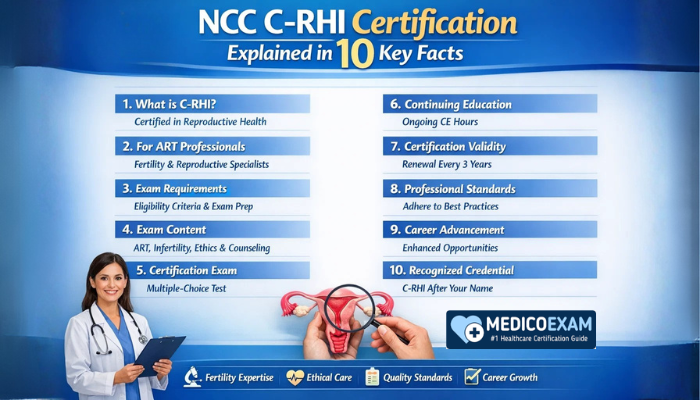
 Expert Career Guidance and Practical Exam Insights for Reproductive Health Professionals
Few credentials carry as much quiet authority in reproductive healthcare as NCC Certification. For clinicians working in fertility clinics, reproductive endocrinology units, and women’s health settings, the C-RHI credential signals something deeper than exam success it reflects clinical judgment, evidence-based practice, and commitment to patient-centered reproductive care.
This guide breaks down 10 essential facts about NCC Certification and the C-RHI Reproductive Health and Infertility exam, blending exam mechanics with real-world professional insight to help you decide whether this credential fits your career path and how to prepare strategically if it does.
What Is NCC Certification and Why It Matters in Reproductive Healthcare
NCC Certification is a nationally recognized professional credential awarded by the National Certification Corporation for healthcare professionals specializing in obstetric, gynecologic, and neonatal care. In reproductive healthcare, it validates advanced clinical knowledge, ethical practice, and specialty-level competence.