
10 Key Facts About NCC Certification and the C-RHI Reproductive Health Exam
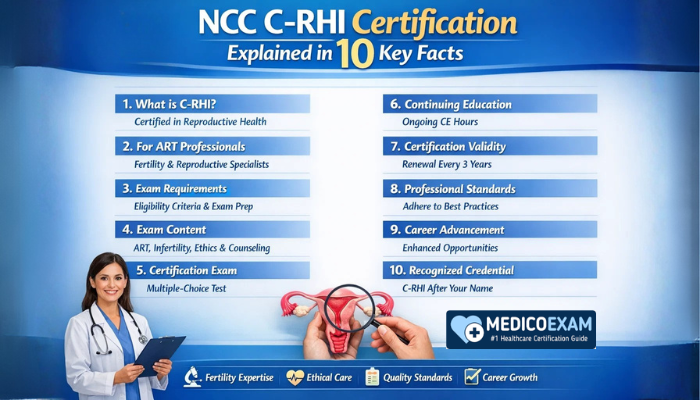 Expert Career Guidance and Practical Exam Insights for Reproductive Health Professionals
Few credentials carry as much quiet authority in reproductive healthcare as NCC Certification. For clinicians working in fertility clinics, reproductive endocrinology units, and women’s health settings, the C-RHI credential signals something deeper than exam success it reflects clinical judgment, evidence-based practice, and commitment to patient-centered reproductive care.
This guide breaks down 10 essential facts about NCC Certification and the C-RHI Reproductive Health and Infertility exam, blending exam mechanics with real-world professional insight to help you decide whether this credential fits your career path and how to prepare strategically if it does.
What Is NCC Certification and Why It Matters in Reproductive Healthcare
NCC Certification is a nationally recognized professional credential awarded by the National Certification Corporation for healthcare professionals specializing in obstetric, gynecologic, and neonatal care. In reproductive healthcare, it validates advanced clinical knowledge, ethical practice, and specialty-level competence.
Why NCC Certification Holds Weight
From a clinical leadership perspective, NCC Certification matters because it:
-
Demonstrates validated specialty expertise beyond licensure
-
Aligns with evidence-based reproductive health standards
-
Supports credentialing, privileging, and employer trust
-
Enhances professional credibility in interdisciplinary teams
In fertility and reproductive endocrinology settings, credentials often influence role expansion, patient education authority, and participation in treatment planning discussions.
What Is the C-RHI Reproductive Health and Infertility Certification
The C-RHI (Reproductive Health and Infertility) certification is an NCC specialty exam focused on comprehensive reproductive health care, infertility evaluation, assisted reproductive technologies, and patient counseling across the fertility continuum.
Who the C-RHI Is Designed For
The C-RHI credential is particularly relevant for:
-
Registered Nurses in fertility clinics and REI practices
-
Women’s Health Nurse Practitioners (WHNP-BC)
-
Physician Assistants supporting reproductive medicine teams
-
Clinicians involved in ART coordination and patient education
Unlike general women’s health certifications, C-RHI reflects depth in infertility diagnostics, treatment planning, and ART management, making it especially valuable in specialized reproductive environments.
Key Eligibility and NCC Certification Requirements
NCC Certification requirements for the C-RHI exam include an active healthcare license and documented clinical experience in reproductive health or infertility care, as outlined in the official NCC candidate guide.
Core Eligibility Considerations
Eligibility typically involves:
-
Active RN, NP, PA, or physician license
-
Specialty clinical experience in reproductive health or infertility
-
Practice exposure aligned with exam content domains
-
Compliance with NCC application documentation requirements
Requirements may evolve, so candidates should always verify current criteria using official NCC resources:
NCC C-RHI Candidate Guide (PDF)
From a professional standpoint, eligibility reflects scope-appropriate experience, not just job titles hands-on involvement with fertility care pathways matters.
NCC Certification Cost and Investment Value
The total NCC Certification cost for the C-RHI exam is $210, plus a $50 non-refundable application fee, making it a relatively accessible specialty credential in healthcare certification.
Cost Breakdown
|
Component |
Cost |
|
Application Fee |
$50 |
|
Exam Fee |
$210 |
|
Total |
$260 |
Evaluating ROI
From a career perspective, the investment is modest compared to:
-
Graduate-level certifications
-
Board subspecialty training programs
-
Credentialing exams in adjacent healthcare fields
Clinicians often find value through:
-
Increased clinical autonomy
-
Enhanced employer recognition
-
Stronger positioning for fertility-focused roles
Core Topics Covered in the C-RHI Reproductive Health Exam
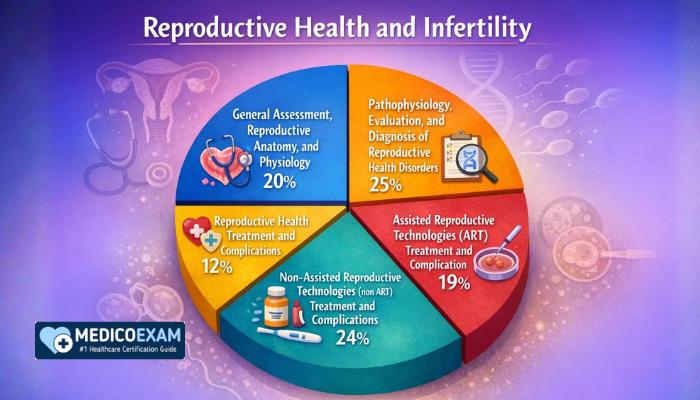
The C-RHI exam evaluates knowledge across reproductive anatomy, infertility diagnostics, non-ART and ART treatments, and complication management using a structured domain-weighted framework.
Exam Content Domains and Weighting
-
General Assessment, Reproductive Anatomy & Physiology – 20%
-
Pathophysiology, Evaluation & Diagnosis – 25%
-
Non-ART Treatments & Complications – 12%
-
ART Treatments & Complications – 24%
-
Reproductive Health Treatments & Complications – 19%
This distribution reinforces that clinical reasoning and treatment management outweigh rote memorization, especially in ART-related scenarios.
Understanding the C-RHI Exam Format and Scoring
The C-RHI exam consists of 125 multiple-choice questions administered over 2 hours, designed to test applied clinical judgment rather than isolated facts.
Key Format Insights
-
Computer-based testing
-
Scenario-driven clinical questions
-
Emphasis on patient safety and care coordination
-
Time pressure rewards structured reasoning
From experience, successful candidates pace themselves at roughly one question per minute, leaving buffer time for review.
Common C-RHI Reproductive Health and Infertility Exam Questions
Most C-RHI reproductive health and infertility questions focus on diagnostic pathways, treatment selection, complication management, and patient counseling decisions rather than isolated definitions.
Typical Question Themes
-
Interpreting hormone panels and diagnostic imaging
-
Choosing between non-ART vs ART interventions
-
Managing ovarian hyperstimulation risks
-
Counseling patients on success rates and complications
Many candidates struggle not due to knowledge gaps—but because they overthink straightforward clinical logic.
This is where structured practice becomes valuable. Scenario-based practice questions help reinforce decision-making patterns aligned with NCC expectations.
Proven NCC C-RHI Exam Preparation Tips from Experienced Professionals
Effective NCC exam preparation combines official guidelines, domain-based study planning, and realistic practice questions that simulate exam-level reasoning.
Practical Preparation Strategy
1. Start with the exam blueprint
-
Match study time to domain weighting.
2. Study by clinical workflow, not chapters
-
Think assessment → diagnosis → treatment → complications.
3. Use practice exams to identify reasoning gaps
-
Quality practice highlights how NCC frames questions.
4. Avoid over-memorization
-
The exam rewards clinical prioritization, not trivia.
Many clinicians integrate targeted online practice tools during final preparation stages. MedicoExam’s NCC practice resources are designed to mirror NCC question logic and timing without replacing official study materials.
Career Benefits of NCC Certification in Reproductive Health
NCC Certification in reproductive health supports career advancement by validating specialty expertise, strengthening professional credibility, and aligning clinicians with recognized standards of care.
Tangible Career Advantages
-
Recognition in fertility and REI clinical settings
-
Enhanced role in patient education and counseling
-
Improved competitiveness for specialized positions
-
Stronger interdisciplinary collaboration credibility
Employers increasingly view specialty certification as evidence of clinical maturity, not just exam success.
Is NCC C-RHI Certification Worth It for Your Career Goals?
The NCC C-RHI certification is worth pursuing if your career involves reproductive endocrinology, fertility treatment coordination, or advanced reproductive health counseling.
When It Makes Strategic Sense
-
You work directly with infertility patients
-
You want deeper involvement in ART care pathways
-
You seek professional differentiation without academic retraining
If your role is peripheral to fertility care, the return may be limited—but for those embedded in reproductive medicine, the credential often becomes a career accelerant.
Frequently Asked Questions (FAQs)
Q1. How difficult is the NCC C-RHI exam?
-
The exam is considered moderately challenging, focusing on applied clinical reasoning rather than memorization. Candidates with hands-on fertility experience generally find scenario-based questions familiar but must manage time and avoid overanalyzing straightforward cases.
Q2. How long should I prepare for the C-RHI exam?
-
Preparation time varies, but most candidates study for 8–12 weeks. Clinicians already working in reproductive health often require less time, while those transitioning into infertility care may need longer to review ART-specific concepts.
Q3. What happens if I fail the C-RHI exam?
-
Retake policies are governed by NCC and may change over time. Typically, candidates can reapply after a defined waiting period and must submit a new application and exam fee. Always confirm current retake rules via official NCC guidance.
Q4. Is NCC Certification recognized internationally?
-
NCC Certification is primarily U.S.-based but widely respected globally, particularly in fertility clinics following American reproductive health standards. International recognition often depends on employer policies and local credentialing frameworks.
Q5. Does NCC Certification increase salary?
-
Salary impact varies by employer and region. While NCC Certification does not guarantee raises, it often supports promotion, role expansion, and professional leverage in reproductive health settings.
Q6. Are practice tests useful for C-RHI preparation?
-
Practice tests are helpful when they reflect exam-level reasoning and domain weighting. They are most effective when used to identify clinical judgment gaps rather than as memorization tools.
Q7. Is the C-RHI exam more ART-focused than non-ART?
-
Yes. ART topics account for nearly one-quarter of the exam, making in-vitro fertilization, ovarian stimulation, and complication management essential study areas.
Q8. Can nurse practitioners take the C-RHI exam?
-
Eligibility depends on licensure and clinical experience. Many WHNPs and advanced practice clinicians qualify, but candidates should verify current eligibility criteria through NCC’s official resources.
Q9. How often does NCC update the exam content?
-
NCC periodically reviews exam content to reflect evolving clinical standards. Candidates should rely on the most recent candidate guide and exam outline when preparing.
Conclusion: Advancing Your Reproductive Health Career with NCC Certification
NCC Certification, particularly through the C-RHI Reproductive Health and Infertility exam, represents more than a professional milestone it reflects clinical depth, ethical practice, and commitment to evidence-based reproductive care.
For clinicians dedicated to fertility and reproductive health, this credential validates what experience alone cannot always demonstrate on paper. With thoughtful preparation, realistic practice, and a clear understanding of exam expectations, the C-RHI can become a powerful step forward in both professional confidence and career trajectory.
- NCC C-RHI Sample Questions |
- NCC C-RHI Exam Guide |
- NCC C-RHI Exam Syllabus |
- NCC C-RHI Exam Topics |
- NCC C-RHI Syllabus |
- NCC Certification Syllabus |
- NCC Reproductive Health and Infertility Syllabus |
- C-RHI Practice Questions |
- NCC C-RHI Exam Questions |
- NCC C-RHI Practice Test |
- NCC Certification Sample Questions |
- NCC Certified-Reproductive Health and Infertility (C-RHI) Exam Preparation |
- NCC Reproductive Health and Infertility Sample Questions |
- NCC C-RHI Mock Test |
- NCC C-RHI Online Test |
- NCC C-RHI Practice Exam |
- NCC C-RHI Simulation |
- NCC C-RHI Study Guide |
- NCC Certification Practice Exam |
- NCC Certified-Reproductive Health and Infertility (C-RHI) Preparation |
- NCC Reproductive Health and Infertility Practice Exam |
- NCC Reproductive Health and Infertility Practice Test


