
ANCC FNP-BC Exam: 20 Essential Questions Answered
 The ANCC Family Nurse Practitioner Board Certified (FNP-BC) exam is the gold-standard credential for nurses advancing into primary care. Nurse Practitioner employment is projected to grow 40% from 2024 to 2034, making this one of the fastest-growing roles in healthcare, with a median annual salary of $132,050 (Health Jobs Nationwide). This guide answers the 20 questions FNP-BC candidates ask most in 2026.
Key Facts Box
-
Exam Length: 175 questions (150 scored, 25 pretest)
-
Time Limit: 3.5 hours (210 minutes)
-
Exam Cost: $295 (ANA members) / $395 (non-members)
-
Passing Score: 350 out of 500 (scaled)
-
NP Median Wage: $132,050 annually (Health Jobs Nationwide)
-
Job Growth: 40% projected growth from 2024–2034
-
ANCC Readiness Test: $85 (60 questions, 75 minutes)
-
2026 Testing Suspension: August 25 – September 6, 2026
If you're new to nursing certifications, this ANCC certification beginner guide explains everything from eligibility to exam structure.
Section 1: Eligibility & Registration
1. What Are the Eligibility Requirements for the FNP-BC Exam?
-
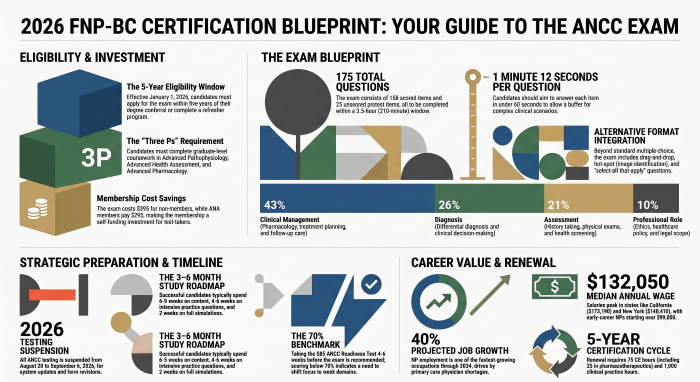
You must hold an active, unencumbered RN license in a U.S. state or territory. You need a master's degree, postgraduate certificate, or Doctor of Nursing Practice (DNP) from an accredited family nurse practitioner program that holds either CCNE or ACEN accreditation. The program must include a minimum of 500 faculty-supervised clinical hours within the family nurse practitioner role. You must also have completed graduate-level coursework in three core areas: advanced physiology/pathophysiology, advanced health assessment, and advanced pharmacology — often referred to as the "Three Ps." Beginning January 1, 2026, ANCC requires candidates to apply within five years of degree conferral from their applicable APRN program (ANA/ANCC). This five-year window is a significant policy change — candidates who graduated more than five years ago may need to complete a post-graduate certificate or refresher program to regain eligibility.
2. How Much Does the FNP-BC Exam Cost in 2026?
-
The standard non-member exam fee is $395. American Nurses Association (ANA) members receive a discounted rate of $295 — a $100 savings that makes the $199 ANA membership effectively pay for itself. American Association of Nurse Practitioners (AANP) members and student members may also qualify for reduced rates. If you do not pass, retake fees apply at the same rate.
3. How Do I Register and Schedule the Exam?
-
After submitting your application through the ANCC online portal and receiving eligibility confirmation, you schedule your exam through Prometric testing centers at prometric.com/ancc. You will use your ANCC certification number to book your appointment. Authorization to test is typically valid for 90 days after issuance — if you do not schedule and complete your exam within that window, you must reapply. You can choose from hundreds of Prometric centers across the United States. Scheduling early is recommended, especially in the spring and summer months when testing slots fill quickly due to May and August graduation cycles. Hard copy transcripts, if required, should be sent to the American Nurses Credentialing Center at 8403 Colesville Road, Suite 500, Silver Spring, MD 20910 (ANA/ANCC).
4. Is There a Testing Suspension in 2026 I Should Know About?
-
Yes. The ANCC will suspend FNP-BC testing from August 25 through September 6, 2026, for system updates and exam form revisions. If your study timeline targets a late-August exam date, schedule your appointment before August 25 or after September 6. This suspension period affects all ANCC certification exams, not just the FNP-BC. Plan around this blackout window to avoid disruption to your preparation schedule.
Section 2: Exam Format & Structure
5. How Many Questions Are on the FNP-BC Exam?
-
The FNP-BC exam contains 175 total questions. Of these, 150 are scored items that determine your pass or fail outcome. The remaining 25 are unscored pretest questions — items being evaluated for inclusion in future exam forms. Pretest questions are randomly distributed throughout the exam, so you cannot distinguish them from scored questions. Treat every question as if it counts.
6. How Much Time Do I Have to Complete the Exam?
-
You have exactly 3.5 hours (210 minutes) to complete all 175 questions. This translates to approximately 1 minute and 12 seconds per question. The time pressure is real — many candidates report feeling rushed in the final 30 minutes. Building speed through timed practice sessions is essential. You should aim to answer each question in under 60 seconds to bank buffer time for complex clinical scenarios.
7. What Content Domains Does the FNP-BC Exam Cover?
-
The ANCC Test Content Outline divides the exam into four weighted domains:
|
Domain |
Weight |
Focus Areas |
|---|---|---|
|
Assessment |
21% |
History taking, physical examination, diagnostic reasoning, health screening |
|
Diagnosis |
26% |
Differential diagnosis, clinical decision-making, interpreting diagnostic data |
|
Clinical Management |
43% |
Pharmacology, treatment planning, referrals, patient education, follow-up care |
|
Professional Role |
10% |
Ethics, healthcare policy, evidence-based practice, quality improvement, legal scope |
Clinical Management at 43% is by far the largest domain. You must know first-line pharmacological treatments, current clinical guidelines (JNC 8 for hypertension, ADA Standards of Care for diabetes, GOLD for COPD), and follow-up protocols to perform well.
8. Are There Alternative Question Formats Beyond Multiple-Choice?
-
Yes. While the majority of questions are standard four-option multiple-choice, the ANCC has integrated alternative item types. These include drag-and-drop ordering questions, hot-spot questions (where you click on an image to identify a finding), and select-all-that-apply (multiple response) questions. Practice with these formats before exam day so the interface does not slow you down. MedicoExam's simulation-based practice tests include alternative item type questions that mirror the ANCC format.
Section 3: Study Preparation & Resources
9. How Long Should I Study for the FNP-BC Exam?
-
The ANCC recommends dedicating up to 6 months of consistent preparation. Most successful candidates actively study for 3–4 months after graduating from their NP program, dedicating 2–3 hours per day, 5–6 days per week. If you have been out of school for more than a year, plan for a full 6-month study window. Structure your preparation into phases: spend the first 6–8 weeks building content knowledge across all four domains (reviewing clinical guidelines, pharmacology, and assessment techniques), the next 4–6 weeks on intensive question practice (completing 50–100 practice questions daily), and the final 2 weeks on timed full-length simulations. Track your progress weekly — if your practice test scores plateau below 70%, shift your strategy toward your weakest domains rather than continuing broad review.
10. What Is the ANCC Readiness Test and Should I Take It?
-
The ANCC Readiness Test is an official self-assessment tool available for $85. It consists of 60 practice questions with a 75-minute time limit (ANA/ANCC). The test provides a score report identifying your strengths and weaknesses across the four content domains. Take it approximately 4–6 weeks before your scheduled exam date. If you score below 70%, consider postponing your exam and focusing on your weakest domains. The Readiness Test is not a practice exam replacement — it is a diagnostic tool.
11. What Is the Best Way to Study for the Clinical Management Domain?
-
Clinical Management accounts for 43% of the exam — nearly half your score. Focus on current clinical guidelines rather than textbook theory. Know the first-line medications for the 20 most common primary care conditions: hypertension (ACE inhibitors/ARBs), type 2 diabetes (metformin), hypothyroidism (levothyroxine), depression (SSRIs), COPD (bronchodilators + inhaled corticosteroids), and asthma (step therapy). You must also understand non-pharmacological management, referral criteria, and patient education approaches. Using question banks to drill these scenarios repeatedly is the most effective strategy. Try MedicoExam's FNP-BC practice tests for targeted clinical management questions.
12. What Is the Biggest Study Mistake FNP-BC Candidates Make?
-
Neglecting the Professional Role domain. At only 10% of the exam, many clinically focused candidates skip ethics, healthcare policy, Medicare/Medicaid billing, quality improvement frameworks, and legal scope of practice questions. This is a costly error — those 15 scored questions can easily be the difference between passing and failing. The second most common mistake is relying exclusively on one review course or textbook without supplementing with a large question bank. Research on certification exam preparation consistently shows that active recall through practice questions produces stronger retention than passive reading. Dedicate at least one full study week to professional role content, including HIPAA regulations, informed consent, malpractice considerations, Healthy People objectives, evidence-based practice principles, and National Patient Safety Goals. Know the difference between NP scope of practice in full practice authority states versus reduced and restricted practice authority states.
"Earning my FNP-BC wasn't just about the salary bump — it completely shifted my clinical autonomy. The rigorous ANCC exam ensures you are truly ready to serve as a primary care provider." — Michael Torres, MSN, FNP-BC
Section 4: Scoring & Results
13. What Is the Passing Score for the FNP-BC Exam?
-
The ANCC uses a scaled scoring system with a maximum of 500 points. You must achieve a minimum scaled score of 350 to pass. This scaled score accounts for slight differences in difficulty between exam forms, ensuring fairness across all testing windows. The 350 threshold represents a consistent competency standard — it does not correspond to a simple percentage of questions answered correctly.
14. When Will I Receive My Results?
-
If you test at a Prometric center, you receive a preliminary pass/fail result on screen immediately upon completing the exam. This preliminary result is accurate in the overwhelming majority of cases. Official results, including your scaled score and domain-level performance data, are mailed and updated in your ANCC online portal within 2–4 weeks. You can use your domain scores to identify areas for continuing education even after passing.
15. What Happens If I Fail the FNP-BC Exam?
-
You can retake the exam, but you must wait a minimum of 60 days before retesting. You cannot test more than three times within any 12-month period. You must submit a new application and pay the full exam fee for each retake attempt. Use the 60-day waiting period strategically — review your domain-level score report, identify your weakest areas, and focus exclusively on those content gaps before rescheduling. Many candidates who fail on the first attempt pass on the second by narrowing their study focus. If your score report shows Clinical Management as your weakest domain, spend the entire 60 days drilling pharmacology, first-line treatment protocols, and clinical guideline updates. Consider investing in the ANCC Readiness Test ($85) before your retake to confirm you have closed the knowledge gap (ANA/ANCC).
16. Are Some Exam Forms Harder Than Others?
-
No. The ANCC uses psychometric standard setting and scaled scoring to ensure that all exam forms are statistically equivalent in difficulty. A scaled score of 350 represents the same level of competency regardless of which form you receive. You will not be disadvantaged by testing on a particular date or receiving a particular question set.
Section 5: Career Value & Renewal
17. What Is the Job Outlook for FNPs in 2026 and Beyond?
-
The job outlook is exceptional. The Bureau of Labor Statistics projects 40% growth in NP employment from 2024 to 2034, making it one of the fastest-growing occupations in the United States (Health Jobs Nationwide). This translates to tens of thousands of new NP positions annually. Primary care physician shortages, expanding scope of practice laws, and growing demand for preventive care and chronic disease management are all driving NP hiring. As of 2026, 27 states plus the District of Columbia grant NPs full practice authority — the ability to evaluate, diagnose, and prescribe independently without physician oversight. Retail clinic chains, urgent care networks, and telehealth platforms are aggressively recruiting FNPs to fill the gap left by declining numbers of primary care physicians in both urban and rural settings.
18. What Is the Average Salary for a Certified FNP?
-
The median annual wage for Nurse Practitioners is $132,050 nationally (Health Jobs Nationwide). Salaries vary significantly by state and experience. California NPs earn the highest average at $173,190, followed by New York at $148,410 and Oregon at $148,030. The lowest-paying states — Tennessee at $108,180 and Alabama at $109,650 — still offer strong six-figure incomes (Nurse.org). NPs with 10–19 years of experience average $117,000, while those just starting out earn approximately $99,000. Practice setting also matters: NPs in private urgent care or specialty clinics tend to earn more than those in academic medical centers, which typically pay 8–12% less but offer stronger benefits and research opportunities. When adjusted for cost of living, states like New Mexico and Iowa move toward the top of the effective salary rankings (NurseJournal.org).
19. How Long Is the FNP-BC Certification Valid?
-
Your FNP-BC credential is valid for five years from the date of initial certification. You must renew before the expiration date to maintain your certified status. Allowing your certification to lapse may affect your ability to practice, prescribe, or bill under your NP scope, depending on your state's regulations.
20. What Are the Renewal Requirements for the FNP-BC?
-
To renew your FNP-BC certification, you must meet three requirements. First, maintain your active, unencumbered RN license throughout the renewal period. Second, complete 75 continuing education (CE) hours, including a mandatory minimum of 25 hours in pharmacotherapeutics — this pharmacology requirement ensures you stay current with evolving drug therapies and formulary changes. Third, fulfill one of ANCC's professional development categories — typically by documenting a minimum of 1,000 clinical practice hours during the 5-year certification period. Alternative professional development options include academic coursework (at least 5 semester hours in nursing-related content), preceptorship of NP students (at least 150 hours), published research or quality improvement projects, or professional presentations at regional or national conferences. Begin tracking your CE hours and practice hours in the first year of your certification cycle rather than waiting until year four or five. ANCC requires documentation of all renewal activities, and incomplete records are a common cause of renewal delays.
FNP-BC Exam Summary Table
|
Topic |
Detail |
|---|---|
|
Certifying Body |
American Nurses Credentialing Center (ANCC) |
|
Credential |
FNP-BC (Family Nurse Practitioner — Board Certified) |
|
Exam Questions |
175 total (150 scored, 25 pretest) |
|
Time Limit |
3.5 hours (210 minutes) |
|
Question Types |
Multiple-choice, drag-and-drop, hot-spot, select-all-that-apply |
|
Domains |
Assessment (21%), Diagnosis (26%), Clinical Management (43%), Professional Role (10%) |
|
Passing Score |
350/500 (scaled) |
|
Exam Cost |
$295 (ANA members) / $395 (non-members) |
|
ANCC Readiness Test |
$85 — 60 questions, 75 minutes (ANA/ANCC) |
|
Testing Centers |
Prometric (nationwide) |
|
2026 Suspension |
August 25 – September 6, 2026 |
|
Results |
Preliminary pass/fail immediately; official scores in 2–4 weeks |
|
Retake Policy |
60-day wait; max 3 attempts per 12-month period |
|
Certification Validity |
5 years |
|
Renewal Requirements |
75 CE hours (25 in pharmacotherapeutics) + active RN license + professional development |
|
NP Median Salary |
$132,050 (Health Jobs Nationwide) |
|
Job Growth |
40% projected (2024–2034) |
|
Eligibility Change |
As of January 1, 2026: must apply within 5 years of degree conferral (ANA/ANCC) |
Ready to Pass the FNP-BC Exam?
Do not let the 2026 testing suspension derail your timeline. Start preparing now by building a 3–6 month study plan focused on Clinical Management (43% of the exam) and Diagnosis (26%). Use the ANCC Readiness Test to benchmark your progress, and drill thousands of practice questions to build speed and confidence.
Try MedicoExam's simulation-based FNP-BC practice tests to master advanced pharmacology, differential diagnosis, and clinical management scenarios in an exam-realistic format.
Written by the MedicoExam Content Team — Healthcare Education Specialists at MedicoExam.com Last
Updated: April 2026
Disclaimer: This article is for informational purposes only. MedicoExam does not provide leaked questions or exam recalls. Always refer to the ANCC for official, up-to-date exam guidelines and policies.
- ANCC Family Nurse Practitioner Practice Test |
- ANCC FNP-BC Question Bank |
- ANCC FNP-BC Eligibility & Requirements |
- ANCC FNP-BC Exam Cost |
- ANCC FNP-BC Registration Process |
- ANCC Family Nurse Practitioner Study Guide |
- ANCC FNP-BC Recertification |
- ANCC FNP-BC Certification Overview |
- ANCC Family Nurse Practitioner Syllabus |
- ANCC FNP-BC Preparation Time |
- ANCC FNP-BC Passing Score |
- ANCC FNP-BC Exam Format |
- ANCC Family Nurse Practitioner Sample Questions |
- ANCC FNP-BC Career Opportunities |
- ANCC FNP-BC Exam Difficulty


