
ANCC AGPCNP-BC Exa: Adult-Gerontology Primary Care NP
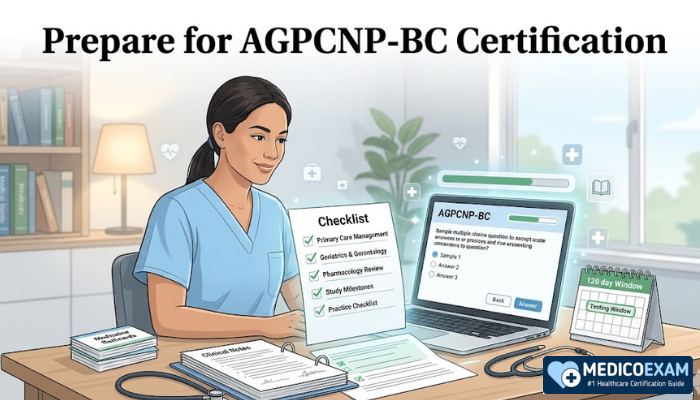 The ANCC AGPCNP-BC (Adult-Gerontology Primary Care Nurse Practitioner–Board Certified) certification validates your ability to deliver comprehensive primary care to patients across the adult lifespan, from adolescents through older adults. The exam contains 175 questions—150 scored and 25 unscored pretest items—administered in 3.5 hours at Prometric testing centers, with a scaled passing score of 350 out of 500. According to ANCC 2024 certification data, the first-time pass rate is 85%, and the credential remains valid for 5 years.
| Detail | Information |
|---|---|
| Credential Awarded | AGPCNP-BC |
| Certifying Body | American Nurses Credentialing Center (ANCC) |
| Total Questions | 175 (150 scored + 25 pretest) |
| Time Limit | 3.5 hours (210 minutes) |
| Passing Score | 350 / 500 scaled |
| Exam Fee | $395 non-member · $295 ANA member · $340 AANP member |
| First-Time Pass Rate | 85% (2024 ANCC data) |
| Certification Validity | 5 years |
| Testing Format | Computer-based at Prometric centers |
| Scheduling Window | 120 days after application approval |
What Is the AGPCNP-BC Certification?
The AGPCNP-BC is a nationally recognized credential awarded by the American Nurses Credentialing Center (ANCC), a subsidiary of the American Nurses Association. It certifies that a nurse practitioner has met rigorous educational, clinical, and examination requirements to deliver primary care to patients aged 13 and older. The certification aligns with the Consensus Model for APRN Regulation: Licensure, Accreditation, Certification, and Education.
AGPCNP-BC holders practice in outpatient clinics, community health centers, long-term care facilities, internal medicine offices, and rural health settings. Their scope includes preventive care, chronic disease management, health promotion, and non-emergent acute care across the adult-gerontology population. The credential is accredited by both the Accreditation Board for Specialty Nursing Certification (ABSNC) and the National Commission for Certifying Agencies (NCCA), as noted by ANCC.
Who Is Eligible for the AGPCNP-BC Exam?
Candidates must hold an active U.S. RN license and have completed a graduate-level adult-gerontology primary care nurse practitioner program with at least 500 faculty-supervised clinical hours. According to ANCC eligibility requirements, the full list includes:
Licensure:
-
Current, active RN license in a U.S. state or territory (or the legally recognized equivalent in another country)
Education:
-
Master's degree (MSN), post-graduate certificate, or Doctor of Nursing Practice (DNP) from an AGPCNP program accredited by CCNE, ACEN, or NLN CNEA
-
Minimum 500 faculty-supervised clinical hours within the AGPCNP program
Required Graduate-Level Courses (three separate, comprehensive courses):
-
Advanced physiology/pathophysiology (general principles across the lifespan)
-
Advanced health assessment (assessment of all human systems, advanced techniques)
-
Advanced pharmacology (pharmacodynamics, pharmacokinetics, pharmacotherapeutics of all broad categories of agents)
Additional Content Requirements:
-
Health promotion and/or maintenance
-
Differential diagnosis and disease management, including pharmacologic and nonpharmacologic interventions
Candidates who have completed all coursework and clinical hours may sit for the exam before degree conferral under Authorized to Test (ATT) status. ANCC will hold exam results and issue certification only after the final, degree-conferred official transcript is received.
What Are the AGPCNP-BC Exam Content Domains?
The AGPCNP-BC exam is organized into five content domains weighted by the nursing process. Each domain tests both knowledge and applied clinical judgment, per the ANCC test content outline:
| Domain | Weight | Approximate Scored Questions |
|---|---|---|
| I. Assessment | 19% | ~29 |
| II. Diagnosis | 17% | ~26 |
| III. Planning | 19% | ~29 |
| IV. Implementation | 29% | ~44 |
| V. Evaluation | 15% | ~23 |
| Total | 100% | 150 scored |
Domain I — Assessment (19%)
Focuses on comprehensive health history collection, physical examination techniques, psychosocial and cognitive assessments, functional assessment (ADLs, IADLs), and differentiation between normal and pathophysiological changes. Expect questions on screening tools and risk stratification across the adult-gerontology population.
Domain II — Diagnosis (17%)
Tests your ability to synthesize assessment findings, develop differential diagnoses, select and interpret laboratory and diagnostic tests, and apply evidence-based practice guidelines. Knowledge of the effects of development and aging on physiology is heavily tested.
Domain III — Planning (19%)
Covers pharmacotherapeutic decision-making, pharmacokinetics, pharmacodynamics, and pharmacogenetics. Beers Criteria and polypharmacy management are high-yield topics. This domain also assesses non-pharmacologic intervention selection and advance care planning.
Domain IV — Implementation (29%)
The largest domain evaluates chronic condition management, behavioral change strategies (motivational interviewing), patient and family education, palliative and hospice care, and reassessment of treatment plans. Questions integrate comorbidity considerations and evidence-based treatment modifications.
Domain V — Evaluation (15%)
Assesses your capacity to evaluate treatment effectiveness, identify barriers to care, and modify plans based on patient outcomes. Expect scenario-based questions requiring clinical reasoning about when to adjust or escalate management.
How Much Does the AGPCNP-BC Exam Cost?
The standard exam fee is $395 for non-members. ANA members pay $295, and AANP members pay $340. According to ANCC, AANP student members pay $290, and GAPNA members pay $340. All fees include a $140 non-refundable administrative fee. Discounts must be claimed within 5 business days of application submission.
| Membership Status | Initial Certification Fee |
|---|---|
| Non-member | $395 |
| ANA member | $295 |
| AANP member | $340 |
| AANP student member | $290 |
| GAPNA member | $340 |
Renewal fees (every 5 years) are $375 for non-members, $275 for ANA members, and $295 for AANP members.
What Is the AGPCNP-BC Pass Rate?
The 2024 ANCC first-time pass rate for the AGPCNP-BC exam is 85%, according to ANCC certification data. This rate is consistent with other ANCC NP certification exams and reflects a challenging but achievable benchmark for well-prepared candidates. Individual program pass rates vary.
The passing threshold is a scaled score of 350 on a 0–500 scale. Because the exam uses scaled scoring, the number of correct answers required may shift slightly between test forms. ANCC does not publish a raw-score equivalent, but a strong mastery of all five domains—particularly Implementation at 29%—is essential.
How Should You Prepare? 12-Week AGPCNP-BC Study Plan
A structured 12-week study plan targets each domain proportionally and builds in practice testing to simulate exam conditions.
Weeks 1–2: Foundation and Assessment (19%)
-
Review advanced health assessment: comprehensive history-taking, physical exam techniques, and screening tools
-
Study functional, psychosocial, and cognitive assessment across the lifespan
-
Complete 100–150 practice questions on assessment topics
Weeks 3–4: Diagnosis (17%)
-
Focus on differential diagnosis development and evidence-based clinical guidelines
-
Review laboratory and diagnostic test interpretation
-
Study effects of aging on physiology and pathophysiology
-
Complete 100–150 practice questions
Weeks 5–6: Planning and Pharmacology (19%)
-
Deep-dive into pharmacotherapeutics: Beers Criteria, polypharmacy, deprescribing
-
Study pharmacokinetics, pharmacodynamics, and pharmacogenetics across the adult lifespan
-
Review advance care planning and palliative care frameworks
-
Complete 150 practice questions
Weeks 7–9: Implementation (29%)
-
Dedicate the most time to the highest-weighted domain
-
Master chronic disease management: diabetes, heart failure, COPD, hypertension
-
Study motivational interviewing, behavioral change theories, and patient education strategies
-
Review non-pharmacologic interventions and referral pathways
-
Complete 200+ practice questions
Weeks 10–11: Evaluation and Professional Practice (15%)
-
Practice clinical reasoning for treatment modifications and outcome evaluation
-
Review scope of practice, legal and ethical considerations, social determinants of health
-
Study health promotion, disease prevention, and DEI principles
-
Complete 100 practice questions
Week 12: Full-Length Practice Exams and Review
-
Take 2–3 timed, full-length practice exams (175 questions in 3.5 hours)
-
Analyze missed questions and revisit weak domains
-
Review high-yield pharmacology and chronic disease management topics
"The candidates who pass on the first attempt almost always share one trait: they practice under timed, exam-realistic conditions. Familiarity with the format reduces anxiety and sharpens clinical reasoning." — Dr. Maria Santos, DNP, AGPCNP-BC, Nursing Education Director
Recommended Resources:
-
ANCC Test Content Outline and Reference List
-
ANCC Readiness Tests
-
MedicoExam AGPCNP-BC practice exams — simulation-based questions aligned to ANCC domains
-
Generic graduate-level adult-gerontology primary care NP review resources
-
Primary care NP pharmacology, assessment, and clinical guideline review materials
What Do AGPCNP-BC Certified NPs Earn?
Adult-gerontology primary care nurse practitioners earn competitive salaries reflecting the advanced practice credential. According to the U.S. Bureau of Labor Statistics, nurse practitioners earn strong compensation nationally. Salary varies by location, setting, experience, and role.
| Experience Level | Estimated Annual Salary |
|---|---|
| New graduate (0–2 years) | $95,000–$110,000 |
| Mid-career (3–5 years) | $115,000–$130,000 |
| Experienced (6–10 years) | $130,000–$150,000 |
| Senior/leadership roles | $145,000–$170,000+ |
Salary is influenced by practice setting, geographic location, years of experience, and additional subspecialty certifications.
What Career Paths Are Available for AGPCNP-BC Holders?
AGPCNP-BC certified nurse practitioners work across a wide range of primary care environments. Demand for nurse practitioners remains strong, especially in primary care, outpatient, rural, and aging-population care settings.
Common practice settings include:
-
Family practice and internal medicine clinics
-
Community health centers and federally qualified health centers (FQHCs)
-
Long-term care and skilled nursing facilities
-
Rural health clinics (often with greater autonomy)
-
Geriatric specialty practices
-
Occupational health clinics
-
Telehealth primary care platforms
Career advancement paths:
-
Clinical lead or chief NP: Oversee NP teams within a health system
-
Academic faculty: Teach in MSN or DNP programs (typically requires a doctoral degree)
-
Healthcare administration: Move into director-level roles in primary care operations
-
Subspecialty focus: Pursue post-master's certificates in areas like geriatric palliative care, cardiology, or endocrinology
-
Independent practice: In states with full practice authority, AGPCNPs can establish their own primary care practices
How Does AGPCNP-BC Compare to AGACNP-BC?
Both credentials certify adult-gerontology nurse practitioners, but they serve different care settings and patient acuity levels. The primary distinction lies in the continuity versus episodic nature of the care delivered.
| Feature | AGPCNP-BC (Primary Care) | AGACNP-BC (Acute Care) |
|---|---|---|
| Care Setting | Outpatient clinics, community health, long-term care | ICU, ER, hospital inpatient units, urgent care |
| Patient Acuity | Stable, chronic, preventive care | Critical, complex, unstable conditions |
| Care Relationship | Longitudinal, ongoing | Episodic, admission-to-discharge |
| Core Focus | Chronic disease management, health promotion, wellness | Stabilization, emergency intervention, complex illness |
| ANCC Exam Domains | Assessment 19%, Diagnosis 17%, Planning 19%, Implementation 29%, Evaluation 15% | Core Competencies 23%, Clinical Practice 45%, Professional Role 32% |
| Certifying Bodies | ANCC (AGPCNP-BC), AANPCB (A-GNP) | ANCC (AGACNP-BC), AACN (ACNPC-AG) |
| Typical Specialization | Generalist across the adult lifespan | Cardio-pulmonary, trauma, oncology, neurosurgery |
For a detailed comparison of all NP certifications, see the ANCC certification hub on MedicoExam. If you are weighing between these two pathways, also visit our AGACNP-BC guide.
How Do You Renew Your AGPCNP-BC Certification?
The AGPCNP-BC credential is valid for 5 years. To renew, you must maintain an active RN license and complete 75 continuing education (CE) hours, as outlined by ANCC. Continuing education must relate to the AGPCNP certification specialty.
In addition to the 75 CE hours, you must fulfill at least one professional development category:
-
75 additional CE hours (beyond the mandatory 75)
-
5 semester credits or 6 quarter credits of academic coursework
-
Presentations totaling 5 or more hours
-
Evidence-based practice project, QI project, publication, or research
-
120+ preceptor hours for students in academic programs
-
2+ consecutive years of healthcare volunteer service
-
1,000 practice hours
-
Re-take and pass the current AGPCNP-BC exam
Renewal applications can be submitted up to one year before the certification expiration date.
Frequently Asked Questions
Q1. How many questions are on the AGPCNP-BC exam?
The AGPCNP-BC exam contains 175 total questions. Of these, 150 are scored and 25 are unscored pretest items used by ANCC for future exam development. All questions are multiple-choice and delivered via computer at Prometric testing centers.
Q2. What is the passing score for the AGPCNP-BC exam?
The passing score is 350 on a scaled score range of 0 to 500. ANCC uses a criterion-referenced standard-setting methodology, meaning the passing standard reflects minimum competency rather than comparison to other test-takers.
Q3. How long do I have to complete the AGPCNP-BC exam?
You have 3.5 hours (210 minutes) to complete all 175 questions. This works out to approximately 1.2 minutes per question. Time management is critical—practice with timed exams to build pacing skills.
Q4. Can I take the AGPCNP-BC exam before graduating?
Yes. ANCC grants Authorized to Test (ATT) status to candidates who have completed all coursework and clinical hours but have not yet received degree conferral. Certification is issued only after ANCC receives your final, degree-conferred official transcript.
Q5. What is the difference between AGPCNP-BC and A-GNP certification?
AGPCNP-BC is awarded by ANCC, while the A-GNP (Adult-Gerontology Primary Care NP) credential is awarded by AANPCB. Both certify primary care NPs for the adult-gerontology population, but the exam content outlines, domains, and question counts differ. Most states accept either credential for licensure.
Q6. How much does the AGPCNP-BC exam cost?
The exam costs $395 for non-members, $295 for ANA members, $340 for AANP members, and $290 for AANP student members. All fees include a $140 non-refundable administrative fee.
Q7. What is the AGPCNP-BC first-time pass rate?
The 2024 first-time pass rate is 85%, according to ANCC certification data. Individual program pass rates may be higher—some accredited programs report rates above 95%.
Q8. How many clinical hours are required for eligibility?
A minimum of 500 faculty-supervised clinical hours within an accredited AGPCNP program is required. These hours must be completed in adult-gerontology primary care settings.
Q9. Is the AGPCNP-BC recognized in all 50 states?
Yes. The AGPCNP-BC is nationally recognized and accepted for NP licensure in all 50 states, the District of Columbia, and U.S. territories. However, scope of practice authority (full, reduced, or restricted) varies by state.
Q10. What continuing education is required for renewal?
You must complete 75 CE hours over 5 years, with all hours related to your AGPCNP certification specialty. At least 60 hours must be formally approved CE credits (CNE, CME, or Joint Accreditation). You must also complete one professional development activity category.
Start Preparing for the AGPCNP-BC Exam Today
Passing the AGPCNP-BC exam opens the door to a rewarding career in primary care for adult and geriatric patients, with strong salary potential and robust job growth. Build your confidence and clinical reasoning skills with simulation-based practice questions that mirror the ANCC exam format.
Try MedicoExam's AGPCNP-BC practice tests — designed to replicate the five exam domains and help you identify knowledge gaps before test day. For more ANCC certification resources, explore the ANCC certification hub, our FNP-BC guide, or the PMHNP-BC guide.
Disclaimer: This article is for informational purposes only. It does not contain exam recalls, leaked questions, or proprietary ANCC content. Always verify current eligibility requirements and exam details at nursingworld.org.
Written by the MedicoExam Content Team — Healthcare Education Specialists at MedicoExam.com
Last Updated: April 2026
- ANCC AGPCNP-BC Question Bank |
- ANCC AGPCNP-BC Eligibility & Requirements |
- ANCC Adult-Gerontology PRIMARY Care Nurse Practitioner Practice Test |
- ANCC AGPCNP-BC Exam Cost |
- ANCC AGPCNP-BC Registration Process |
- ANCC Adult-Gerontology PRIMARY Care Nurse Practitioner Study Guide |
- ANCC AGPCNP-BC Recertification |
- ANCC AGPCNP-BC Certification Overview |
- ANCC Adult-Gerontology PRIMARY Care Nurse Practitioner Syllabus |
- ANCC AGPCNP-BC Preparation Time |
- ANCC AGPCNP-BC Passing Score |
- ANCC AGPCNP-BC Exam Format |
- ANCC Adult-Gerontology PRIMARY Care Nurse Practitioner Sample Questions |
- ANCC AGPCNP-BC Career Opportunities


