
CCS Certification: 82% of Employers Value This Skill
The AHIMA Certified Coding Specialist (CCS) certification stands as a pivotal credential for health information management professionals, validating a specialized expertise in medical coding. This rigorous certification, identified by the exam code CCS and offered by the American Health Information Management Association (AHIMA), is designed for individuals adept at assigning accurate medical codes for diagnoses and procedures performed in hospital and various healthcare settings. Earning the CCS credential demonstrates proficiency in navigating complex coding systems like ICD-10-CM, CPT, and HCPCS Level II, which is critical for reimbursement, statistical reporting, and compliance with healthcare regulations. Employers increasingly seek this specialized skill, recognizing the profound impact accurate coding has on a healthcare organization's financial health and operational integrity. This article explores the profound value of the CCS certification, detailing its requirements, exam structure, preparation strategies, and the significant career advantages it offers in a rapidly evolving healthcare landscape.
Elevating Your Professional Standing with CCS
Professionals holding the AHIMA CCS certification are recognized for their advanced coding skills and deep understanding of medical documentation. This credential signals a commitment to excellence and accuracy, qualities that directly translate into improved data integrity and optimized revenue cycles for healthcare providers. The demand for certified coding specialists remains consistently high, driven by the ever-increasing complexity of healthcare regulations and coding guidelines. This specialization empowers professionals to assume key roles in health information management, contributing significantly to patient care quality through precise data.
Demonstrating Critical Industry Expertise
The CCS certification specifically targets professionals working with facility-based coding, encompassing inpatient and outpatient services. This focus requires a nuanced understanding of coding guidelines specific to hospitals, which differ considerably from physician office coding. Certified specialists ensure that every patient encounter is translated into accurate codes, which directly impacts billing, data analysis, and public health reporting. This precise application of coding knowledge helps healthcare organizations maintain financial stability and regulatory compliance.
Bridging the Gap to Enhanced Career Prospects
For those aspiring to leadership positions or seeking to specialize further in health information management, the CCS credential provides a distinct competitive edge. It opens doors to roles such as Lead Coder, Coding Auditor, or Clinical Documentation Specialist, where comprehensive coding knowledge is paramount. The certification not only validates current skills but also positions individuals for continuous professional development and adaptation to new industry standards.
Understanding the AHIMA Certified Coding Specialist Credential
The AHIMA Certified Coding Specialist (CCS) credential is a testament to an individual's proficiency in medical coding across various healthcare settings. It signifies a comprehensive understanding of medical terminology, anatomy, physiology, pharmacology, and disease processes essential for accurate code assignment. This deep knowledge base enables coders to interpret complex health records and translate them into standardized codes used for billing and data analysis.
Defining the Purpose and Scope of CCS
The primary purpose of the CCS certification is to ensure coders possess the specialized skills required to assign diagnostic and procedural codes for facility-based encounters, adhering to official coding guidelines. This includes mastery of ICD-10-CM for diagnoses, ICD-10-PCS for inpatient procedures, and CPT/HCPCS Level II for outpatient procedures. The certification's scope extends to ensuring data quality, compliance with government regulations, and ethical coding practices. Holding this credential demonstrates a coder's capability to contribute effectively to a healthcare organization's operational and financial success. To delve deeper into the professional recognition associated with this credential, explore the official AHIMA resource for details.
Who Benefits from This Specialized Certification?
The CCS certification is ideal for experienced medical coders who work in hospital inpatient or outpatient departments, ambulatory surgery centers, or other healthcare facilities that require complex procedural and diagnostic coding. It is also highly beneficial for health information management professionals seeking to validate their advanced coding skills and enhance their career trajectory in specialized coding roles. Aspiring auditors, coding educators, and clinical documentation specialists will find the CCS a foundational credential for their professional growth.
Dissecting the CCS Certification Examination
The AHIMA Certified Coding Specialist (CCS) exam is a comprehensive assessment designed to evaluate a candidate's mastery of medical coding principles and their application in diverse healthcare scenarios. Administered by AHIMA, the exam ensures that certified professionals can accurately interpret medical documentation and assign appropriate codes across various settings. Understanding its structure is key to effective preparation and successful credential attainment.
Key Examination Logistics
Candidates planning to take the CCS exam should be aware of several important logistical details. The examination is designed to test both theoretical knowledge and practical application, requiring a substantial time commitment for completion.
-
Exam Price: AHIMA members are offered a discounted rate of $299 (USD), while non-members can take the exam for $399 (USD).
-
Duration: The exam has a strict time limit of 240 minutes (4 hours), emphasizing the need for efficient time management.
-
Number of Questions: The test comprises 107 questions in total, with 97 scored items and 10 pretest items that do not count towards the final score.
-
Passing Score: A score of 300 is required to pass, graded on a scaled range from 100 to 400. This scaled score reflects a consistent standard of competency.
Strategic Focus of Exam Content
The CCS exam is structured to cover a wide array of coding knowledge and practical application areas. Candidates must be proficient across multiple domains to demonstrate the breadth of their expertise. The content outline ensures that certified individuals are well-rounded in all facets of health information coding, encompassing medical scenarios that test real-world decision-making.
Exploring the AHIMA CCS Syllabus Topics
The AHIMA CCS certification demands a comprehensive grasp of various coding and healthcare information management domains. The syllabus is meticulously designed to cover the core competencies required of a skilled coding specialist, ensuring that certified professionals are prepared for the complexities of modern healthcare data. This detailed content outline provides a roadmap for effective study and preparation. For a comprehensive overview, refer to the detailed content outline from AHIMA.
Fundamental Coding Knowledge and Skills (39-41%)
This domain forms the bedrock of the CCS credential, emphasizing a deep understanding of classification systems and coding conventions. Candidates are assessed on their ability to accurately assign codes for diagnoses and procedures using ICD-10-CM/PCS and CPT/HCPCS Level II. This includes proficiency in applying official guidelines, coding principles, and resolver logic. Success in this area requires a strong foundation in medical terminology, anatomy, and disease processes.
Coding Documentation and Records (18-22%)
Accuracy in coding hinges on the ability to critically review and interpret clinical documentation. This section evaluates a candidate's skills in identifying pertinent information within health records, understanding the components of a complete medical record, and recognizing documentation deficiencies that impact code assignment. It also covers the importance of clinical indicators and their correlation with diagnoses and procedures.
Provider Query Best Practices (9-11%)
Effective communication with healthcare providers is crucial for resolving documentation discrepancies and ensuring coding accuracy. This domain assesses knowledge of appropriate query methodologies, compliance with query guidelines, and the ability to formulate clear, concise, and compliant queries. It emphasizes the ethical considerations and regulatory requirements associated with querying providers for clarification.
Adhering to Regulatory Compliance (18-22%)
Medical coding operates within a highly regulated environment. This section tests understanding of federal and state regulations, payer requirements, and ethical coding standards (such as the AHIMA Code of Ethics). Topics include reimbursement methodologies, fraud and abuse laws (e.g., False Claims Act), and auditing principles designed to maintain data integrity and prevent non-compliance issues.
Leveraging Information Technologies (9-11%)
Modern coding environments rely heavily on technology. This domain explores the use of electronic health records (EHRs), computer-assisted coding (CAC) tools, and other health information systems. It covers data security and privacy principles (e.g., HIPAA), data quality management, and the role of technology in enhancing coding efficiency and accuracy.
Navigating Medical Scenarios
Beyond theoretical knowledge, the exam includes practical medical scenarios that require candidates to apply their coding expertise to real-world cases. These scenarios integrate knowledge from all syllabus domains, challenging candidates to demonstrate their ability to accurately code complex patient encounters from various inpatient and outpatient settings.
The Profound Benefits of AHIMA CCS Certification
Attaining the AHIMA CCS certification is more than just adding a credential; it's a strategic career move that significantly enhances a professional's marketability and earning potential within the healthcare industry. Employers highly value this certification, recognizing it as a benchmark for excellence in complex medical coding. The benefits extend beyond individual career growth, impacting the quality and compliance of healthcare organizations.
Increased Earning Potential and Job Security
Professionals with a CCS certification often command higher salaries compared to their non-certified counterparts. The specialized skills validated by the CCS credential are in high demand, leading to greater job security and more opportunities for advancement. As healthcare regulations continue to evolve, the need for expert coders who can navigate these changes grows, cementing the CCS as a valuable asset in the workforce.
Expanded Career Opportunities and Advancement
The CCS opens doors to a diverse range of roles, including advanced coding positions, auditing, consulting, and even management within health information departments. It signifies an individual’s capability to handle complex inpatient and outpatient coding challenges, making them indispensable to hospitals and other large healthcare facilities. This breadth of opportunity allows for flexible career paths and continuous professional development.
Enhanced Professional Credibility and Industry Recognition
The AHIMA CCS is a widely respected credential within the health information management community. It demonstrates a commitment to professional standards and ongoing learning, building trust with employers, peers, and healthcare providers. Holding a CCS signifies that a coder adheres to the highest ethical standards and possesses the critical judgment necessary for accurate and compliant coding practices.
Pathway to AHIMA Certified Coding Specialist Eligibility
To pursue the AHIMA Certified Coding Specialist (CCS) certification, candidates typically need a blend of education and practical experience in medical coding. While specific requirements can vary, AHIMA emphasizes a strong foundational knowledge and real-world application of coding principles to ensure that certified professionals are truly competent. This preparation ensures that individuals are ready for the rigorous demands of the certification exam.
Educational Background Recommendations
Prospective CCS candidates often possess an associate's or bachelor's degree in health information management, health sciences, or a related field. Completing an accredited coding program that covers anatomy, physiology, medical terminology, and advanced coding systems (ICD-10-CM/PCS, CPT, HCPCS Level II) is highly recommended. These educational pathways provide the theoretical knowledge base necessary for understanding complex medical records and assigning accurate codes.
Essential Work Experience Guidelines
While AHIMA does not mandate a specific number of years of experience for eligibility, most successful candidates have significant practical experience in facility-based coding. This typically includes working in hospital inpatient or outpatient settings, where they have gained hands-on experience with diverse case types and the intricacies of applying official coding guidelines. Direct experience is crucial for developing the critical thinking and problem-solving skills tested by the CCS exam.
Preparing for the Eligibility Criteria
Even without formal experience requirements, candidates should self-assess their readiness based on their practical exposure to medical records and coding software. Many find value in pursuing entry-level coding roles to build a robust experience portfolio before attempting the CCS exam. This practical application solidifies theoretical knowledge and enhances confidence for the examination process.
Mastering the CCS Exam: Effective Preparation Strategies
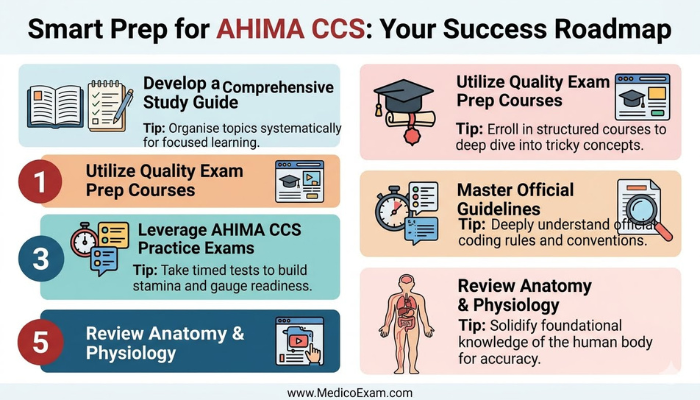
Approaching the AHIMA CCS exam requires a strategic and disciplined preparation plan. Given the comprehensive nature of the content and the practical application required, a multi-faceted study approach is crucial for success. Candidates should leverage various resources and techniques to solidify their understanding and build confidence.
Developing a Comprehensive Study Guide
A personalized study guide is an invaluable tool for CCS exam preparation. It should outline all syllabus topics, allocating study time based on individual strengths and weaknesses. Focus areas should include detailed reviews of ICD-10-CM/PCS and CPT/HCPCS Level II guidelines, anatomy, medical terminology, and regulatory compliance. Regularly consulting the official AHIMA content outline ensures that all critical areas are covered effectively.
Utilizing Quality Exam Prep Courses
Enrolling in an AHIMA CCS exam prep course can provide structured learning, expert instruction, and valuable insights into exam strategies. These courses often include in-depth lectures, practice exercises, and mock exams that simulate the actual testing environment. The structured nature of such courses helps maintain focus and ensures a thorough review of complex topics, making them an excellent investment for serious candidates.
Leveraging AHIMA CCS Practice Exams
Practice exams are essential for familiarizing oneself with the exam format, question types, and time constraints. Regularly taking AHIMA CCS practice exam questions helps identify knowledge gaps, build endurance, and refine test-taking strategies. Analyzing performance on practice tests allows candidates to fine-tune their study plan, focusing on areas that need further review. For comprehensive practice questions and detailed explanations, consider exploring effective specialized CCS materials.
Comparing AHIMA CCS vs. CPC Certification
For many aspiring medical coders, the choice between the AHIMA CCS and the CPC (Certified Professional Coder) certification is a critical decision. While both credentials validate expertise in medical coding, they cater to different aspects of the healthcare industry and demand distinct skill sets. Understanding these differences is crucial for aligning your career goals with the appropriate certification.
Distinguishing Focus Areas
The primary distinction lies in their focus:
-
AHIMA CCS: Primarily focuses on facility-based coding, which includes inpatient hospital coding (ICD-10-PCS for procedures) and outpatient hospital coding (CPT and HCPCS Level II for procedures and services). It emphasizes the complexities of coding for hospital services, data quality, and compliance in institutional settings.
-
CPC: Focuses on physician office and outpatient coding. It primarily uses CPT, ICD-10-CM, and HCPCS Level II to code diagnoses and procedures for professional services rendered by physicians and other healthcare providers in clinics, private practices, and ambulatory settings.
Both certifications require a strong foundation in medical terminology, anatomy, and disease processes, but the application of coding guidelines differs based on the setting.
Career Path Implications
The choice between CCS and CPC significantly impacts potential career paths. A CCS credential holder is typically sought after for roles in hospitals, large clinics, and health systems, often leading to positions like inpatient coders, outpatient coders (hospital-based), auditors, and coding managers within facility settings. A CPC, on the other hand, is ideal for those pursuing careers in physician offices, billing companies, and ambulatory care centers, focusing on professional fee coding. Many experienced coders pursue both certifications to broaden their career options and demonstrate versatile expertise.
Securing AHIMA Certified Coding Specialist Employment
The AHIMA Certified Coding Specialist (CCS) credential opens doors to a wide array of rewarding career opportunities in the dynamic field of health information management. Employers actively seek CCS-certified professionals for their proven expertise in complex coding scenarios, which are critical for accurate reimbursement and regulatory compliance. The demand for these skilled individuals ensures robust job prospects across various healthcare settings.
Diverse Job Roles and Responsibilities
CCS-certified professionals are qualified for specialized roles that involve intricate coding and data management. Common job titles include:
-
Inpatient Coder: Assigning ICD-10-CM diagnoses and ICD-10-PCS procedure codes for hospital inpatient encounters.
-
Outpatient Hospital Coder: Specializing in CPT, ICD-10-CM, and HCPCS Level II coding for outpatient services, including emergency departments, ambulatory surgery, and clinics.
-
Coding Auditor: Reviewing coded records for accuracy, compliance with regulations, and identifying documentation deficiencies.
-
Clinical Documentation Specialist (CDS): Collaborating with physicians to improve clinical documentation, which in turn enhances coding accuracy and supports quality metrics.
-
Coding Manager/Supervisor: Overseeing coding departments, managing teams, and ensuring adherence to coding guidelines and productivity standards.
These roles require not only coding proficiency but also strong analytical and communication skills to interact with clinicians and other healthcare professionals.
Industry Demand and Growth
The healthcare industry's increasing reliance on accurate data for financial operations, quality reporting, and public health initiatives fuels a consistent demand for certified coding specialists. Legislative changes, such as those related to value-based care and population health management, further underscore the need for experts who can ensure data integrity. This sustained demand makes the AHIMA CCS a future-proof credential for long-term career stability and growth.
Investing in Your Career: AHIMA CCS Certification Cost
Pursuing the AHIMA CCS certification involves a financial investment, primarily for the exam itself and potential preparation materials. Understanding these costs upfront allows candidates to budget effectively and plan their journey toward professional credentialing. While there is a fee, the long-term career benefits and increased earning potential often outweigh the initial expense.
Breakdown of Exam Fees
The primary cost associated with the CCS certification is the examination fee. AHIMA offers different pricing tiers based on membership status:
-
For AHIMA Members: The exam price is $299 (USD). Membership provides access to a network of professionals, educational resources, and discounted certification fees.
-
For AHIMA Non-Members: The exam price is $399 (USD). While higher, this still represents a valuable investment for those committed to advancing their coding career.
It is important to note that these fees cover only the cost of taking the exam. Any retakes would incur additional fees.
Considering Additional Preparation Expenses
Beyond the exam fee, candidates should budget for various study resources. These might include:
-
Study Guides and Textbooks: Comprehensive coding manuals and specialized textbooks are essential for thorough preparation.
-
Online Prep Courses: Many candidates opt for structured online courses, which can range from a few hundred to over a thousand dollars, depending on the provider and depth of content.
-
Practice Exams: Investing in quality practice exams helps simulate the testing environment and identify areas for improvement.
-
Coding Software/Tools: Access to coding encoders or electronic health record (EHR) simulators can also be beneficial for practical application.
While these additional costs can add up, they are often critical for successful exam preparation and should be viewed as an investment in professional development.
Navigating CCS Exam Difficulty and Achieving Success
Many prospective candidates ask, "Is the AHIMA CCS exam hard?" The answer is consistently yes, reflecting its rigorous nature and the high standards of a credential valued by 82% of employers. The CCS exam is challenging because it requires not only extensive theoretical knowledge but also the ability to apply complex coding rules to diverse and often ambiguous medical scenarios. Success hinges on a well-structured preparation plan and a deep commitment to mastering the material.
Understanding the Challenges of the CCS Exam
The difficulty of the CCS exam stems from several factors:
-
Breadth of Content: It covers multiple coding systems (ICD-10-CM, ICD-10-PCS, CPT, HCPCS Level II) across both inpatient and outpatient settings, alongside regulatory compliance, documentation, and provider queries.
-
Application-Based Questions: Many questions are scenario-based, requiring critical thinking and the application of guidelines rather than simple recall. This tests a coder's judgment and problem-solving skills in real-world contexts.
-
Time Constraints: Four hours for 107 questions means candidates must manage their time efficiently, quickly analyzing scenarios and arriving at the correct codes without dwelling too long on any single question.
-
Constant Updates: Coding guidelines and regulations are frequently updated, requiring candidates to stay current with the latest official coding advice and industry changes.
Strategies to Effectively Pass the CCS Exam
Passing the CCS exam requires a disciplined and comprehensive approach:
-
Master Official Guidelines: Deeply understand and consistently apply the Official Guidelines for Coding and Reporting for ICD-10-CM/PCS and the CPT Assistant for CPT. These are your primary resources.
-
Extensive Practice: Work through as many practice coding scenarios as possible. Focus on different specialties and levels of complexity.
-
Time Management Skills: Practice taking timed exams to improve speed and accuracy. Learn to quickly identify key information in documentation.
-
Review Anatomy & Physiology: A strong understanding of the human body and disease processes is fundamental to accurate coding.
-
Utilize AHIMA Resources: Leverage study guides, coding handbooks, and official prep courses offered by AHIMA.
With dedicated effort and strategic preparation, overcoming the challenges of the CCS exam is achievable, leading to a highly respected and career-advancing credential.
Conclusion: Empowering Your Future with CCS Certification
The AHIMA Certified Coding Specialist (CCS) certification is a testament to advanced coding proficiency and an invaluable asset for professionals seeking significant career growth in healthcare. This credential not only validates a specialized skill set in complex medical coding across various facility settings but also positions individuals as indispensable contributors to the financial health and compliance of healthcare organizations. The high value placed on CCS by employers underscores its importance in a field driven by evolving regulations and the critical need for accurate health information.
Embracing the challenge of the CCS exam is an investment in a future defined by expanded opportunities, increased earning potential, and enhanced professional credibility. It signals a commitment to excellence, ensuring that certified professionals are at the forefront of health information management. Ready to elevate your career and join the ranks of highly valued coding specialists? Begin your journey by exploring comprehensive resources and structured preparation programs. Advance your expertise and unlock new professional horizons today by visiting medicoexam.com to discover how to prepare effectively.
Frequently Asked Questions
1. What does AHIMA CCS certification validate?
The AHIMA CCS certification validates an individual's expertise in assigning accurate medical codes for diagnoses and procedures performed in hospital (inpatient and outpatient) and other facility settings. It demonstrates proficiency in ICD-10-CM, ICD-10-PCS, CPT, and HCPCS Level II coding systems, as well as regulatory compliance and documentation review.
2. How does AHIMA CCS differ from CPC certification?
AHIMA CCS primarily focuses on facility-based coding, including inpatient and hospital outpatient services, using ICD-10-PCS for inpatient procedures. CPC (Certified Professional Coder) focuses on physician office and outpatient coding, primarily for professional services rendered by physicians in clinics and private practices.
3. What are the general eligibility requirements for the CCS exam?
While AHIMA doesn't specify a strict work experience mandate, candidates typically need a strong educational background in health information management or a related field, along with significant practical experience in facility-based medical coding. Completing an accredited coding program is highly recommended.
4. Is the AHIMA CCS exam difficult, and how should I prepare?
Yes, the AHIMA CCS exam is considered challenging due to its comprehensive content, application-based scenarios, and time constraints. Effective preparation includes mastering official coding guidelines, extensive practice with coding scenarios, utilizing quality exam prep courses, and taking practice exams to simulate the testing environment.
5. What career opportunities open up with CCS certification?
CCS certification opens doors to various specialized roles such as Inpatient Coder, Outpatient Hospital Coder, Coding Auditor, Clinical Documentation Specialist (CDS), and Coding Manager/Supervisor. These roles are typically found in hospitals, large clinics, and health systems, offering enhanced earning potential and career advancement.
- AHIMA CCS Question Bank |
- AHIMA CCS Eligibility & Requirements |
- AHIMA Coding Specialist Practice Test |
- AHIMA CCS Exam Cost |
- AHIMA CCS Registration Process |
- AHIMA Coding Specialist Study Guide |
- AHIMA CCS Recertification |
- AHIMA CCS Certification Overview |
- AHIMA Coding Specialist Syllabus |
- AHIMA CCS Preparation Time |
- AHIMA CCS Passing Score |
- AHIMA CCS Exam Format |
- AHIMA Coding Specialist Sample Questions |
- AHIMA CCS Career Opportunities |
- AHIMA CCS Exam Difficulty


