
CPCD vs CPC: Which Coding Credential Fits a Dermatology Career?
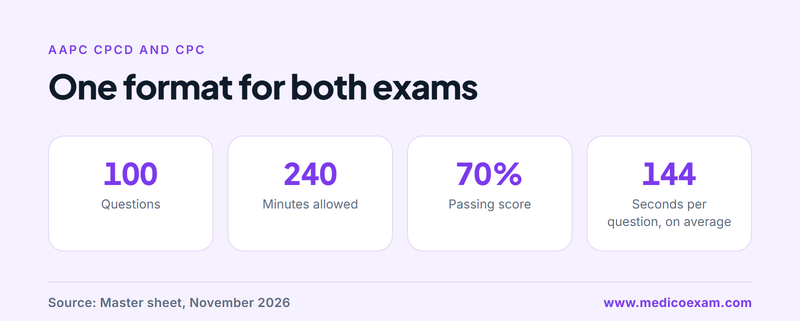
If you code for a dermatology practice, the AAPC Certified Professional Coder in Dermatology (CPCD) is the specialty credential and the CPC is the broad one. Both put 100 questions in front of you across 240 minutes with a 70% pass mark, so the decision rests on scope, fee and where your career is heading, not on stamina.
Most coders weigh this choice for a practical reason: the voucher costs money and the study hours cost more. This guide sets the two exams side by side using AAPC's own pages and MedicoExam's records, then ends with a checklist you can answer honestly. If you already know you want the specialty, start with the CPCD practice test and come back to plan the weak areas.
Which should a dermatology coder sit first, the CPCD or the CPC?
It depends on how much coding you already do. AAPC presents the CPC as the foundation credential for outpatient and physician-service coding, and calls it "the best place to start your coding career." It presents the CPCD as a validation of advanced dermatology skill, and it names CPC-certified coders who want to specialize among the people the CPCD is for. If you are new to coding, that wording points you toward the CPC first. If you already code dermatology charts every day, the CPCD describes the work you do.
AAPC's CPCD page does not say that you must hold the CPC before you sit the CPCD. What it does set is a knowledge standard. You should be comfortable with skin-related terminology, anatomy and disease processes, and you should be able to apply all three code sets: CPT® for procedures, HCPCS Level II for supplies, and ICD-10-CM for diagnoses. Eligibility wording can change, so read AAPC's current text at checkout instead of trusting a summary.
Three situations cover most readers. The first is a coder with no credential and a dermatology job: the CPC gives you the general base, the CPCD gives you the specialty, and the order is a matter of what your employer rewards first. The second is a CPC holder in a dermatology practice: the CPCD is the natural next step because it tests the lesion, repair and surgical work that fills your day. The third is a coder in a multispecialty clinic where skin work is only part of the queue: the CPC may cover more of what you touch, and the specialty credential is worth adding when dermatology becomes your main line.
One more input should weigh heavily: ask the person who hires or promotes you which credential they look for. A credential that your own employer recognizes will do more for you than one that is merely impressive in the abstract. If the general route is your pick, MedicoExam has a separate write-up on getting ready for the broader outpatient coding exam.
How do the CPCD and CPC compare on format, fee and renewal?
The two exams share a format, so a side-by-side table is the quickest way to see where they actually differ. Figures come from MedicoExam's records and AAPC's two certification pages, as of November 2026.
| Fact | CPCD | CPC |
|---|---|---|
| Number of questions | 100 | 100 |
| Time limit | 240 minutes | 240 minutes |
| Pass mark | 70% | 70% |
| Time per question, on average | 144 seconds | 144 seconds |
| Two-attempt bundle in MedicoExam's records | $399 for two exam attempts | $100 more than the CPCD bundle |
| Training course on AAPC's page | Online self-paced, starting at $660 | Self-paced and virtual instructor-led, starting at $2,799 |
| Staying certified | Annual AAPC membership and 36 CEUs per cycle of two years, 8 in dermatology | Annual AAPC membership and 36 CEUs per cycle of two years |
Read the table for what it leaves out. The first four rows match exactly, which means the CPCD is not a longer or shorter test than the CPC. Whatever extra difficulty you feel will come from depth in one specialty, not from endurance. Each question still gets about 144 seconds on average, enough for a simple lookup and tight for a scenario that asks you to hold several rules in mind.
The money rows need more care. In MedicoExam's records the CPCD bundle of two attempts is $399, and the CPC bundle costs $100 more. AAPC's own pages show a starting voucher price for each exam, with the same difference of $100 between them. The training gap is far larger, with the CPCD course starting at $660 and the CPC course at $2,799, but AAPC's CPC page lists self-paced and virtual instructor-led options, so make sure you compare like with like before reading anything into that difference. Prices move, so check AAPC's current CPCD page and CPC page before you pay.
Renewal is the quiet cost of either choice. Each credential lapses unless you keep your membership current and log continuing education, and the CPCD adds a specialty rule on top: 8 of the 36 units have to be dermatology specific. That is a small extra for someone who works in the field anyway, yet it shows the specialty credential expects you to keep learning where you practice. Both exams are delivered the same way too, either at home under a live remote proctor or at a testing center, and the dates only appear once a voucher is bought.
What do the four CPCD syllabus areas cover?
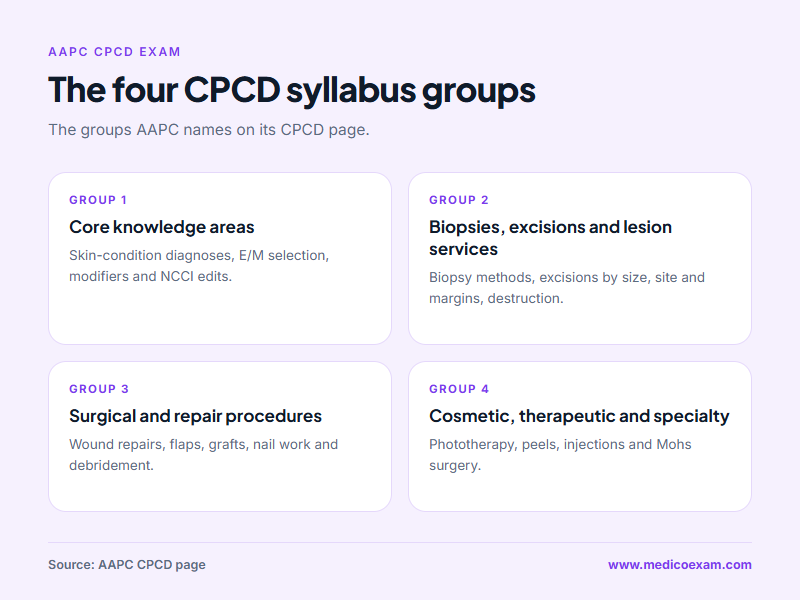
AAPC lists four groups of content on its CPCD page, and MedicoExam's syllabus overview mirrors that list. Neither source gives a percentage for any group, or a separate pass mark for one, so assume one overall result in which every group can cost you marks.
Core knowledge areas. This group is the diagnosis and evaluation layer. It covers ICD-10-CM coding for dermatologic conditions such as acne, eczema, psoriasis, skin infections and skin cancers. It also covers choosing the right evaluation and management service for preventive, diagnostic and procedural dermatology visits, and using modifiers, NCCI edits and payer rules that are specific to dermatology.
Biopsies, excisions and lesion services. Here you code punch, shave, incisional and excisional biopsies. You assign malignant and benign lesion excisions based on size, location and margins, and you code the destruction of lesions by cryotherapy, electrosurgery, laser or chemical methods. This group is where careful reading of measurements pays off.
Dermatologic surgical and repair procedures. Expect simple, intermediate and complex wound repairs, including layered closures, adjacent tissue transfers, flaps and skin grafts. The group also takes in nail procedures, debridement, and the treatment of pressure ulcers or wounds commonly addressed in dermatology.
Cosmetic, therapeutic and specialty services. The last group covers phototherapy, laser treatments, and cosmetic procedures such as chemical peels and scar revisions when they are medically necessary or covered. It adds injections and therapeutic treatments for skin conditions, for instance corticosteroid injections and biologic therapies, and Mohs micrographic surgery coding, including the documentation elements that compliance requires.
Compare this list with what AAPC says the CPC covers: ICD-10-CM codes across all body systems, CPT® and HCPCS Level II codes for procedures, services and supplies, evaluation and management services, and compliance with payer requirements. The CPC is built around breadth, and the CPCD takes the same toolkit and points it at one body of work. A CPC holder will recognize the building blocks and find the lesion, repair and Mohs material the deeper part.
What does a dermatology coding scenario look like on the exam?
Expect short chart summaries that end in a question about what to report. The exam bank is unpublished, so this section only describes the kind of thinking involved and quotes nothing real.
A typical item gives a setting, a list of services, a few measurements and a twist. The twist carries the marks. It may be a biopsy that led to an excision at the same visit, a lesion where size, site and margins decide the code, a repair that you must sort into simple, intermediate or complex, or a cosmetic service whose coverage is in doubt. Spot the twist before you reach for any code.
Many coders settle into a sequence. Name the service first: evaluation, biopsy, excision, destruction, repair or specialty treatment. Then ask which services stand alone. Next test the combination against modifiers, NCCI edits and payer rules. Last, attach the diagnosis that justifies each service. Starting with the code book instead of the service is how people land on a lovely code for the wrong procedure.
Documentation sits under every item. AAPC specifically mentions the documentation elements needed for Mohs micrographic surgery, so the exam clearly cares about what the record must contain and not only about which code exists. If a detail you would ask the provider about is absent from the scenario, answer from the facts you are given.
A note on visit levels: AAPC teaches that an evaluation and management level follows medical decision making or total time, and that history and examination are no longer the deciding factors. Anyone trained on older rules should retrain before timed practice.
Where do dermatology coders lose marks?
There is no published breakdown of missed questions, so the list below comes from the structure of the four groups and not from candidate data. Use it to audit yourself.
Misreading a measurement. Excision coding turns on size, site and margins. A margin left out of the total, a unit misread or a lesion placed on the wrong body area will give a wrong code even when your method is right. Slow down on every number.
Blurring biopsy and excision. Punch, shave, incisional and excisional biopsies are named apart from lesion excisions. Learn what defines each and then practise stems that put two of them into one encounter.
Classifying a repair by instinct. Layered closure, adjacent tissue transfer, flap and graft each follow their own rules. Judge from the operative description, never from how serious the wound sounds.
Crossing the cosmetic line. AAPC places peels and scar revisions among services reported when medically necessary or covered. A question can hinge on that single condition, so read the coverage wording before choosing.
Skipping the edit check. NCCI edits and dermatology payer rules belong to the core group. Visits often pair an evaluation with a procedure, and credit goes to the coder who asks whether the pair may be reported together.
Forgetting stamina. With roughly 144 seconds an item, no single question is the threat. Fatigue is. People rush the opening stretch and then read the closing items sluggishly, which is why one complete rehearsal is worth many short drills.
After every practice set, find the answer you were most certain about and still got wrong. That one marks a rule you have misunderstood, and it deserves more study time than a coin-flip miss.
Where can each credential take a dermatology coder?
AAPC frames the two credentials as different kinds of signal. On its CPC page it describes the credential as a base that can grow into inpatient coding, risk adjustment, compliance, auditing and specialty certifications, and it calls it the most versatile starting point. On its CPCD page it describes a specialty credential regarded highly by dermatology practices and healthcare organizations, one that positions you for advanced opportunities in dermatology coding, auditing and compliance.
Those are AAPC's descriptions of its own products, not a promise about your pay or your next job, and neither page publishes a salary figure or a pass rate. Treat them as the vendor's positioning and test them against your local market. Look at job postings in your area for dermatology coding and see which credential employers name. A few minutes of reading advertisements will tell you more about your own market than any general article can.
A sensible long view is to treat the credentials as layers. The CPC proves you can code the wide range of outpatient and physician services. The CPCD proves you can handle the work that is particular to skin: lesion measurements, biopsy methods, repair techniques and payer bundling rules, all named on AAPC's page. Holding both tells an employer you have the base and the specialty, and nothing stops you from planning the second credential while you study for the first.
Cost is part of this too. Since the CPC bundle costs $100 more than the CPCD bundle in MedicoExam's records and the renewal cycles run to the same 36 units, money alone rarely decides the matter. Scope, employer recognition and your daily work should carry more weight than the fee gap.
How should you prepare for the CPCD, step by step?
Treat this as five stages, with the calendar left open. Where you begin determines how long it takes.
Stage one, a cold baseline. Sit a mixed set with no books and tag every miss with its syllabus group. You want a map of thin spots, not a grade.
Stage two, rules plus cases. Take one group at a time. Read the guideline, then immediately code cases drawn from that group. Reading alone gives you familiarity, and the exam wants recall.
Stage three, a full dress rehearsal. Complete all 100 questions inside 240 minutes, with only the pauses the real sitting allows. Record where focus fades and which kinds of item you hurry.
Stage four, a cause log. Beside each wrong answer, note the reason: misread stem, missing rule, or an office habit the guidelines do not back. The remedies differ, and the habit type is the one you rarely notice unaided.
Stage five, a steady signal. Book only after several different sets land above 70%. Since that mark applies to the exam as a whole, headroom in your weakest group is worth more than a spectacular score in your strongest.
For taught content, AAPC sells a self-paced online course, which its CPCD page describes as everything needed to prepare for and take the exam. For rehearsal with scenario questions, MedicoExam's practice exam is a separate product and is not made by AAPC.
Build the plan around a working week. Brief regular blocks on one group usually outlast occasional long weekends. Reserve one block weekly for mixed questions so you keep switching among biopsies, repairs and cosmetic services, as the exam forces you to. Keep a personal cheat sheet of the rules that keep slipping away, in your own words, and reread it before each set.
Can you practise for the CPCD with a timed mock exam?
AAPC's CPCD page sells a voucher and a course but shows no question bank, so candidates who want timed rehearsal look elsewhere. MedicoExam has a practice exam for this credential and a free demo on the product page for trying the interface first. It is independent of AAPC and does not reproduce live exam questions.
Judge any practice material on three tests. Does it build scenarios instead of asking for isolated code lookups? Does it explain the reason behind each wrong option? Is it timed against the same 240-minute allowance? Material that fails one of these can leave you feeling prepared without being prepared.
Then read the results by syllabus group. Let the weakest group choose your next session, and treat a rising overall total with one flat group as a caution rather than good news.
A checklist before you buy the CPCD or the CPC voucher
Answer each question truthfully, and buy only when most are a firm yes.
Do you handle dermatology charts most days, or are you about to start? Can you separate the four biopsy methods and say what documentation each needs? Can you derive an excision code from size, site and margins? Can you sort a repair into its type from the description alone? Do you know when a cosmetic service can be reported? Can you explain what a modifier or an NCCI edit does to two services on one claim? Have you completed a timed full set and kept your focus to the last item?
Several no answers are cheap information. Go back to the matching group, work more cases, and test again. If you hold no coding credential at all, think about the CPC first, because AAPC itself frames it as the base for specialty paths. If most answers are yes and your scores clear 70% across more than one set, purchase the voucher from AAPC and pick a date.
Both exams run 100 questions over 240 minutes with a 70% pass mark. What differs is the proof they ask for: breadth across outpatient coding for the CPC, depth in dermatology for the CPCD. Choose the exam that matches the work you do now or want next, prepare for all of it, and let your practice results decide when to sit.
Frequently Asked Questions
Is the CPCD exam harder than the CPC?
The format is identical: 100 questions, 240 minutes and a 70% pass mark. Difficulty comes from content. The CPC spans outpatient coding broadly, while the CPCD goes deep on biopsies, excisions, repairs and Mohs surgery, so a coder without dermatology experience will find the specialty exam harder.
Do I need the CPC before I take the CPCD?
AAPC's CPCD page does not list the CPC as a prerequisite. It asks for high-level knowledge of dermatology terminology, anatomy and pathophysiology and of CPT, HCPCS Level II and ICD-10-CM application. Eligibility can change, so confirm the current rules on AAPC's page before you buy.
How much does the CPCD exam cost?
As of November 2026, MedicoExam lists $399 for two exam attempts, while AAPC's CPCD page shows an online training course starting at $660. Fees move, so verify the figure on AAPC's page at the time you buy.
What score do I need to pass the CPCD exam?
You need 70%, which means 70 correct answers from the 100 questions. Neither AAPC nor MedicoExam publishes a weighting for the four content groups or a cut score per group, so a weak group can quietly drag down the single overall result.
How do I keep the CPCD credential after passing?
Keep your AAPC membership paid each year and collect 36 continuing education units across every two-year cycle, with 8 of the 36 specific to dermatology. Renewal terms can be revised, so read AAPC's CPCD page again close to your renewal date.
Can I take the CPCD exam from home?
Yes, AAPC offers a remote option supervised live by a proctor as well as seats at testing centers. A voucher purchase comes first, and only then can you view dates and times, so you pick between the two delivery modes while scheduling.
- AAPC CPCD Question Bank |
- AAPC CPCD Eligibility & Requirements |
- AAPC Professional Coder in Dermatology Practice Test |
- AAPC CPCD Exam Cost |
- AAPC CPCD Registration Process |
- AAPC Professional Coder in Dermatology Study Guide |
- AAPC CPCD Recertification |
- AAPC CPCD Certification Overview |
- AAPC Professional Coder in Dermatology Syllabus |
- AAPC CPCD Preparation Time |
- AAPC CPCD Passing Score |
- AAPC CPCD Exam Format |
- AAPC Professional Coder in Dermatology Sample Questions |
- AAPC CPCD Career Opportunities |
- AAPC CPCD Certification Practice Exam


